Unknown's avatar

#Meditation is Good for Our (#Aging) #Brains

#Meditation is Good for Our (#Aging) #Brains

In case you were wondering, and I was, why so many of my Buddhist friends and fellow meditators are mentally so healthy and over the ages of 65, 70, 75, I decided to “look it up” and see if my suspicions were correct. They are.

If we’re lucky enough not to have anything else kill us or ruin our brains, meditation DOES have a measurably profound, positive impact on our mental and physical health, particularly on maintaining cognitive functionality into our senior years.
And, it’s not just those in my experience whose brains are doing great: meditators everywhere (if we could study us all) most likely have brains that are younger, more pliable, and less prone to diseases of aging, even as the calendars march us onward. This is a club you want to join!

No need to ditch your current religion, spirituality, atheism or anything: just learn to meditate and do it regularly!
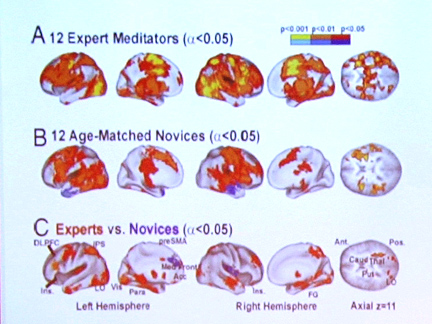
“A [2016] study suggested that taking time from your busy schedule to meditate can actually help preserve your mind and slow Alzheimer’s disease and related dementias. Learn more about how meditation can slow Alzheimer’s.” https://www.jeffersonhealth.org/your-health/living-well/yes-meditating-can-reverse-cognitive-decline-heres-how#:~:text=Yes%2C%20Meditating%20Can%20Reverse%20Cognitive,Here’s%20How%20%7C%20Jefferson%20Health

Meditation has been shown to slow the typical aging effects on our brains very specifically. This longitudinal individual study, quoted and linked, below, makes me smile, since I know this Rinpoche (an honorific Tibetan term meaning “precious teacher”).
“Using MRI and a machine learning framework which estimates ‘brain-age’ from brain imaging, [neuroscientist, Richard] Davidson and lead scientist, Nagesh Adluru, studied the mind of Tibetan Buddhist meditation master, [His Eminence] Yongey Mingyur Rinpoche, over the course of 18 years….
Rinpoche was first scanned in 2002 at the age of 27. At the time, he had already completed nine years of meditation retreats. He was scanned again at the respective ages of 30, 32 and 41 years old.
“The last time he was scanned, he had just returned from a four-and-a-half-year wandering retreat, and his brain was calculated to be 33-years-old, eight years younger than his biological age.
“The researchers compared Rinpoche’s aging brain to a control group and his appeared to age much slower than the general focus group.”
https://www.cnn.com/2020/03/20/health/meditation-slows-brain-age-trnd-wellness/index.html#:~:text=A%20recently%20pubished%2018%2Dyear,compared%20to%20a%20control%20group

So, how long does it take and how much meditation do we need to do to gain positive effects? Read on and check out the longer articles in each link.

How long you need to meditate to see results for your body and brain
“…[M]editation can affect the brain and body in myriad ways, from reducing the risk for chronic diseases to lowering the risk for anxiety and depression….
“Research shows meditation reduces stress, anxiety, and depression symptoms. A 2016 study found that longer-term meditation practice was associated with structural changes of the ‘white matter’ in the brain, which is responsible for ‘relaying sensory information’ and can explain why meditation helps people stay in the present moment and may help combat age-related cognitive decline. 
“A more dated study found an increase in gray matter in the brain’s hippocampus, the areas associated with memory, emotional regulation, self-processing, and perspective taking, with regular meditation. 
“‘The practice also enhances attention, and increases the ability to cultivate awareness around emotions so they don’t bubble up later,’ Gonzalez says….
“Studies point to 8-weeks of meditation practice to see results. One study found improvements to memory, emotional regulation, and mood with 8 weeks of 13 minutes of meditation a day. But there isn’t a magic number. 
“Gonzalez, who has trained over numerous leaders in the practice, says: ‘as little as 10 minutes can make a difference. What matters most is dedicating yourself to the technique (that means not checking work notifications in the middle of a practice).'”

How long you need to meditate to see results for your body and brain?
It can take as little as 10 minutes a day to rewire the brain.
Twenty minutes or more: even better!

Neurologists, neuroscientists, gerontologists, psychiatrists and others are VERY interested in these results! More, below.

“‘Mental training that targets stress and attention regulation has the potential to improve both cognitive and emotional aspects of ageing,’ researcher [Dr. Chetelat] says….
“Dr. Chetelat said: ‘Strategies to prevent dementia are urgently needed. Mental training that targets stress and attention regulation has the potential to improve both cognitive and emotional aspects of ageing.
“’Previous studies have shown mindfulness meditation improves cognition, specifically in older adults across multiple domains including attention, executive functions and self-awareness or meta-cognition.
“’Mindfulness meditation can also reduce stress, anxiety and depression – including in older adults.’…
”Dr. Chetelat said: ‘Meditation appears to be a promising approach to preserve brain structure and function as well as cognition and thus to reduce dementia risk by directly targeting psycho-affective factors.’”
“The study is in the journal JAMA Neurology.”
https://www.independent.co.uk/news/health/meditation-dementia-causes-mindfulness-study-b2200022.html

You can learn basic meditation from an app, a book, or a friend.
Advanced or more complicated techniques require a teacher or a class/workshop, but these are not necessary to acquire benefits listed above.

Really. Get to it, NOW! #MEDITATEDAILY!

Unknown's avatar

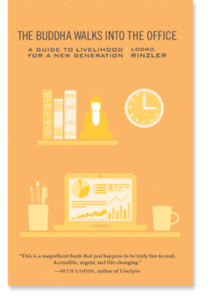
REBLOGGING: Great video talk by Lodro Rinzler, the author of “The Buddha Walks into a Bar,” regarding his newest book, “The Buddha Walks into the Office”

REBLOGGING:
Great video talk by Lodro Rinzler, the author of The Buddha Walks into a Bar, regarding his newest book, The Buddha Walks into the Office. Here is his website for more information about him, his books, etc.: https://www.lodrorinzler.com/

First video on the reblogged page (link is below) is an intro. Go to the second one.

Has a simple guided #meditation near the beginning, which is a basic intro to #Buddhist meditation.

Then, starting at around 29.00: “Our lives are a mandala. There is something at the center of it, of all of our lives, and we are either consciously aware of it or unconsciously living it.”

He leads the audience through a wonderful exercise of helping one become more aware of the #mandala of one’s own life, as a values-clarification and awareness-building activity, by putting a quality we want to cultivate at the center and others components where they fit regarding how closely we see each one to that central aspect, and how each aspect connects to others.

Worth doing for life, not just for work.

I wish he had used the word “ethical” as often as “meaningful” for types of work one can engage in for money, because plenty of people would think earning the most money, even while harming others, is “meaningful.”

But, working on behalf of oneself and one’s own interests alone is not what the Buddha meant, IMHO, by “Right Livelihood.”

Definitely listen to the Q & A at the end. Very good exchanges and more info, there. An hour well-spent.

LINK:
https://tgrb.wordpress.com/2017/07/01/the-buddha-walks-into-the-office

Unknown's avatar

“Kindness Chronicle” and “Elephant Journal”: Humans Sometimes Do Good

I grow weary of bad news, humans’ behaving atrociously and other direct hits to my ever-decreasing optimism. To counter the effects of the inevitable daily doses of ugly, I subscribe to two great sources of “humans sometimes do good”: The Kindness Chronicle at http://kindnesschronicle.com and
The Elephant Journal at http://elephantjournal.com

Unfortunately, my life is somewhat fast-paced and my priorities are often elsewhere, so instead of actually reading these daily posts and clicking on their links, I stockpile them in a folder. Just knowing they are there gives me comfort, and since I also subscribe/ LIKE their public pages on Facebook, I often see some of the individual link posts, anyway.

However, I mostly had no idea what actual uplifting stories are in this folder…until this week. So glad that I scheduled time to go through them to prepare this post.

From this stuffed inbox of good news (not the Christian “Good News” kind), I share some of these inspiring anecdotes with you all.

Enjoy! Subscribe! Do some good yourselves!

From The Kindness Chronicle:

KC-Logo-150px-Blue-Yellow

Most of the posts are stories describing individuals or organizations who have made considerable (but not necessarily extraordinary, given how many of them there are, now) efforts to demonstrate gratitude, kindness, helpfulness, volunteerism, respect, support, encouragement and other forms of caring to humans, animals and the environment. So many of them are similar, with the main distinction being location rather than activity, I decided not to list them here.

Please visit the above link, or the link below, for plenty of ideas, examples and even some research results on outcomes for “Paying it Forward,” teaching empathy and compassion, and other actions taken in the name of Kindness.

The Write Place: Not-So-Random Acts of Kindness site http://goo.gl/mWZ5nk recommends, among other sites: http://randomactsofkindness.org

Below is one of hundreds of images that heralds this excellent “movement”:

InspireKindnessQuote
image from http://www.cbizschool.com


From The Elephant Journal:

EJ logo

The Elephant Journal is an online ‘zine and site that provides updates, information and opinion articles (warning: most of these are junk science, “New Age” garbage, and “affirmations” that aren’t worth reading) on a variety of topics related to living “a more mindful life.” This open-ended mandate allows The Elephant Journal to surprise me often with their choices of topics, perspectives and data.

TEJ‘s pieces include multimedia formats that can feature humor, health, relationships, nutrition info/recipes, politics and edgy/radical points of view (with the aforementioned exceptions), pulled from a diverse group of commentators. I don’t always agree with or even like what is posted, but I appreciate the range of opinions, which can veer way over to “totally ‘woo-woo,’ New-Age junk science” to well-researched, documented, data-filled info pieces.

I appreciate this compilation enormously and respect the people who work there and write/ create/ collate/ curate for TEJ a lot. TEJ also posts excellent images (photographs, logos, infographics, memes) that are inspiring, beautiful and informative separately or to accompany an article.

Here are some of my favorite recent examples of their offerings, which arrive in emails entitled: “A Daily Gap in the Inbox of Your Mind,” steered by Waylon Lewis, editor-in-chief, host of Walk the Talk Show.

Evan Silverman opens his heart and explores how we can do the same in “Blow The Roof off Your Heart” (a piece that originally appeared in the Shambhala Times) http://goo.gl/ppT30e

—Great resources for businesspeople who wish to incorporate more mindfulness into their work lives are in “Waylon & Blake’s Best Mindful Business Books & Resources for Entrepreneurs,” in which Waylon Lewis wrote:

“This is a list that would have saved me years of my life, made me hundreds of thousands of dollars and spared me (and my team) hundreds of mistakes.” http://goo.gl/z9wbo9

—What about something eminently practical? Shoes that grow! Awesome! http://goo.gl/v5BJst

Waylon Lewis (the editor of TEJ) also bares his soul (sensing a theme, here, of my faves?), in “Thank You for Helping to Break My Heart,” that richly moved and helped me: http://goo.gl/Lj928K

Most tellingly, he starts with this subtitle: “I am sorry I loved you so badly.” I have a list of people I should say this to….Sigh.

The ending is also worth quoting in its entirety, in case you don’t click through:

May our relationships teach us. May we improve, instead of merely defending our confusion. May our intention be to be of benefit, and not merely to “get what we want.”

Life is hard, sometimes. Sometimes it’s rich and dear. If we want to take it easy, we should instead wish to be stronger, and more vulnerable.

May our love life be as full of grace as our spiritual path, our right livelihood, and our friendships and family relationships.

True love is defined by correct intention.

Thank you, Waylon.


My email program just informed me: “Your ‘Kindness and Good Deeds’ folder is now empty.” I’m glad to know it will surely be filling up again.

Unknown's avatar

#Buddhism and #Science: the Facts, the Yogis, the Practices

A repost from 1/30/14 from my own blog.

quantum-buddha-side

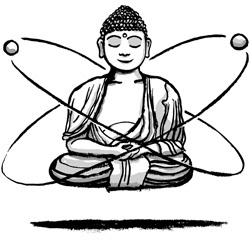
The above image is entitled “Quantum Buddha,” and it captures the essence of this post: the intersection of Buddhism and modern science. Meditation as medicine, mindfulness for many purposes, research data to support their usefulness seem to be in the headlines almost daily. Some links are below to articles like that.

http://ideas.time.com/2014/01/17/we-need-to-take-meditation-more-seriously-as-medicine/

Being called The Third Metric, and The Way of the Future for politics, leadership, business and family life, mindfulness is now almost mainstream.

http://www.huffingtonpost.com/2014/01/21/third-metric_n_4612396.html

Will meditation cure your depression? Your cancer? Your diabetes? Your stress?

http://www.wildcat.arizona.edu/article/2014/01/heat-the-body-heal-the-mind

What are the facts? What is true? What is correct? How do you know?

Einstein and Buddhism

There was recently a forum on meditation led by the actor, Goldie Hawn, at a World Economics conference!

http://www.bloomberg.com/news/2014-01-20/at-davos-rising-stress-spurs-goldie-hawn-meditation-talk.html

You decide, after learning to meditate, researching via personal experience as well as reading and watching videos, attending conferences and talking with others, what YOU believe. The Buddha would want you to do that. Really.

reject buddha Dalai Lama

When you have time and want to learn a lot more, watch this amazing documentary. Yogis of Tibet.
https://www.youtube.com/watch?v=DctQTDm-HdU