
My Progress on MEDITATIVE CONCENTRATION: Acquiring the Qualities in the “Six Perfections” (Paramitas) of Buddhism for the 6 Weeks prior to my 72nd Birthday
As readers of my books and blog posts know, I have been a practicing Tibetan Vajrayana Buddhist since 1996/1989/1983 and many lifetimes prior to this.
Fundamental parts of being this type of meditator are studying, attempting to gain the qualities and do the practices (and others) described at the end of this post, known as “The Six Perfections” (Paramitas).
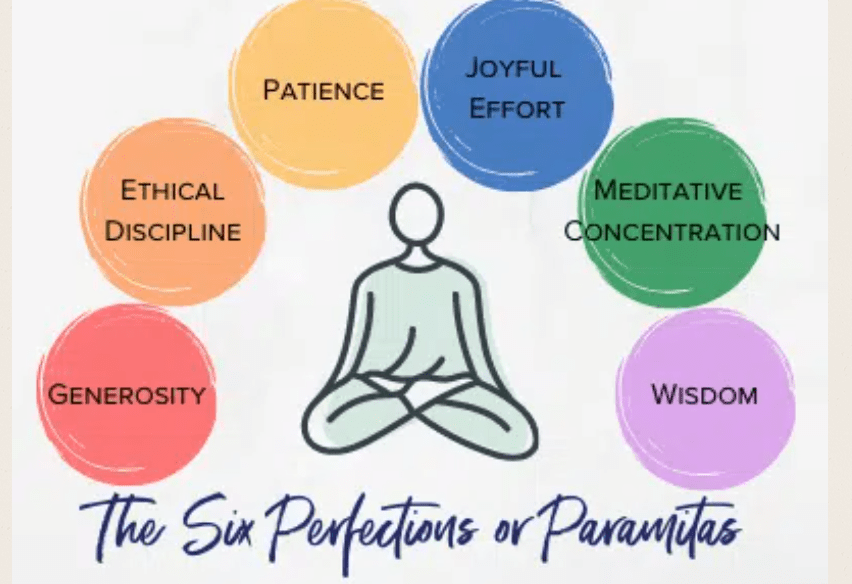
From https://www.namchak.org/community/blog/six-perfections-or-paramitas/
And, also check out: https://act4tibet.wordpress.com/2022/03/27/6paramitas/
For these six weeks prior to my birthday (July 17 – August 22, 2026), I plan to blog once each Friday about each of these qualities and my difficulties and seeming successes over the last 30 years of intensively practicing within this framework.
I have been studying and contemplating them and incorporating these as much as possible into daily life. Time for a self-assessment.
Stay tuned and check in each subsequent week, and please add your own experiences in the comments. Check this location for future posts: https://sallyember.com/2026/07/10/my-progress-on-acquiring-the-qualities-in-the-six-perfections-paramitas-of-buddhism-for-the-6-weeks-prior-to-my-72nd-birthday/
Week Five: Meditative Concentration
Sometimes this 5th of the 6 Perfections/Paramitas is known as Discipline, sometimes Meditative Absorption, sometimes just Meditation. Below are the finer points to be learned in practicing to achieve this.
It sounds simple, but OY, it is not easy.
YOU try it (if you’re not already engaged in these practices). And if you are already attempting to master this, let me know in the comments how you’re doing?
These images, the quote and bullet points, above and below, are from: https://www.namchak.org/community/blog/practicing-the-perfection-of-meditative-concentration/
“Meditative concentration, known in Sanskrit as Dhyāna or Samādhi, is the fifth of the Six Perfections (Pāramitās) in Mahayana Buddhism. It is the practice of resting the mind steadily and calmly on a single virtuous object, free from distraction, dullness, or emotional agitation.”
Core Meaning
- One-pointed awareness: Cultivating a stable, clear, and focused mind that does not wander.
- Mental stability: Acting as a firm anchor that protects the mind from external chaos and internal noise.
- Foundation for wisdom: Creating the steady inner space required to develop the final paramita, the perfection of wisdom (Prajñā).
Key Obstacles to Overcome
- Laziness: A lack of motivation or putting off practice.
- Forgetfulness: Losing track of the meditation object or instructions.
- Dullness: Mental heaviness, sleepiness, or subtle loss of clarity.
- Agitation: Restlessness, anxiety, or runaway thoughts.
Practical Benefits
- Increases emotional awareness so you can respond rather than react.
- Brings a deep, lasting sense of inner peace and calm.
- Prepares the mind to see reality clearly without distortion.
I do all right with understanding all this (gee, I should, after meditating in various ways since 1972…). However, as we all know by now, understanding is only the first step in achievement of something so complex and difficult to attain, yet simple to describe.
What’s become interesting to me in the last twenty years of my focusing on my main practice of Dzogchen in Dudjom Rinpoche’s/Longchenpa’s lineages of Tibetan Buddhist Vajrayana Nyingma practices is this: we don’t have to “clear” our minds to meditate in the tradition of Dzogchen. In fact, we aren’t supposed to “do” anything. We are supposed to let it all be “as it is.” Now, THAT sounds simple, but is profoundly difficult to explain, much less do.
So, how am I doing with this Paramita? Well, the main aspect of Dzogchen practice is “remembering to remember,” which means every time our mind becomes “ordinary,” bring it back to rest in “awareness,” or “rigpa,” or “rigpa yeshe.”
Here’s how that goes: My mind wanders, I bring it back. Mind wanders; I don’t remember to bring it back for quite a while; THEN, I remember and I bring it back. Mind wanders; I bring it back, but sometimes I don’t bring it back for DAYS or WEEKS or MONTHS. Then, I remember, and I bring it back.
Best are the times that my mind doesn’t wander for a few seconds or even minutes; or, sometimes (joy of joys) longer. This usually only happens when I’ve set aside dedicated meditation time in a home or “away” retreat, but I’m getting better at having this occur “in daily life,” which is the point, after all.
Mostly, I forget to remember, and I’m supposedly a very advanced, experienced meditator. So, basically, I SUCK at remembering too much of the time. But, I persevere and try and continue. THAT is “diligence,” in my estimation: never giving up.
Overall grade among meditators, possibly a “C-.” Among all humans, probably “B-,” but, only because most humans aren’t even trying to do this.
What about you? Our main teacher, Chagdud Tulku Rinpoche, famously said (in English): “Keep going.” “’Keep going’ was the signature, trademark encouragement of Chagdud Tulku Rinpoche (1930–2002), a renowned Tibetan Buddhist master of the Nyingma tradition and founder of the Chagdud Gonpa Foundation. Whenever students faced inner doubt, emotional confusion, or heavy resistance in their meditation practice, he would cut through their hesitation by simply urging them: ‘Keep going.’” http://www.chagdudgonpa.org
So, I do.


