Unknown's avatar

My Progress on WISDOM/VIEW: Acquiring the Qualities in the “Six Perfections” (Paramitas) of Buddhism for the 6 Weeks prior to my 72nd Birthday

My Progress on WISDOM/VIEW: Acquiring the Qualities in the “Six Perfections” (Paramitas) of Buddhism for the 6 Weeks prior to my 72nd Birthday

As readers of my books and blog posts know, I have been a practicing Tibetan Vajrayana Buddhist since 1996/1989/1983 and many lifetimes prior to this.
Fundamental parts of being this type of meditator are studying, attempting to gain the qualities and do the practices (and others) described at the end of this post, known as “The Six Perfections” (Paramitas).
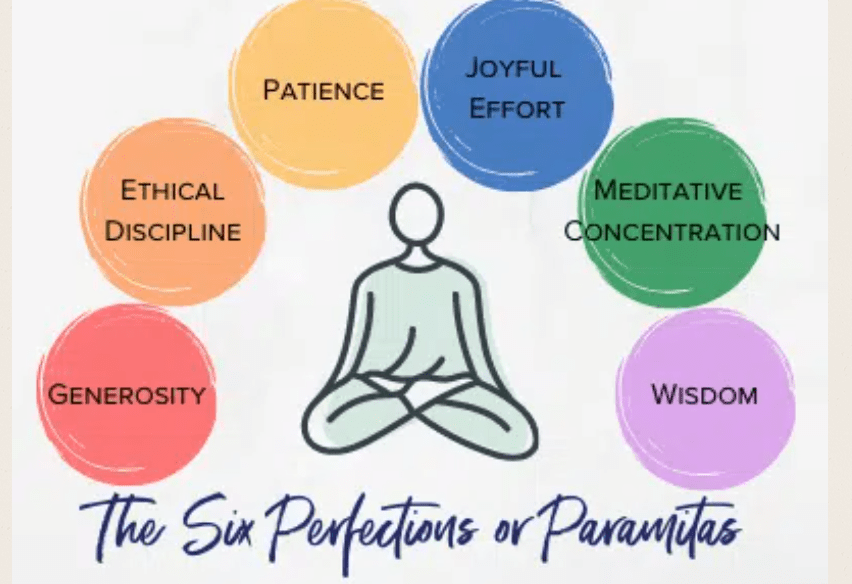
This image has an empty alt attribute; its file name is image.png

From https://www.namchak.org/community/blog/six-perfections-or-paramitas/

And, also check out: https://act4tibet.wordpress.com/2022/03/27/6paramitas/

For these six weeks prior to my birthday (July 17 – August 22, 2026), I have now blogged once each Friday about these Six qualities and my difficulties and seeming successes over the last 30 years of intensively practicing within this framework.
I have been studying and contemplating them and incorporating these as much as possible into daily life. Time for a self-assessment.

Please add your own experiences in the comments. Check this location for past posts, since this is the final one: https://sallyember.com/2026/07/10/my-progress-on-acquiring-the-qualities-in-the-six-perfections-paramitas-of-buddhism-for-the-6-weeks-prior-to-my-72nd-birthday/

Week Six: Wisdom/View

Wisdom” in this context does not mean what ordinary definitions would provide to us. Yes, this type of Wisdom does involve knowledge, experience, understanding and implementation, which are parts of ordinary wisdom. It’s great to attempt to improve one’s wisdom in ordinary ways, so that’s okay to focus on, for most people.

However, Wisdom as a Perfection goes beyond that (“Gate, gate, paragate, parasamgate, bodhi soha is the mantra from the Heart Sutra, Prajnaparamita, for this practice, which is loosely translated as “Gone, gone beyond, gone completely beyond, into Wisdom,” or “Gone, gone, gone to the other shore, gone completely to the other shore, awakening, so be it!”).

Yogapedia offers:

Gate (gāte): Gone (repeated for emphasis).

Paragate (pāragate): Gone to the further shore (transcending conventional limits).

Parasamgate (pārasaṃgate): Gone completely to the further shore (reaching total liberation).

Bodhi: Awakening or enlightenment.

Soha (or Svāhā): A sacred exclamation similar to “hail,” “amen,” or “so be it,” used to seal a prayer or ritual.

In other words, “the sixth paramita is wisdom (Sanskrit: prajñā), which is the transcendent perfection of understanding the true nature of reality. It acts as the ultimate guide and ‘eyes’ for the first five perfections, transforming ordinary acts into a path to enlightenment.” from https://tzuchi.us/blog/the-six-perfections

This type of Wisdom inhabits territory I’m not even allowed to specifically discuss, unless the reader/listener has been initiated into this level of Buddhist teachings. Since my blog followers are mostly unknown to me, I can’t go into that kind of detail here.

I will share that striving to embody and live into this Paramita is the most difficult, and cultivating Wisdom is also the most basic of my daily practices, all at the same time.

The Namchak Community offers this perspective, which is the closest to what I’ve been taught and practicing: “Wisdom, or sublime intelligence, as it is sometimes translated, means to know things precisely as they are. In other words, to know reality as it really is. In the context of the Six Perfections, the Perfection of Wisdom means the realization of emptiness—the ultimate nature of all things. It is this wisdom that makes the other five become ‘perfections.’ The first five are the methods that will lead us to the wisdom that realizes emptiness, which is one of the primary causes of enlightenment.”

This site continues:
Seeing reality: It means knowing things precisely as they are, free from delusion.
Understanding emptiness: It recognizes that all things lack a permanent, independent self.
Guiding the path: Without wisdom, the other practices lack direction; with it, they lead to liberation.”

You can learn more here as well: https://openheartproject.com/the-six-paramitas-wisdom/ This site has weekly meditations and teachings, and this perspective on the 6th Paramita, Wisdom:
“…[T]he paramitas are not about ordinary qualities, but about transcendent ones–transcendent generosity, transcendent discipline, and so on. Now we arrive at transcendent wisdom, which is tricky to talk about because it exists beyond concept, beyond words, beyond even thought. But we will do our best!
“The first thing to note is that all the paramitas are about living with an awakened heart and being of benefit to this world. In Buddhism, this is called being a bodhisattva or an awakened being. The paramitas comprise the activities of a bodhisattva–and at the same time they are, in some sense, quite ordinary. Please have a listen to this talk to learn more.”
These quotes, videos and more are from Susan Piver, a well-known Buddhist practitioner, teacher, author and video creator. Check her out!

So, where am I with this, the most basic and most challenging of the Paramitas? Overall, my understanding is sublime. I “get it.” However, do I practice it, consistently, constantly? Is it my way of being, living, seeing? I WISH IT WERE.

I get too caught up in the ordinary, the annoying, the irritating. I get too angry, too attached to others’ words and behaviors, too sad at losses, too outraged at perceived betrayals, and too lost in the mundane. The entire point of this practice, especially of the 6 paramitas, is to TRANSCEND while still being alive, here.

I’m great at being alive, here. It’s managing to keep transcending that I fail at doing.

Sometimes, when I’m doing intensive, silent, prolonged retreat (at least 3 full days, up to 11 weeks, for me), I am immersed enough in meditation and away from ordinary life enough to live as I wish. But, “keeping it,” carrying this into daily life, IS the practice, and, believe me, I am still PRACTICING, and not perfect.
I do try, and I fail, and I try again, and again, and again.

Oh, how I wish I could live like this image exhorts (from https://evaminstitute.org/). So far, I’d give myself an erratic C+, or sometimes a B-, I suppose.
Maybe I’m too hard on myself, you ask?
Or, maybe I’m not critical enough, I say.
I have been meditating for many lifetimes; in this one, over 54 years; in this tradition, almost 30 years. What’s my excuse? I “should” be further along, I believe.

But, being “better” than this at this point is clearly not my karma in this lifetime, so I keep on keeping on.

Do you? How are you doing with this? Let me know? Comment below.

Thanks for going on this self-assessment journey with me. Happy 72nd Birthday to me on Saturday.

Wishing you all well, and may all beings benefit.

Unknown's avatar

My Progress on MEDITATIVE CONCENTRATION: Acquiring the Qualities in the “Six Perfections” (Paramitas) of Buddhism for the 6 Weeks prior to my 72nd Birthday

My Progress on MEDITATIVE CONCENTRATION: Acquiring the Qualities in the “Six Perfections” (Paramitas) of Buddhism for the 6 Weeks prior to my 72nd Birthday

As readers of my books and blog posts know, I have been a practicing Tibetan Vajrayana Buddhist since 1996/1989/1983 and many lifetimes prior to this.
Fundamental parts of being this type of meditator are studying, attempting to gain the qualities and do the practices (and others) described at the end of this post, known as “The Six Perfections” (Paramitas).

This image has an empty alt attribute; its file name is image.png

From https://www.namchak.org/community/blog/six-perfections-or-paramitas/

And, also check out: https://act4tibet.wordpress.com/2022/03/27/6paramitas/

For these six weeks prior to my birthday (July 17 – August 22, 2026), I plan to blog once each Friday about each of these qualities and my difficulties and seeming successes over the last 30 years of intensively practicing within this framework.
I have been studying and contemplating them and incorporating these as much as possible into daily life. Time for a self-assessment.

Stay tuned and check in each subsequent week, and please add your own experiences in the comments. Check this location for future posts: https://sallyember.com/2026/07/10/my-progress-on-acquiring-the-qualities-in-the-six-perfections-paramitas-of-buddhism-for-the-6-weeks-prior-to-my-72nd-birthday/

Week Five: Meditative Concentration

Sometimes this 5th of the 6 Perfections/Paramitas is known as Discipline, sometimes Meditative Absorption, sometimes just Meditation. Below are the finer points to be learned in practicing to achieve this.
It sounds simple, but OY, it is not easy.
YOU try it (if you’re not already engaged in these practices). And if you are already attempting to master this, let me know in the comments how you’re doing?

These images, the quote and bullet points, above and below, are from: https://www.namchak.org/community/blog/practicing-the-perfection-of-meditative-concentration/

“Meditative concentration, known in Sanskrit as Dhyāna or Samādhi, is the fifth of the Six Perfections (Pāramitās) in Mahayana Buddhism. It is the practice of resting the mind steadily and calmly on a single virtuous object, free from distraction, dullness, or emotional agitation.”

Core Meaning

  • One-pointed awareness: Cultivating a stable, clear, and focused mind that does not wander.
  • Mental stability: Acting as a firm anchor that protects the mind from external chaos and internal noise.
  • Foundation for wisdom: Creating the steady inner space required to develop the final paramita, the perfection of wisdom (Prajñā).

Key Obstacles to Overcome

  • Laziness: A lack of motivation or putting off practice.
  • Forgetfulness: Losing track of the meditation object or instructions.
  • Dullness: Mental heaviness, sleepiness, or subtle loss of clarity.
  • Agitation: Restlessness, anxiety, or runaway thoughts.

Practical Benefits

  • Increases emotional awareness so you can respond rather than react.
  • Brings a deep, lasting sense of inner peace and calm.
  • Prepares the mind to see reality clearly without distortion.

I do all right with understanding all this (gee, I should, after meditating in various ways since 1972…). However, as we all know by now, understanding is only the first step in achievement of something so complex and difficult to attain, yet simple to describe.

What’s become interesting to me in the last twenty years of my focusing on my main practice of Dzogchen in Dudjom Rinpoche’s/Longchenpa’s lineages of Tibetan Buddhist Vajrayana Nyingma practices is this: we don’t have to “clear” our minds to meditate in the tradition of Dzogchen. In fact, we aren’t supposed to “do” anything. We are supposed to let it all be “as it is.” Now, THAT sounds simple, but is profoundly difficult to explain, much less do.

So, how am I doing with this Paramita? Well, the main aspect of Dzogchen practice is “remembering to remember,” which means every time our mind becomes “ordinary,” bring it back to rest in “awareness,” or “rigpa,” or “rigpa yeshe.”

Here’s how that goes: My mind wanders, I bring it back. Mind wanders; I don’t remember to bring it back for quite a while; THEN, I remember and I bring it back. Mind wanders; I bring it back, but sometimes I don’t bring it back for DAYS or WEEKS or MONTHS. Then, I remember, and I bring it back.

Best are the times that my mind doesn’t wander for a few seconds or even minutes; or, sometimes (joy of joys) longer. This usually only happens when I’ve set aside dedicated meditation time in a home or “away” retreat, but I’m getting better at having this occur “in daily life,” which is the point, after all.

Mostly, I forget to remember, and I’m supposedly a very advanced, experienced meditator. So, basically, I SUCK at remembering too much of the time. But, I persevere and try and continue. THAT is “diligence,” in my estimation: never giving up.

Overall grade among meditators, possibly a “C-.” Among all humans, probably “B-,” but, only because most humans aren’t even trying to do this.

What about you? Our main teacher, Chagdud Tulku Rinpoche, famously said (in English): “Keep going.” “’Keep going’ was the signature, trademark encouragement of Chagdud Tulku Rinpoche (1930–2002), a renowned Tibetan Buddhist master of the Nyingma tradition and founder of the Chagdud Gonpa Foundation. Whenever students faced inner doubt, emotional confusion, or heavy resistance in their meditation practice, he would cut through their hesitation by simply urging them: ‘Keep going.’” http://www.chagdudgonpa.org

So, I do.

Unknown's avatar

My Progress on GENEROSITY: Acquiring the Qualities in the “Six Perfections” (Paramitas) of Buddhism for the 6 Weeks prior to my 72nd Birthday)

My Progress on GENEROSITY: Acquiring the Qualities in the “Six Perfections” (Paramitas) of Buddhism for the 6 Weeks prior to my 72nd Birthday

As readers of my books and blog posts know, I have been a practicing Tibetan Vajrayana Buddhist since 1996/1989/1983 and many lifetimes prior to this.
Fundamental parts of being this type of meditator are studying, attempting to gain the qualities and do the practices (and others) described at the end of this post, known as “The Six Perfections” (Paramitas).

From https://www.namchak.org/community/blog/six-perfections-or-paramitas/

And, also check out: https://act4tibet.wordpress.com/2022/03/27/6paramitas/

For these six weeks prior to my birthday (July 17 – August 22, 2026), I plan to blog once each Friday about each of these qualities and my difficulties and seeming successes over the last 30 years of intensively practicing within this framework.
I have been studying and contemplating them and incorporating these as much as possible into daily life. Time for a self-assessment.

Stay tuned and check in each subsequent week, and please add your own experiences in the comments. Check this location for future posts: https://sallyember.com/2026/07/10/my-progress-on-acquiring-the-qualities-in-the-six-perfections-paramitas-of-buddhism-for-the-6-weeks-prior-to-my-72nd-birthday/

Week One: Generosity

I admit to being very judgmental, critical, impatient, and otherwise ungenerous when it comes to certain kinds of people and situations. I am much better than I was when I was younger, and especially since trying to be better, as part of an ongoing practice of increasing generosity and compassion.

But, I lack sorely in this department when it comes to refraining from calling out incompetence, bullying, greed, violence, stupidity that leads to harming others and many other behaviors and traits in others. I am NOT generous enough in my heart. I am wishing to be more so.

I have to admit I have been failing to be beneficient, especially since late in 2015 (the start of the first illegal occupation of the White House in the USA by the usurper Trump and his gang of thieves, liars and warmongers) and even worse since the second occupation (starting in the late fall of 2024).

I’m sure many of my readers will concur with my negative assessment of those people and maybe even forgive my shortcomings (having their own to content with). However, that doesn’t make my lack of progress with internal generosity acceptable to me.

Mainly, my biggest failure in generosity occurs when I am impatient with regular people, some of whom I encounter almost daily where I live or on public transportation routes and waiting areas in the Seattle area (where I live, which I use almost daily, sometimes twice or more per day). I really suck at this right now.

Successes include being generous with my time, expertise, knowledge, help, caring and assistance to those whom I encounter that need or want my aid. Those aspects I am excellent with showing and feeling. However, I have always been so, in my recollection, so that does not constitute progress of any recognizable type with outer or inner generosity, yet.

I also sometimes give money, (even though I have very little), to show concrete gratitude to those who have been helping me and whose own funds aren’t huge; their time and expertise have made their help to me possible. Again, though, I have always been generous with material or personal assistance, so no points for my progress here.

The only improvements with generosity (and many other positive characteristics and behaviors) that have spontaneously occurred in my life when each noticeable changes happened after an accumulation of time in which I was focusing on doing my main meditation practice, such as during an intensive, private, individual, silent retreat of any length. I do best particularly after the longer ones, but even a long weekend helps. I need to do more of those concentrated practice times, for sure.

Meanwhile, I do try to be less impatient, less critical, and call up more kindness and tolerance. Those kinds of Largesse of the spirit are my biggest challenges regarding developing generosity. I am therefore working on:
Philanthropy, Munificence, Magnanimity, Openhandedness when it comes to others, known and up close as well as distant and less “in my life.”

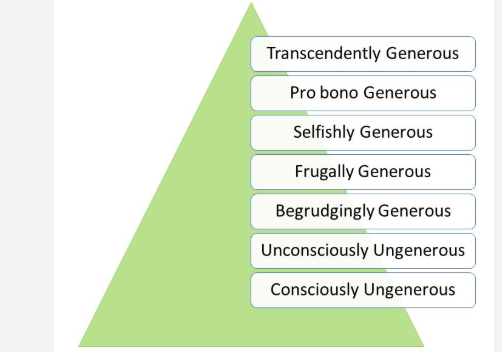
I found this image and agree with its “levels” a lot. What do you think? “7 Degrees of Generosity,” is from Gonser Gerber: https://www.gonsergerber.com/2023/05/01/7-degrees-of-generosity/ [This article was originally posted on Jason’s Blog in May 2023. To read more, visit www.jasonmcneal.com]

He wrote: “The model posits that there are 2 types of people who are unwilling to give – the Consciously Ungenerous and the Unconsciously Ungenerous.

“The difference is that the Consciously Ungenerous are those who see the need, believe they should give, but decide not to nonetheless.  The Unconsciously Ungenerous are those who see the need but simply do not believe or do not understand that they should give. 
“To better imagine the Unconsciously Ungenerous, think of younger people who, from a human development standpoint, may not embrace their responsibility to give just yet.

“The Begrudgingly Generous will give, but only when the pressure (usually social) is too great to decline.

“The Frugally Generous will give of their own will, but will only make modest, token gifts, far below their financial capacity.

“The Selfishly Generous will give, at times significantly, and will want some sort of public recognition or accolades for their support.

“Like the Selfishly Generous, the Pro bono Generous will give at times significantly as well.  They will not, however, be motivated to give because of any pubic recognition they may receive.  In fact, they may eschew recognition.

“And, finally, the Transcendentally Generous also will give significantly and will not be motivated to give because of public recognition.  The fundamental difference between the Pro bono Generous and the Transcendentally Generous is that the latter willingly give without restrictions….
“The Transcendentally Generous typically view giving as a spiritual exercise.  Giving is not about them, the gift, or even the recipient.  Giving is about learning to experience joy from sharing valuable assets with others in ways that most dignify them.”

In Judaism (the culture in which I was raised), there is a term, “tzedakah,” which loosely translates to mean “charity,” but actually means “to give from behind a closed door with an open hand.” So, being that kind of generous is both “pro bono” and “transcendental” in the above model, because engaging in tzedakah means to give without regard for being noticed and without holding on to any particular outcomes from the giving itself. It is actually an obligation, if one is an observant Jew: “…tzedakah is viewed as a mandatory act of righteousness and fairness that everyone is required to perform, regardless of their financial status.”

Wish me luck in rising to being “Transcendentally Generous,” increasing my righteousness, fairness, compassion and loving kindness, as I strive to improve my own inner and outer generosity.

How are you doing with generosity? Leave a comment?