Unknown's avatar

15 Ways I PERSONALLY #Conserve #Water and You MUST, Too!

Here are the 15 EASY ways I PERSONALLY conserve water, since I usually do, anyway, and I now live in the drought-stricken state of California. PLEASE do this.

IMPORTANT: Most of these personal acts DO NOT MATTER if you eat a lot of meat, corn or soy, or foods that contain them (which are MOST if you eat processed foods/fast food). Really. Agriculture uses more than 95% of California’s water, and most of THAT goes to raising animals, corn and soy for animal and human food.

Check out this article (link, below). Here are some key facts:
“California families are concerned and ready to take action. Responsible citizens will be taking shorter showers, shutting off the water while brushing their teeth, and only washing clothes with a full load. But what most people don’t know is the much greater impact of their diet….

“Most people shower every day an average of about seven minutes of hot water with the showerhead flowing out about two gallons of water a minute. The Water Education Foundation calculates that every pound of California beef requires about 2,464 gallons of water to produce. You would save more water just by replacing a pound of beef with plant foods than you would by not showering for six months!…

“It may be more abstract than just turning off the tap, but the foods we choose impact our water supply. Eating more veggies, fruits and grains, and reducing or eliminating our consumption of meat, milk, and eggs will help your family decrease their environmental footprint, get healthy, help animals, and preserve enough fresh water for generations of Californians to come.”

http://www.onegreenplanet.org/news/californias-drought-whos-really-using-all-the-water/

HOWEVER: Personal conversation DOES matter and we should all have better habits and tend to our water use better.

drop of water conserving

1. Use a dishwasher or washing machine only when it is full, unless your appliance has settings for lower water/smaller loads. Then, make sure you set it correctly.

2. Use a cup (not filled) of water to dip your toothbrush in for wetting, rinsing while you brush your teeth. Use the water to rise your mouth. If you still need to rinse your mouth after that, just use one swallow’s worth of water for the final rinse. DO NOT RUN WATER WHILE BRUSHING TEETH, please. Teach your children this.

3. If you have pets and plants, use the leftover water from watering plants to fill pet water bowls and vice-versa. None of these beings will mind one bit.

4. If your water heater is slow to heat your shower or tub to desired temperature, put a dishpan or large bucket under the flow to catch the colder water. Use this water to water plants or give to pets, or, if you wash dishes by hand, to soak dishes.

5. Be vigilant about leaks and drips and do not allow any to continue. Get help or DIY, but end these water-wasters right away.

6. If you must wash your car (like, it’s covered in mud or blood), patronize a car wash that advertises that it uses recycled water. Otherwise, keep your windshield and headlights clean and drive a dirty car. It is not a big deal, compared to RUNNING OUT OF CLEAN WATER. Really.

7. Check recipes and use common sense: only use the amount of water for cooking that the item(s) require, and no more.

8. Get a compost bucket with a lid and stop using your garbage disposal except when the drain is clogged. Then, run minimally, just to clear the clog.

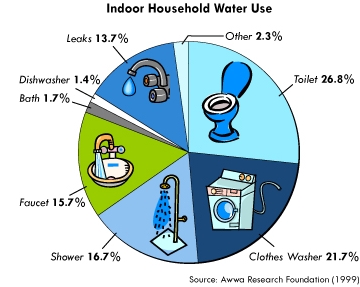
9. Water conserving shower-taking (especially in public places, to be a role model): get wet quickly, all over; lather up body and hair with water turned OFF or trickling, if needed; rinse off, all at once; repeat if needed (like, for hair).

Where_Water_Is_Used

10. Use shower water only for getting clean/rinsed. Do not stand under the shower to “warm up.” Do not stand by and be silent when others do this. Water is not for your or their personal luxury or comfort. WATER IS ALL OF OURS.

11. Bath-takers: STOP TAKING BATHS. Unless you can’t stand up or are too young to shower, stop it. It’s self-indulgent and wasteful. Baths use five times the water that showers do (or more, if you keep “topping it up” to keep it hot). WE CANNOT BATHE in a full tub (70 GALLONS of water!!) in a drought. Really. Stop it. if you must immerse yourself occasionally, join a gym or go where they have an already-filled hot tub. Enjoy.

12. If you use ice cubes in a drink or pitcher and have some leftover but unwanted, let them melt and then water plants or animals with the melted ice.

13. Store water leftover from steaming vegetables or cooking eggs to begin your next soup. Can be frozen and thawed for this purpose.

14. Thaw food in the refrigerator; do not use running water to thaw food. Plan ahead.

15. Get a garbage pail with a lid and put it next to each toilet. Put all but the most soiled toilet paper in the pail. Do not flush the toilet until it is necessary (without toilet paper and only pee: NOT NECESSARY!). If you have children or many guests, put up a sign to this effect. Or, be cuter: “If it’s yellow, let it mellow; if it’s brown, flush it down.” “Please put wet toilet paper in the pail. If it’s ‘heavy,’ put it in the toilet.”

Conserving-Water

Want more ideas, especially for home-owners and landlords/ladies with land or pools and businesses? See this list, below.

SHARE!

http://wateruseitwisely.com/100-ways-to-conserve/

Unknown's avatar

#Judgmental and Proud of It: Employing #Discernment and #Sagacity

I have had the great, good fortune to become well-educated. Some of it was due to sheer luck: family of origin, excellent school system, native intelligence. The rest came from my own motivation, curiosity, dedication, discipline and hard work. Along the way, many people have been jealous, intimidated, angry or otherwise negative toward me due to their own insecurities, competitiveness and failures. Their favorite epithet to fling at me is judgmental (although they usually spell it incorrectly).

My usual response is to agree with them in one way or another and not to be offended, which usually infuriates them further. Yes, I am judgmental.

judge-not-discernment

I am actually quite discerning. I consider the facts, my own beliefs, experience and values. Then, I make a decision as to the worthiness of someone or something. I do not apologize for forming an opinion. It is my right and actually, my duty, to do so.

Not to form an opinion demonstrates a lack of conviction which can indicate one is lazy, ignorant or dishonest. EVERYONE forms opinions, whether we express them or not.

Having judgment to the point of discernment is both a matter of survival and a condition of maturity. It is important to every aspect of our adult lives that we make informed choices. Otherwise, we are undisciplined, disempowered, sheepish followers with no self-driven understandings of our decisions.

NiemollerQuoteMonmouthNJ580pxw

When adolescents fail to learn to make good decisions, we all mourn the horrible consequences of their ill-informed actions (or inactions). Why do we encourage teens to learn to choose and then spend decades castigating adults for being too choosy?

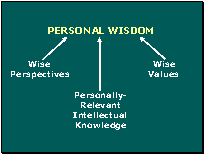
Personal Wisdom graphic

Recently, I got into a disagreement with someone on a website about the way she was administering her “page,” or “event.” She had invited me to participate. I read the rules she had set up, her own guidelines, and then joined. But her rules weren’t being followed. I objected. I pointed out the ways that these rules were being broken, told her I was uncomfortable participating as long as these others were being allowed to continue, and asked her to boot the rule-breakers.

Her response to me was to call me judgmental. She claimed that I was being judgmental by saying that I didn’t want to allow these others to stay on this site. She then threw down the “it’s my site and I’ll do what I want” gauntlet, and continued to refuse to do her admin job. I left the event.

paolo freire quote

I also warned others against participating by explaining the distressing lack of enforcement she was providing considering the invaders’ tactics. The threats they presented were significant. I believe it would have been irresponsible for me not to speak up about the situation since I knew first-hand what participation could cost new participants, and not everyone would be as alert as I had been to the subtleties of these threats. Newcomers would risk harm to their professional reputations, possible tangential criminal involvement, and, at the very least, they’d be wasting their time.

Some thanked me. Others were silent. Some wondered: Was I being appropriate? Was I not nice?

I know some nice people. They are naturally kind, sweet, easy to get along with, agreeable. I envy and yearn to be more like them, but nice doesn’t come into my personality so easily. When I was younger, I often got labeled cute (mostly because I’m quite short), but not usually nice.

I’m fun, funny, generous (to a fault), honest, reliable, hard-working, loyal and trustworthy (also to a fault) and extremely well-organized. But, nice? Not the first adjective people use to describe me. I’m not mean, either.

But when a person is known for being nice, everyone says that about them first. When a person is known for being smart or excellent at other professional components, as I am, nice does not come first in a string of descriptive words. Picky often does. So do strong, quick, intimidating and brilliant.

What about when some people’s “niceness” turns to malleable, when their spines bend in every direction, metaphorically? I do not trust them. They sway with every strong force around them, having no core of their own. Just as being too choosy has a downside (being intolerant comes to mind), so does being too nice. Was this site administrator being too nice or just unable to be strong enough to enforce rules?

Sagacity

What does it mean to be wise in one’s judgments, to show discernment, to exhibit sagacity? We elect and hire people to sit in judgment for us, literally as judges, and in many other roles in which evaluation is necessary or required. We accept or rebel against their opinions, but we don’t tell them not to form them, do we?

Book reviewers are in another category of people to whom we turn for judgment. Readers rely on reviewers to help us make decisions about what to read and to help us understand better why we like or dislike a book. Authors rely on reviewers to represent our work honestly and fairly to readers.

Reviewers are supposed to employ discernment as well as sagacity, drawing on experience, wide-ranging knowledge, professional awareness of trends and their own preferences. Then, we expect them to express these opinions as objectively as possible. We certainly don’t want them not to form opinions. They must be judgmental to do their jobs.

As an author, I appreciate strong, clear, opinionated reviewers and long for those types of reviews for my work. Give me negative or positive reviews, I am grateful to you for being willing to state your opinions, give your reasons, stand by them: I applaud professional reviewers!

So, the next time you feel moved to label someone judgmental, ask yourself these questions and consider these next steps:
1) are YOU being judgmental right now, and not in a good way, but in an intolerant way? If so, back off until you understand your own feelings and thoughts better. Then, try expressing those with more clarity and focus as well as respect.
2) are you merely disagreeing with this person and trying to shut down the argument by calling names or flinging negative labels? That’s lazy discourse. Get a better vocabulary and stay in the discussion, with integrity, or don’t argue at all.
3) are you actually hiding a more personal agenda (e.g., you dislike this person, you feel guilty for whatever it is they’re calling you out about, you actually agree with them, you are ashamed of your failings, they remind you of your mother or father or some other person who evaluated you unfairly in the past, etc.)? Try to figure out what your internal voice is actually saying and then decide if this is the person you even want to say this to or not. Determine further action after that.

Meanwhile, don’t be ashamed of or try to hide your opinions or judgments. Be honest, but use discernment and sagacity: be kind, be careful, be respectful.

Next, have some courage! Don’t back down if you really believe what you’re saying or writing. Just express it better. Then, when people call you judgmental, say, “Thank you for noticing.”

Courage with judgment