Unknown's avatar

#MacArthur Foundation’s 20 Newest Fellows, 2026: #Artists, #Musicians, & #Performers; #Writers & #Poets; #Scientists & #Engineers; and, #Humanities & #Social Scientists

#MacArthur Foundation’s 20 Newest Fellows, 2026:
#Artists, #Musicians, & #Performers; #Writers & #Poets; #Scientists & #Engineers; and, #Humanities & #Social Scientists
“For 45 years, MacArthur Fellows have defied boundaries, by questioning conventions, crossing disciplines, and driving collective progress….The 2026 fellows continue that creative tradition — they explore the depths of our humanity; they reveal untold origins to modern challenges; they expand the edge of scientific inquiry and life-saving research. They show us new ways to understand the world.”
Kristen Mack
Vice-President, Communications, MacArthur Fellows, and Partnerships

“The MacArthur Fellowship is a $800,000, no-strings-attached award to extraordinarily talented and creative individuals as an investment in their potential….Since 1981, 1197 people have been named MacArthur Fellows….

“Nominees are brought to the Program’s attention through a constantly changing pool of invited external nominators chosen from as broad a range of fields and areas of interest as possible. They are encouraged to draw on their expertise, accomplishments, and breadth of experience to nominate the most creative people they know within their field and beyond….

“There are three criteria for selection of Fellows:

  • Exceptional creativity
  • Promise for important future advances based on a track record of significant accomplishments which could be enabled by our support
  • Potential for the Fellowship to facilitate subsequent creative work.”

“The MacArthur Fellows Program is intended to encourage people of outstanding talent to pursue their own creative, intellectual, and professional inclinations. In keeping with this purpose, the Foundation awards fellowships directly to individuals rather than through institutions. Recipients may be writers, scientists, artists, social scientists, humanists, teachers, entrepreneurs, or those in other fields, with or without institutional affiliations. They may use their fellowship to advance their expertise, engage in bold new work, or, if they wish, to change fields or alter the direction of their careers.”

“By providing these individuals with unfettered support in pursuit of creative activities and knowledge, the Fellows Program seeks to:

  • Highlight the importance of imaginative thinking in creating new works of art that inspire;
  • Spotlight the value of risk-taking in addressing deep-rooted societal problems;
  • Expand our understanding of creativity; and
  • Cultivate the next generation of innovators.”

“Although nominees are reviewed for their achievements, the fellowship is not a lifetime achievement award, but rather an investment in a person’s originality, insight, and potential. Indeed, the purpose of the MacArthur Fellows Program is to enable recipients to exercise their own creative instincts for the benefit of human society.

“The Foundation does not require or expect specific products or reports from MacArthur Fellows and does not evaluate recipients’ creativity during the term of the fellowship. The MacArthur Fellowship is a “no strings attached” award in support of people, not projects. Each fellowship comes with a stipend of $800,000 to the recipient, paid out in equal quarterly installments over five years….”

Meet the newest crop of very fortunate creative sorts, this year’s MacArthur Fellows, who will each receive $800,000/year spread over 5 years, to do WHATEVER THEY WANT!

For bios, specific info on each Fellow (photos, videos, websites, more), and plenty about the Program and the Foundation, check out their website: https://www.macfound.org/programs/awards/

Imagine: There are no outside or public applications or nominations. The process for selection is so secretive and unknown that very few people (no one outside the Foundation, supposedly) even knows who the nominating and selection committees’ members ARE each year!

In the Foundation’s favor, the Fellows process has been great on “diversity” and varying geographic locations for quite a while (still heavier on both coasts than within the USA, though). They also seem to make a great effort to vary the balance of seeming gender identities, professions, and types of creativity.

Again, LOVE this!
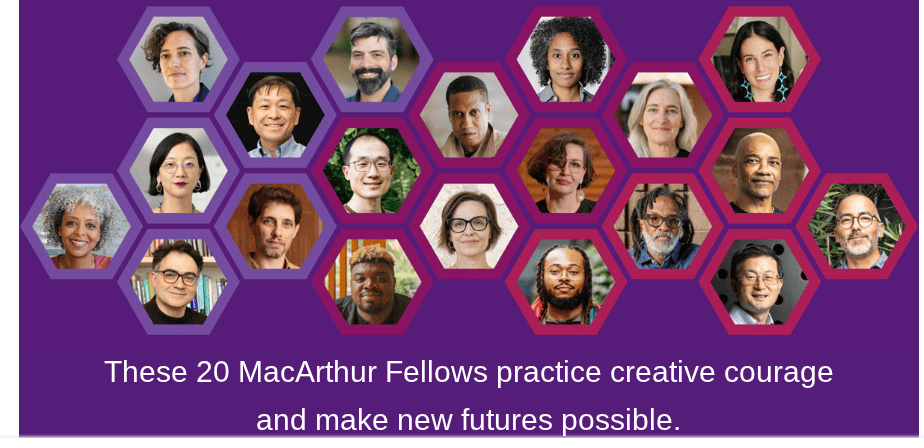
Here are the award rationales/categories for each Fellow for 2026, many of whom are celebrated across more than two disciplines/areas of study and expertise:

Artists, Musicians, & Performers

Christine Sun Kim – Sound and visual performance artist investigating spatial dynamics of Deaf culture and systemic sound hierarchies, Deaf culture and communication.

Immanuel Wilkins – (New York University): Jazz saxophonist and composer expanding contemporary jazz through culturally synthesized compositions. Celebrated for his acclaimed debut album, Omega.

Rodney McMillian – (University of California, Los Angeles): Sculpture professor and Multimedia artist creating texturally complex art interrogating lives outside traditional American dream myths.

Trajal Harrell – Choreographer and contemporary dancer bridging voguing, postmodern dance, and Butoh traditions.

Chip Thomas – Practicing physician and documentary photographer utilizing public art installations on the Navajo Nation.

Vincent Valdez – Contemporary artist and master printmaker creating large-scale socio-political figurative works exposing institutional racism, focusing on political and social commentary.

Writers & Poets

Maaza Mengiste – (Wesleyan University) A widely published fiction writer and English professor. Capturing deeply human dimensions of Ethiopian history, gender dynamics and conflict through transformative historical fiction. Novelist and essayist, best known for her 2020 Booker Prize-shortlisted book, The Shadow King.

Bryan Washington – Fiction writer and essayist exploring community, identity, and queer life. Portraying nuanced, intersectional stories of queer identity, community, and domestic life in urban centers with sharp emotional resonance.

Layli Long Soldier – Award-winning poet, writer and citizen of the Oglala Lakota Nation. Using innovative poetic structures and language to confront historical injustices, indigenous sovereignty, and the complexities of tribal treaties.

Scientists & Engineers

Song Lin – (Stanford University): Chemist using electrochemistry to construct durable, complex organic molecules for sustainable applications.

Vincenzo Vitelli – (University of Chicago): Theoretical physicist studying the bizarre behaviors of metamaterials and active matter. James Franck Institute professor mapping collective behaviors of metamaterials and biological systems.

Liangfang Zhang – (University of California, San Diego): Chemical and nano engineering chair pioneering biomimetic nanotechnology by coating synthetic nanoparticles with natural cellular membranes.

Kaiyu Guan – (University of Illinois): Eco-hydrologist using supercomputing, satellite observations and physics to optimize agricultural ecosystems and crop yields.

Marika Holland – (National Center for Atmospheric Research): Atmospheric scientist mapping long-term sea ice changes in polar regions, advancing global understanding of long-term polar sea ice changes and climate variability.

Humanities & Social Scientists

Ellora Derenoncourt –Labor economist and economic historian recognized for her quantitative research on the systemic, historical roots of racial wealth disparities in the United States researching the historical roots of racial wealth disparities. Assistant Professor of Economics and Faculty Director of the Program for Research on Inequality at Princeton University The foundation honored her for utilizing meticulous data collection and economic frameworks to uncover how historical policy choices continue to shape modern racial inequality. Her landmark research traces the evolution of the Black-white wealth gap from pre-Emancipation to the present day. She is highly recognized for mapping out how the design of federal minimum wage policies affected racial earnings convergence during the Civil Rights Era, as well as examining the northern backlash against the Great Migration and its subsequent impact on Black upward mobility.

Elizabeth Ellis – Associate Professor at Princeton University: Historian tracking Indigenous politics and diplomacy in early North America. Restructuring early American histories by analyzing how smaller Indigenous nations leveraged complex diplomacy and political networks to retain their sovereignty.

Felipe De Brigard – Philosopher and cognitive neuroscientist: Professor in the Department of Philosophy and the Department of Psychology and Neuroscience at Duke University. Pioneering work mapping how the human brain constructs memory and how it interacts with other complex cognitive processes. Bridges philosophy and science to analyze the neural and conceptual mechanisms behind moral judgment, imagination, regret and forgiveness, mapping memory construction and moral judgment.

Holly Jean Buck – Assistant Professor of Environment and Sustainability at the University of Buffalo, NY. Developing a compelling vision for equitable energy and climate transitions. Her research maps out how to implement large-scale climate interventions (like geoengineering and phasing out fossil fuels) while protecting rural communities, addressing social realities, and ensuring environmental justice. Sociologist evaluating rural innovation during climate and energy transitions.

Ariel Ron – History Professor at Southern Methodist University: Unearthing the systemic ties between 19th-century agricultural expansion and the broader rise of American industrial capitalism and economic policy, uncovering agriculture’s direct contributions to 19th-century economic developments.

Kate Spradley – Anthropology Professor at Texas State University: Forensic Anthropologist using skeletal data and biological markers to identify undocumented border crossers, mapping historic population migrations, and advocating for human rights in forensic identification.

You can view ALL 1197 recipients of this “Genius Grant” (all the Fellows): https://www.macfound.org/fellows/search/all and more information is here: https://www.macfound.org/programs/awards/fellows/

Unknown's avatar

#MacArthur Foundation’s 22 Newest Fellows, 2025: Physical #Scientists, Social Scientists, #Writers, #Artists, #Archaeologists, #Activists, #Poets, #Filmmakers, #Musicians, #Performers and #Historians

#MacArthur Foundation’s 22 Newest Fellows, 2025:
Physical #Scientists, Social Scientists, #Writers, #Artists, #Archaeologists, #Activists, #Poets, #Filmmakers, #Musicians, #Performers and #Historians

The 2025 MacArthur Fellows expand the boundaries of knowledge, artistry, and human understanding. They focus our attention on microbial worlds and distant stars, community vitality and timeless traditions, sacred and improvisational music, and shared histories of our time on Earth. With virtuosity, persistence, and courage, they chart new paths toward collaborative, creative, and flourishing futures.
Kristen Mack
Vice President, Communications, MacArthur Fellows, and Partnerships

“The MacArthur Fellowship is a $800,000, no-strings-attached award to extraordinarily talented and creative individuals as an investment in their potential….Since 1981, 1175 people have been named MacArthur Fellows….

“Nominees are brought to the Program’s attention through a constantly changing pool of invited external nominators chosen from as broad a range of fields and areas of interest as possible. They are encouraged to draw on their expertise, accomplishments, and breadth of experience to nominate the most creative people they know within their field and beyond….

“There are three criteria for selection of Fellows:

  • Exceptional creativity
  • Promise for important future advances based on a track record of significant accomplishments which could be enabled by our support
  • Potential for the Fellowship to facilitate subsequent creative work.”

“The MacArthur Fellows Program is intended to encourage people of outstanding talent to pursue their own creative, intellectual, and professional inclinations. In keeping with this purpose, the Foundation awards fellowships directly to individuals rather than through institutions. Recipients may be writers, scientists, artists, social scientists, humanists, teachers, entrepreneurs, or those in other fields, with or without institutional affiliations. They may use their fellowship to advance their expertise, engage in bold new work, or, if they wish, to change fields or alter the direction of their careers.”

“By providing these individuals with unfettered support in pursuit of creative activities and knowledge, the Fellows Program seeks to:

  • Highlight the importance of imaginative thinking in creating new works of art that inspire;
  • Spotlight the value of risk-taking in addressing deep-rooted societal problems;
  • Expand our understanding of creativity; and
  • Cultivate the next generation of innovators.”

“Although nominees are reviewed for their achievements, the fellowship is not a lifetime achievement award, but rather an investment in a person’s originality, insight, and potential. Indeed, the purpose of the MacArthur Fellows Program is to enable recipients to exercise their own creative instincts for the benefit of human society.

“The Foundation does not require or expect specific products or reports from MacArthur Fellows and does not evaluate recipients’ creativity during the term of the fellowship. The MacArthur Fellowship is a “no strings attached” award in support of people, not projects. Each fellowship comes with a stipend of $800,000 to the recipient, paid out in equal quarterly installments over five years….”

Meet the newest crop of very fortunate creative sorts, this year’s MacArthur Fellows, who will each receive $800,000/year spread over 5 years, to do WHATEVER THEY WANT!

For bios, specific info on each Fellow (photos, videos, websites, more), and plenty about the Program and the Foundation, check out their website: https://www.macfound.org/programs/awards/fellows/?utm_medium=email&utm_source=enews&utm_campaign=fellows-landing-10-25

Imagine: There are no outside or public applications or nominations. The process for selection is so secretive and unknown that very few people (no one outside the Foundation, supposedly) even knows who the nominating and selection committees’ members ARE each year!

In the Foundation’s favor, the Fellows process has been great on “diversity” and varying geographic locations for quite a while (still heavier on both coasts than within the USA, though). They also seem to make a great effort to vary the balance of seeming gender identities, professions, and types of creativity.

Again, LOVE this!

Here are the award rationales/categories for each Fellow for 2025, many of whom are celebrated across more than two disciplines/areas of study and expertise:

Ángel F. Adames Corraliza, Madison, Wisconsin, Atmospheric Scientist “Investigating the mechanisms underlying tropical weather patterns. Adames combines deep knowledge of the physics of atmospheric waves with keen analysis of observational data and climate model simulations. He sheds light on tropical atmospheric dynamics that influence global weather patterns and phenomena such as tropical cyclones and monsoons.”

Matt Black, Exeter, California, photographer: “Chronicling people and landscapes in marginalized communities across the United States. In distinctive black and white images, Black compels viewers to grapple with the prevalence of poverty in the United States and its impacts on daily life for many Americans….[Black also] shows the impact of sustained drought on the [Central Valley, CA] region’s migrant farmworkers.”

Garrett Bradley, New Orleans, Artist and Filmmaker: “Blending elements of documentary, narrative, and experimental cinema to explore questions of justice, public memory, and cultural visibility…..Through formal experimentation that pushes aesthetic conventions, Bradley harnesses the full potential of moving images to evoke feeling and render the textures of her subjects’ lives.”

Heather Christian, Beacon, New York, Composer, Lyricist, Playwright, and Vocalist: “Creating music theater performances that explore the possibility for the sacred and spiritual in our modern world. Christian’s musical sound reflects a panoply of influences—the jazz and blues of her Southern upbringing, Catholic and Baptist liturgical music, and European choral traditions—and her exceptional artistry with vocal arrangements and orchestration.”

Nabarun Dasgupta, Chapel Hill, North Carolina, Epidemiologist and Harm Reduction Advocate: “Creating practical programs to mitigate harms from drug use, particularly opioid overdose deaths. Dasgupta combines scientific studies with community engagement to improve the well-being and safety of people who use drugs and people living with debilitating pain.”

Kristina Douglass, New York, New York, Archaeologist: “Investigating how human societies and environments co-evolved and adapted to climate variability. Douglass’s research focuses on coastal communities in southwest Madagascar, a biodiversity hot spot that is particularly vulnerable to present-day climate change pressures.”

Kareem El-Badry, Pasadena, California, Astrophysicist: “investigating how stars form, evolve, and interact. El-Badry leverages astronomical datasets and theoretical modeling to investigate binary star systems, black holes, neutron stars, and other stellar bodies. His ability to extract insights from the enormous amounts of data gathered in space observation missions has led to many discoveries—from overlooked dormant black holes in our galaxy to new classes of stars and coupled systems.”

Jeremy Frey, Eddington, Maine, Artist: “Balancing tradition with innovation in technically precise and visually stunning woven artworks. Frey is descended from a long line of Wabanaki basket makers, and his art is imbued with the value systems, environmental stewardship, and history of traditional Wabanaki ash and sweetgrass basketry. Through experimentation with color, form, and materials, he forges a singular aesthetic that blurs the boundaries between craft, design, and contemporary art.”

Hahrie Han, Baltimore, Maryland, Political Scientist: “addressing critical questions about how and why people participate in civic and political life. Employing a range of ethnographic, sociological, experimental, and quantitative methods, she examines organizational structures and tactics that encourage individuals to interact across lines of difference and work together for change in the public sphere. Han combines the analytical rigor of political science with careful attention to the lived experiences of her subjects.”

Tonika Lewis Johnson, Chicago, Illinois, Photographer and Social Justice Artist: “Exposing the impacts of systematic disinvestment in urban communities. Johnson uses photography, maps, and multimedia storytelling to articulate the vast disparities in conditions, infrastructure, and investment between Chicago’s neighborhoods. At the same time, she creates pathways for residents to begin the process of restitution and repair.”

Ieva Jusionyte, Providence, Rhode Island, Cultural Anthropologist: “Exploring the political and moral ambiguities of border regions, where state policies regulate historically shifting distinctions between legal and illegal practices. Her ethnographic accounts are based on years of fieldwork and immersion among people whose occupations give them frontline vantage points on the ways border policies play out in the lives of individuals and communities. From these rarely observed perspectives, Jusionyte reveals how security mechanisms and cycles of violence perpetuate states of emergency and social fracture.”

Toby Kiers, Amsterdam, Netherlands, Evolutionary Biologist: “Investigating symbiotic partnerships between plants, fungi, and other microbes. She illuminates the evolutionary mechanisms underlying cooperation between species as well as the role of plant-microbe mutualisms in ecosystem health. Kiers’s research shows that microbes are not passive accessories to plants but powerful actors in their own right.”

Jason McLellan, Austin, Texas, Structural Biologist: “Investigating virus fusion proteins and developing new interventions to prevent infectious diseases. McLellan’s engineered viral proteins are critical to catalyzing vaccine design, particularly for infectious respiratory diseases.”

Tuan Andrew Nguyen, Ho Chi Minh City, Vietnam, Multidisciplinary Artist: “Giving aesthetic form to the enduring repercussions of violence and dispossession. He grounds his films and sculptures in the histories of communities grappling with intergenerational traumas of war and displacement, in places ranging from his native Vietnam to the Philippines, Senegal, Papua New Guinea, and the United States. Much of his work explores moving images and material objects as repositories of memory and the potential for storytelling to be an instrument of healing and resistance against colonial erasure.”

Tommy Orange, Oakland, California, Fiction Writer: “Capturing a diverse range of Native American experiences and lives in novels that traverse time, space, and narrative perspectives. Orange’s novels center his characters’ interior lives: their emotions, ideas, and realizations in moments of joy and pain. Through expansive casts of interconnected characters, he shows the many ways historical trauma and dislocation can rupture the fabric of everyday life. Orange’s hometown of Oakland, California, serves as the backdrop for his depictions of urban Native Americans grappling with identity, survival, and healing.”

Margaret Wickens Pearce, Rockland, Maine, Cartographer: “Creating maps that foreground Indigenous Peoples’ understanding of land and place. Pearce pushes the boundaries of cartography beyond two-dimensional depictions of static and defined spaces. She draws on a wide range of archival materials and long-term collaborations with Indigenous communities to resurface their history, knowledge, and presence throughout North America.”

Sébastien Philippe, Madison, Wisconsin, Nuclear Security Specialist: “Exposing past harms and potential future risks from building, testing, and storing launch-ready nuclear weapons. Philippe draws on archival research, data modelling, and his training as a nuclear safety engineer to clarify the extent of human and environmental damage from nuclear tests and the risks associated with nuclear weapon modernization policies. He builds multidisciplinary collaborations to make his research accessible and useful to affected communities and policymakers. “

Gala Porras-Kim, London, England, Los Angeles, California, Interdisciplinary Artist: “Proposing new ways to make visible the layered meanings and functions of cultural artifacts held in museums and institutional collections. With nuance, empathy, and, at times, playfulness, Porras-Kim probes the methods institutions use to classify, conserve, and interpret items in their collections. Her research-intensive practice focuses on objects and forms of knowledge that have been separated from their original contexts.”

Teresa Puthussery, Berkeley, California, Neurobiologist and Optometrist: “Exploring how neural circuits of the retina encode visual information for the primate brain. Her research into retinal ganglion cells is filling a long-standing gap in knowledge about the human visual system. It also has implications for treating retinal neurodegenerative diseases such as glaucoma and macular degeneration.”

Craig Taborn, Brooklyn, New York, Improvising Musician and Composer: “Creating singular soundscapes through a virtuosic command of piano and expansive knowledge of musical genres. In performances and recordings as a soloist, bandleader, and sideman, Taborn brings a fearless and sophisticated approach to music making. He draws from musical traditions as varied as traditional and contemporary jazz, contemporary classical, experimental, electronic, rock, metal, and hip-hop. His constant exploration of genre and style informs his own distinct musical intelligence and voice.”

William Tarpeh, Stanford, California, Chemical Engineer: “Developing sustainable and practical methods to recover valuable chemical resources from wastewater. Tarpeh’s research focuses on recycling nitrogen, sulfur, and phosphorus. His resource recovery technologies require minimal infrastructure and energy, and they offer opportunities for sustainably sourcing agricultural nutrients and industrial metals in a range of contexts.”

Lauren K. Williams, Cambridge, Massachusetts, Mathematician: “Elucidating unexpected connections between algebraic combinatorics and concepts in other areas of math and physics. Williams has made significant contributions to numerous mathematical fields, including cluster algebras, representation theory, and algebraic geometry. She has also forged cross-disciplinary collaborations to tackle long-standing and challenging problems in physics related to quantum field theory, particle physics, and wave propagation.”

You can view ALL 1175 recipients of this “Genius Grant” (all the Fellows): https://www.macfound.org/fellows/search/all

Unknown's avatar

#MacArthur Foundation’s 22 Newest Fellows, 2024: #Scientists, #Writers, #Artists, Policy Makers, #Sociologists, #Activists, #Poets, #Filmmakers, #Musicians, #Performers, #Dancers, #Choreographers and #Historians

#MacArthur Foundation’s 22 Newest Fellows, 2024:
#Scientists, #Writers, #Artists, Policy Makers, #Sociologists, #Activists, #Poets, #Filmmakers, #Musicians, #Performers, #Dancers, #Choreographers and #Historians

The 2024 MacArthur Fellows pursue rigorous inquiry with aspiration and purpose. They expose biases built into emerging technologies and social systems and fill critical gaps in the knowledge of cycles that sustain life on Earth. Their work highlights our shared humanity, centering the agency of disabled people, the humor and histories of Indigenous communities, the emotional lives of adolescents, and perspectives of rural Americans.
Marlies Carruth, Director, MacArthur Fellows

“The MacArthur Fellowship is a $800,000, no-strings-attached award to extraordinarily talented and creative individuals as an investment in their potential….Since 1981, 1153 people have been named MacArthur Fellows….

“Nominees are brought to the Program’s attention through a constantly changing pool of invited external nominators chosen from as broad a range of fields and areas of interest as possible. They are encouraged to draw on their expertise, accomplishments, and breadth of experience to nominate the most creative people they know within their field and beyond….

“The MacArthur Fellows Program is intended to encourage people of outstanding talent to pursue their own creative, intellectual, and professional inclinations. In keeping with this purpose, the Foundation awards fellowships directly to individuals rather than through institutions. Recipients may be writers, scientists, artists, social scientists, humanists, teachers, entrepreneurs, or those in other fields, with or without institutional affiliations. They may use their fellowship to advance their expertise, engage in bold new work, or, if they wish, to change fields or alter the direction of their careers.

“Although nominees are reviewed for their achievements, the fellowship is not a lifetime achievement award, but rather an investment in a person’s originality, insight, and potential. Indeed, the purpose of the MacArthur Fellows Program is to enable recipients to exercise their own creative instincts for the benefit of human society.

“The Foundation does not require or expect specific products or reports from MacArthur Fellows and does not evaluate recipients’ creativity during the term of the fellowship. The MacArthur Fellowship is a “no strings attached” award in support of people, not projects. Each fellowship comes with a stipend of $800,000 to the recipient, paid out in equal quarterly installments over five years….”

“There are three criteria for selection of Fellows:

  1. Exceptional creativity
  2. Promise for important future advances based on a track record of significant accomplishments
  3. Potential for the Fellowship to facilitate subsequent creative work.”

Meet the newest crop of very fortunate creative sorts, this year’s MacArthur Fellows, who will each receive $800,000/year spread over 5 years, to do WHATEVER THEY WANT!

For bios, specific info on each Fellow (photos, videos, websites, more), and plenty about the Program and the Foundation, check out their website: https://www.macfound.org/programs/awards/fellows/results?fellow_class=2024

Imagine: There are no outside or public applications or nominations. The process for selection is so secretive and unknown that very few people (no one outside the Foundation, supposedly) even knows who the nominating and selection committees’ members ARE each year!

In the Foundation’s favor, the Fellows process has been great on “diversity” and varying geographic locations for quite a while (still heavier on both coasts than within the USA, though). They also seem to make a great effort to vary the balance of seeming gender identities, professions, and types of creativity.

Again, LOVE this!

Here are the award rationales/categories for each Fellow for 2024:

Loka Ashwood, Lexington, KY, Sociologist: “Shedding light on rural identity and culture and on the ecological, economic, and social challenges facing many rural communities.”

Ruha Benjamin, Princeton, NJ, Transdisciplinary Scholar & Writer: “Illuminating how technology reflects and reproduces inequality and championing the role of imagination in social transformation.”

Justin Vivian Bond, New York, NY, Artist & Performer: “Working in the cabaret tradition and weaving cultural critique and an ethic of care into performances that center queer joy.”

Jericho Brown, Atlanta, GA, Poet: “Reflecting on contemporary culture and identity in works that combine formal experimentation and intense self-examination.”

Tony Cokes, Providence, RI, Media Artist: “Creating video works that recontextualize historical and cultural moments.”

Nicola Dell, New York, NY, Computer & Information Scientist: “Developing technology interventions to address the needs of overlooked populations, such as survivors of intimate partner violence.”

Johnny Gandelsman, New Paltz, NY, Violinist & Producer: “Reimagining classical works and nurturing the creation of new music across styles and genres.”

Sterlin Harjo, Tulsa, OK, Filmmaker: “Telling stories about the daily lives of contemporary Native Americans with humor and deep affection.”

Juan Felipe Herrera, Fresno, CA, Poet, Educator, Writer: “Uplifting Chicanx culture and amplifying shared experiences of solidarity and empowerment.”

Ling Ma, Chicago, IL, Fiction Writer: “Mixing speculative and realist modes of storytelling to throw into relief the surreal aspects of our contemporary condition.”

Jennifer L. Morgan, New York NY, Historian: “Deepening understanding of how the exploitation of enslaved women enabled the institutionalization of race-based slavery in early America and the Black Atlantic.”

Martha Muñoz, New Haven, CT, Evolutionary Biologist: “Investigating the motors and brakes of evolution.”

Shailaja Paik, Cincinnati, OH, Historian: “Exploring the intersection of caste, gender, and sexuality in modern India through the lives of Dalit women.”

Joseph Parker, Pasadena, CA, Evolutionary Biologist: “Uncovering the origins of symbiosis in rove beetles and the evolution of complex organismal traits.”

Ebony G. Patterson, Chicago, IL, & Kingston, Jamaica, Multimedia Artist: “Creating visually dazzling works that explore themes of visibility, beauty, race, class, violence, mourning, and regeneration.”

Shamel Pitts, Brooklyn, NY, Dancer & Choreographer: “Pioneering experimental performance works inspired by Afrofuturism while reimagining collective ways of world-building.”

Wendy Red Star, Portland, OR, Visual Artist: “Engaging with archival materials in works that challenge colonial historical narratives.”

Jason Reynolds, Washington, D.C., Children’s & Young Adult Writer: “Depicting the rich inner lives of kids of color and ensuring that they see themselves and their communities in literature.”

Dorothy Roberts, Philadelphia, PA, Legal Scholar & Public Policy Researcher: “Exposing racial inequities embedded in social service systems and uplifting the experiences of people caught up in them.”

Keivan Stassun, Nashville, TN, Science Educator & Astronomer: “Expanding opportunities in science, technology, engineering, and math (STEM) education and careers for underrepresented populations.”

Benjamin Van Mooy, Woods Hole, MA, Oceanographer: “Investigating how microbial organisms shape cycling of elements fundamental to life in marine environments.”

Alice Wong, San Francisco, CA, Writer, Educator & Disability Rights Advocate: “Increasing the political and cultural visibility of people with disabilities and catalyzing broader understandings of disability.”

You can view ALL 1153 recipients of this “Genius Grant” (all the Fellows): https://www.macfound.org/fellows/search/all