
#MacArthur Foundation’s 20 Newest Fellows, 2026:
#Artists, #Musicians, & #Performers; #Writers & #Poets; #Scientists & #Engineers; and, #Humanities & #Social Scientists
“For 45 years, MacArthur Fellows have defied boundaries, by questioning conventions, crossing disciplines, and driving collective progress….The 2026 fellows continue that creative tradition — they explore the depths of our humanity; they reveal untold origins to modern challenges; they expand the edge of scientific inquiry and life-saving research. They show us new ways to understand the world.”
Kristen Mack
Vice-President, Communications, MacArthur Fellows, and Partnerships
“The MacArthur Fellowship is a $800,000, no-strings-attached award to extraordinarily talented and creative individuals as an investment in their potential….Since 1981, 1197 people have been named MacArthur Fellows….
“Nominees are brought to the Program’s attention through a constantly changing pool of invited external nominators chosen from as broad a range of fields and areas of interest as possible. They are encouraged to draw on their expertise, accomplishments, and breadth of experience to nominate the most creative people they know within their field and beyond….
“There are three criteria for selection of Fellows:
- Exceptional creativity
- Promise for important future advances based on a track record of significant accomplishments which could be enabled by our support
- Potential for the Fellowship to facilitate subsequent creative work.”
“The MacArthur Fellows Program is intended to encourage people of outstanding talent to pursue their own creative, intellectual, and professional inclinations. In keeping with this purpose, the Foundation awards fellowships directly to individuals rather than through institutions. Recipients may be writers, scientists, artists, social scientists, humanists, teachers, entrepreneurs, or those in other fields, with or without institutional affiliations. They may use their fellowship to advance their expertise, engage in bold new work, or, if they wish, to change fields or alter the direction of their careers.”
“By providing these individuals with unfettered support in pursuit of creative activities and knowledge, the Fellows Program seeks to:
- Highlight the importance of imaginative thinking in creating new works of art that inspire;
- Spotlight the value of risk-taking in addressing deep-rooted societal problems;
- Expand our understanding of creativity; and
- Cultivate the next generation of innovators.”
“Although nominees are reviewed for their achievements, the fellowship is not a lifetime achievement award, but rather an investment in a person’s originality, insight, and potential. Indeed, the purpose of the MacArthur Fellows Program is to enable recipients to exercise their own creative instincts for the benefit of human society.
“The Foundation does not require or expect specific products or reports from MacArthur Fellows and does not evaluate recipients’ creativity during the term of the fellowship. The MacArthur Fellowship is a “no strings attached” award in support of people, not projects. Each fellowship comes with a stipend of $800,000 to the recipient, paid out in equal quarterly installments over five years….”
Meet the newest crop of very fortunate creative sorts, this year’s MacArthur Fellows, who will each receive $800,000/year spread over 5 years, to do WHATEVER THEY WANT!
For bios, specific info on each Fellow (photos, videos, websites, more), and plenty about the Program and the Foundation, check out their website: https://www.macfound.org/programs/awards/
Imagine: There are no outside or public applications or nominations. The process for selection is so secretive and unknown that very few people (no one outside the Foundation, supposedly) even knows who the nominating and selection committees’ members ARE each year!
In the Foundation’s favor, the Fellows process has been great on “diversity” and varying geographic locations for quite a while (still heavier on both coasts than within the USA, though). They also seem to make a great effort to vary the balance of seeming gender identities, professions, and types of creativity.
Again, LOVE this!
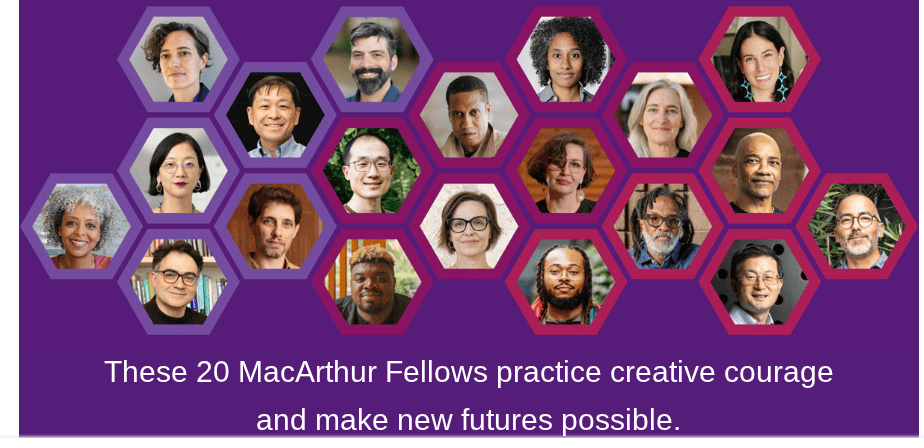
Here are the award rationales/categories for each Fellow for 2026, many of whom are celebrated across more than two disciplines/areas of study and expertise:
Artists, Musicians, & Performers

Christine Sun Kim – Sound and visual performance artist investigating spatial dynamics of Deaf culture and systemic sound hierarchies, Deaf culture and communication.

Immanuel Wilkins – (New York University): Jazz saxophonist and composer expanding contemporary jazz through culturally synthesized compositions. Celebrated for his acclaimed debut album, Omega.

Rodney McMillian – (University of California, Los Angeles): Sculpture professor and Multimedia artist creating texturally complex art interrogating lives outside traditional American dream myths.

Trajal Harrell – Choreographer and contemporary dancer bridging voguing, postmodern dance, and Butoh traditions.

Chip Thomas – Practicing physician and documentary photographer utilizing public art installations on the Navajo Nation.

Vincent Valdez – Contemporary artist and master printmaker creating large-scale socio-political figurative works exposing institutional racism, focusing on political and social commentary.
Writers & Poets

Maaza Mengiste – (Wesleyan University) A widely published fiction writer and English professor. Capturing deeply human dimensions of Ethiopian history, gender dynamics and conflict through transformative historical fiction. Novelist and essayist, best known for her 2020 Booker Prize-shortlisted book, The Shadow King.

Bryan Washington – Fiction writer and essayist exploring community, identity, and queer life. Portraying nuanced, intersectional stories of queer identity, community, and domestic life in urban centers with sharp emotional resonance.

Layli Long Soldier – Award-winning poet, writer and citizen of the Oglala Lakota Nation. Using innovative poetic structures and language to confront historical injustices, indigenous sovereignty, and the complexities of tribal treaties.
Scientists & Engineers

Song Lin – (Stanford University): Chemist using electrochemistry to construct durable, complex organic molecules for sustainable applications.

Vincenzo Vitelli – (University of Chicago): Theoretical physicist studying the bizarre behaviors of metamaterials and active matter. James Franck Institute professor mapping collective behaviors of metamaterials and biological systems.

Liangfang Zhang – (University of California, San Diego): Chemical and nano engineering chair pioneering biomimetic nanotechnology by coating synthetic nanoparticles with natural cellular membranes.

Kaiyu Guan – (University of Illinois): Eco-hydrologist using supercomputing, satellite observations and physics to optimize agricultural ecosystems and crop yields.

Marika Holland – (National Center for Atmospheric Research): Atmospheric scientist mapping long-term sea ice changes in polar regions, advancing global understanding of long-term polar sea ice changes and climate variability.
Humanities & Social Scientists

Ellora Derenoncourt –Labor economist and economic historian recognized for her quantitative research on the systemic, historical roots of racial wealth disparities in the United States researching the historical roots of racial wealth disparities. Assistant Professor of Economics and Faculty Director of the Program for Research on Inequality at Princeton University The foundation honored her for utilizing meticulous data collection and economic frameworks to uncover how historical policy choices continue to shape modern racial inequality. Her landmark research traces the evolution of the Black-white wealth gap from pre-Emancipation to the present day. She is highly recognized for mapping out how the design of federal minimum wage policies affected racial earnings convergence during the Civil Rights Era, as well as examining the northern backlash against the Great Migration and its subsequent impact on Black upward mobility.

Elizabeth Ellis – Associate Professor at Princeton University: Historian tracking Indigenous politics and diplomacy in early North America. Restructuring early American histories by analyzing how smaller Indigenous nations leveraged complex diplomacy and political networks to retain their sovereignty.

Felipe De Brigard – Philosopher and cognitive neuroscientist: Professor in the Department of Philosophy and the Department of Psychology and Neuroscience at Duke University. Pioneering work mapping how the human brain constructs memory and how it interacts with other complex cognitive processes. Bridges philosophy and science to analyze the neural and conceptual mechanisms behind moral judgment, imagination, regret and forgiveness, mapping memory construction and moral judgment.

Holly Jean Buck – Assistant Professor of Environment and Sustainability at the University of Buffalo, NY. Developing a compelling vision for equitable energy and climate transitions. Her research maps out how to implement large-scale climate interventions (like geoengineering and phasing out fossil fuels) while protecting rural communities, addressing social realities, and ensuring environmental justice. Sociologist evaluating rural innovation during climate and energy transitions.

Ariel Ron – History Professor at Southern Methodist University: Unearthing the systemic ties between 19th-century agricultural expansion and the broader rise of American industrial capitalism and economic policy, uncovering agriculture’s direct contributions to 19th-century economic developments.

Kate Spradley – Anthropology Professor at Texas State University: Forensic Anthropologist using skeletal data and biological markers to identify undocumented border crossers, mapping historic population migrations, and advocating for human rights in forensic identification.
You can view ALL 1197 recipients of this “Genius Grant” (all the Fellows): https://www.macfound.org/fellows/search/all and more information is here: https://www.macfound.org/programs/awards/fellows/





 Jesmyn Ward
 Masha Gessen; Photo: © Tanya Sazansky
 Frank Bidart; Photo from Sigrid Estrada





You must be logged in to post a comment.