I don’t usually blog on Sundays, except for reblogs, so GET READY for International Women’s Day this Sunday, March 8, and do something #feminist!

I don’t usually blog on Sundays, except for reblogs, so GET READY for International Women’s Day this Sunday, March 8, and do something #feminist!

The Truth about Corporal Punishment #Children/ #Parents /#Caregivers: It does not work. Stop doing it. http://wp.me/p1DWDm-Zt via @garyullah
On upworthy.com today, a website which claims to engage about 50 million people a month, I came across the first infographic (below) that I know of that summarises the scientific evidence against spanking (corporal punishment) as an effective parenting technique . This is great. The truth about spanking continues to spread. Research suggests that the vast majority of parents still believe in spanking, but mostly only because they think there is no alternative. This is perhaps one of the most harmful and tragic beliefs of our time. The still widely accepted wisdom in regard to child rearing hasn’t yet caught up with the science. Most parents are still parenting as if spanking benefits children when the reality is that it harms them, now and later on in life.
The best hope for greatly reducing violence against children is the general acceptance of the reality that spanking is harmful and wrong, as this will lead to the…
View original post 32 more words

Thanks for posting. Answers a lot of my questions.

Welcome to the first in a series of walk-throughs that will show you how to set up a MailChimp account, set up templates and lists, and send out a MailChimp newsletter. You can start to set up your subscriber list in MailChimp 2 and create a sign-up form in MailChimp 3 …
MailChimp is a web-based service which allows you to send out newsletters to a list of people who have signed up to receive them. There are other services out there, but MailChimp is very popular, often recommended to newbies and is free as long as you have under 2,000 subscribers and send out fewer than 12,000 emails per month. You can upgrade in order to get extra features and also if your list goes over the 2,000 mark. Please note right here and now that I’m not being sponsored by MailChimp for doing these posts…
View original post 777 more words

WRITING AND PROMOTING A SERIES:
by series authors, Nicholas C. Rossis, Pearseus series, and
Charles Yallowitz, Legends of Windemere series
Guest bloggers and former guests on CHANGES conversations between authors
(Episodes 7 and 9), http://www.sallyember.com

PEARSEUS: VIGIL NOW AVAILABLE ON AMAZON
This joint post was made possible by the invitation of Sally Ember, who has been gracious enough to allow us to speak on her blog. She has done this knowing that Mr. Rossis and Mr. Yallowitz have a history of crazy antics. Indeed, some of these antics occurred on Sally’s very own LIVE video show *CHANGES* conversations between authors, which you can find online. Thank you to Sally Ember and we hope everyone enjoys this post on writing a series.
Check out Nicholas’s newest release, Pearseus: Vigil, by clicking on the above cover art and
prepare for a March/April debut of Charles’s next book, Legends of Windemere: Sleeper of the Wildwood Fugue.
Charles: First, I would like to say that I’m happy to be working with Nicholas again and on a post this time. Our back and forth on our blogs is a lot of fun and he has a very sharp, creative mind that keeps me on my toes. This carries over into his writing, which impressively spans several genres.
Nicholas: Same goes for me. I’m very impressed by Charles, both as an author and as a person. Plus, it’s great to have someone who gets my weird sense of humor!
What is the hardest part about promoting a series?
Charles: It’s really easy at the beginning because you can play around with teasers and you only have one book out. Then you get the second and try to find ways to promote without revealing everything in the first book. Around the third book, if you go higher than a trilogy, you get caught between avoiding big revelations in the earlier books and spoilers for the next one. It’s a really hectic balancing act because you don’t want to say too much. Yet, you have to say enough to keep people interested and lead to them to the rest of the series.
I’ve found that you have to make sacrifices in this, for example, revealing a minor spoiler to promote the next book while keeping the big stuff secret. A teaser helps, too, because it isn’t so much a spoiler, but a hint that something is going to happen or a foreshadowed event is coming to pass. Oddly enough, I found that Twitter is the less nerve-wracking social media site to promote a series on because the 140-character limit means you can’t say much and it’s hard to tiptoe around spoilers like that; you have to stick to catchy blurbs or small quotes from the book.

CLICK FOR AMAZON SITE
Cover Art by Jason Pedersen
Nicholas: I agree with Charles that Twitter is a great promotional medium for a series, as my marketing relies on a short quote and a link.
One of the best things about having a series is that you can have a different book on sale each month and it will help the others’ sales as well. However, unlike Charles, I have also made a book bundle available. This contains all the books published so far in Pearseus. Obviously, when this is on sale, no one buys the rest of the books. However, it does attract a lot of attention as it offers great value for money. So, it’s all a bit of a balancing act.
How difficult is it to maintain continuity in a series and what tricks do you use to accomplish this?
Charles: I once switched one of my main character’s eye colors and a minor recurring character lost his hair. So some of the details can be messed up if one isn’t careful. Perhaps the biggest challenge to story continuity is that you can forget some foreshadowing or you do something that alters a previously established rule. Middle books can also have events that change the finale because what you plan in your head might not always be what comes out on paper. It really is a game of memory and concentration or like putting together a 5,000-piece puzzle with no picture to guide you.
There are two tricks that I use. One is that I keep notes on a lot of things that I believe I will forget. For example, I had some minor characters who step into the spotlight in a later book and I never gave them much description in their first appearances. There was just enough that they stood out and I had to make sure I had those identifiers written down. The other trick is never to be afraid to look back at your earlier books to confirm information. If you have even an inkling that you’re off on a fact, then jump back to the book where you know the information has already been written. This helps with plot lines, character descriptions, world-building and anything else that carries over from book to book.
Nicholas: LOL—I love the idea of “a 5,000-piece puzzle with no picture to guide you.” Indeed, it can feel that way at times.
I have a .doc file that includes all sorts of minor details, from names to subplots. Also, when I write, I always have my older books open as well. That way, I’m instantly able to jump back and forth and check things out. For example, a lot of the action takes place in a place called the “Chamber of Justice.” Every now and again, I’ll catch myself typing “Chambers of Justice” (plural) instead, so I have to remember it’s actually singular. I have no idea why some days it feels self-evident it’s singular and others that it’s plural, but that’s just how it is.

Pearseus Bundle on Amazon
Do you have any suggestions for readers who wish to get into reading a long series?
Charles: I’m a fan of starting from the beginning, but I know many who start at the most recent book. If you do this, then I highly suggest that you read the earlier books at some point for more context and to see events that don’t get mentioned again. Also, one must be patient with a series because the story is stretched out and every book will have an opening. Also, not everything gets cleared up at the end of the earlier books. That understanding helps a reader accept that questions will remain. The only other tip I have is that you have to trust that the author knows what he or she is doing. I see a lot of readers try to demand that certain events happen in a story, but those desires might not fall in line with what the author has planned.
Nicholas: This is a typical “patience is a virtue” situation. Writing a series is a serious responsibility. Reading a series is an investment of both time and money, so we have to make sure that each and every book not only meets the readers’ expectations, but exceeds them. We owe them as much. That is why I’m grateful to all my readers, but those who have invested in Pearseus hold a special place in my heart.
There are several things we can do to make it easier on the reader, of course. For example, all my Pearseus books have a map with the cities and places that have been revealed so far, plus any new ones. Also, I have a character list at the beginning (and in “X-ray,” if reading on a Kindle), with a two-sentence description of who that person is. Another good idea is to offer a quick reminder each time a minor character first appears. For example, you can say something along the lines of:
“Parad walked into the room. He spotted Angel, his daughter, and smiled.”
This helps people who may have forgotten who Angel is.
Yet another trick I use is to give names to as few people as possible. For example, a minor character may be safely referred to by their property or occupation. Readers don’t need to know the name of every healer that tends a hero’s wounds or every blacksmith that sharpens his weapons.
Finally, the best thing to do is to make sure each book can stand on its own. That means no cliffhangers and no obscure references—at least not without a reminder.
Sadly, this is not always possible. Mad Water, the third book in the series, ends on a cliffhanger because the subplots raised there are not resolved for another 400 pages. So I could either have an 800-page-long book or two 400-page ones, the first of which ends on a cliffhanger.
Obviously, I chose the latter, which brings me back to readers’ patience. 🙂

CLICK FOR AMAZON SITE
Cover Art by Jason Pedersen
Charles Yallowitz‘s Information

Blog: www.legendsofwindemere.com
Twitter: https://twitter.com/cyallowitz
Facebook:https://www.facebook.com/CharlesYallowitz
Amazon Author Page: http://www.amazon.com/Charles-E-Yallowitz/e/B00AX1MSQA/
Website: www.charleseyallowitz.com
Jason Pedersen, Legends of Windemere‘s Cover Artist: http://www.jasonpedersen.com/
Nicholas Rossis‘ Information

Blog:http://nicholasrossis.me/ .
Amazon Author Page: http://www.amazon.com/Nicholas-C.-Rossis/e/B00FXXIBZA/
Goodreads: Pearseus: Schism can be read for free on Goodreads.
Twitter: www.twitter.com/Nicholas_Rossis
Google+: https://plus.google.com/+NicholasRossis
Facebook: www.facebook.com/NicholasCRossis
Sally Ember, Ed.D., is the author of the sci-fi/romance/utopian ebooks in The Spanners Series. Volume I, This Changes Everything, is permafree. Volume II, This Changes My Family and My Life Forever, is usually $3.99. Look for Volumes III and IV in 2015.
All reviews, info, excerpts, links: http://www.sallyember.com/Spanners

MG LGBTQIA2S authors, take note! Submission opportunity, here!
 If you write MG and have a diverse background, including (but not limited to) LGBTQIA, people of color, gender diversity, people with disabilities, and ethnic, cultural, and religious minorities, you may be interested in submitting a short story to We Need Diverse Books. They are putting together an anthology of children’s literature to be published in January 2107.
Phoebe Yeh, VP/Publisher of Crown Books for Young Readers/Random House, has acquired publication rights to this Middle Grade WNDB Anthology, working title “Stories For All Of Us.”
The anthology will be in memory of Walter Dean Myers and it will be inspired by his quote: “Once I began to read, I began to exist.” Every new story contribution to this anthology will be by a diverse author.
WNDB is proud to announce that the anthology will have one story reserved for a previously unpublished diverse author. WNDB will fill that slot via…
View original post 283 more words

The little-known Jewish history of the Vulcan greeting. We already miss you, http://widdershinsfirst.com/2015/02/27/bon-voyage-leonard-nimoy/

http://goo.gl/ulUNMe
Want to read more books about #TimeTravel and discuss it with #authors? Join us for Episode 23 of *CHANGES* and participate with me and Lorrie Farrelly ! Wed., March 4, LIVE, 10 – 11 EST USA on G+ https://plus.google.com/u/0/events/clf7dlkpim0p4dg1qe40ag0jpe0 or Youtube, http://www.youtube.com/watch?v=eiSOPuxVHXc any time. Find Lorrie here: https://sites.google.com/site/yourbestreads or on Facebook: https://www.facebook.com/LorrieFarrellyAuthor .
~posted by Dave H.
One of the most enduring concepts in science fiction is that of time travel and its consequences. From Ray Bradbury’s famous short story “A Sound of Thunder” to the BACK TO THE FUTURE films and beyond, time travel has remained a core idea in the science fiction genre. The concept itself dates back even before the creation of the genre: both Charles Dickens (A CHRISTMAS CAROL) and Mark Twain (A CONNETICUT YANKEE IN KING ARTHUR’S COURT) used it in their work. However, most science fiction fans date the first full use of the idea to H.G. Wells’ famous novel THE TIME MACHINE. Published in 1895, Wells’ novel follows an unnamed time traveler into the far future where he discovers a human race that has diverged into two different species: the peaceful, childlike Eloi and the brutish, light-fearing Morlocks. Originally meant as a commentary on class…
View original post 353 more words

still have to follow all state and federal tax laws, but go for it: Amazon now hosts givewaways!
 No purchase necessary. See official rules: http://amzn.to/GArules
Now you can give away free physical products, like printed books, directly from Amazon.com.
Amazon hosts the contest:
How does it work?
View original post 526 more words

#Read about Guest #Author, ME, Sally Ember, Ed.D., via Chris Graham’s “The Story Reading Ape”‘s blog. Thanks, Chris! Visit, comment, argue, share. http://thestoryreadingapeblog.com/2015/02/27/read-about-guest-author-sally-ember-ed-d/

 I have been passionate about writing since I was nine years old, when I wrote and published my first story, a fairy tale about an inquisitive princess (see? I started out autobiographical). Always competitive, I’m absurdly proud that I won prizes for my poetry, stories, songs and plays early in life. Did I use up my creativity good karma too soon?
I was born Jewish on the cusp of Leo and Virgo, which seems to mean that my life has been infused with change. Currently, I meditate, write, swim, read and host my LIVE, almost-weekly Google+ Hangout On Air (HOA) *CHANGES* conversations between authors, Wednesdays, 10 – 11 AM EST USA, in St. Louis, Missouri. I have one older brother and two younger sisters (none lives in St. Louis but we’re in close contact) and I used to have seven step-sisters and two step-brothers (we’re not in touch).
I began…
View original post 1,027 more words

#Bookpirating info especially regarding print copies printed and sold on #eBay
Something’s got me seriously confused. I saw a post about getting your books taken down from some pirate sites, so as a matter of interest I googled mine again, and found that not only has African Me been loaded on to heaps more torrent sites for free or paid download, but that now Shadow People has joined the pirate party as well. The thing that’s got me wondering is that they’re both being offered on ebay too as paper books. I stopped looking after four different sellers there. (Click on pics to see them bigger)

At first I thought it could be a reader selling them second hand, but when I had a proper squiz I saw that they’re being offered as brand new/unopened. The sellers have multiple copies too – ten each mostly in stock, and they’re selling them for less than what Amazon’s charging for them.

I looked…
View original post 514 more words

If you pay or might pay for #book ads, read this first! #marketing
 by meowmeowmeow21.deviantart.com
I’m sure you remember my step-by-step tutorial on how to advertise with Amazon. Three weeks later, I have some preliminary results, which, as promised, I’m sharing with you, so that you can learn from my mistakes.
In a nutshell: I’ve failed. The experiment has so far been a disappointment, albeit one offering fascinating insights.
You may remember that I had done my math and knew that, to make any profit, I had to bid under the proposed $0.50.
Now, for a peek behind the scenes: whenever Amazon is about to show a product page, a small bidding war will rage for a few nanoseconds. Amazon will check to see if that product is linked to any ads. If more than one ads want to be displayed, they will bid for that space, until they reach their cut-off threshold. So, if I have specified 5c as my maximum, then an ad…
View original post 1,257 more words

What did YOU have? Were you wearing “hippie” clothes last century (or still wearing them)? I had: tassels with tiny bells that jingled hanging from the bow I made with the drawstring tie of my Indian-print skirts; little mirrors on the bodices of my “Peasant” blouses; and, fringe (painstakingly created by hand-removing the weft threads from about 1″ of the cuff on each leg) hanging from the cut-off cuffs of every pair of dungaree shorts and long pants. Some of my jeans had studs but I wasn’t into those or lace.

#Canadian #debut #authors #contest

Best part of an excellent essay (loved the part about the “Radium Girls,” too; excellent analogy): “My bigger concern is that, when we package sociopathy as ‘romance’? Sadists as Alpha male heroes? That is a confusing message (and a dangerous one) for everyone, but most especially for those still forming opinions and identities. In fact, I probably would have had NO problem with FSoG had it been in the genre of psychological thriller or horror. But slap ‘ROMANCE’ on it? Whole ‘notha’ ballgame.”
I DID read ALL three 50 Shades books when they came out, just to see what all the fuss was about. It was as if I were watching a train wreck and could not look away. So, I know whereof I speak; I did review these pieces of junk: bad writing, ridiculous and insulting (to both males and females) characters, horrible plotting (what little there is of it), terrible underlying and overt messages.
Read Kristen’s post. She’s insightful and accurate.
 Image via Flikr Creative Commons, via Mikko Luntiala
We had a very lively and interesting debate over the 50 Shades cultural “phenomena” on Friday. I’m deeply grateful for all those commenters who posted such thoughtful opinions, even those who didn’t agree with me. I actually am not afraid of people disagreeing with me and I have zero interest in my blog simply being an ideological echo chamber.
Yet, there are a few things I’ve “heard” in the comments or even on Facebook which leave me flummoxed and I believe these assertions call for a closer examination.
It’s ONLY a Story. It is FICTION. JUST a FANTASY.
 Image via Flickr Creative Commons, courtesy of Mike Licht
One argument that baffled me was this idea that 50 Shades is just a book and only fantasy. I do not begrudge James her success nor am I lambasting anyone who likes the books. To…
View original post 2,052 more words

Grammar geeks unite! Write on!

Pros and Cons of #Writers’ Critique Groups
Reposting from one year ago, since it’s all still true and useful and I have new Followers/Readers
Everyone know the biggest drawback to #self-publishing is the isolation. Yes, every #author who doesn’t collaborate in their #writing writes alone. However, prior to the explosion in self-publishing, most books and ebooks that came to readers went through several other sets of eyes and had several editing and revision drafts done by others that helped polish and tighten the writing prior to publication.

image from vidyasury.com
Today more than ever before, pieces of writing from short stories, blogs and articles to full-length books, both nonfiction and fiction, are getting all the way to a reader with no other editor than the writer. This is not a great situation for most readers or writers.
Because many writers seek professional companionship and critiques as well as audiences for drafts and new ideas, writers’ groups have sprung up for many centuries, both formal and informal. These groups usually meet regularly. Size can vary from a pair to a large group of a dozen or more.
The activities in the group can include public readings and/or sharing of written material with participants’ immediate oral comments, pages returned with mark-ups and discussions of the shared pieces. Locations can vary and many are not available free, so some groups charge a fee or require members to pay dues to cover costs and perhaps invite a speaker/presenter to conduct a workshop or give a talk on occasion.

image from http://www.audreypress.com
Writers’ groups often appoint or hire a facilitator to guide and contribute to the critique. In better-run groups, this leader also keeps time and makes sure the comments are constructive and fair.
However, some groups are not well-run. The ground rules are not clear. Time is not equally distributed because it isn’t tracked well. Comments are not always fair and constructive. The facilitator dominates the discussion. Discussions veer away from the writing into personal stories and tangents introduced by participants. Suggestions are made that are not conducive to the writer’s intent, restrictions, topic, genre or format.
The diverse types of knowledge and experience among participants and in a leader of a writers’ group can be rich sources of varied perspectives OR generate too many irrelevant and unhelpful comments.
Pros and Cons of #Writers’ Critique Groups
CONS: An unskilled or distracted facilitator
— allows too many destructive comments to occur and this encourages more of the same
— allows the exposed author to experience immediate hurt feelings or bewilderment
— allows the writers to leave the critique session discouraged and confused by conflicting advice and too many off-topic remarks
— offers too many comments and dominates the discussion, shutting down, arguing with or interrupting other participants.
Writers in poorly-run groups can be led astray, which can causes them to depart from writing in their own voices and to lose sight of their personal or professional writing purposes. Many writers get discouraged or even “blocked” by attending poorly run writers’ groups.
BEWARE! Better to be isolated than to attend a group that operates negatively.

image from thewildwriters.com
PROS: An skilled or focused facilitator
— leads a well-run group peopled by dedicated, experienced writers as well as “newbies” who each feels comfortable sharing and contributing
— trains and supports members to utilize the time effectively for receiving and offering constructive critiques, with newbies learning from old-timers the most effective methods for delivering and receiving criticism
— can foster an atmosphere of professional support that provides many gems of advice and new points of view for each member, even ones who don’t share in every meeting.
These productive sessions are wonderful catalysts for the writers who share drafts and any who attend. Authors in well-run writers’ groups return from each meeting with new vigor for editing, revising and creating new content.
Tips for Writers’ Groups:
1) Productive critique sessions are NOT riddled with “we loved it,” “it’s great,” and “keep going” with little or nothing else.
Critics must provide reasons for their opinions, especially when they’re positive, so that writers learn what we do well and can replicate our successes.
Critics must also defend their opinions that tell a writer to make changes by offering suggestions for revision or reasons for the ways the writing doesn’t “work” for the reader/listener.
2) Without the prompting of a skilled, focused leader, opinions may be offered with insufficient or no reasons given. Offering positive or negative opinions without rationales is not useful to a writer and should not be allowed.
3) Focus, clear ground rules (e.g., the requirement to give reasons for opinions, taking turns, sharing time equally) and giving both emotional and cognitive responses to a piece of writing are all parts of a productive writers’ group.
4) If YOUR writers’ group is not productive and positive enough, make an effort to change it or leave it. Start your own or join a different group.
5) Networking has never been easier. http://www.Meetup.com is a source of in-person writers’ groups. You can also check your local library’s, college’s, county’s/parish’s, state’s/province’s and country’s organizational listings for professional writers’ groups in your geographic area or genre. Check Facebook, LinkedIn, Google, and many writers’ associations and genre-centered groups online and around the world for possible writers’ groups, critique opportunities and other networking options. Some groups are now meeting online and virtually via SKYPE, iCHAT, Google Hangouts, etc.

If you are a writer seeking a group, I hope you find or start a great one!
Best of luck in your writing.

YA, MG and mixed genre writers who write for youth: you have 1 month to prepare and submit your book for the 2015 #Paterson Prize.
Did you have a book for Young People published in 2014? You have until March 15, 2015 to submit your book for consideration for The Paterson Prize For Books For Young People. Scroll down to see last years winning books. The ones I viewed were not poetry books, just in case you thought that due to it being sponsored by the Poetry Center.
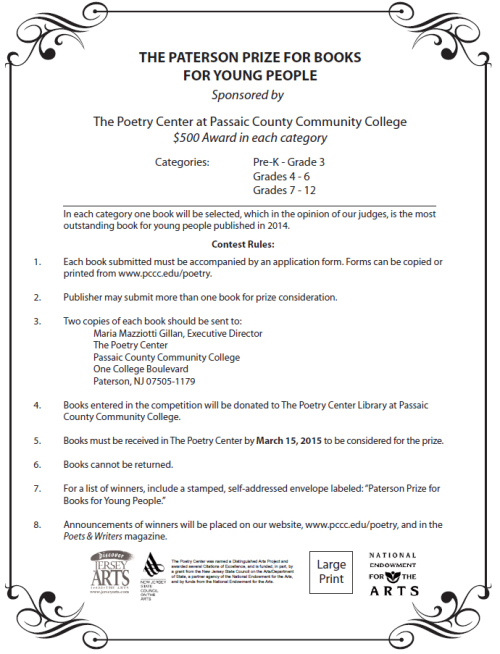 Here are the winners from last year.
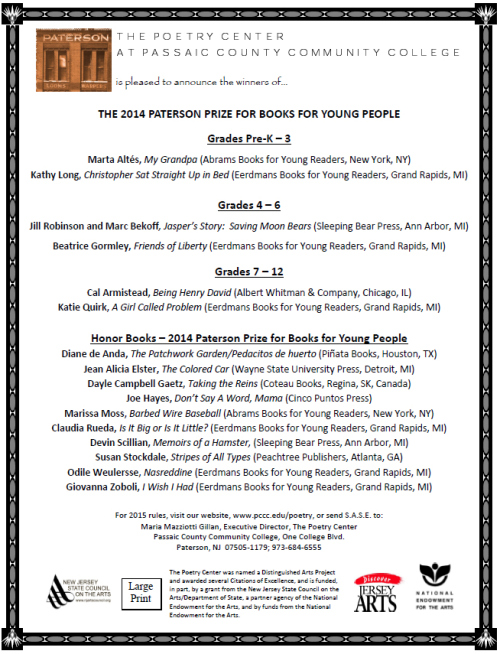 Click Here for Application.
Talk tomorrow,
Kathy

One of the pioneer writers in the then-fledgling Young Adult genre is having a birthday. Thanks, Judy Blume, for so many great books for children and teens which adults also love.
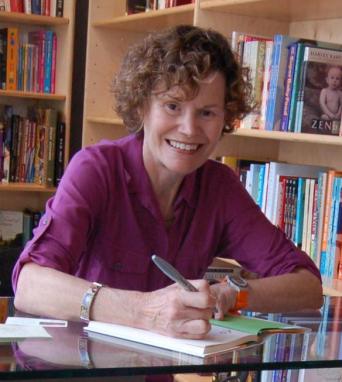 If you are a female human over the age of twelve, and you’ve never read Judy Blume’s Are You There God? It’s Me, Margaret, then you must look outside right now and see if in fact you are living under a rock.
When I was a kid, I loved the school days when we got those magazines (which were more like four page flyers) where we could select books to purchase. (Weren’t those Weekly Readers or Scholastic Magazines?) I also loved when the public library’s bookmobile would come to school or when school would have a book fair. Okay, the truth is, because I went to Christian school, a lot of what we got to read was censored and had to be on “an approved Christian reading list,” so I missed out on a lot of my friends’ favorites such as Are You There God? It’s Me, Margaret. …
View original post 253 more words

Excellent post and great recommendations/inspiration to GO MORE #GREEN, especially in financial choices. I just joined a Credit Union: where do YOU #bank? Also, Inger (the post’s author) was my very engaging and LIVE guest on Episode 20 of *CHANGES*, which you can watch any time: https://www.youtube.com/playlist?list=PLPbfKicwk4dFdeVSAY1tfhtjaEY_clmfq
#Authors, especially those in sci-fi/speculative fiction and who blog, learn more about and get yourself on *CHANGES*, and #Readers, recommend an #author to be scheduled as a guest: *CHANGES* G+ HOA https://sallyember.com/changes-videocasts-by-sally-ember-ed-d/

Great to-list for #marketing your #book, especially for #indies.

I didn’t know about this: International Book Giving Day is this weekend! Buy a book and give it away!
International Book Giving Day is THIS WEEKEND! A whole day dedicated to giving books to children…what could be better?
If you are new to IBGD you can find out more here. You can also download beautifully designed bookmarks and bookplates to tuck into the books you donate. Find them here.

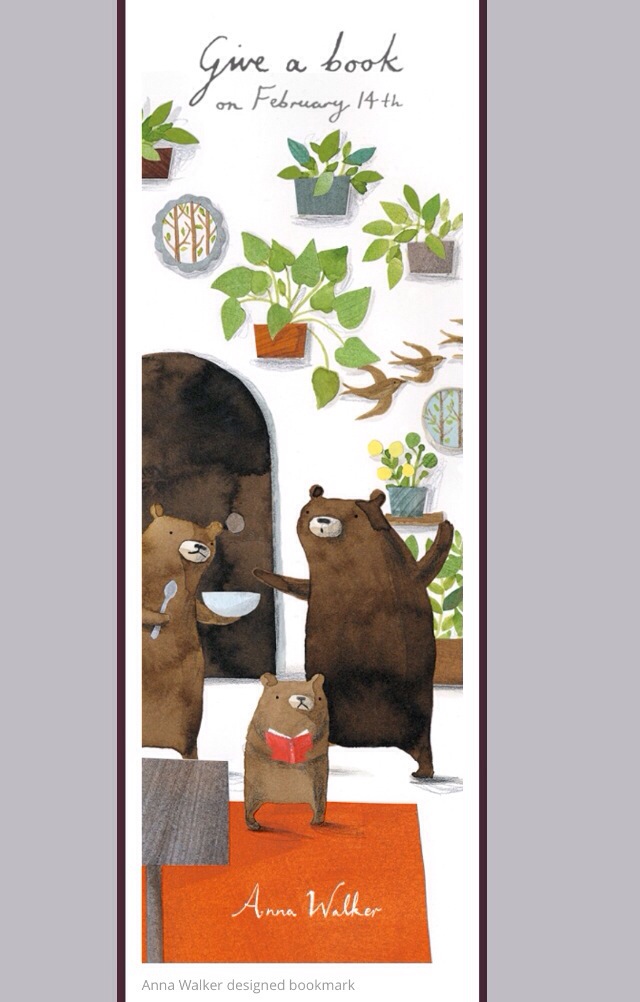
It was IBGD 2013 that inspired the first Rainbow Library. The Rainbow Library has expanded and developed in the last two years and for IBGD this year I will be concentrating on my new partnership with HomestartUK. They are a charity helping families with young children deal with whatever life throws at them. They provide one to one support for parents through their volunteer scheme. This is hands-on support right at the most crucial time in children’s development. I really believe in Home-Start and the difference they make to children’s lives.
Before Christmas I donated a big…
View original post 328 more words

In a post filled with lines calling out our the unmediated #sexism and #objectification of women in our culture, and, in particular, “‘Sports’ Illustrated,” for its ongoing #misogyny, I want to savor and quote, this is my favorite:
“So instead of angering what it perceives to be its base, arguably the nation’s most prominent sports magazine pauses once a year to print up a jerk rag and promote it as some kind of sacred tradition.”Brava and thanks for writing, considering so thoughtfully and well, and posting. MORE of this! You are hereby invited to guest blog on MY site ANY Wednesday (Wednesday is my guest slot day).
best to you,
Sister Feminist,
Sally
Apparently we’re all supposed to celebrate the fact that an average-sized woman will appear in this year’s Sports Illustrated swimsuit edition.
I’m told it’s some kind of triumph that, of the many women pointlessly objectified on the pages of a magazine that’s supposed to be about sports, one will be somewhat heavier than all the others. Sexism is so deeply woven into the fabric of sports in America that this, incredibly, is meant to represent progress.
Never mind that this year’s cover model, in addition to being exactly the size you’d expect her to be, is also waxed to within an inch of her life. Never mind that only average-sized model in the magazine appears not as part of an editorial layout but in an ad. Never mind that both women appear to have been liberally airbrushed, unless you believe neither of their bodies has a single stray hair, birthmark…
View original post 761 more words

@Quantumphysics 101 Excellent!
There is no field in modern science that is misunderstood or misinterpreted more than any other. Two reasons should be mentioned: First, quantum physics deals with the microscopic world, atoms and subatomic particles; it is a world inaccessible to our direct perceptions, to human experience as such. And as much as we like to but our logic and commonsense which are derived from shared human experiences cannot be extended to the realm of atomic phenomena. Even the physicist cannot imagine what an atom looks like. The second reason that has led to much misinterpretation is the desperation of modern man to find meaning, excitement, mystery and surreal phenomena to compensate for the lack of essence in his/her life. Thus, the field is open to people like Deepak Chopra who are the kind to take advantage of the mystery and stick exotic words such as quantum next to whatever it is…
View original post 2,182 more words

Excellent #tips, #advice, #resources and #recommendations. Thanks, Chris McMullen! Best to you! #bloggers #blogging

I first began blogging actively on WordPress in December, 2012.
Only a little over 2 years, and my blog has reached 100,000 views and nearly 4,000 followers. My blog averages over 400 views per day presently, and the viewing frequency steadily accelerates.
If I can do it, you can, too. I believe it.
It’s not rocket science. (Just ignore the fact that I have a Ph.D. in physics. I didn’t use any physics to make my blog.)
In fact, I’m sharing my blogging ‘secrets’ today to help you do the same.
It’s not just me. I meet many other WordPress bloggers with many more views and followers than I have.
If you’re not there yet, don’t worry. You can get there, too.
I’ve created multiple blogs and webpages with WordPress, BlogSpot, GoDaddy, etc. By far my most successful blog or webpage is this WordPress blog. We’re fortunate that…
View original post 4,619 more words

PART FIVE in this excellent series by Susan Toy on The Story Reading Ape’s blog. Thanks, Chris Graham, for posting!

The following is an extract from a talk delivered at the Calgary Public Library in Feb. 2011.
Part 5
Another area of promotion you should consider developing – and only do this if you are comfortable with it – is speaking engagements. Speaking engagements are something your publisher will not arrange for you, unless they are approached directly by a group inviting you to speak. Make sure you are either allowed to sell books or that a bookseller has been asked to look after sales wherever you appear.
Here’s another important statistic I gleaned from reading Get Known Before the Book Deal: Authors who speak at events sell three times as many books. (This book is listed in the bibliography at the end of this post.)
You can give a straight reading from your book, but my preference is to hear an author talk about how…
View original post 1,150 more words

I wish ALL book bloggers were more like Carrie!
Although I honestly had no idea this whole controversy existed until a year or so ago, apparently posting one star reviews is a little controversial in the book blogging community. Some bloggers believe that posting one star reviews is part of an honest and open reviewing process. Others believe one star reviews are a waste of their time or invite unwanted negativity and possibly author attacks. It really varies blogger-to-blogger.
As my regular readers know, I do post one star reviews. Sometimes I’ve posted 0.5 star reviews. Why do I read books I clearly don’t like? Well, like any sane human being I pick up a book because it’s interesting and I think I’ll like it. Sometimes the promise of the blurb and the other reviews encourage me to do so only to disappoint me. When I start a book I don’t like to not finish it. This is in…
View original post 254 more words

And, PART FOUR from Susan Toy, here, for #authors about #marketing. Great series.
The following is an extract from a talk delivered at the Calgary Public Library in Feb. 2011.
Part 4
Okay, now you’ve completed the further editing, the proofs have been approved, and it’s just a matter of waiting for the printer to produce and ship your book. So, what’s been happening at the publishing house all this time? The main thing they’ve been up to is preparing for, and holding, sales conferences for their sales reps. A catalogue page for your book should have been completed and posted online. Be sure to link to this page on your own blogsite, and direct anyone to it who asks about your book. The reps have been told about you, and they have discussed how they can best sell your book to booksellers, libraries, wholesalers and specialty markets. Some of them may have even read the manuscript. If at all…
View original post 1,776 more words

If you are new to or not clear on #ebook #formatting and other structural issues in #self-#publishing, go back and start from the beginning of this great series! Great for all #indie #authors or potential ones!

I had no idea olive oil was being diluted/compromised. Read and share!

That is not to say that it is not natural, or is made from chemicals, but 70% of the “olive oil” on the market — that is marketed as pure olive oil — is not actually pure olive oil. How can this be? This is because olive oil counterfeiters have gotten so good at faking olive oil that most of the professional tasters cannot tell the difference between the real stuff and fake olive oil.
“Fake” olive oil still contains a good portion of “real” olive oil, but is cut with low grade oils from other plants to reduce the cost of the oil. Though the manufacturers save money on creating the oil, they often still sell it as high grade olive oil and for a higher price. This practice has become so prominent in countries…
View original post 416 more words

Thanks so much, Jnana, for featuring me today! I am sharing this widely. Best to you and all the new and continuing followers who join us today and after today. Will love to see responses!
Sally

I am hereby and for an undetermined length of time giving low credence to most book reviews, awards, contests and other honors conferred upon books/authors.
Why? I know some of the awardees’ writing. Many are undeserving of any accolades.
“Grade Inflation”—the widespread awards and the exalting of effort—are ruining writing and writers.

image from http://www.wrkcapital.com
Why does anyone reward mediocrity and worse? How many “open mikes” have you attended in which EVERYONE, no matter how badly they perform or how horribly they read aloud or recite poetry, gets wild applause or even a standing ovation? Does the audience believe that everyone deserves the same response regardless of the quality of their presentation?
I do not.
How does it help any author/artist grow when no one is honest with them about the areas they need to improve and all they hear are overly exuberant praises? Neither are we helping authors or keeping faith with readers when so many provide undeserved 5-star “reviews” for shoddy writing. We are helping our writers and performers when we honestly and with specificity critique their work.
We are not doing our children any favors to give everyone who participates a “winner” ribbon, unless everyone understands that showing up and participation are what get awarded. However, I contend that, for professionals, the industry should not be labeling greatness on effort alone.
Grading on effort makes greatness lose all significance and confuses us all. When everyone “wins,” no one does. For evaluations and competitions to matter, the creation being evaluated of any top-ranking writer or other artist must be excellent by objective standards to have earned that award.
When all are given “A”s, or 5 Stars, or First Place, the rankings become meaningless. Participants can’t begin to discern their actual place among their peers or the value of their work in the world when reviewers and judges do not provide accurate, meaningful, thoughtful critiques and feedback, in the form of awards to the deserving.

image from http://cutemonster.com
At the end of a sports event, such as a foot race or team game, the winners and losers are indisputable. Those that swim are racing each other and the clock, which are immutably obvious regarding who swam the fastest for that race and for all recorded events of that type.
Art assessments should not merely be based on the creator’s intention or your affection for the creator.
Exceptions: if the artist is a child or disabled in some way, then that participation alone is sufficient to earn an award. Obstacles that participant has already overcome just to be involved in that competition or performance do deserve to be honored. THOSE types of contests, in which “everyone wins,” I wholeheartedly honor, e.g., the Special Olympics.
BTW: I strongly believe in and promote cooperative games, the postponement of competition, and an “everybody wins” concept for most activities for children and youth. I wish more youth sports and other harshly competitive games would be permanently removed from options so that everyone could play, learn and grow without that pressure.
This post is not to remove those cooperative and noncompetitive games or friendly, networking-type of awards passed around for fun and support. We all need encouragement.
However, when the competition is on a supposedly “level playing field” (more or less: let’s not get into gender, socio-economic class, age, racial and ethnic biases that unfairly prejudice judging and preclude fairness; that’s another subject), I strenuously object to fairly set competitors’ receiving awards, praises, great reviews or any other merit when the subject of the assessment is insufficiently unscrutinized.
I know some awards are merely a matter of “taste” or “current trends,” and that what anyone “likes” is always subjective.
Fine. Let those competitions be labeled clearly as having someone’s personal preferences, not accepted standards of excellence, as the main criteria for winning.
I’m talking about competitions that adults, professionals, and mostly, writers enter that supposedly have criteria that winners have to meet or exceed, in which the “best” is supposed to be honored the most. I wish that all of these competitions would be judged by obvious and agreed-upon standards of excellence and not determine winners based on effort, affection or popularity, or worse, payment of entry fees.
Also, I’m not talking about what people “like.” I’m asking for awards based on what is excellent, as objectively measured as possible.
Maybe it’s easier to talk about what is NOT excellent. I believe these components, below, are not purely subjective measures and therefore can be evaluated fairly and “blindly.”
FYI: For professional writers, grammar matters. Spelling counts. Syntax is significant. Context is not everything.

image from http://the-modern-housewife.blogspot.com
Here are my “what not to award” components for all types of fiction, whatever length.
[NOTE: I do not believe these need any explanations, but comment here or wherever you see this or email me if you are not sure what I mean, below.]
The next time I hear a writer “won” an award, I hope s/he deserved it. I really do.
In case you need a reminder of what quality is and how deserving some authors are…
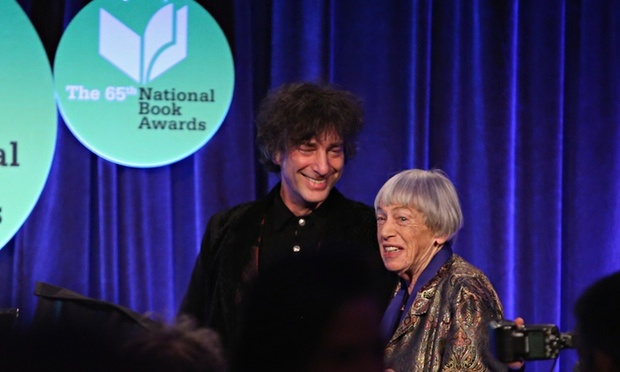
Ursula K. Le Guin and Neil Gaiman at the National Book Awards, 2014, in New York.
image from http://www.theguardian.com Photograph: Robin Marchant/Getty
P.S. I find Gaiman unreadable (personal preference) and adore Le Guin, but I recognize the similar greatness in their writing.

Awesome evidence of the effects #meditation has on our health.

Long overdue. Hope it happens. We should NOT be pandering to China, one of the worst human rights violators in modern society.

Excellent news for Kagyu and other #Buddhist nuns in the #Tibetan tradition. Trashi delek (best of auspicious wishes) to them all and t’huk te je (Thanks) to His Holiness the 17th Karmapa, Gyalwang.

Thanks for posting! I shared!
…there are musicians whose talented gifts surpass JONGGR… in these modern days where we quill-scrapers hear so much about ‘writing in the proper JONGGR,‘ p’raps a wee lesson is to be had listening to these exponents in another field of the artistic arts… if yeez play, sing, write, or perform wonderfully at whatever yeez do, to hell with the JONGGR, I say… Yehudi Menuhin and Stephane Grappelli graced the WURLD with their expertise with their different styles of violin playing… but whomever yeez listened to of the pair, they were outstanding…


 …listen first to this clip, where the two were thrown together for the first time… magical… and the distinctive ‘Voices’ of each of their playing comes triumphantly to the ear…
…now, enjoy Master Menuhin’s talent…
…and compare that of Master Grappelli…
…back in the day, when the rock and roll, beat, and hippy-hippy-shake tsunamis were bouncing…
View original post 73 more words

“#KDP Select #authors can place an advertisement and, in addition to any benefits of the ad itself, receive valuable sales information regarding their books.” Check it out! Thanks, Chris!
 Image from ShutterStock.
Don’t you wish that you could see how many people are viewing your book’s product page at Amazon?
Then you’d be able to see how good your blurb and Look Inside are at closing the deal, or how well a promotion is working.
Well, now you can get tracking data at Amazon.
Amazon marketing services is now available for books enrolled in KDP Select.
For as little as a $100 budget and bids of 2 cents, you can advertise your book on Amazon.
Visit your Bookshelf and click the link under the KDP Select column called Promote and Advertise.
When I did created an advertisement this morning, I received an approval email that said:
This will show how many impressions are made all…
View original post 793 more words

Newbie #authors: Take notes, memorize and be ready for the TEST!
Merry morn to you all! Although, it’s probably not morning where you are. And maybe not so merry. But it will be merry with all these lovely advice videos I handpicked just for you!
Without further ado, the first one is called The Top 5 Mistakes Amateur Writers Make
This one is a crazy length (about an hour and a half) but just pretend you’re at a college lecture – Writing Tips And Advice From Lovecraft Ezine Editor Mike Davis
This one is from a friend of the ‘vlogbrothers’, who are two professional writers who also make videos. It’s called Dare To Suck
This one is called Writing for Magazines: Top Tips by Freelance Writer Linda Formichelli and Editor Laura Pepper Wu
This is from the same channel, called: What a literary agent wants! With Rachelle Gardner

Excellent analysis and insights, here. Share!
I have several relatives and friends who deal with this disease in varying degrees as well as others who have chronic illnesses; many of us have “invisible” physical limitations and other “differences.”
I like this part of your post the best:
“…I don’t think what Townsend did is all that ‘brave’ — it’s just reality. She’s just telling it like it is. This is her reality, this is who she is, and that’s that. We can either accept it or reject it – and we’d be better to accept it.
“And really, this goes for any number of things – people in wheelchairs, people with cognitive disabilities, older people – anyone and everyone. Making snap judgments usually does no one any favors.”

Thanks, EJ! Visited, emailed C.E. Kilgore with my sci-fi/romance The Spanners Series’ two titles and my info right away! Great site! #sfrStation and #scifirom
Sci-fi/romance (SFR) is a bit of a red-headed step-child. Some romance readers turn up their noses at all the “unrealistic” elements of SFR. Some sci-fi purists turn up their noses at the “mushy” romantic elements. But for me, SFR is home. It’s what I want to read. When I read “straight” romance, I’m dreaming of FTL-travel and dystopian societies. When I read “straight” sci-fi, I miss the romantic tension and hope of a happy ending. The blend of science-fiction and romance feels right to me, and always has, even before I knew it was a “genre.”
Feel the same way? There’s a site for that.
 SFR Station is a great new resource for sci-fi readers and authors. A member of the Science Fiction Romance Brigade has undertaken the herculean task of creating a new library for readers who can find authors writing in the genre, including recent releases, free offerings…
View original post 118 more words

New series about #marketing for #authors: check it out!

Sharing books, author voices, and news from the University of Washington Press
Where Adventure, Lifestyle, and Food Come Together
It's a beautiful day in the neighborhood.
Every Second Thursday | 5-8pm
A novelist with a passion for reading and traveling shares his view of the world and his adventures.
Rejuvenate, relax and revitalize with holistic healing.
Information & Analysis on Global Mass Transit Industry
Stories to warm the furry heart and soul
Local Burien News and Stories that support Human Flourishing and Balanced Community Conversations. Topics include Education, Government, Sports, Lifestyle and Community Perspectives.
Updates from King County's School-based Partnerships Program
Community News For All of Seattle's Capitol Hill
News that connects you
An interdisciplinary research project on cities and the night.
Manhattan's little, quieter island and beyond
Smile Always
#Evola #Traditionalism #Metaphysics #Initiation #Esotericism #JuliusEvola #SpiritualHierarchy #Transcendence


 Sally Ember, Ed.D.
You must be logged in to post a comment.