Unknown's avatar

What I got from The Schrödinger Sessions II: Physics for Science-Fiction Writers, Second Installment

What I got from The Schrödinger Sessions II: Physics for Science-Fiction Writers, Second Installment
JULY 28, 2016 to JULY 30, 2016

jqi-logo
http://jqi.umd.edu/Schrodinger-sessions-II

I have over thirty pages of notes and comments. Not going to put them all in one post, so here is the second installment. Look for others starting August 8, 2016: http://www.sallyember.com/blog

For any terms or concepts I don’t define or which I define poorly, please refer to: http://www.physicsoftheuniverse.com/glossary.html

I don’t have any more than what I’m posting, here. Physicists: please add, comment, correct, elaborate, explain! Thanks!

NOTE: the superscripted and subscripted numbers and letters won’t copy/paste correctly here; sorry.


Session III, Chad Orzel, Ph.D.

A. What is “waving”?
pilot wave: the guiding particle of a group of particles

B. wave-particle duality
[BOOK: Leonard Susskind & Art Friedman, Quantum Mechanics]

C. superposition: prior to measurement/observation of any kind, objects (particles or whatever) can be in multiple states/locations simultaneously (the famous dead/alive cat in the box)

D. for probability, square the wavefunction to add waves in the double-slit experiment

E. Heinsenberg’s Uncertainty Principle: we can’t know both where we are and how fast we’re moving simultaneously

FORMULA: [‑ ħ2/2m∆2+V]ψ = iħ∂/∂t*ψ

the part before the = sign is the energy of the particle
the trident ψ is psi, which represents the wavefunction, the fundamental object in QM (Quantum Mechanics)
the italicized “i” is the square root of -1, an imaginary number
the part after the second ħ represents change over time
* shows multiplication happens between these two portions
/ shows a fraction (division) line

F. epistemic statements are about our knowledge of a system that necessarily are actual

G. ontological statements are about real physical objects changing over time, and many use the humorous ψ-ontologists, “psi-ontologists,” or “ontic” thinking as that description

H. duality occurs when we attempt to get something to “behave” as both a particle and a wave simultaneously

I. there is a 100% probability that a particle is in a particuar position at any given time until it is observed/measured

J. wavepacket add two waves together (differing wavelengths) and beats are created. Square these, like the square of a sine wave, to get the complex conjugate, or curve formula

K. Heisenberg’s Uncertainty Principle

FORMULA: ∆x*∆p ≥ ħ/2

x is the position
p is the momentum (both of these can never be zero)
is delta, or change
ħ is always h/2π (because all physicists are inherently lazy and don’t want to write the same thing multiple times if they can use a shortcut)

L. physicists like to use closed systems, educated guesses and thought experiments rather than actually accept paradoxes and the unknown

Session IV Professor Steve Rolston, Ph.D.

A. Welcher Weg = “which way,” in German
if, in principle, I know which way the particle went, there is no interference

encoded via spin within atoms

B. quantum eraser changing the observation or measurement “afterwards”

C. wavefunction collapse all probabilities disappear upon being measured/observed, because the object (wave/particle) now has a known/fixed position

D. polarization light has both vertical and horizontal oscillation, so polarizing eliminates one or the other. This allows for 3-D glasses, sunglasses and other glare-reduction lenses to work by blocking one set, or vector, of waves with a lens

E. Decoherence theory: collapse occurs through interaction with a larger system (an observer, the environment, the “measurement”)

F. measuring device is anything that interacts with the outside world for that object

G. there is “no need to introduce consciousness” to have an observer

H. “entanglement is continuously destroyed”

I. quantum Bayesian(sp?) (Qubism)

J. The “many worlds” perspective / theory originated with Hugh Evert in 1957, but it was Dr. Bryce Seligman DeWitt, Ph.D., who said: “Everything is always everywhere,” and Richard Bach, among others, who said “Everything that can happen is happening now.”

K. measurement just generates correlations (entanglement)

L. In The Spanners Series (my sci-fi/romance series) timulters allow parallel worlds’ objects/people to communicate with one another

M. “the wavefunction is a mathematical description of humans’ knowledge of nature, not of a physical entity.”

N. theories are not “laws” and most cannot become “laws”

Session V Professor Alan McDowell, Ph.D.

A. measurement is quantification

B. feedback leads to an altered strategy based on the results of measurement

C. radiometry is an “absolute” source

D. blackbody: a kiln/oven with a uniform temperature and 1 opening generates temperature then leads to radiance

E. physicists need to get out more; they are hard up for entertainment (they like to play with rotating polarized lenses)

F. 0 and 1 box game, with three columns and three rows of possible positions, in which the columns must add up to “even” numbers and the rows must add up to “odd” numbers, doesn’t work: the final box can never be filled in correctly

G. low efficiency yields small subsets, not large enough to be a scientific sample

H. random number generators are important for many functions


See below for more information about The Schrödinger Sessions.

Who was in charge?
Coordinators:
Chad Orzel, Union College
Emily Edwards, JQI
Steve Rolston, JQI

Organizing Institutions
Joint Quantum Institute (JQI)
National Institute of Standards and Technology (NIST)

Sponsoring Institutions
This workshop was made possible by a Public Outreach and Informing the Public grant from the American Physical Society (APS) and support from the National Science Foundation (NSF)

Location
Joint Quantum Institute
2136 Physical Sciences Complex
University of Maryland
College Park, MD 20742
USA

How did I get to go?
I applied in March and was accepted in April!

The Schrödinger Sessions II was the second of two (first was 2015) three-day (2.5 days, really) sets of seminars, Physics for Science-Fiction Writers, offering a “crash course” in modern physics for non-scientists who utilize physics and other sciences in our work and wish to do it better. It was held at the Joint Quantum Institute (JQI), one of the world’s leading research centers for the study of quantum mechanics. [The organizers kept their promises to] introduce participants to phenomena like superposition, entanglement, and quantum information through a series of lectures by JQI and NIST scientists and tours of JQI laboratories. [They most certainly DID] inform and inspire new stories [and sharing information, like this] in print, on screen, and in electronic media, that will in turn inspire a broad audience to learn more about the weird and fascinating science of quantum physics and the transformative technologies it enables.

The workshop was held at JQI from Thursday, July 28 through Saturday, July 30, 2016. Participants were housed locally at a university dorm with breakfast offered at a dining commons near the dorm and lunch provided at the workshop, which was at the Physical Sciences building. Evenings were free to allow participants to explore the Washington, D.C. area (but I was much too tired at each day’s end to do any exploring).

Participants were selected on the basis of an application asking about personal background, interest, and publication history. [Organizers worked] work to ensure the greatest possible diversity of race and gender as well as type of media (print, television, etc.) with an eye toward reaching the broadest audience. Applications were accepted online from March 1 through March 20, 2015, and acceptance decisions were made around April 15, 2015.

FYI: Next year, 2017, JQI plans to offer a similar seminar for a different professoinal group, Physics for Journalists, and then, pending funding, re-offer this same session as I attended, Physics for Sci-Fi Writers, in the summer of 2018.

Watch this space for more of my notes, reactions and ideas catalyzed by these great seminars, after 8/8/16! http://www.sallyember.com/blog

Unknown's avatar

What I got from The Schrödinger Sessions II: Physics for Science -Fiction Writers, First Installment

What I got from The Schrödinger Sessions II: Physics for Science-Fiction Writers, First Installment
JULY 28, 2016 to JULY 30, 2016

jqi-logo
http://jqi.umd.edu/Schrodinger-sessions-II

I have over thirty pages of notes and comments. Not going to put them all in one post, so here is the first installment.

For any terms or concepts I don’t define or which I define poorly, please refer to: http://www.physicsoftheuniverse.com/glossary.html

I don’t have any more than what I’m posting, here. Physicists: please add, comment, correct, elaborate, explain! Thanks!

NOTE: the superscripted and subscripted numbers and letters won’t copy/paste correctly here; sorry.


Session I, Professor Steve Rolston, Ph.D.

A. Measuring diameter by diffraction
the smaller the diameter of the hair, the greater the distance from the hair to each point of diffraction, and therefore, light is a wave

B. electrons eject from light and become collectible as charged particles when light bounces off a hard (metallic) surface, becoming photoelectric or photovoltaic

light color shows the frequency, so “yes” = blue”; “no” = red

materials also cause variations in the number of electrons emitted, so light is particles/ photons (corpuscles, in old language)

C. frequency = the inverse of wavelength

Planck’s constant is usually written as “h,” but if the reference/formula already includes h/2π, then the “h” represents that and gets a diagonal bar across its stem, “ħ” and is called “h bar

FORMULA: 6.626 * 10-34 m2 kg/s = h
(VERY SMALL number)

this refers to frequency at varying temperatures

E. a micron = 1 millionth of a meter; a human hair is about 30 – 80 microns in width

F. Lasers are usually emitting a single color of light at 10K watts, brightly focused
an incandescent light bulb is emitting about 100 watts and many colors, so this is called incoherent light

G. photons could be interacting but physicists can’t measure, observe or predict any of their interactions (yet), so physicists say that photons “do not interact”

Session II, Professor Chad Orzel, Ph.D.

A. http://dogphysics.com = his website
he handed out diffraction slides (grading)

B. Energy per photon depends on frequency

FORMULA: E*photon = hv

C. Particles have wave nature (atoms, molecules, photons, electrons, neutrons, positrons)

D. Excited gases are heated or electrified to move more quickly

E. every element emits and absorbs light uniquely, which is one way to identify them, even when they are isotopes (missing one or more electrons, and therefore “charged ions”)

F. there is a simple mathematical pattern to all light on the known spectrum (each color makes discrete “lines”)

G. Rutherford effect: scattering/deflecting pattern, “back-scattering,” occurs when using “alpha” particles, e.g., heavy atomic particles
light atomic particles, e.g., nucleus of Helium, do not have this

H. Use the Planck constant to explain energy differences between frequencies of light

FORMULA: hf = E1 – E2

I. mass (m) * velocity (v) = linear momentum

J. angular momentum = spinning or orbiting

FORMULA: MeVeR = n * h/2π

R = orbit; n = an integer; M = mass

K. electrons emit X-rays

L. wavelength, from de Broglie, λ = an object and this formula shows how to calculate its angular momentum

FORMULA: λ = h/p

M. Electron waves = the way electrons wrap around the atom’s orbital pattern

N. Standing waves = peaks and valleys of or a bit that is repeated and fixed, from start = finish
if number of peaks are high enough, then these can create a pattern

O. stringed instruments’ pitch is created by the frequency of standing waves, and are adjusted by changing the start or finish point (loosening or tightening one end of the string’s attachment pin)

P. electrons as particles behave as waves when there are high enough numbers create a pattern

Q. random numbers can be generated/derived from background radiation, which are the decay patterns of the atomic isotopes

R. molecules behave like waves, as do all other particles, even those without mass
electrons, protons and neutrons have mass
photons have no mass and always move at the speed of light (c)

S. Stanford University has an interferomoter

T. bigger objects have smaller wavelengths (a dog running has wavelengths to its running pattern of about 10-35

U. wavelength graphs become blobs because peaks of waves are touching on the paper/surface we use to show them

V. everything physical vibrates/oscillates

W. even when separated by ½ a meter , very large atoms resume wave behavior when reunited (there is no permanent divorce possible within an atom’s parts)


See below for more information about The Schrödinger Sessions.

Who was in charge?
Coordinators:
Chad Orzel, Union College
Emily Edwards, JQI
Steve Rolston, JQI

Organizing Institutions
Joint Quantum Institute (JQI)
National Institute of Standards and Technology (NIST)

Sponsoring Institutions
This workshop was made possible by a Public Outreach and Informing the Public grant from the American Physical Society (APS) and support from the National Science Foundation (NSF)

Location
Joint Quantum Institute
2136 Physical Sciences Complex
University of Maryland
College Park, MD 20742
USA

How did I get to go?
I applied in March and was accepted in April!

The Schrödinger Sessions II was the second of two (first was 2015) three-day (2.5 days, really) sets of seminars, Physics for Science-Fiction Writers, offering a “crash course” in modern physics for non-scientists who utilize physics and other sciences in our work and wish to do it better. It was held at the Joint Quantum Institute (JQI), one of the world’s leading research centers for the study of quantum mechanics. [The organizers kept their promises to] introduce participants to phenomena like superposition, entanglement, and quantum information through a series of lectures by JQI and NIST scientists and tours of JQI laboratories. [They most certainly DID] inform and inspire new stories [and sharing information, like this] in print, on screen, and in electronic media, that will in turn inspire a broad audience to learn more about the weird and fascinating science of quantum physics and the transformative technologies it enables.

The workshop was held at JQI from Thursday, July 28 through Saturday, July 30, 2016. Participants were housed locally at a university dorm with breakfast offered at a dining commons near the dorm and lunch provided at the workshop, which was at the Physical Sciences building. Evenings were free to allow participants to explore the Washington, D.C. area (but I was much too tired at each day’s end to do any exploring).

Participants were selected on the basis of an application asking about personal background, interest, and publication history. [Organizers worked] work to ensure the greatest possible diversity of race and gender as well as type of media (print, television, etc.) with an eye toward reaching the broadest audience. Applications were accepted online from March 1 through March 20, 2015, and acceptance decisions were made around April 15, 2015.

FYI: Next year, 2017, JQI plans to offer a similar seminar for a different professoinal group, Physics for Journalists, and then, pending funding, re-offer this same session as I attended, Physics for Sci-Fi Writers, in the summer of 2018.

Watch this space for more of my notes, reactions and ideas catalyzed by these great seminars, after 8/8/16! http://www.sallyember.com/blog

Unknown's avatar

Why I #write utopian, #Buddhist-infused, #multiverse #scifi/rom #novels & why you should #read & share them.

Reposted from 10/30/13 and 2/5/15

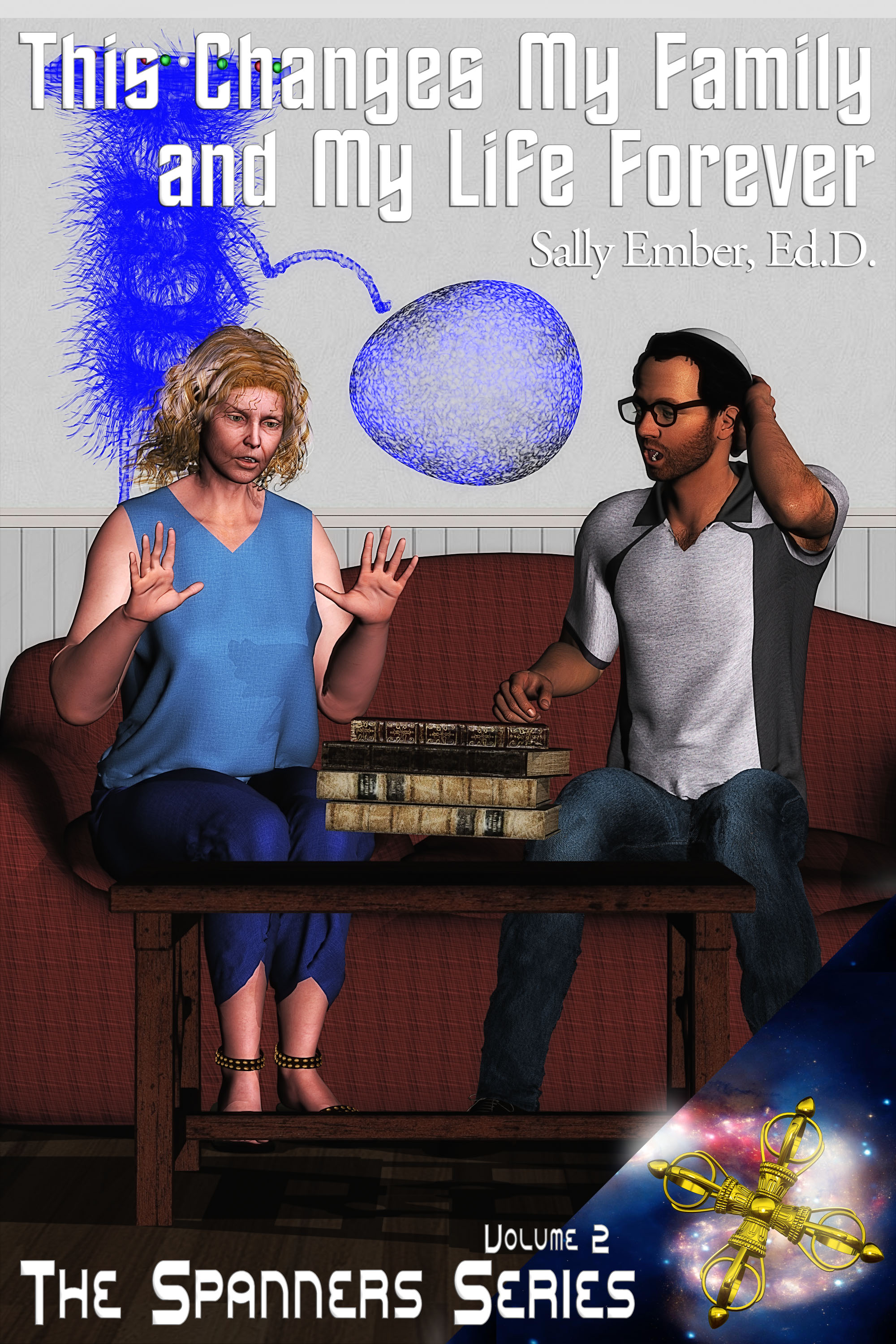
Writers are often exhorted to write the books we want to read that seem not to exist, yet. I am following that advice with The Spanners Series, especially Volume I, This Changes Everything, which is now PERMAFREE, and also with subsequent volumes (Volume II, This Changes My Family and My Life Forever, released 6/9/14; look for Volumes III and IV in 2015).

I am an avid reader and have probably read hundreds of thousands of books in my 56 years of reading independently and quickly, sometimes devouring ten books a week. If I say books like mine—a series like The Spanners—don’t yet exist, I’m probably correct.

logoAuthorsDen
All buy links, reviews, interviews, readings and more: http://www.sallyember.com/Spanners Look right; scroll down.

Why am I writing #science-fiction/#romance, #Buddhist-infused, #multiverse/#multiple timelines #utopian #novels besides the reason already given? And, why should you read them? Because we live in a deteriorating, or degenerating Age, according to #Tibetan Buddhists (and probably many others I’m not bothering to research right now).

When I first hear this claim, I disbelieve it. Aren’t most things “improving” for humanity? Modern medicine, technology, transportation, knowledge of all types: in the 20th and 21st centuries, we are experiencing incontrovertible advances, mind-blowing progress, right? Plus, that POV is just such a downer!

Why would the Buddha’s followers propose and then Buddhist teachers and scholars maintain such a doom-and-gloom perspective on life? It’s not enough that Buddha focused his teachings on suffering and impermanence? Most Buddhists must be depressed: that’s what I thought.

I could understand why Tibetans, having been living under horrible oppression, genocide and cultural destruction under Chinese rule for decades, would be so pessimistic. But, we’re in the good ole’ USA: things are great here, right?

Not so much. I won’t go into the facts we all know now (even more than ever, thanks to Snodwen and Manning) about how screwed up the USA has been and still is, nor how terrible the economy is here and everywhere. I won’t provide the list. We all know too well the horrors of our modern life. Modern tragedies, however, are actually not even relevant to this discussion.

The “degenerating” part of our Age has little to do with actual external conditions. Our deterioration involves humans’ not being able to learn #dharma, not being able to find qualified and worthy Buddhist teachers, not being able to practice meditation well or at all. The Buddha’s teachings and Buddhists practitioners are what are degenerating, in what is called “The Third Age” or “The Latter Day of the Law.”

You can look this up. http://en.wikipedia.org/wiki/Three_Ages_of_Buddhism

My point is, dystopian futures abound. Most sci-fi writers, even those that include romance in their stories, write of increasingly worsening conditions on and around this planet and across the Universe. They pile on the violence, showing increasing discord, more political and social unrest, deaths and destructions even worse than we have now. We already have too much awfulness for me to want to read about even worse futures.

Enough, already: I believe we need some hope, ideas of how else things could go, whether or not I always believe they will take these turns. Since I can’t find this optimism in the daily news or libraries’ and bookstores’ fiction, I decide to create it. I need this in my personal life, for the USA, for the continent, the water, air and land: I am imagining routes for improvement for the planet and the entire universe.

When I #meditate, especially during a #retreat phase in which I was #contemplating lives of beings in the “God Realm,” it occured to me repeatedly that we live in opulence amid squalor, all over the planet. Beauty smack dab in the middle of ugliness, every day. #Yin and #yang. We do have to “take the good with the bad,” but do we have to emphasize the “bad”?

I do not.

In my novels, even when things are “bad,” there is more good than bad. Buddha teaches often that we have to discern between “good” and “bad” even as we know these are illusory. Many teachings expound on how there is NO “good” or “bad,” no “birth” and no “death,” no “coming” and no “going.”

While you puzzle over that, I’m going to continue my utopian illusions in The Spanners Series. In my current and future multiverses, beings, including humans, will have love, better conditions and dharma: they/we have it all!

Furthermore, I’m going to HOPE—even though we are instructed to meditate partly in order to relinquish all hope and all fear—that YOU read my books and enjoy them as much as I enjoy writing them.

Please let me know! Write your comments here on this and other posts, on excerpts from my novel, and whatever else occurs to you. Let’s converse!

Unknown's avatar

OPENINGS on *CHANGES* conversations between authors: 7/8 and beyond!

OPENINGS on CHANGES conversations between authors 7/8/15 and beyond!

CHANGES Theme Image_3

CHANGES is a unique Google+ Hangout On Air (HOA) simulcast on YouTube most Wednesdays, LIVE, 10 – 11 AM Eastern time, USA, with host Sally Ember, Ed.D., in spontaneous dialogue with an author from any fiction type or genre and also from nonfiction, poetry, screenwriting, playwriting, and blogging.

The show is NOT an “author interview,” although some of those elements do occur during the show (promoting/talking about one’s writing, books, origins, plot, characters, ideas).

CHANGES YouTube Image_3 best

#Authors, especially those in sci-fi/speculative fiction and who blog, learn more about and get yourself on CHANGES, and #Readers, recommend an #author to be scheduled as a guest: http://goo.gl/1dbkZV

Watch conversations with my previous CHANGES 30+ guests any time: http://goo.gl/eX0D8T

CHANGES Trailer Image_3

Unknown's avatar

IndieReCon2 = April 15-17, 2015, ONLINE and FREE! #IndieReCon #IRC15

ALLi_IRC2015-RGB_websitetabsolid

The online IndieReCon2 conference is “a 3-day global event to promote quality and craft in #indie #publishing…scheduled for April 15-17, 2015, with online seminars, workshops, discussions and master classes culminating in a reader-centered, Indie #Author Fringe Fest live!”

Our posts, talks and online seminars cover all stages of the publishing process:

—Author Education: How to Write and Publish Well
—Author Empowerment: Finding Your Best Pathways to Publication
—Reaching Readers: Understanding and Serving Your Readers

“10 Reasons to Attend IndieReCon2” HERE:
ONE: “IndieReCon2 is FREE to attend.”
TWO: “IndieReCon2 is a conference for authors by authors.”

Click link below for the other 8 reasons:
http://www.selfpublishingadvice.org/wp-content/uploads/2015/04/10ReasonsToAttendIndieReCon2.pdf

REGISTER HERE:
http://indierecon.org/register/

SPEAKERS LIST HERE:
Mark Coker, founder of Smashwords, and Orna Ross, founder of the Alliance of Independent Authors (sponsor of this event), and many others!
http://www.selfpublishingadvice.org/wp-content/uploads/2015/04/All-you-need-for-IndieReCon-2015.pdf

…and more info, plus photos and bios of speakers HERE:
http://indierecon.org/speakers/

EVENTS LIST HERE:
http://indierecon.org/events/

PRIZES/COMPETITIONS LIST HERE:
http://indierecon.org/competitions/

Learn more about the ALLi and its Ethical Code HERE:
http://allianceindependentauthors.org

ALLiEthicalAuthor_Final-Outlines-300x173

Unknown's avatar

Pros and Cons of #Writers’ Critique Groups

Pros and Cons of #Writers’ Critique Groups
Reposting from one year ago, since it’s all still true and useful and I have new Followers/Readers

Everyone know the biggest drawback to #self-publishing is the isolation. Yes, every #author who doesn’t collaborate in their #writing writes alone. However, prior to the explosion in self-publishing, most books and ebooks that came to readers went through several other sets of eyes and had several editing and revision drafts done by others that helped polish and tighten the writing prior to publication.

artsy-writer-working
image from vidyasury.com

Today more than ever before, pieces of writing from short stories, blogs and articles to full-length books, both nonfiction and fiction, are getting all the way to a reader with no other editor than the writer. This is not a great situation for most readers or writers.

Because many writers seek professional companionship and critiques as well as audiences for drafts and new ideas, writers’ groups have sprung up for many centuries, both formal and informal. These groups usually meet regularly. Size can vary from a pair to a large group of a dozen or more.

The activities in the group can include public readings and/or sharing of written material with participants’ immediate oral comments, pages returned with mark-ups and discussions of the shared pieces. Locations can vary and many are not available free, so some groups charge a fee or require members to pay dues to cover costs and perhaps invite a speaker/presenter to conduct a workshop or give a talk on occasion.

writers_group 1
image from http://www.audreypress.com

Writers’ groups often appoint or hire a facilitator to guide and contribute to the critique. In better-run groups, this leader also keeps time and makes sure the comments are constructive and fair.

However, some groups are not well-run. The ground rules are not clear. Time is not equally distributed because it isn’t tracked well. Comments are not always fair and constructive. The facilitator dominates the discussion. Discussions veer away from the writing into personal stories and tangents introduced by participants. Suggestions are made that are not conducive to the writer’s intent, restrictions, topic, genre or format.

The diverse types of knowledge and experience among participants and in a leader of a writers’ group can be rich sources of varied perspectives OR generate too many irrelevant and unhelpful comments.

Pros and Cons of #Writers’ Critique Groups

CONS: An unskilled or distracted facilitator
— allows too many destructive comments to occur and this encourages more of the same
— allows the exposed author to experience immediate hurt feelings or bewilderment
— allows the writers to leave the critique session discouraged and confused by conflicting advice and too many off-topic remarks
— offers too many comments and dominates the discussion, shutting down, arguing with or interrupting other participants.

Writers in poorly-run groups can be led astray, which can causes them to depart from writing in their own voices and to lose sight of their personal or professional writing purposes. Many writers get discouraged or even “blocked” by attending poorly run writers’ groups.

BEWARE! Better to be isolated than to attend a group that operates negatively.

critique
image from thewildwriters.com

PROS: An skilled or focused facilitator
— leads a well-run group peopled by dedicated, experienced writers as well as “newbies” who each feels comfortable sharing and contributing
— trains and supports members to utilize the time effectively for receiving and offering constructive critiques, with newbies learning from old-timers the most effective methods for delivering and receiving criticism
— can foster an atmosphere of professional support that provides many gems of advice and new points of view for each member, even ones who don’t share in every meeting.

These productive sessions are wonderful catalysts for the writers who share drafts and any who attend. Authors in well-run writers’ groups return from each meeting with new vigor for editing, revising and creating new content.

Tips for Writers’ Groups:
1) Productive critique sessions are NOT riddled with “we loved it,” “it’s great,” and “keep going” with little or nothing else.
Critics must provide reasons for their opinions, especially when they’re positive, so that writers learn what we do well and can replicate our successes.
Critics must also defend their opinions that tell a writer to make changes by offering suggestions for revision or reasons for the ways the writing doesn’t “work” for the reader/listener.

2) Without the prompting of a skilled, focused leader, opinions may be offered with insufficient or no reasons given. Offering positive or negative opinions without rationales is not useful to a writer and should not be allowed.

3) Focus, clear ground rules (e.g., the requirement to give reasons for opinions, taking turns, sharing time equally) and giving both emotional and cognitive responses to a piece of writing are all parts of a productive writers’ group.

4) If YOUR writers’ group is not productive and positive enough, make an effort to change it or leave it. Start your own or join a different group.

5) Networking has never been easier. http://www.Meetup.com is a source of in-person writers’ groups. You can also check your local library’s, college’s, county’s/parish’s, state’s/province’s and country’s organizational listings for professional writers’ groups in your geographic area or genre. Check Facebook, LinkedIn, Google, and many writers’ associations and genre-centered groups online and around the world for possible writers’ groups, critique opportunities and other networking options. Some groups are now meeting online and virtually via SKYPE, iCHAT, Google Hangouts, etc.

CA writers club logo

If you are a writer seeking a group, I hope you find or start a great one!

Best of luck in your writing.

Unknown's avatar

#Writing as Excavation of the Soul

Repost from 12/2/13

For me, #writing fiction and poetry always involves digging up artifacts and dirt. My own and others’ buried treasures, junk, secrets and lies are uncovered, examined, deemed worthy “as is” or refurbished, cleaned up and presented within the text.

Writing #ClaraBranon, as her and about her, is the most autobiographical fiction I’ve ever written. I decided to gift Clara with most of my own “stories” and history, to see what would happen when a version of me is involved in the circumstances and relationships Clara encounters. It’s a roller-coaster for me, delving into my own life to pull up people, events, emotions, reactions, wishes, fears, griefs and successes and foist them onto Clara.

Usually, she does a lot better than I do or I already have with these events and has a much higher “success” rate with her conversations and intimacies than I can claim. In many ways, I feel envious of her. I also do not want her life, especially the public part. But, I do sometimes wish I had her personal strength and courage.

Oh, wait; I do. I must. I also have her creativity, the fire that burns within her, since I gave it to her. Of course I do.

Then, why is it so much easier to see this in Clara than in myself? I believe I make a character in my own image and deliberately make her better than I am only to discover that she can’t be better than I am because I made her. Not to put too fine a point on it, but the whole “God-made-humans-in-‘His’-own’-image” story has similar issues, yes?

As a fiction and poetry creator, as a #Buddhist well aware of the illusory nature of all phenomena, as a fabricator and dreamer, I am well aware of the fantasies I make into a semblance of reality with each paragraph or stanza I put into words. I paint pictures of scenes, drawing upon deep emotional bonds and reactions in order to do it, but we all know none of this is “real.” Right? Except for the parts that are true, that is.

The exhilarating, terrifying ride of writing one’s own stories in whatever forms is that others are going to read them and get to know things about me and my inner world I would never tell them, otherwise. My best defense, then, is to mix these true tales with pure fiction.

Sometimes serving up this admixture seems to be a cop-out move on my part, as I feel a taunting voice within me saying: “Na, na: you can’t know me! You don’t know what parts of this are ‘mine’ and which are completely made up. So there! Try and figure it out. I’ll never tell!”

This is the gauntlet every writer throws down to one’s readers: “Catch me, if you can!”

I do leave breadcrumbs for your journey, especially on Pinterest: http://www.pinterest.com/sallyember and here in my blog posts. Happy treasure hunting, readers!

Please let me know what you find and what labels you decide to put on each trinket. We can compare later. Start with Volume I, This Changes Everything (NOW FREE) and ask: “Who is #EpifanioDang?” Move on to “Are there really #aliens coming or already here from the #ManyWorldsCollective?”
http://www.sallyember.com for buy links, reviews, interviews and more. Look right; scroll down.

Continue with a chapter-by-chapter analysis of world history, politics, biology, religions, the arts and meditation and keep going: The Spanners Series has so much to offer you, including Volume II, This Changes My Family and My Life Forever, which released 6/9/14, and Volumes III and IV coming out in 2015!

Enjoy! Write Reviews! Share!

Unknown's avatar

Is all disagreement “negativity”? When did that happen? I DISAGREE!

THIS POST IS DEDICATED TO MY MIDDLE SISTER, W. ELLEN E. FLEISCHMANN, A MISSOURI STATE CHAMPION DEBATER, WHOSE BIRTHDAY IS TODAY!

Is all disagreement “negativity”? When did that happen? I DISAGREE, and I am not being “negative,” unless we’re in a debate, in which case my “side” is “con” (as opposed to “pro”).

This issue has arisen in various ways over the last two years or so, since I became a indie author, blogger and online participant. However, in my latest foray into online “conversations,” I engaged in an exchange that has been very disappointing.

An online acquaintance who moderates one of the Facebook groups I belong to has a public website that includes a blog where she often posts reviews. I’ve been following her site and occasionally reading her posts. Otherwise, we don’t know each other.

A bit of background: I don’t usually comment on hers or anyone’s reviews unless one is particularly well-written or I happen to vehemently agree or disagree with it, which was the case, here. This is a public site and she allows for comments.

This reviewer (who shall remain nameless) posted rave comments for the 50 Shades trilogy, including her wish to speak with E.L.James (making it seem as if she had an “author crush” on E.L. James, which I have no issue with at all). It was her calling the main relationship portrayed in 50 Shades “the greatest modern love story” of her time (this reviewer is about 20 years younger than I am, by my estimate; perhaps younger), that compelled me to respond.

I thought carefully about what I felt and thought and how I wanted to convey these bits, edited and revised my comments a few times before I posted them for approval. Then, I went on to my day’s other business.

Unfortunately, I received the following message (see below for our email chain) later that day.
Her decision not to “approve” or post my comment on her site and her intense, personal reaction surprised and appalled me, as you will see by my email response to her.

I’m not trying to start any kind of conflict or flame war. I really want to know what you all think. (See below.) Here are my main questions to you, my blog readers:

—-Are we supposed to withhold responding when we have ANY disagreement between us and any members of our online “community”?
—-Is ALL disagreement “negativity”?
—-Do we have to speak in “soft tones,” “soft-pedaling” anything that might possibly be critical, because so many writers/bloggers seem unable to tolerate being criticized?
—-Are we supposed to keep our sites (and purportedly, our lives) free of all conflictual conversations by not approving critical comments?
—-Do those of us who have criticisms to levy have to refrain or risk being called “trolls,” or banned/kicked out of review groups, comments sections, social network platform groups, etc.?
—-Do only “yes” people and “supporters” feel (and get) welcomed online?

not every critic is a hater

I can’t recreate my exact comment, but here is the gist:

Your post made me feel sad and I feel sorry for you. What world do you live in, that these two-dimensional characters and their dysfunctional sex and interactions constitute any kind of “love story,” much less “the greatest one”? James’ depiction of her disempowered, ignorant female lead character is insulting to women everywhere. The “billionaire” male lead is selfish, clueless about healthy relationships and awful to his “girlfriend.” The “plot,” thin as it is, is implausible. Some of the “play” depicted in the sex scenes is not credible or even possible (people have tried to recreate it with laughable and/or injurious results).

I reviewed and disliked all three books, giving many considered reasons. Please go read my reviews. I also consider E.L. James’ writing among the worst to receive public acclaim, so as an editor, author and reader, I challenge your evaluation of the writing of these novels. Your opinions caused me to feel discouraged.

Here are the first email I got from this reviewer, below, and our exchange below that.

Subject: Blog Comment

“I was really on the fence with whether or not to approve your comment, Sally, or to respond to it. Because realistically the best way to deal with negativity is to not feed into it. So in this case, I’m going to respond privately.

“In answer to your question: ‘What world do you live in?’ I live in a democratic world where everyone is entitled to their own opinion, and since it is my blog, I am free to express it. You chose to read my blog, just as you obviously chose to read Fifty Shades of Grey. And like all readers in the world, we all have different viewpoints on how we interpret a book. You have no right to judge my opinion, just as I have no right to judge yours.

“However, the fact that you chose to try and publicly insult me on my blog, saying that you feel sorry for me for my opinion, that you feel saddened by it, is extremely hurtful.

“I have supported your posts on [the Facebook group I moderate] since its inception, and I am disgusted that you would even try to publicly insult me, as I have never done anything but provide you with support. I did not approve your comment.”

comment not approved

I’m reading this, stunned. Really? These two lines, in the same paragraph, written without irony?
“I live in a democratic world where everyone is entitled to their own opinion…” followed by
“You have no right to judge my opinion, just as I have no right to judge yours.”

If we have a “democratic” right to our opinions, isn’t judgment a form of opinion? Why does she think we “have no right” to judge anyone else’s opinions? That is so absurd I don’t even know where to start with a response.

And, a deletion of my comment follows this “explanation”? I’m sputtering and laughing, both.

What IS a review, if it’s not exactly that: one reader and possibly another writer JUDGING another’s opinions and writing?

What is the function of comments on reviews, if not to JUDGE that review (like it, dislike it, agree/disagree)?

I considered, took some deep breaths, decided it was worth my time to respond. Maybe she could learn something… Maybe not.

I wrote, revised a few times, then responded:

Subject: Re: Blog Comment

“Dear XXX,

“It is your blog, your review and your opinions: all true. But, if the only comments you ‘approve’ on your site are those that agree with you, make you feel good and support your opinions unequivocally, you will stagnate.

“Your choice.

“I did not set out to be nor do you have to take my comments as ‘hurtful.’ I was expressing my dismay, my personal (as a female and feminist who is a lot older than you) and my professional (as a writer who has been writing a lot longer than you) sorrow at your conclusions and approval of those books. I read them all, too. I reviewed them all, too.

“If you want to go and comment on my reviews, please do. Say whatever you want, as a reviewer, a writer and a reader: that is your right. I encourage you to do so.

“Your previous support of my posts is appreciated, but your using that as if you ‘paid’ for my approval forever by doing so is insulting to me. Stop approving, stop supporting, if you think you ‘deserve’ some special and DISHONEST responses from me for doing so.

“If you want to close off conversations between us because you disagree and get hurt feelings when I don’t like what you write or post, I can’t stop you, but please; don’t make it as if I did anything wrong. You have a public blog. Comments are public. I did not ‘publicly insult you.’ I responded to your public post, in public, where comments belong.

“Sheesh.

“Sally”

She wrote back:

Re: Re: Blog Comment

“I will not respond to your negativity, Sally.

“We obviously do live in two different worlds. I’m happy to stay in mine.”


I did not and will not respond directly to her. I gave up on her: not apparently willing to be learning; not worth my time.

Instead, I am writing this post and asking for YOUR opinions.

Maybe I could have phrased my comment more “gently,” in some misguided attempt to protect her, but I would NEVER consider doing that for a man or someone my own age. Wouldn’t I be subjecting her to gender and age bias if I were to withhold, “dumb down” or soft-pedal my considered and professional opinions just because she’s a woman and/or someone younger than I am? She presents herself as a professional in public so I treated her as one.

Why doesn’t she expect some responses that don’t please her and have a better way to manage her own feelings about them? Why can’t she handle disagreement and criticism with more grace, or, even better, engage in a conversation with me about her points of disagreement, defend her opinion, argue her points, instead of playing the “hurt” and “insulted” cards? Why is all right for her to judge my comments but not all right for me to judge her review?

Are we “fellow authors” and reviewers/bloggers really obligated—no; supposed to—send all comments in which we disagree with a blogger to them privately, first? Why?

I vehemently disagree with these ever-expanding hiding-from-public-view practices. I am certain that hiding disagreements results in the disappearance of complex, nuanced dialogue and provides the public with pablum, instead. Then, the only thing readers get is a distorted picture of author engagement, in which we all hold hands and sing “Kum Ba Ya” all the time. When we post only glowing reviews, readers are misled and we breach the public trust.

When some label comments they don’t like as “negativity” and relegate disagreement to the private realm, we are all then left with sanitized, white-washed, dishonest and hypocritical non-dialogue in all public spaces: what is the point of engagement, then? Just keep patting everyone on the back, regardless of value, worth, logic, perceptions?

Not all disagreement is “negativity.” Not all conflicts between us should position one person as “good” and the other as a “troll.” Yes, there are “trolls.” I am not one of them, and this person should realize that. I am not hurt, just pointing out the obvious.

If she really can’t tell the difference between my expressing my honest opinions, while I am respecting but not liking hers; if she can’t see that I am not liking that she came to the conclusions she did or made the choices she did, but I am taking the time to tell her that as one professional to another, then I am led to give up on her.

Authors and bloggers, in my view, do not “earn” uncritical support (or maybe you think you do and you want it, but I do NOT) just by joining a group or getting to know each other online. If you are my professional “friend” or colleague, PLEASE tell me the truth. I don’t want applause; I want critiques and engagement that matter.

Just so you know: I do not go around looking for people to disagree with. I am busy. Most of my posted comments are supportive and positive, and I don’t post a lot of those, either.

HOWEVER, when something disturbs and moves me enough to write to someone about it, that writer should be grateful: I read his/her piece, respected the author enough to consider their opinions or positions, and responded from a thoughtful place.

When I am writing to the reviewer or blogger in order to provide my emotional as well as logical responses, that is further proof that I believe in this author or blogger enough to take MY precious time to craft and post a response.

If this blogger and any others do not understand that all thoughtful comments, however contradictory or critical, are a gift, their censorship is going to make honest dialogue even more rare.

Some writers apparently don’t have the courage to stand by their own public proclamations and engage publicly with people who do not agree with them. I term this behavior “unprofessional” and deem them unworthy of my time and opinions in the future.

BTW: I went to her FB group to see if she (the moderator) had kicked me out, and so far, not. However, she posted and pinned this query, right after our email exchange:

“Since this group is becoming more and more of a spam magnet, and not so much about [the group’s stated topic] anymore, I’m thinking it’s time to put it to rest?

“If anyone cares to keep it open, please respond with a comment, and I’ll see what reception I receive.

“I’m thinking about opening another one using a different name and with a slightly different purpose. Thoughts?”

Shutting down this group and using a different name to start another one?

Coincidence? I doubt it.

PLEASE post your comments here, on my main blog, to this any any other post:
http://www.sallyember.com/blog.
ALL comments that are not SPAM are ALWAYS approved.

comment approved baby
image from http://www.phoenixheart.net

Keep writing, keep commenting, keep reading, keep approving.

Best to you all.

Unknown's avatar

“Grade Inflation”—the Widespread Awards and Exalting of Effort—are Ruining Writing and Writers

I am hereby and for an undetermined length of time giving low credence to most book reviews, awards, contests and other honors conferred upon books/authors.

Why? I know some of the awardees’ writing. Many are undeserving of any accolades.

“Grade Inflation”—the widespread awards and the exalting of effort—are ruining writing and writers.

inflated A
image from http://www.wrkcapital.com

Why does anyone reward mediocrity and worse? How many “open mikes” have you attended in which EVERYONE, no matter how badly they perform or how horribly they read aloud or recite poetry, gets wild applause or even a standing ovation? Does the audience believe that everyone deserves the same response regardless of the quality of their presentation?

I do not.

How does it help any author/artist grow when no one is honest with them about the areas they need to improve and all they hear are overly exuberant praises? Neither are we helping authors or keeping faith with readers when so many provide undeserved 5-star “reviews” for shoddy writing. We are helping our writers and performers when we honestly and with specificity critique their work.

We are not doing our children any favors to give everyone who participates a “winner” ribbon, unless everyone understands that showing up and participation are what get awarded. However, I contend that, for professionals, the industry should not be labeling greatness on effort alone.

Grading on effort makes greatness lose all significance and confuses us all. When everyone “wins,” no one does. For evaluations and competitions to matter, the creation being evaluated of any top-ranking writer or other artist must be excellent by objective standards to have earned that award.

When all are given “A”s, or 5 Stars, or First Place, the rankings become meaningless. Participants can’t begin to discern their actual place among their peers or the value of their work in the world when reviewers and judges do not provide accurate, meaningful, thoughtful critiques and feedback, in the form of awards to the deserving.

participation trophy
image from http://cutemonster.com

At the end of a sports event, such as a foot race or team game, the winners and losers are indisputable. Those that swim are racing each other and the clock, which are immutably obvious regarding who swam the fastest for that race and for all recorded events of that type.

Art assessments should not merely be based on the creator’s intention or your affection for the creator.

Exceptions: if the artist is a child or disabled in some way, then that participation alone is sufficient to earn an award. Obstacles that participant has already overcome just to be involved in that competition or performance do deserve to be honored. THOSE types of contests, in which “everyone wins,” I wholeheartedly honor, e.g., the Special Olympics.

BTW: I strongly believe in and promote cooperative games, the postponement of competition, and an “everybody wins” concept for most activities for children and youth. I wish more youth sports and other harshly competitive games would be permanently removed from options so that everyone could play, learn and grow without that pressure.

This post is not to remove those cooperative and noncompetitive games or friendly, networking-type of awards passed around for fun and support. We all need encouragement.

However, when the competition is on a supposedly “level playing field” (more or less: let’s not get into gender, socio-economic class, age, racial and ethnic biases that unfairly prejudice judging and preclude fairness; that’s another subject), I strenuously object to fairly set competitors’ receiving awards, praises, great reviews or any other merit when the subject of the assessment is insufficiently unscrutinized.

I know some awards are merely a matter of “taste” or “current trends,” and that what anyone “likes” is always subjective.

Fine. Let those competitions be labeled clearly as having someone’s personal preferences, not accepted standards of excellence, as the main criteria for winning.

I’m talking about competitions that adults, professionals, and mostly, writers enter that supposedly have criteria that winners have to meet or exceed, in which the “best” is supposed to be honored the most. I wish that all of these competitions would be judged by obvious and agreed-upon standards of excellence and not determine winners based on effort, affection or popularity, or worse, payment of entry fees.

Also, I’m not talking about what people “like.” I’m asking for awards based on what is excellent, as objectively measured as possible.

Maybe it’s easier to talk about what is NOT excellent. I believe these components, below, are not purely subjective measures and therefore can be evaluated fairly and “blindly.”

FYI: For professional writers, grammar matters. Spelling counts. Syntax is significant. Context is not everything.

grammar shit
image from http://the-modern-housewife.blogspot.com

Here are my “what not to award” components for all types of fiction, whatever length.

[NOTE: I do not believe these need any explanations, but comment here or wherever you see this or email me if you are not sure what I mean, below.]

  • Poorly plotted stories
  • Superficially drawn or insufficiently motivated characters
  • Illogical, incomplete or inconsistent world-building
  • Triteness in storyline, characterization or setting
  • Not credible settings and/or situations
  • Poorly edited, insufficiently copyedited, badly spelled and/or incorrectly written sentences, paragraphs, entire works
  • Repetitious language, situations, characters and plots across one or more works by the same author
  • Sexism, racism, ageism, classism, ethnocentrism and other oppressive biases as expressed through one’s characters and plots/situations

The next time I hear a writer “won” an award, I hope s/he deserved it. I really do.

In case you need a reminder of what quality is and how deserving some authors are…

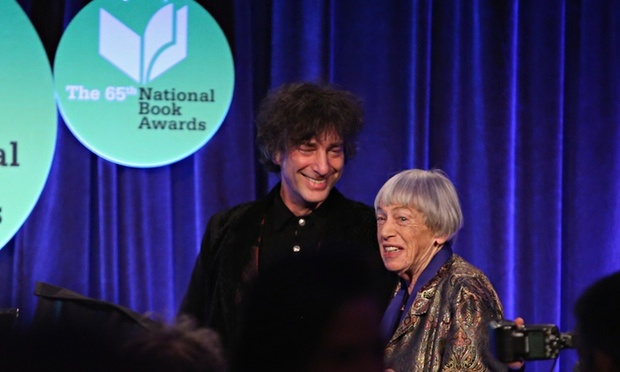
Ursula--Le-Guin-and-Neil--010
Ursula K. Le Guin and Neil Gaiman at the National Book Awards, 2014, in New York.
image from http://www.theguardian.com Photograph: Robin Marchant/Getty

P.S. I find Gaiman unreadable (personal preference) and adore Le Guin, but I recognize the similar greatness in their writing.

Unknown's avatar

15 reasons I could only give a 2-Star #Review for The Self-Publisher’s Ultimate Resource Guide, 2015

I received an Advance Review Copy (ARC) of The Self-Publisher’s Ultimate Resource Guide and promised to write and post an honest review here on my own blog and on at lesat one other ebook site (see links, below) in exchange.

Self-publishing Ultimate cover

According to the co-editors, this Guide “is the first and largest collection of curated and verified resources for independent authors who plan to publish their own books. Produced by a team with long experience in both traditional and independent publishing, the over 850 resources are listed in an easy-to-use format that includes live links, phone numbers, email addresses and brief descriptive copy. The Guide makes vendors and other resources easy to find by separating them into 33 distinct categories within the 3 main tasks the self-publisher must deal with. How to Prepare, Publish, and Promote their books.”

15 reasons I could only give a 2-Star #Review for

The Self-Publisher’s Ultimate Resource Guide

PERSONAL NOTE: This Guide already received some excellent endorsements from “heavy-hitters” in the Indie-Publishing industry, several of whom happen to be my unofficial mentors: Mark Coker of Smashwords, Joanna Penn of The Creative Penn, and Joan Stewart, The Publicity Hound, to name a few.

I’m daring to add to and not to agree with these experts’ opinions, here. If I were you, I’d also go read theirs! And, please: I’m trying to be constructive, so I give a lot of recommendations and make many pleas. It’s not just a pan.

I wanted to like this book. I wanted to give it 5 stars. I cannot.

The best thing I can say about this is that the editors promise that they want it to be improved and added to quarterly or annually.

I am NOT trying to be snarky or mean. I genuinely went in with high hopes and expectations, given all the hype and positive endorsements this Guide has had. These hopes were dashed in the first few chapters and it did not get better as I went along.

I hope they will take my critique and others’ feedback to make the Guide better, not just longer.

Here are my 15 reasons for giving Guide only 2 stars:

  1. Why isn’t this an actual GUIDE? Why is the Guide almost entirely just a lot of somewhat organized lists?
    Instead of directing, informing, and assisting new indie authors with each selected aspect (and I do like the aspects, or chapters, they decided to include), there is a lot of information not given. This info is either missing, such as the reasons a writer would need to use a section or how to use the information provided, or withheld, such as the providing of a rating system or users’ experiences for each resource—annotations, as in YELP or Angie’s List—for each entry.
    If we wanted to acquire a list of resources, we could do that from many other places.
    The editors say these have been vetted, but where is the evidence of that? What did they assess? Why don’t they include their assessments, or a summary of why each listing is “better” than those not included, and for what, exactly?
    I was very disappointed in the editors’ lack of interaction with each listing provided. They seem to have merely collected a lot of self-written descriptions or blurbs about each entry (meaning, written by each resource provider, not the editors or users) and put the selected listings in alphabetical order.
    Since they say they vetted each entry and rejected some, why aren’t we reading more about WHY they included each entry?
    If I had paid for this “GUIDE,” I’d want a refund.

  2. This book was poorly written and edited. However, the authors’ long, impressive bios (see below) list extensive experiences in editing and proofreading. They also exhort the need for both in this Guide .
    However, even though I wasn’t looking for or expecting to find mistakes, find them I did. There were numerous mistakes in grammar, punctuation and syntax as well as inexcusably sloppy and poor writing in almost every one of their brief intros/summaries for each section/chapter. Finding so many problems was surprising and very disappointing.

  3. The editors mention more than once a warning to readers to “read the fine print” if they choose to enter into contracts, but nowhere do they provide any tips or hints about exactly what to watch out for, what to avoid, what to accept. Why?
    Their advice is so vague as to be trite and useless; without specifics, they’re not helping anyone. Why not a chapter on “Don’ts” or “Beware of…”?
    [It’s as if they started to write a guide and then, halfway through, made it a listing service instead. It makes me wonder if there was some money exchanging hands, ensuring certain listings and keeping out others.
    Is that just my inner cynic talking? There is no evidence of resource providers’ purchasing their listings….]

  4. Why did they not include a chapter on authors’ support networking? There are so many indie authors’ forums, Kindle Boards, authors’ groups, etc.
    If they take my advice and add that chapter, I hope they make notations as to which resources/ groups/ providers are fee-based and which are free, and what the fee ranges are, if applicable, and what the fees avail members of, specifically.
    Fee information is crucial but missing from every chapter.
    Also, I hope they weed out the “review swap” groups, since these violate Amazon’s Terms of Service, and I hope they would EXPLAIN the TOS violation consequences (removal of reviews, for example) in their new chapter.

  5. Why is there a chapter on websites for authors? What makes a website for authors particularly unique vs. a website for bloggers, e.g., or vs. any other small business? This claim of distinction is never explained, yet there is a chapter devoted to a list of people they are supporting who supposedly create websites “for authors.”
    I’m scratching my head over this. If the editors explained their rationale, I might be on board. However, again, no explanations are given.

  6. There is a chapter devoted to Book Reviews with no mention of the extremely important and controversial issue of paid vs. free reviews, and no annotations as to which of those listed charges authors for providing reviews nor how much they charge.
    These omissions are significant oversights. Must correct in future revisions, please.

  7. There are several chapters that are devoted to formatting one’s book—ebooks vs. print vs. Print On Demand vs. “Short Run” [sic]—with no explanation as to the differences among these formats or which to do first and the reasons.
    Also, what about the issue of whether or not even to have a print version: why? when? at what cost? Many of us do not have any print versions: what are the consequences of going ebook-only for each genre?
    Furthermore, when introducing each type of formatting, there is no explanation about the reasons/ bases for ebooks’ formatting issues or the assistance offered, via Smashwords vs. Amazon, for example, or about difficulties of passing through Smashwords‘ “meatgrinder” successfully and what that success generates in benefits; no mention is made of that nor that Digital2Digital does not use such gate-keeping, for example.
    If this is truly going to serve as a guide, MORE ANNOTATIONS and information are needed.

  8. What is a Short Run [sic]? I have never heard of it (since I have no print books, yet) and it was not sufficiently explained (nor hyphenated?). Why include it if not also to explain more completely what it is?

  9. Several key “players” were omitted, which I know can be corrected, but since some of them provided endorsements or reviews, I’m baffled by their absences. Many of those missing are very prominent in the blogosphere, Google+ or Twitter but not so much on Facebook. What about those who shine on Pinterest, Instagram, or Tsu?
    Maybe these editors not as active on the other social media platforms? The Book Marketing Tools and its free ebooks listing tool, e.g., were not included.
    In order to be an actual GUIDE and not just a list, part of this chapter should include annotations giving pros and cons of authors’ activity on each platform and who the leaders are on each.

  10. Social media platforms are the not the only places authors need to “go” or be “seen.” Start with: Blog Talk Radio shows that feature authors and books, like Indie Books with Will Wilson, The Backporch Writer with Kori Miller, and so many more; Google+ LIVE and taped Hangouts on Air, such as my show, CHANGES, which then go to Youtube; D’vorah Lansky’s and others’ teleseminars and webinars devoted to books, book marketing and authors; The Authors Show, A Book and a Chat and many others on their own “channels”; podcasts and other shows, such as The Author Hangout, with Shawn Manaher and R.J. Adams, via iTunes and other sources, and so many more.
    Please request and create a chapter with annotated listings of opportunities of this type and how to access them.

  11. There was no mention of Amazon’s Kindle Unlimited and the controversies/problems indie authors face regarding this, nor was a distinction made between Kindle Select and Kindle Direct.
    These are exactly the types of explanations missing from this book that need to be put in, please.

  12. Why was there such a small number of “Social Media Consultants” included? I could come up with more than that, yet I am not one myself nor have I used one.
    The editors need to do better outreach, here, and a LOT of annotating, since many who call themselves “experts” are NOT; I know vetting is something these editors say they have been doing, so let’s see the results.

  13. There needs to be more info about money. For example, if the chapter on contests and awards is going to be useful as more then an incomplete list, each entry needs to be annotated to include info on entry fees and deadlines as well as more about the actual value of winning or placing in each.
    These contests can take a lot of time: show us what’s required, specifically, to enter, please, and what we might gain from winning.
    Great to include a chapter on acquiring funding, too, but that also seemed a bit “light.” There are many more opportunities out there, but at least there were several clearinghouses, like C. Hope Clark’s Funds for Writers, listed.
    Such lacks make this book more of a jumping-off point than a guide, though.

  14. I also don’t understand why those who provide services in more than one area (as delineated by these editors) are not dually or triply listed, as often ought to be the case. Readers/users will find resources only in the chapters they go to skim and may not read other chapters at all.
    For example, Judith Briles is listed for her private site, but Author U is not listed at all, anywhere I could find.
    I know it would make the Guide longer, but there must be a way to show readers that a listing appears elsewhere in the book, or could appear elsewhere (and in what chapters) but editors decided to list each resource only once for space reasons, right?

  15. I do not think Book Promoters are the same as book PR people, but perhaps I’m alone in this. In any case, I think having the word “Promoters” missing from the chapter headings is confusing.

If/when most or all of these omissions, errors and improvements are managed, I’d love to see that version. Or, maybe they should change the title from “Ultimate Resource Guide” to “Resource Compendium” or “Resource Listings.” They’d have fewer changes to make if they did that.

I wouldn’t think that would be as useful, though, as my revised version could be. I hope SOMEONE makes that version!

Meanwhile, although I believe The Self-Publisher’s Ultimate Resource Guide may be worthwhile as a starting point, it is far from being the “Ultimate Resource Guide” at this point.

Any newbie to self-publishing would have to pick up many other and better guides to make this one useful.


On their book’s website, in the FAQs, they state: “We plan to update the ebook edition of The Self-Publisher’s Ultimate Resource Guide monthly after the launch, eventually moving to a quarterly update. The print edition will be updated once each year, so we’ll have a new edition reflecting all the changes at the end of 2015.”

Proof? they post this excellent exhortation/invitation on the “CONTACT” page:

The Self-Publisher’s Ultimate Resource Guide is a living document.

Although we have tried to gather the most valuable resources for indie authors, it’s inevitable that some have been missed, and new products and services are constantly being introduced. We want your help to make it even better. If you know of a person, company, product, or service of value to independent authors that’s not included in this guide, please let us know. You can send submissions to be included in the next edition of The Self-Publisher’s Ultimate Resource Guide by the contact form below. Thank you.

Essential Qualification Guidelines for those who wish to be listed in The Self-Publisher’s Ultimate Resource Guide.

Extensive, professional experience in serving the self-publishing community.
A current, informative, interactive website.
Complete contact information; location (city, state/province, country), phone number, email address, and contact person if applicable.
Outstanding reputation; positive client/customer testimonials and/or reviews.
The final decision on all listings is at the editors’ discretion.

Note: Personal connection or recommendation of resource/business, is meant for anyone who is recommending someone else’s business. Say you are an author and use an editor not listed in the book. You can put that into the submission as your connection (I am an author who uses these services) and recommendation (what you think of the services you receive). It would not apply to someone who is asking for their own company to be included.


For more information: http://www.spresourceguide.com/

Ebook Purchase and Review Links:
Amazon (Kindle): http://www.amazon.com/dp/B00QSKUS2Q/
B&N (Nook): http://www.barnesandnoble.com/w/the-self-publisherr-joel-friedlander/1120927172?ean=2940150138957
Kobo: http://store.kobobooks.com/en-US/ebook/the-self-publisher-s-ultimate-resource-guide
Apple (iBooks): https://itunes.apple.com/us/book/self-publishers-ultimate-resource/id950440919?mt=11

The Authors/Editors:

Joel Friedlander
“…is an award-winning book designer and blogger who has been launching the careers of self-publishers since 1994 from his book design and consulting practice at Marin Bookworks in San Rafael, California. Joel is a self-published author and the blogger behind http://TheBookDesigner.com, a popular and award-winning blog on book design, book marketing, and the future of the book. Joel is also the founder of The Self-Publishing Roadmap, a training course for authors, and http://TheBookMakers.com and http://BookDesignTemplates.com, where he provides tools and services for authors who publish their own books. He speaks often at publishing industry events and is a past president of the Bay Area Independent Publishers Association.”
Joel-2014-headshot-300x

Betty Kelly Sargent
“…is the founder of BookWorks, and the founder of The Educated Author, and writes a monthly column on self-publishing for Publishers Weekly. She is a member of the Independent Editors Group (EIG) and has spent more than 30 years in the traditional publishing business, most recently as editor-in-chief of William Morrow, where at one point she had three books on the New York Times best-seller list at once. She has also been executive editor at HarperCollins, executive editor at Delacorte Press, Fiction and Books editor at Cosmopolitan magazine, and book reviewer for CNN. She is the author of seven traditionally published books and one self-published book. She moderates panels and workshops in New York City and Los Angeles and is passionate about helping indie authors learn to navigate the ever-changing landscape of self-publishing.”

Betty-photo-1

Copyright © 2015 Marin Bookworks, All rights reserved.

CONTACT:
The Self-Publisher’s Ultimate Resource Guide Editors,
Joel Friedlander and Betty Kelly Sargent
Marin Bookworks
369-B THIRD STREET #572
SAN RAFAEL, CA 94901
editor@spresourceguide.com

Unknown's avatar

#Crowdfunding with #Patreon: Sally Ember’s Campaign Needs Your Support!

#Crowdfunding with #Patreon: Sally Ember’s Campaign Needs Your Support!

If you are in the “giving” mood this month, as many are, or any time after December, 2014, please consider becoming a Patreon member (free) and supporter of creative people? You could help us to achieve particular goals, complete projects, and acquire enough general financial support to keep being creative.

WIN_20141113_151113
Sally Ember, Ed.D.

What’s unique about Patreon‘s site and its campaigns is that donors and creative petitioners have the chance to interact via messages and also by the recipient’s offer of “rewards” as “thank-you” gifts, services, or products.

Sally (I) put on this campaign’s “rewards” page several options based on amounts of donations (first starts with a donation as low as $4.00), which include free ebooks, editing/proofreading services of increasing size for increasing donations, and other rewards in the future.

THE PITCH VIDEO:
http://youtu.be/f8nYsfjm_aU?list=UUqnZuobf0YTCiP6silDDL2w

Please visit, watch the pitch video, share, and consider becoming a Patreon patron.

Help fund a book cover, sound equipment upgrade and conversion of videos to podcasts, conversion of ebooks to print books and becoming available as Print-On-Demand (POD) books and/or provide any size donation to go towards the general financial support of a working #writer, CHANGES Google+ Hangout On Air (#HOA) talk show host and blogger who supports other #indie #authors.

Thanks, Happy Holidays, happy creating and happy reading!

THE PATREON PAGE:

http://www.patreon.com/sallyember

Unknown's avatar

#Crowdfunding with #Patreon: Sally Ember’s Campaign Needs Your Support!

#Crowdfunding with #Patreon: Sally Ember’s Campaign Needs Your Support!

If you are in the “giving” mood this month, as many are, or any time after December, 2014, please consider becoming a Patreon member (free) and supporter of creative people? You could help us to achieve particular goals, complete projects, and acquire enough general financial support to keep being creative.

WIN_20141113_151113
Sally Ember, Ed.D.

What’s unique about Patreon‘s site and its campaigns is that donors and creative petitioners have the chance to interact via messages and also by the recipient’s offer of “rewards” as “thank-you” gifts, services, or products.

Sally (I) put on this campaign’s “rewards” page several options based on amounts of donations (first starts with a donation as low as $4.00), which include free ebooks, editing/proofreading services of increasing size for increasing donations, and other rewards in the future.

THE PITCH VIDEO:
http://youtu.be/f8nYsfjm_aU?list=UUqnZuobf0YTCiP6silDDL2w

Please visit, watch the pitch video, share, and consider becoming a Patreon patron.

Help fund a book cover, sound equipment upgrade and conversion of videos to podcasts, conversion of ebooks to print books and becoming available as Print-On-Demand (POD) books and/or provide any size donation to go towards the general financial support of a working #writer, CHANGES Google+ Hangout On Air (#HOA) talk show host and blogger who supports other #indie #authors.

Thanks, Happy Holidays, happy creating and happy reading!

THE PATREON PAGE:

http://www.patreon.com/sallyember

Unknown's avatar

“10 Underestimated Blogs Worth a Writer’s Attention” from Where Writers Win

“10 Underestimated Blogs Worth a Writer’s Attention” from Where Writers Win

and, add http://www.sallyember.com/bloghttp://go.shr.lc/1wdm3Wa via @WhereWritersWin

Unknown's avatar

“10 Underestimated Blogs Worth a Writer’s Attention” from Where Writers Win

“10 Underestimated Blogs Worth a Writer’s Attention” from Where Writers Win

and, add http://www.sallyember.com/bloghttp://go.shr.lc/1wdm3Wa via @WhereWritersWin

Unknown's avatar

“Actualists” vs. “Realists”: The Evolution of Modern #Fiction thanks to #Quantum #Physics

FULL DISCLOSURE: I have not read the book, FICTION IN THE QUANTUM UNIVERSE, being reviewed in the blog post I am quoting, written by Marti. I probably won’t.

quantum-fiction cover

But, I’m fascinated by the topic, which relates directly to my own writing and choices in The Spanners Series ebooks and appreciate her review and snippets enormously.

logoAuthorsDen

I’m sharing some of Marti’s review, linking to her blog (below) and commenting here on mine.

Of course, I encourage anyone interested to read the full review AND read Susan Strehle’s book. Some day, I will.

FICTION IN THE QUANTUM UNIVERSE by Susan Strehle

Reviewed by Marti on What has Been Read Cannot Be Unread book blog

9/15/14

Marti characterizes this as an “interesting but academic book” which is hard to argue with, for sure. Her summary of Strehle’s premise is: “a new fiction has developed from the influence of modern physics.”

I LOVE this idea! As a new-ish speculative fiction writer (This Changes Everything, Volume I, and This Changes My Family and My Life Forever, Volume II, published as ebooks, so far) who would definitely fit into this category, I’m glad to have these choices honored and recognized as parts of a trend.

This-Changes-Everything----web-and-ebooks

final cover print

Strehle calls this new fiction actualism, which I like as a term. However, I don’t like her positioning realism as its opposite, since Buddhists and quantum physicists all realize that NOTHING is “REAL” in the sense of the word as we currently know it.

Marti writes that Strehle claims we actualists are writing the way we do “in order to reflect more accurately what we now understand as real.”

This I do agree with. For example, I am choosing to write my novels in the present tense (which aggravates and confounds many readers and reviewers; too bad) to emphasize the simultaneity of time and the “nowness” of everything. I also write about the existence of multiple timelines and some people’s abilities to know facts, events, circumstances, etc., across these timelines in the multiverse. How would I and and other sci-fi writers be doing this without the influences of quantum physics?

I adore these quotes from Marti’s review, some of which are double quoted, since they’re from the book:

[Strehle] says that in the new physical or quantum universe, reality is discontinuous, energetic, relative, statistical, subjectively seen, and uncertainly known — all terms taken from new physics, and that rather than choosing between art and actuality, contemporary novelists pursue both in fiction.

“Contemporary fiction departs from realism without losing interest in reality. Reality is no longer realistic; it has more energy and mystery, rendering the observer’s position more uncertain and more involved.”

Actualist fiction is characterized by incompletions, indeterminacy, and “open” endings unsatisfying to the readerly wish for fulfilled promises and completed patterns. Gravity’s Rainbow [by Thomas Pynchon], for example, ends not with a period but with a dash. Strehle argues that such innovations in narrative reflect on twentieth-century history, politics, science, and discourse.

Read Marti’s full review by following the link, here, and read Strehle’s book by following her links to it or getting it from your local library. Enjoy!

http://whathasbeenread.wordpress.com/2014/09/15/fiction-in-the-quantum-universe-by-susan-strehle/

Unknown's avatar

“Actualists” vs. “Realists”: The Evolution of Modern #Fiction thanks to #Quantum #Physics

FULL DISCLOSURE: I have not read the book, FICTION IN THE QUANTUM UNIVERSE, being reviewed in the blog post I am quoting, written by Marti. I probably won’t.

quantum-fiction cover

But, I’m fascinated by the topic, which relates directly to my own writing and choices in The Spanners Series ebooks and appreciate her review and snippets enormously.

logoAuthorsDen

I’m sharing some of Marti’s review, linking to her blog (below) and commenting here on mine.

Of course, I encourage anyone interested to read the full review AND read Susan Strehle’s book. Some day, I will.

FICTION IN THE QUANTUM UNIVERSE by Susan Strehle

Reviewed by Marti on What has Been Read Cannot Be Unread book blog

9/15/14

Marti characterizes this as an “interesting but academic book” which is hard to argue with, for sure. Her summary of Strehle’s premise is: “a new fiction has developed from the influence of modern physics.”

I LOVE this idea! As a new-ish speculative fiction writer (This Changes Everything, Volume I, and This Changes My Family and My Life Forever, Volume II, published as ebooks, so far) who would definitely fit into this category, I’m glad to have these choices honored and recognized as parts of a trend.

This-Changes-Everything----web-and-ebooks

final cover print

Strehle calls this new fiction actualism, which I like as a term. However, I don’t like her positioning realism as its opposite, since Buddhists and quantum physicists all realize that NOTHING is “REAL” in the sense of the word as we currently know it.

Marti writes that Strehle claims we actualists are writing the way we do “in order to reflect more accurately what we now understand as real.”

This I do agree with. For example, I am choosing to write my novels in the present tense (which aggravates and confounds many readers and reviewers; too bad) to emphasize the simultaneity of time and the “nowness” of everything. I also write about the existence of multiple timelines and some people’s abilities to know facts, events, circumstances, etc., across these timelines in the multiverse. How would I and and other sci-fi writers be doing this without the influences of quantum physics?

I adore these quotes from Marti’s review, some of which are double quoted, since they’re from the book:

[Strehle] says that in the new physical or quantum universe, reality is discontinuous, energetic, relative, statistical, subjectively seen, and uncertainly known — all terms taken from new physics, and that rather than choosing between art and actuality, contemporary novelists pursue both in fiction.

“Contemporary fiction departs from realism without losing interest in reality. Reality is no longer realistic; it has more energy and mystery, rendering the observer’s position more uncertain and more involved.”

Actualist fiction is characterized by incompletions, indeterminacy, and “open” endings unsatisfying to the readerly wish for fulfilled promises and completed patterns. Gravity’s Rainbow [by Thomas Pynchon], for example, ends not with a period but with a dash. Strehle argues that such innovations in narrative reflect on twentieth-century history, politics, science, and discourse.

Read Marti’s full review by following the link, here, and read Strehle’s book by following her links to it or getting it from your local library. Enjoy!

http://whathasbeenread.wordpress.com/2014/09/15/fiction-in-the-quantum-universe-by-susan-strehle/

Unknown's avatar

My Blogaversary and 1st year of Book Marketing: Report Card

First of all, thanks for financial and technical support to my niece, Sarah Miranda, my sister, Ellen Fleischmann, and my son, Merlyn Ember. Thanks, also, to WordPress.com techhies and Q & A and fora participants.

Second, but equally important, I am grateful to all of my readers, responders, rebloggers, guest bloggers and/or followers for your interest, suggestions, support and interactions. My site would be dead air without you!

On my one-year Anniversary of my Blog, what many call a “Blogaversary,” I am summarizing and analyzing my accomplishments and progress, to date. Let me know what you think!

My Blog Stats

I ended my first full year of blogging with 243 Followers. 208 followers are on WordPress; 35 are on Tumblr.
THANKS, all!

I started with a site that was new and unknown so it wasn’t even rated by ALEXA. I had zero “backlinks.”
Today (8/9/14), I have 128 Backlinks. My ALEXA international rating is 419,061 out of over 4 millions sites.
For the USA, sallyember.com is rated 68,034 out of over 2 million sites.

If you want to check your site’s rankings on ALEXA, get the free extension to your toolbar and check about once every few days by going to your main page/splash page, then clicking on that icon on your toolbar.

I aspire to have a Google Page Ranking: yet to be earned.

followed-blog-200-1x

Total Number of Visitors/Views: 8326

I figured out early on how to cross-post each of my blog entries to my personal/author’s pages on Facebook, Twitter and LinkedIn (although I mysteriously have to “refresh” this connection periodically, according to prompts from WordPress).

Later, I added Goodreads, Amazon, Shelfari, BookLikes, and Google+ as well as my Spanners Series page on Facebook as automatic recipient posting sites.

About twice a month, I utilize one of the images in each of my original content entries and put those posts on my Pinterest “My Blog Posts” board, which then automatically cross-posts to Twitter and Facebook, again.

Mostly due to these cross-posting, my Followers on Twitter, Pinterest, Facebook, LinkedIn and Goodreads have all increased dramatically. When I started my Blog, I was brand-new to Pinterest, Author Central, and my series’ pages, and mostly inactive on LinkedIn and Goodreads; and had only 7 Twitter Followers. Here are the Blogaversary comparison stats.

FOLLOWERS/LIKES/CIRCLES TALLIES, August 10, 2013 – August 10, 2014
(all links are on the right sidebar of my website)
Twitter 7 to 3441
Pinterest 0 to 208
LinkedIn 200 to 500+ (LI maxes out the count at 500)
Facebook personal 232 to 1438
Facebook Series page 0 to 937
Google+ personal 0 to 1301
Google+ Series page 0 to 29 (not much action, here; can’t get blog to cross-post)
Goodreads author page 110 to 1113
Amazon Author Central page 0 to 142

PAGE/POST VIEWS

My highest-ever number of views in one day was 197, spread around several posts and pages.

Month-by-month Views/Visitors:
Aug, 2013 = 114 (first day was August 10)
Sept. 200
Oct. 307
Nov. 528
Dec. 535
Jan., 2014 = 999
Feb. 1,144
Mar. 740
Apr. 580
(concussion/accident 4/6/14; offline a lot April – June)
May 830
June 872
Jul. 1,161
Aug.(to date) 326

Highest single-day Views = 197

Average Views/Day
for 2013 (5 months): 13
for 2014 (7 months): 30

Blog Posts
200 of my 357 posts (about 40 are reblogs) had 10 or fewer views. These include ALL of the Serialized Excerpts of my sci-fi series, Volumes I and II, most of the reports of these books’ reviews, and many others that I thought were more popular than that.

Freshly Pressed

One of my posts was featured on “Freshly Pressed,” the elite selection gleaned from among all daily blog posts, highlighted for that day in WordPress’ Blog Reader!

Views by Country
Views by visitors from 111 countries
Highest = USA, with 5,909
2nd = UK, with 484
3rd = Canada, with 354
4th = Australia, with 155
5th = Germany, with 128
6th = India, with 125
The rest are 60 or fewer; many are just 1 or 2, so far.

Highest page views were for my site’s main pages:
–ABOUT (my blog’s splash page), with 2,001
–the Home page’s Archives, with 1,703
The Spanners Series page, with 492

For individual posts, the highest number of views were for:
#Buddhism and #Science: the Facts, the Yogis, the Practices , with 232
My #Literary #Meh List 2014: 15 Plots, Devices, Characters I’m BORED with, with 205
Why My First Experience with Using #Pre-Orders Will Help Get My NEXT #Ebook Higher on #Best-Seller Lists, with 185
15 Points about the #Effects of #Concussions on #Meditators’ #Brains, with 160
Pros and Cons of #Writers’ Critique Groups, with 112
When #Spiritual #Teachers Respond with #Countertransference, with 110

Total number of comments (and half or more are my replies): 202

Setting aside the two posts with the most comments that were part of Blog Hops, the next-most commented-upon post was
15 Points about the #Effects of #Concussions on #Meditators’ #Brains, with 12

BLOGGING and BOOK MARKETING ASSESSMENTS

I learned a lot about how to assess my book marketing efforts from many people. I excerpt from PROMOTING MY BOOK , by Lee Gale Gruen, with my commentaries as to my progress/use of these ideas and link to Lee and her sites at the end of this section.
(I first saw this article posted in “Funds for Writers,” compiled weekly by the wonderful Hope Clark: http://www.chopeclark.com Thanks, Hope!)

I am therefore scoring myself on Book Marketing for my first two self-published ebooks according to Lee’s great list, below, of marketing tips and ideas. Let’s see what I learned!

Lee recommends these activities, below, and I agree:

  • 1. Read websites and books such as APE by Guy Kawasaki and Michael Kremer’s books. I also join and watch many free webinars, teleseminars, and Google+ Hangouts On Air regularly for more tips.
  • 2. Join writer’s organizations. Learn from your peers. I joined several here in California with great successes. I will be looking for writers’ groups/clubs in St. Louis in September. Any recommendations?
  • 3. Network at writers’ groups, conferences, online forums, etc. I’ve only been to one conference, so far, but may go to more. How are they worthwhile?
  • 4. Check writers’ websites, materials, author talk/book signings. Learn from their examples. I need to more of this but I do follow quite a few writers’ blogs and learn from their posts.

Lee also talks about “creating” one’s own marketing “tools,” and I get an A+, here! I’ve done them all and I hadn’t even seen this list prior to doing them!

  • 1. Have a website to refer interested people. I have that via my blog, http://www.sallyember.com
  • 2. Purchase your website name (domain) immediately. Thanks to my niece, Sarah Miranda, I did this right off! sallyember.com is MINE!
  • 3. Print flyers with your book cover, synopsis, photo, and bio to hand out at events. I have done this and gotten some new readers from it by handing them out at my writers’ groups.
  • 4. Get business cards. I got free ones from KLOUT, at first, then ordered almost-free ones from Vistaprint.com.
  • 5. Compose a cover letter to email to prospects. I have done this for, in my case, book reviewers.
  • 6. Post a video of yourself discussing your book on http://www.YouTube.com. I did this by accident: the Q & A for my Book Launch talk didn’t work, so there is a 2-hour monologue of me on my youtube channel. Also, 2 more vids of me reading chapters from each of my ebooks and book trailers are on that channel. Starting August 6, almost-weekly episodes from CHANGES, my Google+ HOA, are also there.
  • 7. Add an electronic signature to your emails with links to your website and video. I had done this, but then my son said a signature with many links after it is viewed as “spam” and “shouting” at email recipients, so I removed them. What do you think?

Lee’s advice for how to “Promote Yourself” caused me to realize how much I still have to accomplish here. The BOLD ones are TO BE DONE.

  • 1. Sell yourself as well as your book. Develop a useful message other than just “buy my book.” I mostly do this by curating interesting content and creating it on my blog, Facebook, Twitter, Google+ and LinkedIn. I also repost on some sites like Suvudu, StumpleUpon, Reddit, etc. I’ve also joined and interact with folks in a lot of Groups on Goodreads, Facebook, LinkedIn and Communities on Google+
  • 2. Give author talk/book signings.
  • 3. Volunteer to speak at book clubs, speakers’ bureaus, panels, etc. I have volunteered to some book clubs, but no invitations have arrived, yet.
  • 4. Mention your book in conversations using your “elevator speech:” a one-minute synopsis of your book with a hook to grab the listener. I don’t do this as often as I should, but I do it.
  • 5. Ask readers to post a review on Amazon and Goodreads. If I could find my readers, I would do this more! I wish readers could “opt in” to “author can find me” lists.
  • 6. Submit articles. I’ve been published in my local newspaper and my retirement newsletter. I want to do this.
  • 7. Join HARO (http://www.helpareporter.com) to submit yourself as an interview subject for writers and journalists. I’ve had 6 interviews and will be in an upcoming book. I’ve started my own Google+ Hangout On Air, submitted responses as an Expert on Quora and Ask an Expert, and am considering joining this org, next.
  • 8. Write a blog of interest to your target audience. http://www.sallyember.com is mine. Is it of interest?
  • 9. Look online for similar blogs. Submit guest blogs. Links to my guest posts are on my site. Look to the right and scroll down.

    guest-blogging-image

  • 10. Build an email address list. Email a notice of each appearance, blog, etc. I’ve been slowly building this list, but many commenters or followers don’t provide and I can’t find their email addresses, only Twitter handles or website URLs. How do I get email addresses without paying to get them via a service?
  • 11. Host a book giveaway on http://www.Goodreads.com. Goodreads still doesn’t allow ebook giveaways. SNOBS.
  • 12. Network or search online for professional reviewers. I submitted my book to http://www.midwestbookreview.com for small press publishers. I only do this when there is no fee. I refuse to pay for book reviews.

BIO: Lee Gale Gruen is an actress, author, speaker, and blogger. Her book website is: http://AdventuresWithDadTheBook.com. Her blog, “Reinventing Myself in My Senior Years” is at: http://LeeGaleGruen.Wordpress.com

My Overall Grade/Score for Year One in Blogging and Book Marketing

Well, I give myself an A+ for effort
I earned about a B- for effectiveness, I think (but it’s difficult to make comparisons since I don’t have others’ stats nor know their efforts).

If I’m going by the numbers of books sold (Volume II of The Spanners Series, This Changes My Family and My Life Forever, just went on sale June 9) or sold and downloaded since Volume I of The Spanners Series, This Changes Everything, went permafree on April 1 and went on sale December 19, 2013, the dates don’t jibe and the numbers won’t be impressive (to me, anyway). We all have Hugh Howey to thank for that, right?

Plus, even though I can get rankings or paid sales stats from some sites, I can’t get sales or free download numbers from all sites. So, the numbers below are not all-inclusive; they’re just what I can get. Here are the stats for book sales and downloads:

12/19/13 – 3/31/14 Sales and 4/1/14 –> Free downloads for
Volume I of The Spanners Series, This Changes Everything
66 books sold
2296 free downloads
(about 40 for reviewers)

6/9/14 –> Sales for
Volume II of The Spanners Series, This Changes My Family and My Life Forever
4 sales
4 free downloads
(all for reviewers)

I look forward to becoming more “visible” via this and other parts of my “author platform” in my second year blogging and being a fiction author.

Please comment and share your experiences! Best to you all!

Unknown's avatar

*CHANGES* Episode 1 on Youtube Google+ HOA with Sally Ember and Shay West

Did you miss it? We had a blast! Catch the recorded version of my LIVE conversation on CHANGES with Dr. Shay West here. https://www.youtube.com/watch?v=lrjdj0S8AQo

or here: http://youtu.be/lrjdj0S8AQo

Shay West photo

Dr. Shay West http://shay-west.com

We talked about writing, biology, teaching, optimism, gratitude, epigenetics, horror, real-life medical horrors and community support as motivations for writing, writers’ groups, Google + Hangouts on Air, and more!

Next week, August 13, CHANGES welcomes Connie Dunn. 7 – 8 AM Pacific USA Time.

Tune in and get involved with your comments and questions, LIVE, or watch CHANGES Episodes later on YouTube.

If you are an author, philosopher, creative sort who likes free-wheeling conversations and wants to be on CHANGES, watch a show or two, then contact the host, Sally Ember: sallyember@yahoo.com and request a slot in October or beyond.

CHANGES occurs on most Wednesdays, but not all. Watch this space for schedule!

Are YOU ready for the CHANGES?

Unknown's avatar

*CHANGES* Episode 1 on Youtube Google+ HOA with Sally Ember and Shay West

Did you miss it? We had a blast! Catch the recorded version of my LIVE conversation on CHANGES with Dr. Shay West here. https://www.youtube.com/watch?v=lrjdj0S8AQo

or here: http://youtu.be/lrjdj0S8AQo

Shay West photo

Dr. Shay West http://shay-west.com

We talked about writing, biology, teaching, optimism, gratitude, epigenetics, horror, real-life medical horrors and community support as motivations for writing, writers’ groups, Google + Hangouts on Air, and more!

Next week, August 13, CHANGES welcomes Connie Dunn. 7 – 8 AM Pacific USA Time.

Tune in and get involved with your comments and questions, LIVE, or watch CHANGES Episodes later on YouTube.

If you are an author, philosopher, creative sort who likes free-wheeling conversations and wants to be on CHANGES, watch a show or two, then contact the host, Sally Ember: sallyember@yahoo.com and request a slot in October or beyond.

CHANGES occurs on most Wednesdays, but not all. Watch this space for schedule!

Are YOU ready for the CHANGES?

Unknown's avatar

Thanks, Anne Allen: Tips on Best Ways to Utilize #Writing Critique Groups

#Writers: great info and tips, here, for what kinds of critique/writing groups there are, what to do with the advice you get and the people in them.

I like the names she gives each type of group and I especially appreciate her tips for making the best of even the worst advice or participants! Thanks, Anne!

Full post link is below. It’s well worth your time.
http://annerallen.blogspot.com/2014/08/why-you-should-ignore-most-of-advice.html

critique

Unknown's avatar

Sally Ember’s CHANGES Google + HOA (Hangouts On Air) Start August 6

Sally Ember’s G+ HOAs 60-minute shows, CHANGES

G+ HOA with G+ logo

from ncedchat.blogspot.com

are going to be on Wednesdays, 9 AM CST (Central Time, USA), about three times/month. Premier show: August 6.

Next shows: August 13, 27, Sept. 10, 17, 24.

CHANGES‘ topics will vary a lot, including insights, humor, information, reviews, tips, personal/professional stories, and more. Sally and special guests will provide whatever we believe is useful and interesting to authors, writers, thinkers, readers, social marketing newbies and others.

I will also be learning how to and then posting these as podcasts as well as on YouTube so the CHANGES HOAs can be accessed as archived videos/audios any time.

If you’d like to be a guest or suggest a topic or guest for CHANGES, please contact Sally: sallyember@yahoo.com

google-youtube

from http://www.webinarsonair.com

Guests must have access to Google+ Hangout On Air/You Tube video tech (webcam, appropriate camera and audio quality, bandwidth) and be comfortable with being on camera and on the air before being on this show.

Suggestion: if you’re a newbie to HOAs or a bit camera-shy but want to get involved and be a guest on Sally Ember’s or anyone else’s, first get acquainted with all the great help available for free “out there.”

Check out some of Sally’s mentors and ongoing inspirations:

Meloney Hall‘s “Lights, Camera, HOA” http://bigupticksocial.com/overcome-live-camera-shyness-introducing-lights-camera-hoa/ Here is a link to the episode that features me, Sally Ember, and Michael Daniels’ and others’ great info, with many laughs! You can then get to the new episodes from that channel. Every Monday, 1 PM PST. https://plus.google.com/u/0/events/ciouo2m50c6vrror6eeei9105hc

Denise Wakeman‘s “Adventures in Visibility” http://denisewakeman.com/hoa

Ryan Hanley‘s “Content Warfare” http://www.ryanhanley.com/

Shawn Manaher‘s “Author Hangout” http://bookmarketingtools.com/blog/category/hangout/

Mia Voss‘ HOAs http://themiaconnect.com/

Ron Bincer‘s youtube tutorials http://www.thehangouthelper.com/

Martin Shervington‘s YoutTube tutorials and PDFs, http://www.martinshervington.com/

Rebekah Radice‘s tips and posts http://rebekahradice.com/

Mike Daniels‘ “User2User-Live!” G+ group https://plus.google.com/u/0/communities/101944073205735325459

Rayne Dowell has her own site and info on it, such as this:
“Your YouTube Channel & HOA Practice Sessions”

If you’d like to practice HOA’s to improve your Hosting skills these are a few things to keep in mind.

You can host an HOA from your personal profile or your Page, each one can have its own YouTube Channel.

There are 3 basic types of HOA’s:
1. SHOAE (Scheduled Hangout On Air) – created from the Hangout option under the Google+ menu
2. Event – created from the Event option under the Google+ menu and can be created in a community
3. Public Event/Private HOA – created from the Event option under the Google+ menu

There is another option, a CCHOA (this is a community centred HOA, which is created by a page and is more advanced (+Heather Kraafter +Michael Daniels and +Andrew Hatchett are the experts on this if you’d like more info)

► In each case, after you’ve hosted any one of these types of HOA’s, your YouTube channel will hold the end product (video).
► If you are planning on using your personal profile or page in the future to host your own HOA shows, you may decide to mark your practice sessions as ‘private’, giving only a circle access to them.
► You cannot assign access to a g+ community on the YouTube side, only a circle.
► For example, I’ve been practising the Public Event/Private HOA-type of HOA, I’m not able to enter the url and add this video to this post, because the video is marked ‘private’ and shared with a circle (those people in the circle will be able to watch the video, those not will see a black screen).
► If you add or remove a name from your g+ circle, YouTube will then give or remove access to that video based on your circle.

This is what I’ve learned so far about HOA’s and YT. If I’ve come to any conclusions you haven’t, please do let me know – questions are welcome!

Here is a link to Rayne’s youtube channel: https://www.youtube.com/channel/UCNh4hA1l5mW_DoM2qtDlVKQ

There are many others who generously and spectacularly teach us/show us how to use G+ HOAs. I honor them all!

If you are a newbie to the entire world of Google+, there are many who can help you learn about it. Here is one link to a great guide: http://www.scottbuehler.com/social-media/beginners-guide-google-plus/

Remember: the only constant is CHANGE!

impermanace Buddha changes

from meditationstreet.com

Are YOU ready for CHANGES? What will you do with CHANGES?

Unknown's avatar

Sally Ember’s CHANGES Google + HOA (Hangouts On Air) Start August 6

Sally Ember’s G+ HOAs 60-minute shows, CHANGES

G+ HOA with G+ logo

from ncedchat.blogspot.com

are going to be on Wednesdays, 9 AM CST (Central Time, USA), about three times/month. Premier show: August 6.

Next shows: August 13, 27, Sept. 10, 17, 24.

CHANGES‘ topics will vary a lot, including insights, humor, information, reviews, tips, personal/professional stories, and more. Sally and special guests will provide whatever we believe is useful and interesting to authors, writers, thinkers, readers, social marketing newbies and others.

I will also be learning how to and then posting these as podcasts as well as on YouTube so the CHANGES HOAs can be accessed as archived videos/audios any time.

If you’d like to be a guest or suggest a topic or guest for CHANGES, please contact Sally: sallyember@yahoo.com

google-youtube

from http://www.webinarsonair.com

Guests must have access to Google+ Hangout On Air/You Tube video tech (webcam, appropriate camera and audio quality, bandwidth) and be comfortable with being on camera and on the air before being on this show.

Suggestion: if you’re a newbie to HOAs or a bit camera-shy but want to get involved and be a guest on Sally Ember’s or anyone else’s, first get acquainted with all the great help available for free “out there.”

Check out some of Sally’s mentors and ongoing inspirations:

Meloney Hall‘s “Lights, Camera, HOA” http://bigupticksocial.com/overcome-live-camera-shyness-introducing-lights-camera-hoa/ Here is a link to the episode that features me, Sally Ember, and Michael Daniels’ and others’ great info, with many laughs! You can then get to the new episodes from that channel. Every Monday, 1 PM PST. https://plus.google.com/u/0/events/ciouo2m50c6vrror6eeei9105hc

Denise Wakeman‘s “Adventures in Visibility” http://denisewakeman.com/hoa

Ryan Hanley‘s “Content Warfare” http://www.ryanhanley.com/

Shawn Manaher‘s “Author Hangout” http://bookmarketingtools.com/blog/category/hangout/

Mia Voss‘ HOAs http://themiaconnect.com/

Ron Bincer‘s youtube tutorials http://www.thehangouthelper.com/

Martin Shervington‘s YoutTube tutorials and PDFs, http://www.martinshervington.com/

Rebekah Radice‘s tips and posts http://rebekahradice.com/

Mike Daniels‘ “User2User-Live!” G+ group https://plus.google.com/u/0/communities/101944073205735325459

Rayne Dowell has her own site and info on it, such as this:
“Your YouTube Channel & HOA Practice Sessions”

If you’d like to practice HOA’s to improve your Hosting skills these are a few things to keep in mind.

You can host an HOA from your personal profile or your Page, each one can have its own YouTube Channel.

There are 3 basic types of HOA’s:
1. SHOAE (Scheduled Hangout On Air) – created from the Hangout option under the Google+ menu
2. Event – created from the Event option under the Google+ menu and can be created in a community
3. Public Event/Private HOA – created from the Event option under the Google+ menu

There is another option, a CCHOA (this is a community centred HOA, which is created by a page and is more advanced (+Heather Kraafter +Michael Daniels and +Andrew Hatchett are the experts on this if you’d like more info)

► In each case, after you’ve hosted any one of these types of HOA’s, your YouTube channel will hold the end product (video).
► If you are planning on using your personal profile or page in the future to host your own HOA shows, you may decide to mark your practice sessions as ‘private’, giving only a circle access to them.
► You cannot assign access to a g+ community on the YouTube side, only a circle.
► For example, I’ve been practising the Public Event/Private HOA-type of HOA, I’m not able to enter the url and add this video to this post, because the video is marked ‘private’ and shared with a circle (those people in the circle will be able to watch the video, those not will see a black screen).
► If you add or remove a name from your g+ circle, YouTube will then give or remove access to that video based on your circle.

This is what I’ve learned so far about HOA’s and YT. If I’ve come to any conclusions you haven’t, please do let me know – questions are welcome!

Here is a link to Rayne’s youtube channel: https://www.youtube.com/channel/UCNh4hA1l5mW_DoM2qtDlVKQ

There are many others who generously and spectacularly teach us/show us how to use G+ HOAs. I honor them all!

If you are a newbie to the entire world of Google+, there are many who can help you learn about it. Here is one link to a great guide: http://www.scottbuehler.com/social-media/beginners-guide-google-plus/

Remember: the only constant is CHANGE!

impermanace Buddha changes

from meditationstreet.com

Are YOU ready for CHANGES? What will you do with CHANGES?

Unknown's avatar

A DNF (Did Not Finish) Experience Does NOT Qualify for a “Review”

As a writer and as a reader, I am a genre outsider. I don’t write or read squarely within any genre except Speculative Fiction, but that is so large as to be considered a literary category and not one genre (see previous post, https://sallyember.com/2014/07/10/guest-post-the-politics-of-speculative-science-fiction/, for what belongs within Spec Fic).

Furthermore, I don’t usually like what is published in most of the #SpecFic subgenres. I don’t even like their plots or characters. Same goes for #Romance. I often have to label books Did Not Finish (DNF), although I reserve even that designation for books I read a great deal of before abandoning.

DidNotFinish_purple_Banner

image from http://www.prettyinfiction.com by Jesse Burgoyne

Here are the reasons that I often Did Not Finish (DNF) a book. Books on my DNF list feature:

  • zombies and other horror characters/plots, especially “damsel in distress”;
  • dystopian, apocalyptic downers;
  • space wars, medieval wars, any other wars;
  • combat/violence masquerading as plot points;
  • instant, superficial romance (humans with humans or humans with aliens, shapeshifters, vampires or whatever);
  • gratuitous sex or violence (meaning, does not advance the character development or plot, and appears every so many pages, anyway);
  • military characters, past/future or pretend;
  • “instant” solutions, usually involving a main character’s finding a lover, to serious grief or other problems;
  • sexist, racist, misogynistic, heterosexist/homophobic, classist, ageist and other oppressive depictions of characters, even if they’re “realistic” for the characters or eras
  • clichès, trite plot twists, 2-D characters, and /or other types of bad writing
  • too many typos, grammar or other mistakes that reveal the absence of or very poor editing
  • nothing interesting, so I’M BORED.

As you might imagine, this list includes most speculative fiction and romance books.

You now understand the main reason I almost never do “review swaps.” I so strongly dislike other people’s books/stories, even when they’re relatively well-written, that I can’t even read past the first few pages for most of them. I have tried to read and review them, especially when they are well-written or the author is someone I wish to support for other reasons, but I just can’t appreciate what I don’t like.

Unlike other reviewers who find themselves unable to finish a book because they don’t like it, I don’t post a “review” of an unfinished book unless it’s written by a well-established author whom many others are praising. In those cases, I post my dissenting viewpoint just to round out the PR for that book, knowing my minority, low opinion won’t crush or crash them.

Otherwise, I don’t post my many DNFs with ratings and I do not post “reviews.” I strongly wish other DNF readers would adopt my policy.

It is completely unfair for anyone to give a “professional” opinion (which is what a review purports to be) of a piece of literature the reviewer hasn’t completed. I’ve had some “reviewers” read a few dozen pages of my 300+-page books and then have the audacity to post a ZERO or one-star “review.” What is the justification for that? When they label a sarcastic or dissatisfied DNF response after having read only a few pages a “review,” that infuriates me.

I don’t mind that some readers DNF my books. I understand that some don’t like them. I also encourage readers to comment on any books they want, all they want. As a frequently dissatisfied reader, myself, I empathize with DNF experiences. Sometimes, I explain.

I object strenuously, however, when these DNF readers label their preliminary reactions and comments a “review.” Even more heinous is that some have the gall to rate their DNF books.

In what other profession or situation does a “professional” who has had only a brief experience with the piece become entitled to the right to judge it? Can an Olympic judge watch just a few seconds of the gymnast’s floor exercise routine, then rate it? Do we allow a jury to hear only one witness or just a few words of testimony and give a verdict? When do we ever allow a teacher to give a semester’s grade after briefly meeting the child or giving just one quiz?

DeadLast

image from mackenzian.com

Yes: not all readers finish books or even read most of a book. I am a reader who has a list of titles pages long I have done that with because they did not hold my interest. However, for fairness and professionalism, I strongly request that readers and especially reviewers who DNF not to rate or review those books. Please.

It is fair and helpful, meanwhile, for professional reviewers and avid readers to maintain a DNF list and even to share it. Better would be that we explain a little about our DNF reasons, but that is not expected or required (we’re busy!).

dnf-recap

image from mylifeinbookss.wordpress.com

I hereby proclaim: these are fake reviews, due to the readers’ DNF status. DO NOT READ DNF “reviews.” DO NOT BELIEVE WHAT THEY WRITE. DO NOT SUPPORT “REVIEWERS” who postDNF “reviews.”

One bonus: Within a DNF‘s comments are sometimes witty lines. Those I am pleased to re-post, just for fun.

Meanwhile, back in authors’ support land: please don’t ask me to do a review swap. I mostly do not do reviews, anyway. I do not consider myself a “professional” reviewer. I am just an avid reader and an author.

When I do choose to read a book and finish it, I will post a review. I promise.

Mostly, these days, #Iamwriting my books and blog posts.

Best to you all.

Unknown's avatar

Good #Writing DOES Require #Talent, Not just Hard Work

I really got inspired last week (frustrated, actually), by a post written by a colleague about supporting ALL writers. I contributed this comment, below, on her blog.

In my recap (I waited a week to make sure I wanted to post this), below, I update you on the online “conversation.” First, I quote from her blog, link to it, and post my original comment in its entirety. Images added for fun.

Comments

from blog.performics.com

In response to “You Don’t Have to Be Good (at Writing)” by Jordan Rosenfeld

Good #Writing DOES Require #Talent, Not just Hard Work by Sally Ember, Ed.D.

original post on http://jordanrosenfeld.net/you-dont-have-to-be-good-at-writing/

posted on 7/9/14

quotes from Jordan’s post:
“…’good’ is arbitrary; you’ll be good enough for some, while others will reject you. It’s a standard you’ll never live up to because it’s subjective and always changing.

“Beating yourself up over being ‘not good enough’ is a form of stopping up the free flow of creative energy. It can even be a form of self-sabotage. In the worst case scenario, it’s an excuse to not have to get any better at it; a statement of ‘This is just the way I write.'”

“False! This is how you write at this time, in this moment, with whatever resources are at your disposal. Every time you read a fantastic book, your writing has a chance to crack open. Every time you hear a lecture, attend a class, or pick up a writing guide, you can learn or see something in a new light, and your writing changes. Time and distance also change how you see your writing.”

“What you can be is committed to continually probing the depths of your work, or taking time to learn something you struggle with, or just stepping back completely and reading when your own work feels too unwieldy.”

“These voices of doubt and uncertainty are gremlins sent to test our creative mettle, to strengthen us up. The more we fend them off by patching the leaks they tear open inside us with further work, the more power we have to overcome them. Like the ‘dark side’ that calls to us with its illusion of power, its promise of the familiar, which is cozy in a bleak sort of way.”

“Shine some serious, badass light on those demons when they come, instead. Write them into a new narrative.”

“Don’t worry about being good. Be enough. Be committed.”

My comment:
Hi, Jordan,

I have to disagree. I am not of the opinion (as many are; seemingly, you) that anyone who wants to “share” should be honored for doing so regardless of the quality of their content and writing. There are a lot of inadequate writers who self-publish and some who get published by trad publishers who never should have had their writing seen by others.

Some people can’t write. What they do write is unclear, repetitious, uninteresting, banal, riddled with cliches and lapses in logic or sense. I’m not just talking about too many typos or grammatical problems. I’m talking about bad writing. It exists. It needs to be called out.

bad writing meme

from http://www.memecenter.com

About thirty years ago, in an effort to combat overly critical adults’ impact on children and imitating the Special Olympics’ methods, most parents, recreation and education people began to make huge mistakes: participation became the same as surpassing. Everyone in the Pre-K “graduated” to Kindergarten. Everyone at a camp or club got a ribbon for attending.

Result? People who are now 45 and younger have the mistaken belief that everyone is “great”; it’s other people who make them “feel bad.” Self-esteem-building was taken to such an extreme as to make actual achievement or superiority meaningless. An overly developed sense of entitlement goes hand-in-hand with an inability to discern good from bad. I’m sorry to point it out, but your post is a prime example of this faulty thinking.

Real life: not everyone wins, nor should they. Ask Brazil this morning! Poor performance should NOT get a medal, and not all performances are equal.

Not everyone is talented, skilled, or worthwhile in every area. It’s fine to acknowledge this and not in any way demeaning. In fact, applauding mediocrity makes it indistinguishable from excellence, or worse, allows everyone who can put words on paper to call themselves a “writer.” That makes excellent or even passably good writing impossible for most people to recognize or value.

Not everyone should be encouraged to be a writer. Really. You did that person a serious disservice by not evaluating his work objectively.

We have no trouble saying that people who are “tone-deaf” or clumsy shouldn’t be professional singers or dancers. Sing in the shower; dance in a club or at home. But, we don’t encourage them to call themselves artists. Why can’t we use the same discernment about untalented authors?

What does “be enough” mean when we should be talking about quality, not quantity? It’s fine to be “committed” to self-expression; commitment doesn’t make a person a good writer.

Some people really AREN’T “any good” and should not be encouraged to write for the public. Tell them: journal all you want. Or, get a ghostwriter, if your story is compelling and you can’t write it well.

Please stop encouraging everyone equally. You aren’t being an editor, then; you’re being a cheerleader for the entire world.

Don’t encourage inadequate writers that no amount of coaching can improve to share their drivel. Not every story should be told by every storyteller.

monkey-typing

from multicultclassics.blogspot.com

Some people really can’t tell jokes, either, and should not. I’m one of those.

Best to you,

Sally

Since that day, I thought a lot more and want to add these components:

1) Most people are perfectly willing to assign the label of “bad” to other art. Why is that so much easier to do than to label someone’s short story, novel or article as poorly written?

2)I’m not looking for perfection. I want high standards to be understood and upheld (but not at the expense of heritage or gender differences). I want people who are in positions of authority in publishing, editing and education to help explain and maintain standards. Give writers something obvious to aspire to (with a healthy range of “good” within many genres and types of excellence).

3) Paying for awards and buying one’s accolades have to stop. We as readers and authors shouldn’t allow any authors to buy “positive” reviews, “win” a prize they’ve paid for, stuff the review “box,” or otherwise corrupt our understanding of what is excellent. We must speak out about these corrupt practices and not be sucked into them ourselves, however tempting.

UPDATE: Many people have commented in the last week on Jordan’s post about how awful I am to have shared these opinions. Some say that any typos I ever made negate all of my opinions’ value (!?!). Some say that I don’t have the right to disagree on this blogger’s site with her posts (Jordan herself actually invited me to stop visiting since she thinks I don’t read her posts carefully enough).

The comments from some of the others highlight the unfairness and absurdity of insisting that everyone who wants to express themselves on paper/online is equally valuable as a professional writer. Just because everyone can publish anything doesn’t mean they should. Who disagrees?

I’m not demeaning the validity of self-expression. But, everyone who bangs on a piano is not a professional pianist. Everyone who jumps around is not a professional dancer. Does anyone dispute this? Why is it so difficult (and, obviously, painful) for amateurs and those whose words are best kept private to be told the truth?

There is “good” writing, albeit subjectively assessed, and I agree that the standards are constantly changing and open for dispute. Don’t I have the right to state my own standards?

Yes, some writers improve with practice, and everyone who writes might improve. What if they don’t?

Are all writers to be considered “professionals” and deserving of praise just because, at this point in time, anyone can publish? Yes, completing an entire book is an accomplishment. But, are all accomplishments equal? Prize-givers and reviewers don’t believe that is true.

Why am I being lambasted for pointing out my reasons for wanting “writing coaches” to be able to be professionally helpful in assessing them and then be honest with their clients, while personally being as encouraging as they choose? Wouldn’t you want an editor you are paying to edit to–oh, I don’t know–edit? Why are these distinctions so dreaded?

Worst are responders to this “conversation” who are petty and mean, calling me names, disparaging me and my writing, because I dared to disagree with the blogger and provided reasons these commenters didn’t like. Really? That is the way discourse operates on these sites, now? More trolls than writers, there.

I made a professional comment. There should have only been professional replies. I was NOT being a troll. I respect and admire Jordan, usually, and enjoy her posts. I wouldn’t allow that kind of personal, disrespectful disparagement to be approved as comments on my site.

Guess my comments struck a nerve. Looking forward to your opinions! Go read the other comments, if you want.

I did get one bonus, though: someone found a typo on my site’s ABOUT page, which I then fixed. Thanks!

BTW: I was sent several private messages, from people who didn’t want to “join the fun” and then get blasted, I guess. They encouraged and thanked me, agreeing with my opinions and adding their own. Too bad they’re too scared of the blow-back to go public with their opinions.

P.S. to Jordan: I was not disparaging you by labeling your supportive actions “cheerleading,” merely being descriptive. I WAS an actual cheerleader, an achievement earned by having talent, being committed, acquiring and honing skills, and (unfortunate and unfair, but pertinent) being “popular.”

Similarly, as hard as it is for some to acknowledge, professional writers must also fulfill all of these to succeed. Everyone “in the stands” can and is encouraged to cheer. However, at my school in 1968, only eight of over one hundred girls each year were selected to be cheerleaders.

How many journal writers and home bloggers are going to make the “cut” to become professional writers? What is required? I hope you help them determine their eligibility and assess their chances, not just keep cheering.

Unknown's avatar

#Writing Opp/#Publication Opp for #Women #Writers: Deadline June 1, 2014

Dear Friends of Women Writers, Women Books,

Warm spring greetings from North Carolina to all of you who have commented on our online magazine at http://www.booksbywomen.org Your participation is what makes the difference on our site.

WRITING OPPORTUNITY

Our Site Sponsor, Diane DeBella, author of a powerful and disclosing memoir, I Am Subject: Sharing Our Truths to Reclaim Our Selves, is inviting submissions of your stories for an anthology she will edit, and we will publish.

You don’t have to call yourself a writer. You don’t have to be previously published. You don’t have to have a blog.
All you need for this opportunity is the desire to share a powerful moment in your life when you claimed, or reclaimed your self.

Women writer upholding book

image from writersrelief.com

DETAILS

Under 1250 words.
Written specifically for this project, the #iamsubject project.
Email: diane@iamsubject.com or anora@booksbywomen.org with any questions.
Deadline June 1, 2014. (Email us if you need a little more time.)

Submit by email to diane@iamsubject.com OR Read more about the #iamsubject project:
http://booksbywomen.us8.list-manage.com/track/click?u=40251f201df2e2c799764d2d5&id=5f0ec05277&e=777d21d198

The Call for Submissions information:
http://booksbywomen.us8.list-manage.com/track/click?u=40251f201df2e2c799764d2d5&id=be30d2dac6&e=777d21d198

Read submissions here: http://booksbywomen.us8.list-manage.com/track/click?u=40251f201df2e2c799764d2d5&id=269003237f&e=777d21d198

We will select a collection from the essays submitted for an anthology, which will give you a publishing credit, important if you’re just starting out, and fun to be part of no matter what your writing experience is.

NEWS: DIANE DEBELLA’S MEMOIR

Diane DeBella teaches writing and women’s studies at the University of Colorado in Boulder, and has just published an analytical memoir that draws from the lives of important women writers. It is a powerful book, and through May 31 is available internationally as an ebook for our readers at the equivalent of $2.99 US.
http://booksbywomen.us8.list-manage2.com/track/click?u=40251f201df2e2c799764d2d5&id=7519bc9987&e=777d21d198

We would be thrilled to hear that you would like to submit an essay!

Anora McGaha
Founder and Co-Editor of Women Writers, Women Books
anora@booksbywomen.org

Unknown's avatar

#Writing Opp/#Publication Opp for #Women #Writers: Deadline June 1, 2014

Dear Friends of Women Writers, Women Books,

Warm spring greetings from North Carolina to all of you who have commented on our online magazine at http://www.booksbywomen.org Your participation is what makes the difference on our site.

WRITING OPPORTUNITY

Our Site Sponsor, Diane DeBella, author of a powerful and disclosing memoir, I Am Subject: Sharing Our Truths to Reclaim Our Selves, is inviting submissions of your stories for an anthology she will edit, and we will publish.

You don’t have to call yourself a writer. You don’t have to be previously published. You don’t have to have a blog.
All you need for this opportunity is the desire to share a powerful moment in your life when you claimed, or reclaimed your self.

Women writer upholding book

image from writersrelief.com

DETAILS

Under 1250 words.
Written specifically for this project, the #iamsubject project.
Email: diane@iamsubject.com or anora@booksbywomen.org with any questions.
Deadline June 1, 2014. (Email us if you need a little more time.)

Submit by email to diane@iamsubject.com OR Read more about the #iamsubject project:
http://booksbywomen.us8.list-manage.com/track/click?u=40251f201df2e2c799764d2d5&id=5f0ec05277&e=777d21d198

The Call for Submissions information:
http://booksbywomen.us8.list-manage.com/track/click?u=40251f201df2e2c799764d2d5&id=be30d2dac6&e=777d21d198

Read submissions here: http://booksbywomen.us8.list-manage.com/track/click?u=40251f201df2e2c799764d2d5&id=269003237f&e=777d21d198

We will select a collection from the essays submitted for an anthology, which will give you a publishing credit, important if you’re just starting out, and fun to be part of no matter what your writing experience is.

NEWS: DIANE DEBELLA’S MEMOIR

Diane DeBella teaches writing and women’s studies at the University of Colorado in Boulder, and has just published an analytical memoir that draws from the lives of important women writers. It is a powerful book, and through May 31 is available internationally as an ebook for our readers at the equivalent of $2.99 US.
http://booksbywomen.us8.list-manage2.com/track/click?u=40251f201df2e2c799764d2d5&id=7519bc9987&e=777d21d198

We would be thrilled to hear that you would like to submit an essay!

Anora McGaha
Founder and Co-Editor of Women Writers, Women Books
anora@booksbywomen.org

Unknown's avatar

Support #Authors this Month: Join Your Local #Writers’ Club!

Any writers' club

Are you a #writer/#author? Do you find yourself alone a lot or looking for other writers? You can belong to a local group almost anywhere in the USA and around the world, now, or start your own! Use the example of California, which has such a long-standing and active network of writers’ clubs, workshops, groups.

california-writers-club-redwood-writers-

I am lucky to live in California, home of a large network of excellent Writers’ Clubs, each with its own niche and geographic location. Each CWC has its own way of doing things, but there are some similarities and a set of by-laws.

CA writers club logo

The NorCal coalition of these clubs had an excellent annual meeting of leaders and newbies this past Saturday right in Newark. I was invited to attend by our club’s President, Carol Hall (Thanks, Carol!) and thoroughly enjoyed the day. Learned a lot, networked, shared. Exactly what a writers’ clubs’ coalition meeting SHOULD be!

My “home” club, since I live closest to it, is the Fremont Area Writers’ Club. Great people, excellent organization. Monthly meetings with guest speakers, activities, genre support critique sessions, as well as public open mike and book-signing/selling opportunities throughout the year. Thanks, FAW!

FAW logo

Every month at BookSmart bookstore in the Newark Park Mall, Newark, CA, we have an Open Mic at 7 PM on the 4th Monday. Come!

FAW other logo

There are writers’ clubs, reading groups, book clubs, writers’ critique groups/circles, and many more variations on these themes for writers and readers. For inspiration, information, support, ideas, networking, critiques and more: JOIN!

Do a web search, ask at your local library or bookstore (SUPPORT BOTH!).

Check for “writers” groups in your geographic area on http://www.MeetUp.com OR http://www.writers.com/groups.html

PLEASE support and join a group or attend an event as a guest this month. Volunteer, attend, participate! Keep books, writing, reading and sharing ALIVE!

Thanks!

Unknown's avatar

5 Things Wrong with #Sex Scenes in #Romance Novels and How to Improve Them

5 Things Wrong with #Sex Scenes in #Romance Novels and How to Improve Them

1. Men, even the first time having sex with a long-awaited or extremely attractive partner, can last more than fifteen seconds (three thrusts) before orgasm, even when impassioned, unless they are under age 20 or suffer from PME (Pre-Mature Ejaculation), in which case, that man is not a good candidate for being the romantic lead.

Dear Jayne Ann Krentz/Castle/Amanda Quick or any of the 4 other pseudonyms you use: I’m sorry the men/man you have sex with can’t last more than fifteen seconds after being undressed, touched, licked or inside a woman. The rest of us have had better lovers. I pity you.


PME timer
image from healthystateofthinking.blogspot.com

2. Oral sex in the 2010’s is not shocking, novel, strange, shameful, disgusting or horrifying. Really. No recipient or provider should be having these reactions unless the participants are ages 15 and under, in which case, please do not depict them having sex. That is not “romantic”: that is sexual exploitation of minors.

Dear YA Authors: take note. Teens having sex (and oral sex DOES count, despite President Bill Clinton’s assertions to the contrary) with older lovers (having more than a five-year age difference when over 14; more than a two-year difference when under 14) are victims of statutory rape in most US states.

3. Having protagonists/female leads who are “virgins” or incredibly inexperienced with sex in the 2010s, yet who are stunningly beautiful, capable and independent who are older than twenty is absurd. This characterization of inexperience as what makes a woman desirable caters to archaic/paternalistic fantasies.

Dear Historical Fiction Romance Authors: You may be exempt from the atavistim, but you are nonetheless feeding into these fantasies. Please stop. It’s okay to depict these girls/women as appropriately inexperienced, but to make that lack of knowledge the center of their attractiveness means that after one encounter, they automatically become less attractive. Awful.

4. Thanks for including clitoral stimulation in heterosexual sex scenes. Thanks for depicting male romantic leads who not only know the clitoris exists, but can find it, know how to please a woman, and want to do this. It only took about 100 years of romance writing to get men to be this aware. Okay.

Dear Modern Romance Writers; Now that we’ve established that clitoral stimulation is important and necessary for females’ sexual satisfaction, not every sexual encounter has to depict women’s having both oral and digital stimulation to the point of orgasm, always having multiple orgasms and the woman having the first orgasms before the man’s, every time. Repetition and routine kill sex. When a reader becomes bored reading the sex scenes, you have failed.


how to find clitoris
image from http://www.buzzfeed.com

5. Bondage, rape, domination and other masochistic sexual relationships are NOT psychologically healthy sexual expressions even if consenting adults decide to act these out. Also, these “relationships” do not accurately depict what occurs in most women’s lives and your characterizations set women back about three centuries.

Dear Shades of Whatever Authors: We know your books sell well. We know they’re not especially well-thought-out or well-written, are easy to write and are quick to get published. Since you insist on writing and publishers insist on publishing these types of drivel as “romance,” could you at least occasionally depict a strong, intelligent, capable woman who refuses to engage sexually with such mentally ill men? PLEASE?


not-sex
image from feministing.com

Three ways to write better sex scenes:

1. Have sex scenes in which a variety of activities occur with enthusiastic, willing participants of legal ages and with male participants who can last longer than fifteen seconds when erect.

2. Depict at least some of your female leads as strong, capable, experienced and independent prior to having sex as well as during and after meeting their romantic lead.


feet
excelle.monster.com

3. Include some sexual encounters in which female’s multiple or simultaneous partners’ orgasmms do not occur and participants are happy with each other, anyway.

Thanks, Romance Authors who already write sex scenes like this. Many of you do.

Unknown's avatar

5 Things Wrong with #Sex Scenes in #Romance Novels and How to Improve Them

5 Things Wrong with #Sex Scenes in #Romance Novels and How to Improve Them

1. Men, even the first time having sex with a long-awaited or extremely attractive partner, can last more than fifteen seconds (three thrusts) before orgasm, even when impassioned, unless they are under age 20 or suffer from PME (Pre-Mature Ejaculation), in which case, that man is not a good candidate for being the romantic lead.

Dear Jayne Ann Krentz/Castle/Amanda Quick or any of the 4 other pseudonyms you use: I’m sorry the men/man you have sex with can’t last more than fifteen seconds after being undressed, touched, licked or inside a woman. The rest of us have had better lovers. I pity you.


PME timer
image from healthystateofthinking.blogspot.com

2. Oral sex in the 2010’s is not shocking, novel, strange, shameful, disgusting or horrifying. Really. No recipient or provider should be having these reactions unless the participants are ages 15 and under, in which case, please do not depict them having sex. That is not “romantic”: that is sexual exploitation of minors.

Dear YA Authors: take note. Teens having sex (and oral sex DOES count, despite President Bill Clinton’s assertions to the contrary) with older lovers (having more than a five-year age difference when over 14; more than a two-year difference when under 14) are victims of statutory rape in most US states.

3. Having protagonists/female leads who are “virgins” or incredibly inexperienced with sex in the 2010s, yet who are stunningly beautiful, capable and independent who are older than twenty is absurd. This characterization of inexperience as what makes a woman desirable caters to archaic/paternalistic fantasies.

Dear Historical Fiction Romance Authors: You may be exempt from the atavistim, but you are nonetheless feeding into these fantasies. Please stop. It’s okay to depict these girls/women as appropriately inexperienced, but to make that lack of knowledge the center of their attractiveness means that after one encounter, they automatically become less attractive. Awful.

4. Thanks for including clitoral stimulation in heterosexual sex scenes. Thanks for depicting male romantic leads who not only know the clitoris exists, but can find it, know how to please a woman, and want to do this. It only took about 100 years of romance writing to get men to be this aware. Okay.

Dear Modern Romance Writers; Now that we’ve established that clitoral stimulation is important and necessary for females’ sexual satisfaction, not every sexual encounter has to depict women’s having both oral and digital stimulation to the point of orgasm, always having multiple orgasms and the woman having the first orgasms before the man’s, every time. Repetition and routine kill sex. When a reader becomes bored reading the sex scenes, you have failed.


how to find clitoris
image from http://www.buzzfeed.com

5. Bondage, rape, domination and other masochistic sexual relationships are NOT psychologically healthy sexual expressions even if consenting adults decide to act these out. Also, these “relationships” do not accurately depict what occurs in most women’s lives and your characterizations set women back about three centuries.

Dear Shades of Whatever Authors: We know your books sell well. We know they’re not especially well-thought-out or well-written, are easy to write and are quick to get published. Since you insist on writing and publishers insist on publishing these types of drivel as “romance,” could you at least occasionally depict a strong, intelligent, capable woman who refuses to engage sexually with such mentally ill men? PLEASE?


not-sex
image from feministing.com

Three ways to write better sex scenes:

1. Have sex scenes in which a variety of activities occur with enthusiastic, willing participants of legal ages and with male participants who can last longer than fifteen seconds when erect.

2. Depict at least some of your female leads as strong, capable, experienced and independent prior to having sex as well as during and after meeting their romantic lead.


feet
excelle.monster.com

3. Include some sexual encounters in which female’s multiple or simultaneous partners’ orgasmms do not occur and participants are happy with each other, anyway.

Thanks, Romance Authors who already write sex scenes like this. Many of you do.

Unknown's avatar

#Opportunities in May and June for #Writers from #Aerogramme

In case you missed this posting, check out these #publication opportunities, #grants, #conferences and #festivals, #competitions and #prizes/#awards and more for #writers. Occurring/deadlines are in May, June, ongoing/rolling and beyond.

Compiled by Aerogramme Writers’ Studio. Thanks!

My favorite: Electric Literature’s Recommended Reading
publishes one story a week and reopens for submissions on 1 May. Previously unpublished fiction ranging in length from 2,000 to 10,000 words will be considered and each contributor is paid US$300.
https://electricliterature.submittable.com/submit

trophy

http://www.aerogrammestudio.com/2014/04/24/opportunities-for-writers-may-june-2014/?utm_source=feedburner&utm_medium=feed&utm_campaign=Feed%3A+AerogrammeWritersStudio+%28Aerogramme+Writers%27+Studio%29

Unknown's avatar

Forget your “#authorplatform” and BE NICE! Write better, make connections

Building Platform: What Most Writers are Getting Wrong
Mar 23, 2014 EXCELLENT POST by Anne R. Allen

Thank you Anne! Your blog is the BEST!

Best part?

“But guess what is the #1 thing an agent, editor or reviewer wants to find out when they Google you?

“Whether you’re a pain in the butt.

“Seriously.”

http://annerallen.blogspot.com/2014/03/building-platform-what-most-writers-are.html

Part I to this topic, also from Anne: “7 Ways Authors Waste Time ‘Building Platform’ on Social Media”

“The best way to sell books is to write more books. Good ones.”
http://annerallen.blogspot.com/2013/06/7-ways-authors-waste-time-building.html

Unknown's avatar

my #SFRB post: Lending Actual People’s Bios to #Fictional #Characters: Pros and Cons

Subtitle: Why everyone who has ever been in a writer’s life should be afraid, VERY afraid!

Writers who invent characters claim they work harder than the rest of us whose characters are drawn from “real” life. How accurate is this claim? Let’s examine the pros and cons of lending actual people’s bios to fictional characters. Then, YOU decide which writers work harder!

Originally posted 3/11/14 in Science-Fiction/Romance Brigade: http://sfrcontests.blogspot.com/2014/03/lending-actual-peoples-bios-to.html

PROS:
1. Actual people already have an appearance, so we can describe instead of straining our imaginations to create features, saving time and energy for generating original plot points and conflicts.

  1. Instead of starting from scratch, we can get a head start on character development by using the people we already know. Then, take whatever liberties we want with their biographies, attitudes, styles, intentions, relationships, even ages, inventing or exaggerating in whatever ways suit our stories.

  2. Some people will feel honored, flattered, amused or intrigued when we let them know we are basing a character on them. Try to choose those people to “borrow” heavily from and not those who would object!

  3. When we put our constellations of former and current relatives, lovers, friends, bosses, colleagues, fellow students, politicians, celebrities and other famous sorts into the skylines of our stories, we can create street riots by having them act out our psychological fantasies, desires, dreams and yearnings without our actually engaging with these people.

  4. Cheaper than therapy, safer than revenge, more satisfying than almost any other way we legally can acquire to work through whatever issues we have with these actual people: write them into our stories. Especially popular is making someone we despised or who betrayed us into a villain or victim. My favorite is to give the heroine or hero a great romance with someone I secretly covet. One murder mystery author’s usual victims or villains are the same type of man…. I wonder which guy pissed her off?

CONS:
1. Make sure to make the drafted characters mostly unrecognizable to avoid the range of possible consequences, from hurt feelings to lawsuits.

  1. Getting permissions can be difficult to obtain, so choose carefully and disguise well.

  2. Even when we make the fictional characters “better” than the originals, the originals may not be happy with our versions. Be prepared.

  3. Keeping straight in the writer’s mind who is who requires a pseudonyms list. Try to avoid calling your actual people by their characters’ names in public.

  4. Changing key details, relationships, and/or circumstances can feel like “cheating,” but may be necessary for everything to work well. If you give the murderer one child because your murderer’s counterpart has one but you need your murderer to have two for a plot point, give him two and REMEMBER than you did. Maintain a spreadsheet of important dates, alterations to “actual” characters’ events, and other changes or you run the risk of causing yourself and possibly your readers undue confusion.

Those who start with “real” and then expand into fictional characters must be sharply focused and spend extra time to keep it all clear. Therefore, I declare the winner of the harder working among writers to be US!

Be careful and have fun!

Bio:
Sally Ember, Ed.D., is a published nonfiction author and produced playwright whose sci-fi/ romance/speculative/utopian/paranormal/multiverse fiction for YA, New Adult and Adults, The Spanners Series, has two Volumes available by June 9, 2014, and eight more to come. Sally also has had short stories and articles published and has co-written, edited, and proofread multiple media. Sally was raised Jewish and is a practicing Buddhist meditator. She is also an almost-daily swimmer, a mediocre singer/pianist, avid feminist, dreamer, and devoted mother/ sister/ aunt/ daughter/ cousin/ friend. Sally has worked as an educator and upper-level, nonprofit manager in colleges, universities and private nonprofits for over thirty-five years in New England (every state), New Mexico and the San Francisco Bay Area (where she now lives). Sally has a BA in Elementary Education, a Master’s (M.Ed.) and a doctorate in education (Ed.D.).

SallyEmber headshot

This Changes Everything, Vol. I, The Spanners Series by Sally Ember, Ed.D.
Dr. Clara Ackerman Branon, Ph.D., 58, is having the first of many home visits from holographic representations of five beings from the Many Worlds Collective (MWC), a consortium of planet and star systems all around the multiverse, over a thirty-year, increasingly Utopian period. Earth is being invited to join, formally, and the December, 2012, visit is the first one allowed to be made public. Making the existence of the MWC public means many Earthers have to adjust our beliefs and ideas about life, religion, culture, identity and, well, everything we think and are. Clara becomes the liaison— the Chief Communicator—between Earth and the MWC. This Changes Everything relates the events partly from her point of view, partly from records of meetings of varying groups of the MWC governing bodies, and partly from her Media Contact, Esperanza Enlaces, employing humor, poignancy, a love story, family issues, MWC’s mistakes and blunders, history, politics, paranormalcy and hope.

logoAuthorsDen
COVER ART BY WILLOWRAVEN: http://willowraven-illustration.blogspot.com

https://www.smashwords.com/books/view/376197
download excerpts free at Smashwords (or sites below), read more about author or watch author readings https://www.youtube.com/watch?v=HTupok4wCN8

Available for $3.99 on Smashwords (any format), iBooks, nook, Kobo, Amazon/Kindle and many other sites worldwide. http://www.amazon.com/dp/B00HFELTG8?tag=viewbookat0e-20

Read reviews and leave one of your own on any of the above sites and also
https://www.goodreads.com/book/show/18772075-this-changes-everything and http://www.shelfari.com/books/37044452/This-Changes-Everything-(The-Spanners-Series) and http://booklikes.com/book/5125922/this-changes-everything-volume-i-the-spanners-series-sally-ember-ed-d-

#FF (FOLLOW) Sally on Twitter: @sallyemberedd http://www.twitter.com/sallyemberedd

#FF and comment her website, which includes blog: http://www.sallyember.com and http://sallyember.tumblr.com/

LIKE and #FF The Spanners Series by Sally Ember page on Facebook or Google + and leave a comment. Add Sally to Google+ Circles: ssfember@gmail.com https://plus.google.com/u/0/b/115730970500394047116/115730970500394047116/about and https://www.facebook.com/TheSpannersSeriesBySallyEmber

#FF Sally’s Boards on Pinterest! Repin! http://www.pinterest.com/sallyember

Listen to archived one-hour interview with Sally on Blog Talk Radio’s Indie Books show hosted by Will Wilson from 12/27/13 for free: http://www.blogtalkradio.com/indiebooks/2013/12/27/indie-books-show-15 with other interviews and reviews links available via Sally’s website.

This Changes My Family and My Life Forever, Vol. II, The Spanners Series by Sally Ember, Ed.D., goes into Pre-orders via Smashwords, Kobo, iBooks and nook April 15-18, 2014 and releases everywhere, including Amazon, June 9, 2014.

Seeking reviewers for Volume II starting March 15, 2014, and Volume I, any time. Please contact Sally if you’d like to do a review of either Volume I or Volume II. For a FREE ebook download coupon: be a reviewer, belong to a Book Club or be a teacher/student in a class that wishes to utilize TCE or any other of the future volumes of The Spanners Series for discussion/study. Discussion questions/curricula and author SKYPE or visits available upon request. Contact Sally: sallyember@yahoo.com

Unknown's avatar

“Follow My (Book) Blog” Friday

“Follow My (Book) Blog” Friday

RSS-300x180
http://www.sallyember.com/feed

Feature and Follow Friday

Powered by Linky Tools

Click here to enter your link and view this Linky Tools list…

If you’d like to join, follow these rules!

(Required) Follow our Featured Bloggers (Parajunkee and Allison Can Read are the Hosts, so everything is on their sites)

Put your Blog name & URL in the Linky thing, above. You can also grab the code if you would like to insert it into your posts.

Grab the button up there and place it in a post, this post is for people to find a place to say “hi” in your comments and that they are now following you.

If you are using WordPress or another CMS that doesn’t have GFC (Google Friends Connect) state in your posts how you would like to be followed

Please follow Sally Ember, Ed.D. using RSS Feed since I am on a free WordPress site.

Follow Follow Follow as many as you can, as many as you want, or just follow a few. The whole point is to make new friends and find new blogs. Also, don’t just follow, comment and say hi. Another blogger might not know you are a new follower if you don’t say “HI”

If someone comments and says they are following you, be a dear and follow back. Spread the Love…and the followers

If you’re new to the follow Friday hop, comment and let me know, so I can stop by and check out your blog!

Best to you all!

Unknown's avatar

Reblogging: “10 Tools to Make Your Social Media Management Easier” by Andrew Jenkins

“Execnote” “Nimble” “Commun.it” “Pocket”

If these sound like foreign terms, you’re not alone. Indie authors and many others doing our own marketing and outreach are inundated with tasks, content, tweets, posts, blogs, podcasts and videos until we’re ready to explode.

We have to get our social media to be more manageable, don’t we?

Let Andrew Jenkins explain and provide reasons for you to learn about and start using these social media management tools!

Thanks, Andrew!

Social media icons\

http://arcompany.co/10-tools-to-make-your-social-media-management-easier/

SUPPORT-INDIE-ART

Unknown's avatar

Read About and Links to #Nebula #Awards Nominees Online

Read About and Links to #Nebula #Awards Nominees Online

THE NEBULA AWARD NOMINEES (THAT YOU CAN READ FREE ONLINE)
by Susana Polo
http://www.themarysue.com/read-nebula-award-nominees/

Here are the lists. Plan your reading, purchases and sharing!

Awards Nebula

Best Novel

We Are All Completely Beside Ourselves, Karen Joy Fowler (Read a sample here)
The Ocean at the End of the Lane, Neil Gaiman (Read a sample here)
Fire with Fire, Charles E. Gannon
Hild, Nicola Griffith (Read a Kindle sample here)
Ancillary Justice, Ann Leckie (Read a sample here)
The Red: First Light, Linda Nagata (Read a sample here)
A Stranger in Olondria, Sofia Samatar (Read a sample here)
The Golem and the Jinni, Helene Wecker

Best Novella

‘‘Wakulla Springs,’’ Andy Duncan & Ellen Klages (Tor.com 10/2/13)
‘‘The Weight of the Sunrise’’ (excerpt), Vylar Kaftan (Asimov’s 2/13)
‘‘Annabel Lee,” Nancy Kress (New Under the Sun, Arc Manor/Phoenix Pick)
‘‘Burning Girls,’’ Veronica Schanoes (Tor.com 6/19/13)
‘‘Trial of the Century,’’ Lawrence M. Schoen (lawrencemschoen.com, 8/13; World Jumping)
Six-Gun Snow White (excerpt) Catherynne M. Valente (Subterranean)

Best Novelette

‘‘Paranormal Romance,’’ Christopher Barzak (Lightspeed 6/13)
‘‘The Waiting Stars,’’ Aliette de Bodard (The Other Half of the Sky)
‘‘They Shall Salt the Earth with Seeds of Glass,’’ Alaya Dawn Johnson (Asimov’s 1/13)
‘‘Pearl Rehabilitative Colony for Ungrateful Daughters’’ (excerpt), Henry Lien (Asimov’s 12/13)
‘‘The Litigation Master and the Monkey King,’’ Ken Liu (Lightspeed 8/13)
‘‘In Joy, Knowing the Abyss Behind,’’ Sarah Pinsker (Strange Horizons 7/1 – 7/8/13)

Best Short Story

‘‘The Sounds of Old Earth,’’ Matthew Kressel (Lightspeed 1/13)
‘‘Selkie Stories Are for Losers,’’ Sofia Samatar (Strange Horizons 1/7/13)
‘‘Selected Program Notes from the Retrospective Exhibition of Theresa Rosenberg Latimer’’ (audio recording) Kenneth Schneyer (Clockwork Phoenix 4)
‘‘If You Were a Dinosaur, My Love,’’ Rachel Swirsky (Apex 3/13)
‘‘Alive, Alive Oh,’’ Sylvia Spruck Wrigley (Lightspeed 6/13)

Ray Bradbury Award for Outstanding Dramatic Presentation

Doctor Who: ‘‘The Day of the Doctor’’ (Nick Hurran, director; Steven Moffat, writer) (BBC Wales)
Europa Report (Sebastián Cordero, director; Philip Gelatt, writer) (Start Motion Pictures)
Gravity (Alfonso Cuarón, director; Alfonso Cuarón & Jonás Cuarón, writers) (Warner Bros.)
Her (Spike Jonze, director; Spike Jonze, writer) (Warner Bros.)
The Hunger Games: Catching Fire (Francis Lawrence, director; Simon Beaufoy & Michael deBruyn, writers) (Lionsgate)
Pacific Rim (Guillermo del Toro, director; Travis Beacham & Guillermo del Toro, writers) (Warner Bros.)

Andre Norton Award for Young Adult Science Fiction and Fantasy

andre_norton_award_from-sfwa

The Coldest Girl in Coldtown (PDF excerpt), Holly Black (Little, Brown; Indigo)
When We Wake (excerpt), Karen Healey (Allen & Unwin; Little, Brown)
Sister Mine, Nalo Hopkinson (Grand Central)
The Summer Prince, Alaya Dawn Johnson (Levine)
Hero, Alethea Kontis (Harcourt)
September Girls, Bennett Madison (Harper Teen)
A Corner of White, Jaclyn Moriarty (Levine)

Damon Knight Grand Master Award:
Samuel R. Delany

Unknown's avatar

Why My First Experience with Using #Pre-Orders Will Help Get My NEXT #Ebook Higher on #Best-Seller Lists

Thanks to Mark Coker, Founder/CEO of #Smashwords, #indie #authors have lots of information in FREE slide shows and several webinars to help indie ebook authors succeed in self-publishing.

Mark provided excellent instructions, tips and support for my first ebook’s publication last fall, the sci-fi/romance which has been getting great reviews, This Changes Everything, Volume I, The Spanners Series, including persuading me to engage in a “Pre-order” period prior to full sales release.

In his post (link to full post, below), Mark defines Pre-orders:
preorder defn

Mark gives great info on how to schedule a Pre-Order, here:
preorder timing

Furthermore, he details the benefits of Pre-Orders for Authors and Readers:
preorders 5 benefits 1

A great realist, Mark also provided great info as to what to expect, a “Reality Check”:
preorder reality check

So, how did my first experience with pre-orders go?
Not so well.

Let’s review the Tips Mark provided and my own experiences:

Tip One: Plan and implement AGGRESSIVE, multi-week marketing campaign
This was my first time as any kind of book marketer, but luckily (?), I was laid off in August, 2013, which gave me family support (thanks, Ellen Fleischmann, Merlyn Ember, Sarah Miranda, Lauri Stern and Carole Harris) to move my unpublished book forward into self-publication. I began immediately to learn, via Mark Coker’s and others’ Google Hangouts, free webinars, blog posts, groups’ posts and articles, all about the publication and marketing processes for indie authors.

I did it ALL, except pay for PR (no extra funds): I started a new website and blog; I became active on Goodreads and Twitter; I opened Pinterest Boards; I became more active on Facebook, both on my personal and Series pages; I became more active on LinkedIn; I joined Google+ and began to use it more. I joined many Groups/Communities on Facebook, LinkedIn, and Google+ as well as Goodreads. I engaged a professional cover artist (thanks, Willowraven!) and started tracking my KLOUT, SNAP and ALEXA scores.

I had OUTSTANDING results (I thought) in the first few months, bringing my KLOUT score from 31 to 61 by release day (12/19/13) and my website went from no ranking at all to being in the top 3.5 million via ALEXA. I gave up on Snap. My Twitter #FF went from 7 to over 1600; my blog gained almost 40 #FF (NOT my family, either!). I had almost 300 LIKES on my FB Series page and over 300 contacts personally there and on LinkedIn and Goodreads. 60 were #FF on Pinterest. Seemed good, to me.

I also worked hard networking on Wattpad, Goodreads, and Authonomy as well as the above groups and individuals’ websites to garner several very positive pre-sales day reviews which were posted on/into my front matter, my website, Goodreads and all other social media.

I joined Shelfari and BookLikes, Authors’ Database and other sites with author and then book pages. I created and updated my Author’s book page on Amazon (which doesn’t do Pre-orders, but I already had a nonfiction book authorship, so I could do this prior to uploading my ebook). I provided copy for and linked to postings of several author interviews on several websites and BlogTalkRadio’s IndieBooks show. I gave public readings and then videoed myself doing them and posted these on youtube, to start my Series’ Channel.

Using the Cover, I printed up 50 flyers (second time I spent money on this endeavor, first being the cover) and gave them out everywhere I went (which wasn’t many places, but I tried!).

This Changes Everything cover
cover and logo art by Willowraven

I talked it up everywhere I went, also. I sent out FB and GR reminders of the release date and planned an Author Q & A on Google Hangout and Goodreads for release day as an “EVENT,” which I extensively promoted, along with the pre-orders themselves, for weeks prior to sales date.

I believe I did everything I could to create a strong “Author Platform.” But, being a new author to sci-fi/romance and to ebooks, and an indie, self-published author in a very crowded field, the “splash” I was making, despite KLOUT’s encouraging stats, was not feeling large.

Social media icons
from http://www.bakerviewconsulting.com

Furthermore, I had no way to gauge the success of either my Pre-order marketing via the numbers of Pre-orders, because Smashwords, iBooks, KOBO and nook do not provide ANY kind of info as to the numbers of Pre-orders accumulating to authors, EVER. This is very frustrating and I wish this would change.

It is now two months since TCE’s release date, and I still have no figures, other than ranks on nook and KOBO, to tell me how many actual sales TCE has had.

Smashwords does provide “sales” numbers, but mixes “free” or coupon-use downloads with cash sales. This is mixing apples and oranges since my ebook is only free to reviewers and a select few others. Even with a cash total, this is a net profit figure, not a gross sales total: I have to do the math myself to estimate actual cash sales numbers, something else I wish would change.

iBooks sets up threshold before it puts out even a ranking that my ebook hasn’t met up to now (and neither the gate nor my sales number is known, which is frustrating; also needs to change).

As a regular Kindle (KDP), not Kindle Select, author, I did not have the option to do Pre-orders on Amazon, but at least I can check in on any day, any hour and get not only several different sales and author relative ranks, but go look at my actual sales figures online, including total sales, gross cash intake and net royalties. Yeah, Amazon!

Going solely by Amazon’s and Smashwords’ sales figures (the only ones I have), my Pre-Order and regular sales periods have not yet been huge successes, to say the least. I just got my first royalty checks, from Amazon (since Smashwords only pays quarterly and includes all the other vendors in one check). The total would not even pay for one tank of gas.

BUT, I am now a professional, paid ebook author, nonetheless! Woohoo!

My Recommendations: Every book sales site should provide real-time and accumulated stats to authors during Pre-orders as well as regular sales updates if not hourly, then daily, with no “qualifying” threshold to become eligible to see stats. AND, please do not mix free downloads with paid sales in the figures.

Tip Two: Mobilize fans
I tried to first gather fans (see above) and then mobilize them. However, as a first-time ebook author with no other fiction sales before this, my “fan base” is minimal even now, two months later, and nonexistent prior to Pre-orders. So, great tip, but I couldn’t use it for TCE.

I plan to use my growing fan base extensively for This Changes My Family and My Life Forever, Volume II, however, which goes into Pre-Orders in April 15-18 (because of policies and schedules not in Smashwords’ control, other ebook vendor sites do not open Pre-orders on the same days as each other) and on sale June 9, 2014.

Tip Three: Special pricing
I took Mark’s advice about pricing all the way. He suggested lower prices or free for Pre-orders, but strongly suggested NOT offering it free if the ebook has no others before it in the Series.

Mark also suggested, based on his extensive research, the “sweet spot” balancing sales with profits for ebooks, currently is set at $3.99.

So, I set TCE’s Pre-Order price at $1.99.
The sales price for TCE has been $3.99 and will stay that way until Volume II goes into Pre-orders, 4/15/14, at which point Volumes I and II will both be set at $1.99.

On Volume II’s release date, 6/9/14, TCMF&MLF will go up to $3.99 and Volume I will become FREE forever more, to all, as recommended for series authors.

When The Spanners Series ebooks start selling well and my fan base has grown even more, I will bump up Volume II’s price to $5.99 during Volume III’s Pre-order period, November – December, 2014, making This Is/Is Not the Way I Thought Things Would Change, Volume III’s Pre-order price $2.99.

Volume III’s sales price, starting in mid-December, 2014, will then probably be $5.99.

If sales aren’t great (YET), I’ll follow my previous pricing plan for a while longer for upcoming Volumes (the series has 10, total).

I do not believe the exact pricing made that much difference, but I really can’t tell. I also don’t know about the switch from Pre-order’s lower price to the higher sales price regarding sales impact. See Tip One: I don’t know, yet, about any sales figures, except on Smashwords, for Pre-orders, and those were not strong the first time, an understatement.

Tip Four: Use your other books to help
Wish I could. Will do for Volumes II onward. Good tip!

Tip Five: (MY TIP): Do it better each time
Yes, I plan to do it all better, as mentioned above.

CHANGES and IMPROVEMENTS:
1) I’m doing more about getting Beta readers for Volume II.

2) I’m turning reviewers for Volume I into reviewers for Volume II. I have more fans, I am involved in several networks of authors and others that help with promoting each others’ social media sites.

3) I now have 3 Book Trailers ( which I created myself, free, via Animoto) so that my youtube Spanners Series Channel GROWS. Each time I released a Book Trailer, my sales went UP on Amazon. Don’t know about the other sites, but my ranks did go up slightly.

4) I now have 50 more flyers and first, via KLOUT, free business cards via MOO, and when those ran out, got inexpensive ones via Vistaprint which I designed. They have my links, TCE book cover and Series logo on them. I give them out EVERYWHERE.

5) I joined and attend workshops with several local writers’ groups.

6) I comment on and re-blog/re-post others’ blog posts instead of always writing my own

7) I use StumbleUpon, Reddit, Quora, AllExperts.com and other sites to raise the visibility of my “brand” and drive traffic to my website (via WordPress.com). My website now has over 120 #FF, which I know is still small, but it’s a 300% increase since launch date 2 months ago!

8) I set up cross-posting and opened a Tumblr website that receives all posts from my WordPress blog, so my blog posts are re-posted on Twitter, LinkedIn, Facebook, Google +, Goodreads, Shelfari, BookLikes and Amazon.

9) I use JustUnfollow to keep my Twitter #FF useful, active and not ‘bots. Now up over 2300!

10) I continue to use author networks to share and collaborate for increasing each other’s visibility, rankings and comments. All of my numbers are fairly high and staying there on the book and author sites mostly due to these efforts.

So, with all the above, I am READY for the next Pre-order period much more than I was before. I hope this one ROCKS!

Links to TCE’s Reviews, Author Interviews, Book Trailers and more on http://www.sallyember.com

Link to Mark Coker’s full Pre-order Slide Show post here, which is well worth viewing: take notes! Please share, tweet, USE!
http://www.slideshare.net/Smashwords/hit-the-ebook-bestseller-lists-with-preorders-a-guide-to-preorder-strategy

Thanks, Mark. Next time, I’m ALL OVER IT!

Unknown's avatar

#Female #ebook #Authors: Getting Checked Out More at #Libraries

#Libraries’ Top Circulating Print #Books and #Ebooks in Jan, 2014: How Ebooks are Leveling the #Gender Playing Field

library facade

FICTION (PRINT) = 11:4
NONFICTION (PRINT) = 11:4
TOTAL (PRINT) = 22:8, male #authors to female authors (about 3:1)

Female Authors in both print nonfiction and print fiction are outnumbered by male authors almost 3:1. In 2014. This does not bode well for 2014.

How about these figures: Fiction = 15:0. That is the ratio of already published and known authors on the Print Fiction list to unknown/previously unpublished authors.
Fifteen to NONE.

ZERO new authors are among the top circulating Print Fiction in libraries (nationwide, USA) for the first month of 2014. (Link and full list, below, from Library Journal.)

We can’t view a comparable list of ebooks because 1) not all publishers or authors of ebooks provide them to libraries and 2) not all ebooks available are purchased by libraries.

I realize the same could be said for print books, particularly #2, but the vast majority of print books published by major publishers ARE purchased by libraries, whereas there is no such comparable circumstance for the mostly independently published/uploaded ebooks regarding ebooks’ presence in library collections.

Just for thinking purposes, look at what authors’ ebooks are on the “front page” of the lists of 2013’s top circulating e-books that are available to borrow from the Toronto, Ontario, Canada’s public libraries (six or seven, total, on each “page”):
FICTION (EBOOKS) = Kate Atkinson, Sophie Kinsella, Eleanor Cattin, Robert Galbraith and J.K. Rowling, Linwood Barclay, Herman Koch, Dan Brown. 4:3
NONFICTION (EBOOKS) = Kristine Barnett, Kelly Oxford, Shelley Sandberg, Sonali Deraniyagala, Reza Aslan, Michael Moss. 2:4
TOTAL (EBOOKS) = 6:7, males to females.

http://torontopubliclibrary.typepad.com/news_releases/2013/12/2013s-most-popular-ebooks-available-for-borrowing.html

For all of 2013, the authors who wrote the top 30 ebooks (still in Toronto) are:
Mixed, FICTION and NONFICTION (EBOOKS) = 21:9 = 7:3, males to females

http://toronto.lib.overdrive.com/B90B1104-76FA-4C84-B329-CC1A56561D25/10/50/en/SearchResults.htm?SearchID=33874100

You might think: Oh, that is just in Canada, or just Toronto. All right.

Here are Sacramento, California’s figures for 2013, Top 20 physical (print), which are all Fiction, and Top 20 Virtual (ebooks and audiobooks), which are mixed Fiction and Nonfiction, most-circulated titles.
FICTION (PRINT) = 12:10 (three have joint authors), = 6:5
MIXED FICTION/NONFICTION (EBOOKS & AUDIOBOOKS) = 12:10 (two have joint authors) = 6:5
a TIE!

What about the people in “middle America”? Let’s check Marion County, Indiana, which published a list of its 15 most popular (top circulation) ebooks for 2013.
FICTION (EBOOKS): 8:7, male to female authors.
Almost a tie!

Let’s check the New York (City) Public Library, or NYPL top 10 circulating print books’ authors for 2013.
FICTION (PRINT): 3:7
NONFICTION (PRINT): 6:4
TOTAL (PRINT): 10:11, males to females

I requested the top ebooks from NYPL; waiting for that.

http://www.nypl.org/blog/author/miriam-tuliao

My tentative conclusions are these:
1) ebooks are “leveling” the playing field for female authors since, for the first time in publishing history, authors do not have to wait for the largesse or permission from publishers to get our books into the hands of readers, and traditional publishing has always favored males (to date).
2) once more ebooks are available in libraries (still to come), even more ebooks authored by women will be in the hands of readers.
3) since public library patrons are skewed, economically, to the less affluent among us, ebooks and particularly female authored ebooks may not get into everyone’s hands until ebook tech (ereaders) will be borrowable.
4) Because of Indy publications for both print and ebook formats, more female authors are getting published and therefore getting purchased by libraries and into the hands of readers.
5) Don’t have exact numbers, but general stats show that there are more females than males borrowing both print and ebooks from USA libraries. If I had to make an educated guess, I’d say the ratio of readers in the entire USA, using libraries or not, is about 1:2 or 1:3, males to females.

PREDICTION:
More female than male authors are going to be on best-seller and top circulating lists of both print and ebooks in future months and years.

Meanwhile, please donate money, give your used print books and sponsor the purchase of ebooks for your local public libraries so that ALL authors’ work becomes available to more readers! Thanks!

donate to library

http://reviews.libraryjournal.com/2014/01/best-sellers/best-sellers-books-most-borrowed-january-2014/

FICTION
RANK
1 Sycamore Row. John Grisham.
2 The Goldfinch. Donna Tartt.
3 Never Go Back. Lee Child.
4 Gone. James Patterson & Michael Ledwidge.
5 Identical. Scott Turow.
6 Takedown Twenty. Janet Evanovich.
7 Doctor Sleep. Stephen King.
8 W Is for Wasted. Sue Grafton.
9 The Longest Ride. Nicholas Sparks.
10 Storm Front. John Sandford.
11 And the Mountains Echoed. Khaled Hosseini.
12 Doing Hard Time. Stuart Woods.
13 The Cuckoo’s Calling. Robert Galbraith.
14 The Valley of Amazement. Amy Tan.
15 The Gods of Guilt. Michael Connelly.

NONFICTION
RANK
1 David and Goliath: Underdogs, Misfits, and the Art of Battling Giants. Malcolm Gladwell.
2 Killing Jesus: A History. Bill O’Reilly & Martin Dugard.
3 I Am Malala: The Girl Who Stood Up for Education and Was Shot by the Taliban. Malala Yousafzai & Christina Lamb.
4 Zealot: The Life and Times of Jesus of Nazareth. Reza Aslan.
5 Still Foolin’ ’Em: Where I’ve Been, Where I’m Going, and Where the Hell Are My Keys? Billy Crystal.
6 Johnny Carson. Henry Bushkin.
7 Orange Is the New Black: My Year in a Women’s Prison. Piper Kerman.
8 The Reason I Jump: The Inner Voice of a Thirteen-Year-Old Boy with Autism. Naoki Higashida.
9 The Bully Pulpit: Theodore Roosevelt, William Howard Taft, and the Golden Age of Journalism. Doris Kearns Goodwin.
10 Things That Matter: Three Decades of Passions, Pastimes, and Politics. Charles Krauthammer.
11 One Summer: America, 1927. Bill Bryson.
12 Lean In: Women, Work, and the Will To Lead. Sheryl Sandberg.
13 My Story. Elizabeth Smart & Chris Stewart.
14 Grain Brain: The Surprising Truth About Wheat, Carbs, and Sugar—Your Brain’s Silent Killers. David Perlmutter & Kristin Loberg.
15 This Town: Two Parties and a Funeral—Plus, Plenty of Valet Parking!—in America’s Gilded Capital. Mark Leibovich.

Unknown's avatar

Most #self-pub #ebook #authors are earning more $ on fewer books and earnings discrepancy will grow greater over time

Most #self-pub #ebook #authors are earning more $ on fewer books and earnings discrepancy will grow greater over time, favoring the #indie authors! Full explanation and more data in article linked, below.

A few more excerpts, paraphrased for Twitter, just to whet your appetite!

86% of top 2,500 genre fiction bestsellers + 92% of Top-100 best-selling books in overall Amazon store are e-books!

Indie authors outnumber trad pub authors in every earnings bracket but one. Even extreme outliers do better w/self-pub.

Self-pub authors make 50% more profit than trad pub, even though indie books represent only half of the gross sales revenue.

“Our data suggests that even stellar manuscripts are better off self-published.”

“When given a choice, readers will buy books other than those vetted by [the New York Times]. The Kindle bestseller lists prove this.”

Self-Publishing
image from http://www.wow-womenonwriting.com

Advice self-pub author, Hugh Howey (article author), gave publishers three years ago, when the Big 5 were still the Big 6. Did they follow it? What do YOU think? (From the same article):

“Publishers should stop trying to convince themselves and others that they’re relevant, and start actually being relevant. Here’s how:
1. Offer much better royalties to authors.
2. Release titles faster. It can take 18 months after a book is turned in to be published. I can do it myself in a week.
3. Use up-to-date accounting methods that are trackable by the author, and pay royalties monthly.
4. Lower ebook prices.
5. Stop futilely fighting piracy. Hint: all such fighting is futile. Piracy can only be made redundant with cost and convenience.
6. Start marketing effectively. Ads and catalog copy aren’t enough. Neither is your imprint’s Twitter feed. Especially if your author has more Twitter followers than you do.”

Link to article I’m referencing, here:
http://jakonrath.blogspot.co.uk/2014/02/me-hugh-howey-and-legacy-john-on.html

Are you an author (either or both trad and indie/self-pub)? DO THIS!
“The authorearnings.com website is now up and running again. Even if you’ve read the info here, I encourage everyone to visit http://authorearnings.com and take the Author Survey and sign the Petition.”

Thanks, Joe Konrath and Hugh Howey!

If you’d just like to read Hugh’s report without the Q & A and conversation with Joe (less entertaining, but shorter), here is the link:

http://authorearnings.com/the-report/

Unknown's avatar

My #Literary #Meh List 2014: 15 Plots, Devices, Characters I’m BORED with

Maybe I’m jaded.
I know I’m old.
My vim could be faded.
But, truth must be told:
I’M BORED!
and, I’m not the only one…

yawning-is-contageous

Here are the 15 #Literary #Plots, Devices, #Characters that made my 2014 #Meh List. #Writers/#Authors/#Publishers/#Producers: PLEASE stop using these!

15. Vampires as sexy
Really? Blood-sucking, fangs-wearing, skin-ripping, not breathing, cold-feeling, immortal, amoral, selfish, violent, predatory, soul-less monsters are messy, painful, adolescent and FAKE. NOT SEXY. Not role models, either.

Vampires YA poster

14. Werewolves, shapeshifters, or any human who becomes a hybrid of something as sexy
Lovers who are hairy to the max, with bones bursting through into other shapes, moon cycle problems, clothing issues, ever-present danger and mind-numbing repetition of animalistic and imbecilic behaviors do not serve as candidates for great relationships. Another variation of: “He’s /she’s a psychopath and violent, but I love him/her” that NO ONE NEEDS.

13. Sexual abuse/incest/rape/molestation/personal trauma as the rationale or cause for character traits or plot twists
Yes, these abuses are horrible. Yes, these children or adults have suffered. Yes, I’m sure that, for survivors, it’s therapeutic to write about it. But, it is NOT therapeutic to READ about it for the thousandth time. THERE IS NOTHING NEW TO SAY, here. I’m not unsympathetic and I’m more than a little empathetic. That doesn’t mean I want to read or watch stories with these plots or characters AGAIN. I do not.

12. Addiction/recovery as heroic or interesting
I know I risk the censure of every 12-Stepper who ever pledged to “Take One Day At A Time,” but I’m SICK OF THIS topic. I just cannot view the people who chose to become addicts and then finally decide to stop using as “heroes.” (YES, regardless of whatever story the current mental/physical health industry wants to spin for this decade, the START of this journey for almost all of these addicts was a CHOICE.) Their “journey” is not interesting. Their feelings as addicts or those in recovery are not interesting. Many people with their same backgrounds, chemistry and traumas make better choices. Addicts are not interesting, until they stop using/cutting/gambling/having compulsive sex. Then, we’ll talk.

addiction_logo

11. War/battles as fascinating, fun or heroic
War is awful. It is horrible for those who fight in it, it is horrible for those who die or get injured in it. War and battles cause untold injury, damage and tragedy to everyone touched by it. WE ALL KNOW THAT and it’s not fun, fascinating or interesting to ME to see yet another martial arts/special effects kick-boxing/flying show, or more weapons than I can count added to with C.G.I. effects, or any other depictions or descriptions of war or battles in stories. STOP CHOREOGRAPHING FIGHTS, glorifying the military and positioning anyone who volunteers for these unnecessary, terrible wars as “heroic.” Start writing better characters and more interesting stories, please.

10. Terminal or long-term illness, disability or dementia: having it or witnessing it as if it were unusual or interesting and automatically makes the bearer and/or the caregiver a “hero”
Of course, having a long-term or terminal illness in oneself or family is awful. Some people rise to the occasion as bearers or caregivers; some do not. Life goes on. It is no longer interesting, new or entertaining in the least after the tenth book/movie about “my autistic child” or “phantom pain from my missing limb makes me grouchy.” May be educational: make a documentary. Then only the people who need/want to know the gritty details can watch and the rest of us can be spared. Real life is hard enough; everyone suffers. Please stop bringing death, disability and despair to my books or screens, please.

9. Death of a child as the foundation or pivot point
The worst grieving occurs when a child dies. We all know this. There is nothing new to say about it. Marriages falter, friendships wither, people suck. We know.

cat-the-sting-of-death-is

8. “Love” at first sight
After one glimpse, one touch, one word: that isn’t love. Lust, attraction, crushing out, wish-fulfillment, fantasy, sure, but never was and still isn’t love. STOP SAYING IT IS.

7. Bullying/”mean” girls/frat-type hazing as the major problem in a teen’s life until s/he a) develops a super power or b) finds out s/he is magical/royal/superhuman or c) both
Harry Potter and his ilk aside, how many times do we have to see this same plot recycled? Get some new material about and obstacles/miracles among children and teens, please?

6. “Coming out” as the shocking or unique event
Still? in 2014? Please. Even those living under a rock in some remote locale don’t care who’s gay or lesbian, trans or transvestite, any more. Or, not enough for me to care. Come out, don’t come out; it’s not a story any more. It’s a thrift store!

Out-of-the-Closet

5. Muslims or Islam as the “other,” the enemies, the terrorists
Anti-Semitism isn’t always against Jews; it’s alive and well in most TV and films, targeting/vilifying Muslims, the religion of Islam and anyone looking like or coming from countries that include these religious practitioners. Racist/prejudiced and, worst of all, BORING. Enemies wear many faces, and most actual terrorists are white, Christian males if we’re talking about law-breaking, economy- and environmental- destroyers, socio-pathological and inappropriately powerful, overly-wealthy 1%-ers. Move on.

4. Former USSR folks or Chinese as the “mafia” or terrorists and Hispanics as populating the drug “cartels”
Fact: most of the money behind ALL of these illegal activities comes from and flows back to the 1%. See #5. Stop blaming the middle-men (and they are mostly men). Let’s see more stories about the actual criminals of this planet, please, and not just from filmmakers Michael Moore and Robert Reich!

3. “Meet cute” or “hate” at first sight becoming “love,” especially after being “forced” to a) work together or b) share a small space or c) both
Just so trite, tired and over-done. Right? Find some new material!

Fake Love

2. The “ugly” person is actually “beautiful”
If I see one more montage in which the “friends” help this “uglypuss” overdo hair, remove glasses, trendify wardrobe and stir, I may vomit. And, BTW: size 10 is not “plus” sized and losing 10 pounds doesn’t make anyone look all that different.

1. Women who crave billionaires who use bondage, domination, abuse and sado-masochism and women who consider those to be romantic and sexy: 50 shades of ridiculous
Glorification and presumption of women’s rape and bondage fantasies are THE favorite tools of the 1%. Of course: they’re sociopaths. See #5. Feminists need to rise up against this horrific “trend” in “entertainment” and object strenuously to its depiction of vacuous, disempowered female 20- or 30-somethings who “find their bliss” in being beaten up as “romantic.” BREAK FREE of this and every other oppressive stereotype!

woman-EMPOWERMENT

That’s my Meh list for 2014. Argue, agree, applaud, critique, make your own!

Unknown's avatar

My #Writing Process: Revealed!

“Where do you get your ideas?” is the most-asked question of creative people. I’ve been paying attention to my own #writing process since people started asking me that more often. I now know I have three distinct phases for my creative process, but they are not entirely linear in sequence.

Without even consciously knowing I am in it, I am often in the incubation period, phase one for all creative endeavors. This assumes ground zero is pre-phase one, the part in which I determine I’m open to creating and what I want to create, in a general way.

For me, the incubation period is highly receptive. I am like a sponge; I am seemingly almost indiscriminate in my voracious appetite for information, as in Short Circuit‘s Johnny Five’s demands for “more input.”

Short Circuit need input

Phase one includes: getting cognitive but silent input from reading fiction and nonfiction books and magazine or ‘zine articles and blog posts; visual/emotional/audio content input from watching films/TV, TED talks and videos via Facebook, youtube, Google+, blogs and other sources; musical inspiration gleaned from radio, Spotify and other online music players, playing piano, singing; conversing with friends, family, strangers and acquaintances. All of this sparks thousands of ideas.

Next comes the internal percolating, still incubation, from all input and other connections being made. Percolating occurs while: dreaming, meditating, thinking, contemplating, swimming, walking, driving. I love this part: although most of it is invisible, it is palpable. I feel buzzed: re-routed, re-programmed, inspired, electrified. I often feel as if I am in a remembering or retrieval mode, recalling and almost hearing or seeing what I’m about to write as if it’s already written.

Inevitably, I get woken up from sleep or can’t fall asleep because these first gems of ideas are starting to surface and I MUST write them down. I hear them narrated or see them in paragraphs. I make lists, gather URLs and quotes, write down remembered dreams and conversations, make mini-outlines, generate summaries and plot intentions, describe characters and do many other cultivating things with the seeds already planted.

I have to move quickly; these deliveries are clear and sharp at first, but the longer I wait or the longer it takes to put them into form, the weaker the connection or recollection gets. This phase is very exciting but also quite frustrating. I feel as if I only get to write down or collect about half of what I receive.

I am now in phase two: full writing mode. I’m generating and composing my ideas into text. Organizing, whittling, deciding, creating connections are now dominant. Characters, plots, dialog, events, circumstances, facts and conflicts all converge in seemingly random and chaotic ways until I can sift through and wrest them into some order. It feels as if I’m gathering spiderwebs, tantalizing aromas and musical notes and transforming them into particular words, coherent paragraphs, comprehensible stories.

spiderweb fog

Once I start writing them down as lists or collect ideas into documents and folders for later use, I am compelled to follow clues, leads, research trails. These lead to more input and ideas, and those lead to further incubations, more percolating, etc.

These first two phases loop many times until the ideas erupt from me, birthed into existence as writing. I hate to be interrupted when I’m on a trail.

However, I love and crave, even make my own interruptions in the next part, the testing period of writing. I reach out to people to talk things out, hear ideas or dialogue aloud for the first time, getting first bounce-back reactions and more ideas from these interactions. I call certain people many times: my son, my mom, my sisters, a niece, some friends. I post questions and comments online and get responses from strangers/acquaintances. Suggestions, critiques, future-use ideas all welcomed, here.

social-sites

Eventually, the input receiving slows down and the output starts to take precedence. I spend more time writing than researching. This is the highest output part of the process, generating most of the writing. Much of what I generate may not get used, or not used for this immediate project, but I keep it all.

I have dozens of drafts, pieces, drafts of chapters and whole volumes for The Spanners Series in folders that may be mined for future Volumes if not used for the one I’m currently writing. I leave myself gifts and find them later. When I was ready to write Volume II, I was shocked to discover that I had already written large chunks of it while writing Volume I and didn’t even remember having done so much writing for that Volume!

Phase three involves combining, rewriting, generating, refining, selecting, drafting and completing the work. I spend more time revising than creating, which means I’m in the third phase. I do get new ideas and do more research during this final phase, in many of the same ways, but the proportions reverse from the earlier phases.

Some people call these three phases Prewriting, Writing, Revising. Works for me.

writing process three parts

Steven Johnson’s TED talk from 2010: Where good ideas come from, in which he ends with “Chance favors the connected mind,” describes a lot of what I experience. I love that quote.

http://www.ted.com/talks/steven_johnson_where_good_ideas_come_from.html

Good luck with your writing!