Unknown's avatar

3 Reasons That This Changes Everything, Volume I of The Spanners Series, is Permafree

Before I put my first sci-fi/romance/multiverse/paranormal/speculative fiction ebook, This Changes Everything, Volume I of The Spanners Series, up for sale, I attended free webinars, read guidebooks and blog posts and did a lot of research to find out how other fiction ebooks authors managed this journey. I discovered many techniques, procedures and tips which I employed, including what price to use for sales, how to use a pre-order period, and when to offer a book for free (and why).

I have blogged about some of these topics already, but I haven’t written, yet, about why I decided to make Volume I “permafree” last month. I just did it. Now for the explanation, which is then going to be further explained and augmented by the article I’m including a link to, below.

As a new fiction author, I do not yet have a significantly sized “following” or “fan base.” So, I spent a lot of time finding out how one acquires readers and keeps them coming back for subsequent books, since I planned a 10-Volume series. I read others’ stories of their journeys, articles about successes and failures, and took extensive notes I still refer to, from the many webinars I attended.

    Here are the 3 reasons that This Changes Everything, Volume I of The Spanners Series, is permafree:

  1. Well-timed permafree works. Pricing is variable year to year, but market research has shown that series authors have been doing well to make the FIRST volume free, forever (permafree) AFTER later volumes come out. This brings in new readers consistently.

    logoAuthorsDen
    cover art for all covers by Aidana Willowraven.

  2. Permafree brings in the curious and good content keeps them coming back. If the first volume in a series is good enough evidenced by its having a sufficient number of UNPAID and UNFAKED reviews showing that the book is well-written and worth reading, more and more readers will come to download it. This creates the beginning of the author’s fanbase and followers. There will also be those readers who just download anything free, which is also great (but works best if they actually read the ebook after downloading it, like it, and decide to look for and purchase subsequent volumes.
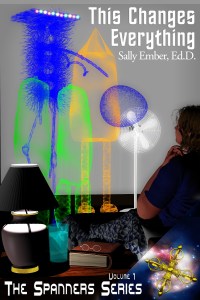
    This Changes Everything cover

  3. Diversified authors attract new fans constantly; permafree gives them as easy way “in” to a series. If the author continues to offer good content BETWEEN books (via a blog, postings on social media sites, email newsletters, author interviews on others’ sites and/or Blog Talk Radio and the like, podcasts, Google On Air Hangouts, and perhaps short stories or other genre fiction) and continues to come out with good writing for each subsequent volume, by Volume III or IV, that author will have a solid following, loyal fans and great sales, all still being “fed” by the permafree Volume I.

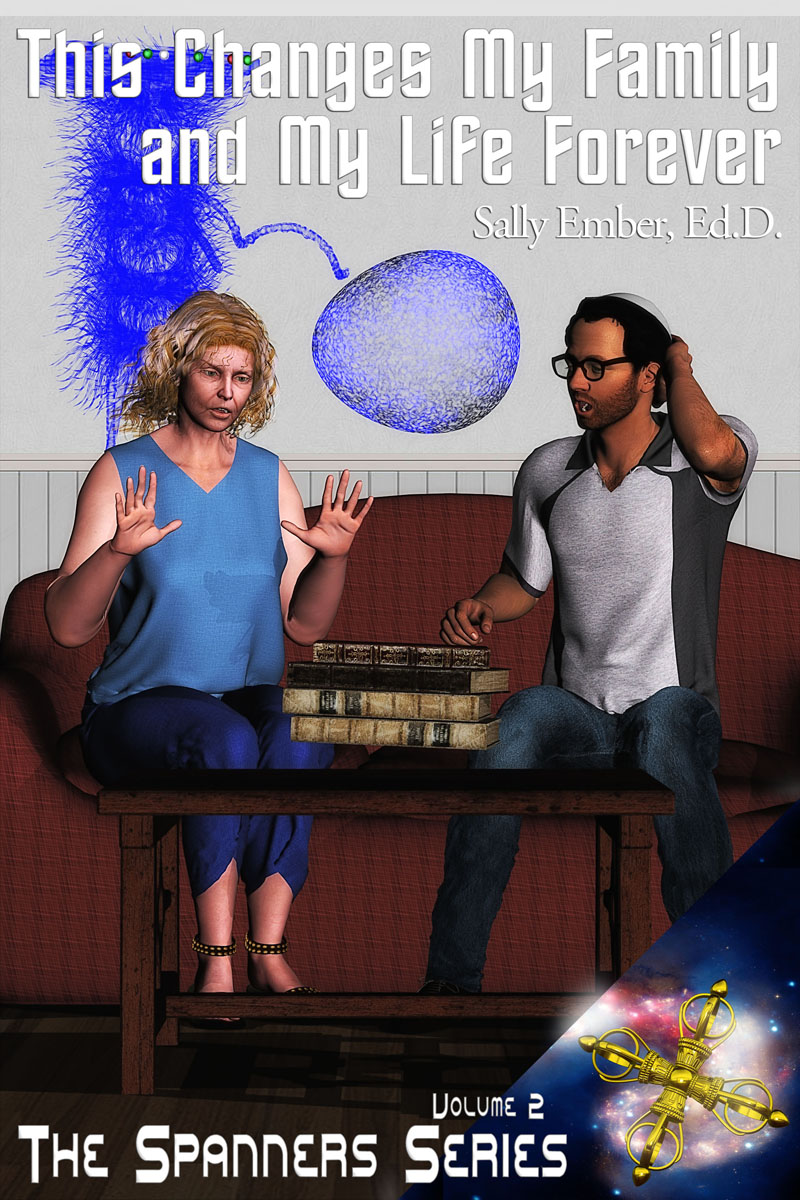
final cover - digital and web

So, The Spanners Series now has Volume I, This Changes Everything, in permafree status everywhere ebooks are sold because Volume II, This Changes My Family and My Life Forever, entered its pre-order period @$1.99 on April 1 and goes on sale June 9 at $3.99.

Since Volume I went free, the number of potential readers (reckoned by the number of downloaded volumes) has gone up 4000%. I am not joking.

I can’t see how well the pre-orders are going for Volume II, yet, or know what the sales figures will be. Reviews for it are due any day, now, and will keep coming in over the next several weeks, if all goes as planned.

I plan to post Volume I on more freebie sites and keep doing interviews, blogging, “creating and posting good content” as I work on Volume III, This Is/Is Not The Way I Thought Things Would Change, which is due out late in the fall of 2014.

I will check in periodically here to let you know how sales and downloads are going and what else happens.

Until/unless I become a gazillllllionaire author who doesn’t need to “bring in new readers” (when does that happen?), Volume I will remain free.

All downloading and purchase links for The Spanners Series as well as links to bloggers’ reviews, interviews and my archived blog posts are at http://www.sallyember.com on the right side panel.

If you want to learn more about Book Marketing, #authors, http://buildabusinesswithyourbook.com/access/aff/go/sallyember It starts this week/weekend!
Silver passes are FREE. Gold passes cost money, but I’m on Silver and it’s great! Lots of blog posts, interviews, videos, and more to help us do better with marketing wherever we are in our process. Check it out! Here’a a list of what’s offered just via the blog, just week one!

Sharon Williams: Developing Your Author Platform and Social Media Presence
Deborah Bateman: Building Your Online Platform as an Author
Eric Van Der Hope: 5 Steps to Developing an Effective Author Platform
Gina Akao: Marketing Your Book with a WordPress Blog
David Wogahn: SEO for Books: Optimizing Your Amazon Book Listing
D’vorah Lansky: Harness the Power of Your Amazon Author Central Page
Ellen Violette: How to Market Your Print Book or eBook in Just Minutes a Day
Penny Sansevieri: Harnessing the Power of Goodreads
Leeza Robertson: Quote Yourself on Goodreads
Amy Harrop: Leveraging the Author Tools of Goodreads to Promote Your Books
Michael Bloom: Promoting Your Book on Your Facebook Author Page
Bryan Cohen: Sixteen Heads Are Better Than One, on Facebook

Want to know more about making books permafree and see if these principles apply to YOUR books? Check out this article, linked to below.

Best to you all!

Why Free Is Your Best Marketing Tool And How To Harness It from The Future of Ink by PENNY SANSEVIERI

Great ideas, examples, and info as well as links to other helpful articles for authors like me who are doing our own marketing:
http://thefutureofink.com/free-is-best-marketing-tool/

Unknown's avatar

3 Reasons That This Changes Everything, Volume I of The Spanners Series, is Permafree

Before I put my first sci-fi/romance/multiverse/paranormal/speculative fiction ebook, This Changes Everything, Volume I of The Spanners Series, up for sale, I attended free webinars, read guidebooks and blog posts and did a lot of research to find out how other fiction ebooks authors managed this journey. I discovered many techniques, procedures and tips which I employed, including what price to use for sales, how to use a pre-order period, and when to offer a book for free (and why).

I have blogged about some of these topics already, but I haven’t written, yet, about why I decided to make Volume I “permafree” last month. I just did it. Now for the explanation, which is then going to be further explained and augmented by the article I’m including a link to, below.

As a new fiction author, I do not yet have a significantly sized “following” or “fan base.” So, I spent a lot of time finding out how one acquires readers and keeps them coming back for subsequent books, since I planned a 10-Volume series. I read others’ stories of their journeys, articles about successes and failures, and took extensive notes I still refer to, from the many webinars I attended.

    Here are the 3 reasons that This Changes Everything, Volume I of The Spanners Series, is permafree:

  1. Well-timed permafree works. Pricing is variable year to year, but market research has shown that series authors have been doing well to make the FIRST volume free, forever (permafree) AFTER later volumes come out. This brings in new readers consistently.

    logoAuthorsDen
    cover art for all covers by Aidana Willowraven.

  2. Permafree brings in the curious and good content keeps them coming back. If the first volume in a series is good enough evidenced by its having a sufficient number of UNPAID and UNFAKED reviews showing that the book is well-written and worth reading, more and more readers will come to download it. This creates the beginning of the author’s fanbase and followers. There will also be those readers who just download anything free, which is also great (but works best if they actually read the ebook after downloading it, like it, and decide to look for and purchase subsequent volumes.

    This Changes Everything cover

  3. Diversified authors attract new fans constantly; permafree gives them as easy way “in” to a series. If the author continues to offer good content BETWEEN books (via a blog, postings on social media sites, email newsletters, author interviews on others’ sites and/or Blog Talk Radio and the like, podcasts, Google On Air Hangouts, and perhaps short stories or other genre fiction) and continues to come out with good writing for each subsequent volume, by Volume III or IV, that author will have a solid following, loyal fans and great sales, all still being “fed” by the permafree Volume I.
final cover - digital and web

So, The Spanners Series now has Volume I, This Changes Everything, in permafree status everywhere ebooks are sold because Volume II, This Changes My Family and My Life Forever, entered its pre-order period @$1.99 on April 1 and goes on sale June 9 at $3.99.

Since Volume I went free, the number of potential readers (reckoned by the number of downloaded volumes) has gone up 4000%. I am not joking.

I can’t see how well the pre-orders are going for Volume II, yet, or know what the sales figures will be. Reviews for it are due any day, now, and will keep coming in over the next several weeks, if all goes as planned.

I plan to post Volume I on more freebie sites and keep doing interviews, blogging, “creating and posting good content” as I work on Volume III, This Is/Is Not The Way I Thought Things Would Change, which is due out late in the fall of 2014.

I will check in periodically here to let you know how sales and downloads are going and what else happens.

Until/unless I become a gazillllllionaire author who doesn’t need to “bring in new readers” (when does that happen?), Volume I will remain free.

All downloading and purchase links for The Spanners Series as well as links to bloggers’ reviews, interviews and my archived blog posts are at http://www.sallyember.com on the right side panel.

If you want to learn more about Book Marketing, #authors, http://buildabusinesswithyourbook.com/access/aff/go/sallyember It starts this week/weekend!
Silver passes are FREE. Gold passes cost money, but I’m on Silver and it’s great! Lots of blog posts, interviews, videos, and more to help us do better with marketing wherever we are in our process. Check it out! Here’a a list of what’s offered just via the blog, just week one!

Sharon Williams: Developing Your Author Platform and Social Media Presence
Deborah Bateman: Building Your Online Platform as an Author
Eric Van Der Hope: 5 Steps to Developing an Effective Author Platform
Gina Akao: Marketing Your Book with a WordPress Blog
David Wogahn: SEO for Books: Optimizing Your Amazon Book Listing
D’vorah Lansky: Harness the Power of Your Amazon Author Central Page
Ellen Violette: How to Market Your Print Book or eBook in Just Minutes a Day
Penny Sansevieri: Harnessing the Power of Goodreads
Leeza Robertson: Quote Yourself on Goodreads
Amy Harrop: Leveraging the Author Tools of Goodreads to Promote Your Books
Michael Bloom: Promoting Your Book on Your Facebook Author Page
Bryan Cohen: Sixteen Heads Are Better Than One, on Facebook

Want to know more about making books permafree and see if these principles apply to YOUR books? Check out this article, linked to below.

Best to you all!

Why Free Is Your Best Marketing Tool And How To Harness It from The Future of Ink by PENNY SANSEVIERI

Great ideas, examples, and info as well as links to other helpful articles for authors like me who are doing our own marketing:
http://thefutureofink.com/free-is-best-marketing-tool/

Unknown's avatar

Support #Authors this Month: Join Your Local #Writers’ Club!

Any writers' club

Are you a #writer/#author? Do you find yourself alone a lot or looking for other writers? You can belong to a local group almost anywhere in the USA and around the world, now, or start your own! Use the example of California, which has such a long-standing and active network of writers’ clubs, workshops, groups.

california-writers-club-redwood-writers-

I am lucky to live in California, home of a large network of excellent Writers’ Clubs, each with its own niche and geographic location. Each CWC has its own way of doing things, but there are some similarities and a set of by-laws.

CA writers club logo

The NorCal coalition of these clubs had an excellent annual meeting of leaders and newbies this past Saturday right in Newark. I was invited to attend by our club’s President, Carol Hall (Thanks, Carol!) and thoroughly enjoyed the day. Learned a lot, networked, shared. Exactly what a writers’ clubs’ coalition meeting SHOULD be!

My “home” club, since I live closest to it, is the Fremont Area Writers’ Club. Great people, excellent organization. Monthly meetings with guest speakers, activities, genre support critique sessions, as well as public open mike and book-signing/selling opportunities throughout the year. Thanks, FAW!

FAW logo

Every month at BookSmart bookstore in the Newark Park Mall, Newark, CA, we have an Open Mic at 7 PM on the 4th Monday. Come!

FAW other logo

There are writers’ clubs, reading groups, book clubs, writers’ critique groups/circles, and many more variations on these themes for writers and readers. For inspiration, information, support, ideas, networking, critiques and more: JOIN!

Do a web search, ask at your local library or bookstore (SUPPORT BOTH!).

Check for “writers” groups in your geographic area on http://www.MeetUp.com OR http://www.writers.com/groups.html

PLEASE support and join a group or attend an event as a guest this month. Volunteer, attend, participate! Keep books, writing, reading and sharing ALIVE!

Thanks!

Unknown's avatar

Artist’s Brains Have More ‘Grey Matter’ Than The Rest of Ours, Study Finds

What about writers’, musicians, and scientists’ brains? This is a VERY small study.

Sarah O'Flaherty's avatarInspired Journeys

The rather small study, published in NeuroImage, is based on the brain scans and drawing performances of 21 art students (graduates and undergraduates attending art and design courses in London at Camberwell College of Art and The Royal College of Art) and 23 non-artists. The scan findings also showed that those who identified as artists — as well as those who performed better on the drawing tests — tended to have more grey matter in the parietal lobe, a region involved with spatial orientation and cognition.

View original post 5 more words

Unknown's avatar

Yoga in Schools

For Lauri Stern and other yoga teachers and parents who do yoga!

Sarah O'Flaherty's avatarInspired Journeys

With yoga, comes teachings on breathing and meditation. All wonderful foundational tools for kids.

Research shows that yoga and other contemplative practices can help kids better regulate their emotions and behaviors in healthy ways. Findings from the Kripalu Yoga in the Schools (KYIS) initiative show that students who have been exposed to these techniques are less reactive, more optimistic, and better able to focus, concentrate, and interact with their peers.

View original post 7 more words

Unknown's avatar

Please Support #Indie Authors, Especially This Month!

Great way to do that is to vote on your favorite indie published book in each category. If yours isn’t there, submit it! You can vote up to 5 times!

Share! Please Vote for YOUR favorite (could it be THIS CHANGES EVERYTHING?) on the “50 Self-Published Sci-Fi Books Worth Reading” in Indie Author Land!

http://www.indieauthorland.com/vote-50-self-published-books-worth-reading-201314-science-fiction/
This Changes Everything cover

There are also other lists. Submit/vote up to 5 times! Leave comments, too.
http://www.indieauthorland.com/vote-early-vote-often/

SUPPORT-INDIE-ART

Unknown's avatar

30 Twitter Tips You Wish You Knew Years Ago

C+ for me, so far. #Learningtotweet

Nicholas C. Rossis's avatarNicholas C. Rossis

twitter tips Photo by thesocialskinny.com

Diana Urban posted 50 Tweetable Twitter Tips You Wish You Knew Years Ago on Hubspot. Here is a smaller selection of 30, for your convenience:

Optimizing Your Twitter Profile

1) Make yourself easy to recognize by using a close-up headshot of yourself as your profile picture.

2) Make the most of your Twitter bio. Show off your skills and uniqueness without over-hashtagging.

3) Twitter’s new profile design dimensions: header photo = 1500 x 500 px | profile pic = 400 x 400 px.

What You Should Tweet

5) Structure your tweets like this to increase clicks: KEY MESSAGE – LINK #HASHTAG AFTERTHOUGHT

6) Don’t be self-promotional on Twitter. Mix up your content and interact with your followers.

7) Curate content you tweet from a wide variety of sources to keep your followers interested.

8) Share images in your tweets to increase engagement, since images now appear inline on…

View original post 435 more words

Unknown's avatar

Time-lapse reveals planet as it was rocked by record-breaking earthquakes in April 2014

Very cool science visuals of earthquake activity for April, 2014.

Salty's avatarThis and That

The earth was rockin last last month! Earthquakes from January 1 to April 30, 2014. Article link below the video.

Articlehttp://www.sott.net/article/278400-Time-lapse-reveals-planet-as-it-was-rocked-by-record-breaking-earthquakes-in-April-2014

View original post

Unknown's avatar

What exists beyond the edge of the Cosmos?

True story: When I was about 10 years old and forced to attend Jewish religious education classes weekly (“Sunday School”), I got kicked out of class by repeatedly asking the teacher, then the Rabbi: “If God created everything, who created God?” and refusing to stop asking until they answered, which they could not.
I’m sure I wasn’t “nice” about it, which is probably how they justified kicking me out. But, really: what IS the answer to that question for theologians and theists? I’m a multiverse adherent, myself, from way back.
But, what could these Goddists possibly respond?

John C. Bader's avatarThe Responsive Universe

I have always been a backyard astronomer. Even as a small child, my love for the stars and the cosmic unknown have been a lifelong interest.  I possess a couple of telescopes including a 10” diameter Dobsonian telescope. It looks like a large cannon and it might even embarrass my wife a little when I drag the 65lb beast out in the back yard on a clear night. I even blog about the various deep sky objects I find – though I have not been very active lately.

earlycosmosDeep Sky Image – Courtesy of NASA

A couple of years ago a seemingly uninteresting but historic image was taken by the Hubble Space Telescope offering a glimpse of what scientists are calling the oldest object so far discovered in the Universe – a young galaxy. Well, let me rephrase that; it was a young galaxy. A pixellated blip on a black background…

View original post 564 more words

Unknown's avatar

Support an Author Month: Love a Blogger! ~ #saam14

Yes, Please: LOVE your favorite bloggers. Here are the ways: share their posts. Follow/subscribe to their blogs. Visit and leave interesting comments. Engage with others’ comments. Buy their books/products and/or recommend them to others. Tweet their blog URLs and latest posts with your comment. Re-post their content on re-posting sites (Reddit, StumbleUpon, etc.). Reblog their posts with your comments. Invite them to guest-post on your site or offer to guest-blog on theirs (if they invite such and you are compatible/capable/available). Write reviews, rank, rate, vote up their books on Goodreads, Listopia, Amazon’s Listmania. Put their books on your “Wish Lists” or “To Buy” lists on book selling sites. Buy their books in indie bookstores. Tell your indie bookstores how glad you are they’re still viable and carrying YOUR favorite authors’ books. Come up with your own ways to SUPPORT AUTHORS this month!

Unknown's avatar

Un-Wiring Your Brain

Would someone please read this and see how it relates to my blog post today about the effects of concussion on meditators?

Diana E Writer's avatar365 Days of Buddha

Imaginary Pictures Buddha.

20140425_121017

If you’re as fascinated as I am by the science-behind-mindfulness, check out this article from Scientific American called Neuroscientists and the Dalai Lama Swap Insights on Meditation.

View original post

Unknown's avatar

THE PASSING OF A FRIEND – THE LAST STORY…

Important, always timely info and advice. Please share! We ALL die.

candacepalmo's avatar BIRTH AND DEATH AND IN BETWEEN

Ten days… From his diagnosis to his death… Ten days.

It gives one pause.

will and testamentMany people have asked. Did he see this coming? Was he prescient? If not, then why did he spend months last fall, while he was presumably healthy, preparing to die – educating himself about death and dying like it was another doctoral thesis? He examined the subject thoroughly from every possible perspective. He contemplated it from a deeply spiritual view in his Buddhist tradition. He became knowledgeable in a practical sense about getting all his affairs in order. He even left signs around his house. “If you find me dead, call these people. Everything is in my briefcase.” He learned about end of life care and hospice services. He went on a road trip, healing old relationships and taking care of unfinished business. “We never know when impermanence will strike,” he used to stay. “You breathe out…

View original post 561 more words

Unknown's avatar

15 Points about the #Effects of #Concussions on #Meditators’ #Brains

What are the #effects of #concussions on #meditators’ #brains? Many doctors and patients now agree that #meditation helps relieve pain and stress. Therefore, meditation is recommended post-concussion for many with injured brains.

However, I haven’t found anything for my problem: my concussion makes it impossible or difficult/painful for me to meditate. What happens to those who are already long-time meditators (such as I am; 42 years), post-concussion?

It’s fewer than four weeks since my injuries. I still have a lot of trouble and need to take much more time than usual to think clearly enough and to write well enough (neither up to former standards) to put this post together. Forgive its clumsiness, please.

Let me explain, first: the type of meditation I currently do is advanced. This means that the meditation techniques take years to learn. Practice is not just for twenty minutes a day or relegated to a physical posture or on a meditation cushion. This type of meditation involves components of many other types as well as more aspects which are unique to it. It is a Tibetan Buddhist practice called dzogchen (“Great Perfection”) that is supposed to occur all day and into the night (excellent practitioners do it 24/7). It takes years to cultivate this ongoing meditation as a habit.

Therefore, whatever brain parts most meditators are activating, meditators doing dzogchen meditation are utilizing those parts plus a few more, and all the time, once we’re “getting it.”

Post-concussion, the worst after-effect, for me, was being unable to meditate. This is comparable to being unable to eat sufficient food or breathe enough air. We can survive, but we are not well, you see?

What about having had a concussion is preventing me from meditating? Why do certain parts of my brain hurt when I try to meditate?

Finding nothing to answer my questions all in one place, I did some of my own research to help me understand and share what has been happening to me since my injury on April 6.

Here is what I found to be true, complete with PET scans, MRIs of brains and other visuals.

1. Scientists are learning more annually about the ways that meditators’ brains are different than non-meditators:

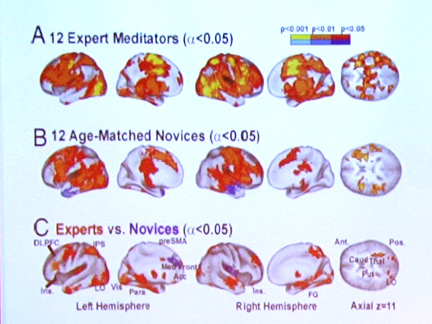
meditators and nonmeditators brains

image from http://www.exploratorium.edu

Conclusions from above: meditation activates parts of our brain that ordinary brain activities do not.

2. Insight or Vipassana (Vipashana) meditators’ brains have been studied most. Here are some pictures to show how much that type of meditation changes the brains of Insight meditators:

insight meditators brains

image from http://www.nmr.mgh.harvard.edu

3. How else does meditation change one’s brain?

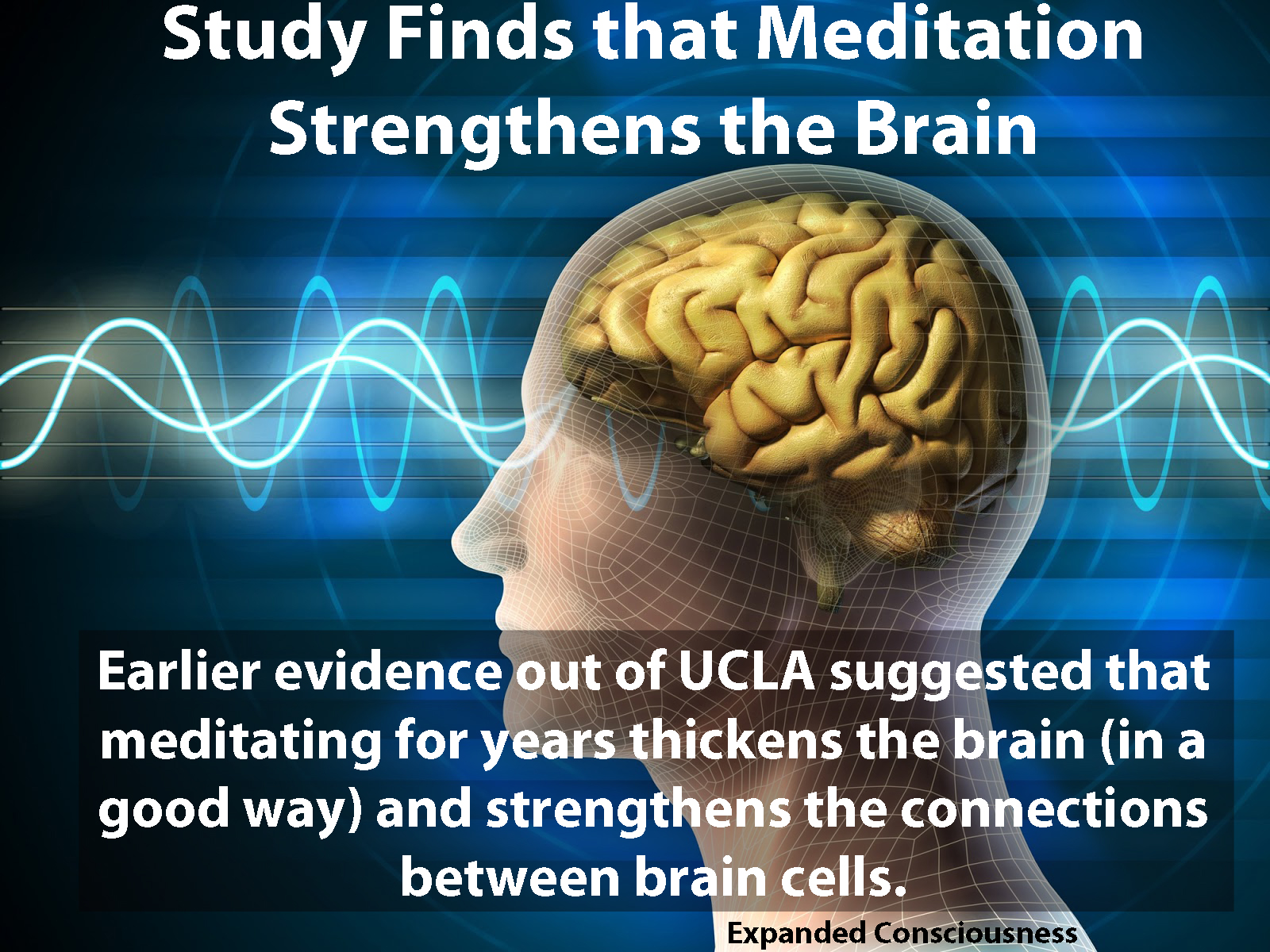
Brain-waves improve from meditation

image from expanded–consciousness.blogspot.com

Meditators’ brains have thicker cortical areas and other parts are also strengthened unusually by meditation. Our brain waves are different even when we are not meditating. Really.

After feeling pain in three particular areas of my brain that hurt (even though my son and others claim we can’t feel pain in our brains… pooh) and the increased pressure in these areas every time I meditated, which made me stop, I went on a research treasure hunt to answer these questions.

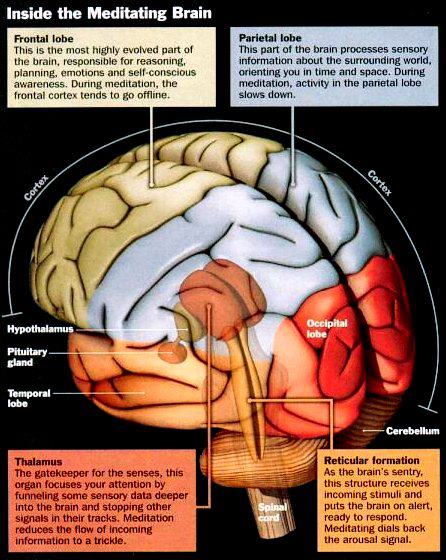
4. What parts of the brain are used in meditation and what types of meditation use what parts most?

brain parts and functions

image from http://www.8limbsholistichealth.com

For me, the thalamus and frontal areas were most impacted and affected, so far, since the front of my face/forehead hit the wall, and since those areas are involved in my type of meditation. However, I could imagine that other injuries/affected areas could impact your meditation differently.

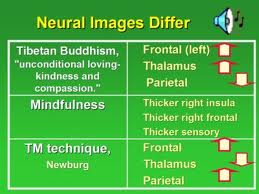
5. What about different kinds of meditation and where in the brain they occur?

variations in types of meditation on brain parts

image from http://www.fredtravis.com

Definitely the thalamus and all frontal areas are affected, for me. I guess I don’t feel the impact in the pariental lobe because mine wasn’t so injured. Again, your experiences could vary a lot.

6. What are the effects on various parts of the brain from a concussion? From my recent and current personal experience, I can answer that. These photos also back up my own understanding completely.

I felt pain and pressure immediately after the concussion when I automatically started to meditate which forced me to stop. Repeatedly. Over time, that pain became most apparent in three locations.

“Recent studies have shown heightened activity in the anterior cingulate cortex, frontal cortex, and prefrontal cortex, specifically in the dorsal medial prefrontal area during Vipassana meditation. Similarly, the cingulate cortex and frontal cortex areas were shown to have increased activity during Zen meditation”
http://en.wikipedia.org/wiki/Brain_activity_and_meditation

Thanks to Wikipedia, I began to understand what was happening to me and why.

7. Meditators use these parts of our brain when we meditate:

PET brain images meditation 1

image from uonews.uoregon.edu

When I found this picture, it made me cry. These are the parts that hurt when I try to meditate, all lit up and obvious. I can just point and you can understand.

8. When we look at three brains: one uninjured, one with a concussion, and one with a severe TBI (Traumatic Brain Injury), we notice obvious differences, particularly in these areas mentioned, above:

normal severe TBI concussion images

image from http://www.vitamindwiki.com

To orient you: top of photos = forehead/frontal areas of brain. Look at the differences in these three scans in that area, particularly. Startling, huh?

9. How does a concussed brain show up on an MRI?

MRI_scan_concussion

image from http://www.ninds.nih.gov

I could be wrong, here, but I think these scans are oriented in opposite ways from those in #8. Top = back/neck, or the occipital lobe area. Look, therefore, at the bottoms of these scans to see how the frontal areas are affected.

Remember, though: most concussion injuries and symptoms do not show up on MRIs, CAT scans or X-rays, even when taken on the same day as the injury, much less those taken weeks or months later. Functional MRIs and PET scans are slightly better, but many effects are just not all that easy to visualize with the technology currently available.

10. What other signs of impact (concussion) on a brain can we see?

impact injuries on brain cross cuts

image from http://www.webdicine.com

For best understanding, contrast the picture in upper left with the one in the lower right. That’s my brain. Yuck.

11. Remembering what parts of the brain we use for meditating, look at these before-and-after scans of a concussed brain:

brain before and after concussion scans

image from http://www.policymic.com

This time, the orientation is like this: forehead/frontal area is on the left of each scan; neck is on the right. Notice the frontal areas’ changes from scan to scan. Heartwrenching, to me.

12. Pay particular attention to the “frontal bruise” on this concussed brain (similar to what I experienced on April 6 when I hit the wall with my nose/face and broke my nose/got concussed):

concussion bruise on frontal area

image from kerlanjobeblog.com

Don’t you just have to say “ouch!” after seeing this frontal bruising? Empathy is easier when you can see it all in front of you.

13. Here is that PET scan, again, of a meditating brain. Notice what parts are “activated” (by colors):

PET brain images meditation 1

image from uonews.uoregon.edu

Now you begin to see more clearly how concussions impact meditation?

14. Our brains should look and function this way when we meditate:

meditation-mind-brain-waves

image from blog.bufferapp.com

I sorely miss the feelings of “after,” calmness and joy which I normally would experience all day long. Awful losses, here. Luckily, purports to be temporary.

15. In conclusion, this quote incorporates the research I found and speaks to my particular injuries to explain why I can’t meditate and the effects of that on me: “The two important areas of the brain that feature prominently in meditation research are the frontal lobes, located in the area of the forehead, above the eyebrows and the limbic system which is deep inside the centre of the brain. Generally speaking, these two areas function and interact to influence our behavior, emotions, thinking, and what we’re going to do with our life. In other words together they have a profound influence on our personality, who we are and how we feel. The other parts of the brain [featured in meditation research] are the parietal lobes, at the top of the head, which primarily deals with the physical body, the occipital lobes at the back of the head that deal mostly with vision and the temporal lobes, above the ears, which deal with auditory information.” 
http://www.beyondthemind.com/extras/meditation-the-brain/frontal-lobes-the-limbic-system-meditation-mental-silence/

Best part of all this? IMPERMANENCE. This, too, shall pass. Injuries tend to resolve. Healing does occur.

Best wishes to all who are in recovery phases from TBIs and concussions. May all beings benefit.

Unknown's avatar

10 Things Creative People Know

Support the #arts in #education and at #home!

Sarah O'Flaherty's avatarInspired Journeys

A recent UCLA study found that when young people engage in the arts at an early age, they outperform their peers in every category, from academics to life skills. Cross-cultural anthropologist Angeles Arrien tells us that in many traditional cultures, when an ill person goes to the healer, he or she is asked four questions: When did you stop singing? When did you stop dancing? When did you stop telling your story? When did you stop sitting in silence? She calls these the healing salves. Numerous studies show that activities like drawing and creative writing—even knitting—raise serotonin levels and decrease anxiety.

This quote is taken directly from Peggy Taylor and Charlie Murphy’s article on the things that creative people know.

View original post 56 more words

Unknown's avatar

When Your Father Dies

For all those who have lost their fathers recently or who still feel the loss.

Jan Wilberg's avatarRed's Wrap

When your father dies, you will be at a loss for words.

If it’s a surprise, you will burst into tears. You will cover your face with your hands and cry like you were six-years old, like the time you got lost on the way home from school and all the houses looked different and you couldn’t find your way. That’s how you’ll cry.

If you knew it was coming, that your dad was going to die because he was so ill, you will lay your head down on your folded arms and weep. You will be tired and part of you will be grateful because nothing is worse than seeing the man who laughed and lifted you up and twirled you around confined to a hospital bed, silent and hurting.

You will wonder who you are now that your father is dead. If your mother is also dead, it…

View original post 465 more words

Unknown's avatar

The Story Behind Leo

OK: friends and family, weigh in on THIS Leo! Leave comments, please!

Jessica Davidson's avatarJessica Davidson

Leo Symbol Each sign of the zodiac represents an archetype. These are elemental structures in the psyche which give shape to our lives and inspire meaning through myth. Astrology is a multidimensional, multivalent system of storytelling. The myths behind your horoscope form a complex web of meaning which underpins the narrative of your life. The gods are alive and living through you…

Leo Myths

Leo is all about creativity and self-creation. They are intuitive, childlike, idealistic, and fiercely loyal. Leo is almost more of a noble Knight than Aries, but instead of all the fighting, it’s more about the poncing about and showing off, as they do tend to think the world revolves around them. Leos are truly original and charismatic, although often not as confident as they seem.

View original post 278 more words

Unknown's avatar

8 Great Literary, Book Nerd, and Storytelling Podcasts

Worth exploring!

Andrea Badgley's avatarAndrea Reads America

I am a huge fan of the podcast medium. I listen while I clean, while I walk, while I cook, while I dress after my shower. I do not subscribe to print periodicals that run book reviews, I am not a librarian, and I no longer work in a book store, but I am a reader who is interested in what’s going on in the book world, in reading culture, and who loves a well-told story. With limited time to consume print media, but with ample time to listen, I have become an avid fan of podcasts, and my hungry mind devours the bookish and storytelling podcasts below. These shows provide the literary fix I need as a word nerd. I plan special walks or add extra chores to my list when any of these drop new episodes. I hope you enjoy them, too.

The New Yorker Fiction Podcast icon on iTunesThe New…

View original post 1,022 more words

Unknown's avatar

5 Things Wrong with #Sex Scenes in #Romance Novels and How to Improve Them

5 Things Wrong with #Sex Scenes in #Romance Novels and How to Improve Them

1. Men, even the first time having sex with a long-awaited or extremely attractive partner, can last more than fifteen seconds (three thrusts) before orgasm, even when impassioned, unless they are under age 20 or suffer from PME (Pre-Mature Ejaculation), in which case, that man is not a good candidate for being the romantic lead.

Dear Jayne Ann Krentz/Castle/Amanda Quick or any of the 4 other pseudonyms you use: I’m sorry the men/man you have sex with can’t last more than fifteen seconds after being undressed, touched, licked or inside a woman. The rest of us have had better lovers. I pity you.


PME timer
image from healthystateofthinking.blogspot.com

2. Oral sex in the 2010’s is not shocking, novel, strange, shameful, disgusting or horrifying. Really. No recipient or provider should be having these reactions unless the participants are ages 15 and under, in which case, please do not depict them having sex. That is not “romantic”: that is sexual exploitation of minors.

Dear YA Authors: take note. Teens having sex (and oral sex DOES count, despite President Bill Clinton’s assertions to the contrary) with older lovers (having more than a five-year age difference when over 14; more than a two-year difference when under 14) are victims of statutory rape in most US states.

3. Having protagonists/female leads who are “virgins” or incredibly inexperienced with sex in the 2010s, yet who are stunningly beautiful, capable and independent who are older than twenty is absurd. This characterization of inexperience as what makes a woman desirable caters to archaic/paternalistic fantasies.

Dear Historical Fiction Romance Authors: You may be exempt from the atavistim, but you are nonetheless feeding into these fantasies. Please stop. It’s okay to depict these girls/women as appropriately inexperienced, but to make that lack of knowledge the center of their attractiveness means that after one encounter, they automatically become less attractive. Awful.

4. Thanks for including clitoral stimulation in heterosexual sex scenes. Thanks for depicting male romantic leads who not only know the clitoris exists, but can find it, know how to please a woman, and want to do this. It only took about 100 years of romance writing to get men to be this aware. Okay.

Dear Modern Romance Writers; Now that we’ve established that clitoral stimulation is important and necessary for females’ sexual satisfaction, not every sexual encounter has to depict women’s having both oral and digital stimulation to the point of orgasm, always having multiple orgasms and the woman having the first orgasms before the man’s, every time. Repetition and routine kill sex. When a reader becomes bored reading the sex scenes, you have failed.


how to find clitoris
image from http://www.buzzfeed.com

5. Bondage, rape, domination and other masochistic sexual relationships are NOT psychologically healthy sexual expressions even if consenting adults decide to act these out. Also, these “relationships” do not accurately depict what occurs in most women’s lives and your characterizations set women back about three centuries.

Dear Shades of Whatever Authors: We know your books sell well. We know they’re not especially well-thought-out or well-written, are easy to write and are quick to get published. Since you insist on writing and publishers insist on publishing these types of drivel as “romance,” could you at least occasionally depict a strong, intelligent, capable woman who refuses to engage sexually with such mentally ill men? PLEASE?


not-sex
image from feministing.com

Three ways to write better sex scenes:

1. Have sex scenes in which a variety of activities occur with enthusiastic, willing participants of legal ages and with male participants who can last longer than fifteen seconds when erect.

2. Depict at least some of your female leads as strong, capable, experienced and independent prior to having sex as well as during and after meeting their romantic lead.


feet
excelle.monster.com

3. Include some sexual encounters in which female’s multiple or simultaneous partners’ orgasmms do not occur and participants are happy with each other, anyway.

Thanks, Romance Authors who already write sex scenes like this. Many of you do.

Unknown's avatar

5 Things Wrong with #Sex Scenes in #Romance Novels and How to Improve Them

5 Things Wrong with #Sex Scenes in #Romance Novels and How to Improve Them

1. Men, even the first time having sex with a long-awaited or extremely attractive partner, can last more than fifteen seconds (three thrusts) before orgasm, even when impassioned, unless they are under age 20 or suffer from PME (Pre-Mature Ejaculation), in which case, that man is not a good candidate for being the romantic lead.

Dear Jayne Ann Krentz/Castle/Amanda Quick or any of the 4 other pseudonyms you use: I’m sorry the men/man you have sex with can’t last more than fifteen seconds after being undressed, touched, licked or inside a woman. The rest of us have had better lovers. I pity you.


PME timer
image from healthystateofthinking.blogspot.com

2. Oral sex in the 2010’s is not shocking, novel, strange, shameful, disgusting or horrifying. Really. No recipient or provider should be having these reactions unless the participants are ages 15 and under, in which case, please do not depict them having sex. That is not “romantic”: that is sexual exploitation of minors.

Dear YA Authors: take note. Teens having sex (and oral sex DOES count, despite President Bill Clinton’s assertions to the contrary) with older lovers (having more than a five-year age difference when over 14; more than a two-year difference when under 14) are victims of statutory rape in most US states.

3. Having protagonists/female leads who are “virgins” or incredibly inexperienced with sex in the 2010s, yet who are stunningly beautiful, capable and independent who are older than twenty is absurd. This characterization of inexperience as what makes a woman desirable caters to archaic/paternalistic fantasies.

Dear Historical Fiction Romance Authors: You may be exempt from the atavistim, but you are nonetheless feeding into these fantasies. Please stop. It’s okay to depict these girls/women as appropriately inexperienced, but to make that lack of knowledge the center of their attractiveness means that after one encounter, they automatically become less attractive. Awful.

4. Thanks for including clitoral stimulation in heterosexual sex scenes. Thanks for depicting male romantic leads who not only know the clitoris exists, but can find it, know how to please a woman, and want to do this. It only took about 100 years of romance writing to get men to be this aware. Okay.

Dear Modern Romance Writers; Now that we’ve established that clitoral stimulation is important and necessary for females’ sexual satisfaction, not every sexual encounter has to depict women’s having both oral and digital stimulation to the point of orgasm, always having multiple orgasms and the woman having the first orgasms before the man’s, every time. Repetition and routine kill sex. When a reader becomes bored reading the sex scenes, you have failed.


how to find clitoris
image from http://www.buzzfeed.com

5. Bondage, rape, domination and other masochistic sexual relationships are NOT psychologically healthy sexual expressions even if consenting adults decide to act these out. Also, these “relationships” do not accurately depict what occurs in most women’s lives and your characterizations set women back about three centuries.

Dear Shades of Whatever Authors: We know your books sell well. We know they’re not especially well-thought-out or well-written, are easy to write and are quick to get published. Since you insist on writing and publishers insist on publishing these types of drivel as “romance,” could you at least occasionally depict a strong, intelligent, capable woman who refuses to engage sexually with such mentally ill men? PLEASE?


not-sex
image from feministing.com

Three ways to write better sex scenes:

1. Have sex scenes in which a variety of activities occur with enthusiastic, willing participants of legal ages and with male participants who can last longer than fifteen seconds when erect.

2. Depict at least some of your female leads as strong, capable, experienced and independent prior to having sex as well as during and after meeting their romantic lead.


feet
excelle.monster.com

3. Include some sexual encounters in which female’s multiple or simultaneous partners’ orgasmms do not occur and participants are happy with each other, anyway.

Thanks, Romance Authors who already write sex scenes like this. Many of you do.

Unknown's avatar

Support An Author Month ~ #saam14

Support an author month = May? Fantastic! There is a “DONATE” button on my website (and many others’, sometimes called “Tip Jars”), so please feel free to express your support with cash! Comments, Follows, LIKES and purchases of /downloads of and reviews, ratings, rankings, votes on lists for our books also very welcomed! Thanks to ALL #authors and #readers!

Unknown's avatar

Part 2, Grants for Writers

More opps for writers, with MONEY or free stays for writing time. Thanks, Savvy Writers!

ebooksinternational's avatarSavvy Writers & e-Books online

.
file4071332781969

.

Would you like a free work-vacation stay, maybe in Paris, France or in Bellagio, Italy? Sometimes even paid… as a Writer-in-Residency? Book mark these tips and links and check periodically the deadlines for grants, fellowships or writers residencies. Besides accommodation, writers often receive a stipend and travel expenses paid. A great way for writers to get out of their routine, find time to write, solitude and possibilities to advance their career. See also Part 1 of Grants for Writers.

.
Rockefeller Foundation Bellagio, Italy, Residencies
Four-week residencies between March 10 and July 31, 2015. Open to composers, novelists, playwrights, poets, video/filmmakers and visual artists from around the globe, with the goal of bringing together people of diverse expertise and cultures in a thought-provoking creative environment. Spouses/life partners may accompany the resident, or may apply for a concurrent residency. The Center also offers collaborative residencies for two to four persons…

View original post 1,019 more words

Unknown's avatar

The 10 Social Media Commandments for Authors

Nicholas C. Rossis's avatarNicholas C. Rossis

10 commandments Photo found on telegraph.co.uk

Anne R. Allen published a great list with The 10 Commandments of Social Media Etiquette for Writers on her blog. Here’s a brief summary: If you don’t have anything nice to say, don’t say it.

Not enough?  Alright then, here are ten tips for online behavior for people planning a writing career:

1) Thou shalt not spam.

What is spam?  Here’s the short version: if you’d ignore it in your own inbox, FB page, or Twitter stream, it’s probably spam.

2) Thou shalt support other authors.

Your fellow authors are not “rivals”. The number one thing a beginner should be doing on social media is getting to know other authors in your genre and subgenre and making friends.

One of the hottest sales tools in the business right now is the multi-author bargain boxed set with several titles by different authors. These boxed sets are getting on to…

View original post 740 more words

Unknown's avatar

#Opportunities in May and June for #Writers from #Aerogramme

In case you missed this posting, check out these #publication opportunities, #grants, #conferences and #festivals, #competitions and #prizes/#awards and more for #writers. Occurring/deadlines are in May, June, ongoing/rolling and beyond.

Compiled by Aerogramme Writers’ Studio. Thanks!

My favorite: Electric Literature’s Recommended Reading
publishes one story a week and reopens for submissions on 1 May. Previously unpublished fiction ranging in length from 2,000 to 10,000 words will be considered and each contributor is paid US$300.
https://electricliterature.submittable.com/submit

trophy

http://www.aerogrammestudio.com/2014/04/24/opportunities-for-writers-may-june-2014/?utm_source=feedburner&utm_medium=feed&utm_campaign=Feed%3A+AerogrammeWritersStudio+%28Aerogramme+Writers%27+Studio%29

Unknown's avatar

Have the Homeless Become Invisible?

This is chilling. We have generated an impossible economy to sustain. The people without jobs and homes are just the “canaries in the mines” whose “asphyxiations” we ignore at all of our perils.

Kindness Blog's avatarKindness Blog

In this social experiment, unsuspecting people walked by relatives pretending to be homeless. Would they notice their family members? Or have the homeless become invisible? Watch how each person reacts after the big reveal in the video below.

View original post

Unknown's avatar

Upcoming Grants for Writers

Want cash while you’re writing? Check out these opps!

ebooksinternational's avatarSavvy Writers & e-Books online

.

Switzerland

.

Are you living in the USA, Canada or United Kingdom? The following grants, fellowships or writers residencies are mostly offered on a yearly basis, sometimes even twice a year. Bookmark their links and check periodically their deadlines. Besides accommodation, writers often receive a stipend and travel expenses paid. A great way for writers to get out of their routine, find solitude and time to write in order to advance their career.

.
Iowa Artist Fellowship
The Artist Fellowship provides support to individuals who demonstrate exceptional creativity in the arts and the capacity for continued contributions to the excellence and innovation of the arts in the State. The Artist Fellowship Program seeks to elevate the arts in Iowa by advancing the artistic careers of Iowa artists through funding and professional development. The Iowa Arts Council awards each fellow $5,000 to support the development of their artistic career.
Deadline May 1…

View original post 1,061 more words

Unknown's avatar

Links/Similarities between Tibetan and Native American groups.

I have also found striking linguistic and phenotype similarities between the the Navajo and Tibetan peoples, particularly in the syntax of both languages, influencing the tonal and syntactical ways many of the ones I have spoken with speak English as a non-native language and in their facial features. Can’t be coincidences.

Unknown's avatar

Vegan Enlightenment

What do you think of this? I’m ambivalent.

Anupadin's avatarThe Search For Enlightenment

Vegan EnlightenmentMy friend and fellow vegan Juliet defines the vegan practice thus: Veganism is a way of living which seeks to exclude, as far as possible and practicable, all forms of exploitation of, and cruelty to, animals for food, clothing or any other purpose.

Enlightenment is a state in which we are aware of the ultimate truth and meaning of everything. As a Buddhist, I strive for enlightenment and also try to avoid, as far as possible, bringing harm or suffering to any other living creature.

When we are aware that each moment of each day, each gesture and step we take, is truly mystical and full of wonder, we will live our lives with greater thought and care. We will also have greater respect and appreciation for the lives of others.

The two overlap in many ways, and although you don’t have to be Buddhist to be vegan, or vegan…

View original post 12 more words

Unknown's avatar

And The Tantrums Will Follow by Nonnie Jules

A forward-thinking, innovative fellow indie author ! Get to know Nonnie and her work!

Bruce A. Borders's avatarBruce A. Borders

Today, I’m happy to welcome author Nonnie Jules! She is the founder and President of
Rave Reviews Book Club and is stopping by on her latest blog tour. And now, here’s Nonnie:

~ ~ ~
Hello, and welcome to Day 8 of my 15-day, “HAPPY BIRTHDAY:  ARE YOU WATCHING NONNIE WRITE” Blog Tour.  I’m so pleased that Bruce has welcomed me here today.  I’m equally excited to be sharing with all of you, his readers and followers.  Bruce and I are fellow Board Members at RAVE REVIEWS BOOK CLUB,where we promote and support Indie Authors and readers alike.  If you’d like to know more about RAVE REVIEWS BOOK CLUB, visit us here www.RaveReviewsByNonnieJules.wordpress.com.
This month marks the one year anniversary of my burst onto the social media scene and it’s also the one year anniversary of my blog “WATCH NONNIE WRITE!”, and during that time, I…

View original post 1,165 more words

Unknown's avatar

19th Serialized Excerpt: Vol. II, This Changes My Family and My Life Forever, The Spanners Series, by Sally Ember, Ed.D.

Vol. II, This Changes My Family and My Life Forever, The Spanners Series, by Sally Ember, Ed.D.

final cover - digital and web

Cover and logo art by Willowraven.

19th Serialized Excerpt, 4/14/14

CHAPTER SNAPSHOT #2

Snapshots of Clara’s Daily Life: Fourteen Octobers, 1963 – 2017

October, 1968

(continued)

“I get sent to the office on several occasions because my skirt or dress is deemed ‘too short.’ This designation is made first by a teacher. Once at the administrators’ office, accused offenders have to kneel on the floor. If our skirt or dress does not touch the ground, we are to be sent home to change (meaning, someone has to come pick us up in a private car, since there is no reliable or close-enough public transportation), unless we opt to wear our hideous ‘gym suits’ the rest of the day.”

“Ironically,” Clara goes on, showing me with her hands how this outfit works, “this jump suit is a sleeveless top with shorts, so it shows more of our legs than any permissible skirt would. Since my mom is home with my youngest sister and often one of them is sick, I can’t get picked up, so gym suit it is.”

“‘Getting suited’ occurs on numerous occasions for many of us ‘popular’ girls. This circumstance, wearing our horrible gym suit around school for the rest of a day, becomes like wearing a badge of honor. We are the ones who dare to wear a skirt that we know in advance is too short (some of us roll the waistbands after leaving home in order to achieve a shorter hemline) and which ‘dooms’ us to wearing our gym suits. Everyone knows this must be intentional. My friends and I make ‘getting suited’ cool.” Clara laughs. “We’re such trend-setters in 1968!”

“You won’t believe the P.E. [Physical Education] classes’ misogynistic and unfair fashion policy: Here it is, summary fashion,” Clara says. “The boys get to wear a comfortable, regular T-shirt and shorts (in white and blue, respectively, our school colors) for P.E. Girls, however, have to wear these ridiculous gym suits. This detested thing is a one-piece, blouson number in an almost-royal blue color. It has an elastic waist and snaps on the too-loose sleeveless bodice with medium-length shorts attached. It has to have been designed to make every girl look terrible in it regardless of body type, which I suppose is a great leveler.”

“As I explain earlier,” Clara reminds me, “if girls forget this monstrosity at home or don’t wash it, don’t have it or don’t wear a clean-enough suit to every class (each girl is issued two and must have one to wear for each P.E. class, every day), we are marked down in our grade and also, made to stay after school (like, a detention).”

“These administrators are so uptight, they treat these infractions the same as forgetting homework or vandalizing the bathrooms. Earn enough detentions and we have to come on a Saturday, too (like the movie, The Breakfast Club), just for “not suiting up.” If we get marked down enough, we could flunk this required class and have to take it again in summer school. I am not kidding!”

Clara is still indignant, these 45 years later. “Lowering academic grades for appearance issues, particularly failing a student for noncompliance to a dress code, becomes illegal, but not yet.”

“Back to the dress code,” Clara goes on. “The only short skirts girls are allowed to wear to school have to be culottes, which are split skirts or skirts with shorts inside (sound familiar?), but only cheerleaders are allowed to wear them. Now you’re starting to understand some of the reasoning behind my wanting to be a cheerleader,” Clara tells me.

“In a typical fall or winter month, once a week all through 9th grade (on “game days,” meaning, a day the 9th-grade boys’ team of the season has a football or basketball game, usually a Friday), I get to wear my cheerleader’s outfit. The rest of the year I am at war with the skirt police and usually ‘get suited.'”

“I wear my gym suit proudly, regularly showing it off in defiance of the school’s absurd policies. There are usually a group of us on any given day. We walk down the halls showing off our legs and laughing at the adults for being such dimwits,” Clara explains. “We show more of our legs wearing these gym suits than we do in any skirt!”

I say mildly, “Quite the rebel, eh?”

Clara misses my light sarcasm, so intent on telling her story of these years. “Some teachers think I’m ‘interesting,’ ‘intelligent’ and ‘fun.’ I know because they tell me or my parents. Others detest me and the feeling is mutual.”

Clara grimaces. “Wearing short skirts and being a ‘smart-aleck’ are what passes for rebellion for a teenage girl in my era, in this town. So, yes. I am a ‘rebel.'”

Guess she does catch my sarcasm. I move to apologize, but she smiles at me and goes on.

“I earn a reputation for ‘being sassy,’ a term only applied to girls who talk back to authority in southern-bordering or actual southern states. In contrast—more sexism, here—a boy who talks back is told to stop ‘giving me lip’ by the adult who is being challenged.”

She looks at me, making sure I understand, then continues. “Disobedient girls are ridiculed and patronized; impertinent boys are given grudging respect by being viewed as threatening. See the difference?”

I nod.

Clara goes on with her reminiscing. “At one point in my dress-code and behavioral scofflaw years, my cheerleader’s status is jeopardized because I refuse to back down in some argument with the chorus teacher about where I am supposed to sit. I dimly remember that she is trying to separate me from my friends because we are ‘disruptive,’ meaning, we are talking and having fun in class. For these ‘bad behaviors,’ she wants to move my seat. I am an alto but she wants to move me to the second sopranos, which is not the part I sing. I refuse to move, declaring that we are now engaged in a ‘sit in’ (which are big in the civil rights and anti-war movements by now) to protest her unfair discrimination against my having friends, or something to that effect.”

“What happens next?” I ask. I am curious how much trouble she gets in.

Clara laughs. “She sends me to the office. I go off, waving derisively at her and happily at my friends. When I get there, the harried assistant Principal threatens to suspend me from being a cheerleader because he has nothing else to hold over me. What’s so ridiculous about this threat is that we’re already in March by now and the only sports ‘season’ left for me to cheer in is track and field, which we really don’t do cheering for, anyway. The Principal can tell his threat is not upsetting me, but he doesn’t know why.”

“When I get home, I tell my father. He decides to come in and threaten them with a lawsuit (he is an attorney by training but not by trade at that point), just for fun (for him, that is). My dad is not very involved in my life or even around much, but he does love a good fight.”

“The day of their meeting, I sit outside the Principal’s office and eavesdrop on the ensuing discussion. It is very funny, to me. My dad talks circles around these guys. They really do not have a leg to stand on, so to speak, since I have done nothing to get myself suspended from being a cheerleader, applying their own rules, my dad points out perfectly: I never smoke, drink alcohol, have public sex, skip classes, vandalize school property or commit any other school ‘crimes.’ There isn’t a policy that calls for a suspension of privileges for being disrespectful or having a ‘bad attitude,’ but they wish there have one, I’m sure.”

“As I see it clearly, now, I am an ‘impudent’ female who regularly gives certain adults much-deserved backtalk and ends up ‘getting suited’ for wearing short skirts (along with dozens of other girls) several times every month. I also have excellent grades and attendance and never forget my gym suit. I am a very good ‘bad’ girl and they don’t have a punishment for someone like me.”

“My dad prevails, but this does not endear me to my chorus teacher or the administrators. I’m glad to get out of that school and on to high school a few months later.”

“What is high school like at the end of the 1960s in the USA Midwest?” I ask.

Clara responds: “In the fall of 1969, losing the fashion battle and the legal war, unintentionally catching up to the rest of the country (at least, the coasts), the Roanne school board President announces that all dress codes are to be discarded across the school district.”

Clara is gleeful, remembering this “victory.”

“Within a few months of entering high school, we girls are wearing cut-offs, halter tops, going barefoot and bra-less to classes. The biggest change for boys is that no one forces them to keep their hair short enough not to touch their collars any longer.”

Clara recalls: “My sophomore year is quite fun and such a shocking contrast to the years of ludicrous restrictions by the fashion police that we are giddy with freedom. People are smoking pot in the courtyard, hanging out the windows playing rock music in the hallways, and generally being rowdy and undisciplined. I love it, but I don’t get into the wildest behaviors, myself.”

“It’s difficult for me to imagine having those restrictions at all,” I say, shaking my head. “By the time I get to kindergarten, we wear whatever we want. 1987, for me.”

Clara shakes her finger at me and exhorts: “Thank a feminist!”

“Thanks!” I tell Clara. I mean it.
************
“Here is the poem that won my spot in the statewide poetry magazine in 1969.” Clara reaches into a paper file folder and hands a yellowish page to me.

The poem is written in cursive writing on manila lined paper in blue ink. It has her teacher’s red-inked comments on it. I point to one part, silently asking Clara to explain.

“Mrs. Hay crosses out the last stanza all together, so I do not include it here, since it is not part of the winning poem’s form,” Clara tells me. Here is the poem.

TO DIE IN VAIN

by Clara Ackerman, 2/21/69, age 14

Sitting on a stool of self-pity

I glance up, casually,

To see if anyone had seen me

Dying.

(I wasn’t really dying, only dreaming of how much

They

would miss me) If I did

Die.

*******

“You could not pay me enough money to be 14 again,” Clara says emphatically.

“Nor me, either.” I agree wholeheartedly.

*********************************

Stay tuned on Sally’s blogs on WordPress (which has all links) and Tumblr, and on The Spanners Series‘ pages on Facebook and Google+, for each of the upcoming Excerpts from Volume II from March 16 – April 18, about one/day.

4/18/14, Volume II becomes available for Pre-orders via Smashwords, Kobo, iBooks and nook for half-price: @$1.99, through June 8, 2014.

On 6/9/14, Vol. II goes LIVE everywhere ebooks are sold for $3.99.

#THESPANNERSSERIES #THISCHANGESMYFAMILYANDMYLIFEFOREVER #THISCHANGESEVERYTHING

Unknown's avatar

19th Serialized Excerpt: Vol. II, This Changes My Family and My Life Forever, The Spanners Series, by Sally Ember, Ed.D.

Vol. II, This Changes My Family and My Life Forever, The Spanners Series, by Sally Ember, Ed.D.

final cover - digital and web

Cover and logo art by Willowraven.

19th Serialized Excerpt, 4/14/14

CHAPTER SNAPSHOT #2

Snapshots of Clara’s Daily Life: Fourteen Octobers, 1963 – 2017

October, 1968

(continued)

“I get sent to the office on several occasions because my skirt or dress is deemed ‘too short.’ This designation is made first by a teacher. Once at the administrators’ office, accused offenders have to kneel on the floor. If our skirt or dress does not touch the ground, we are to be sent home to change (meaning, someone has to come pick us up in a private car, since there is no reliable or close-enough public transportation), unless we opt to wear our hideous ‘gym suits’ the rest of the day.”

“Ironically,” Clara goes on, showing me with her hands how this outfit works, “this jump suit is a sleeveless top with shorts, so it shows more of our legs than any permissible skirt would. Since my mom is home with my youngest sister and often one of them is sick, I can’t get picked up, so gym suit it is.”

“‘Getting suited’ occurs on numerous occasions for many of us ‘popular’ girls. This circumstance, wearing our horrible gym suit around school for the rest of a day, becomes like wearing a badge of honor. We are the ones who dare to wear a skirt that we know in advance is too short (some of us roll the waistbands after leaving home in order to achieve a shorter hemline) and which ‘dooms’ us to wearing our gym suits. Everyone knows this must be intentional. My friends and I make ‘getting suited’ cool.” Clara laughs. “We’re such trend-setters in 1968!”

“You won’t believe the P.E. [Physical Education] classes’ misogynistic and unfair fashion policy: Here it is, summary fashion,” Clara says. “The boys get to wear a comfortable, regular T-shirt and shorts (in white and blue, respectively, our school colors) for P.E. Girls, however, have to wear these ridiculous gym suits. This detested thing is a one-piece, blouson number in an almost-royal blue color. It has an elastic waist and snaps on the too-loose sleeveless bodice with medium-length shorts attached. It has to have been designed to make every girl look terrible in it regardless of body type, which I suppose is a great leveler.”

“As I explain earlier,” Clara reminds me, “if girls forget this monstrosity at home or don’t wash it, don’t have it or don’t wear a clean-enough suit to every class (each girl is issued two and must have one to wear for each P.E. class, every day), we are marked down in our grade and also, made to stay after school (like, a detention).”

“These administrators are so uptight, they treat these infractions the same as forgetting homework or vandalizing the bathrooms. Earn enough detentions and we have to come on a Saturday, too (like the movie, The Breakfast Club), just for “not suiting up.” If we get marked down enough, we could flunk this required class and have to take it again in summer school. I am not kidding!”

Clara is still indignant, these 45 years later. “Lowering academic grades for appearance issues, particularly failing a student for noncompliance to a dress code, becomes illegal, but not yet.”

“Back to the dress code,” Clara goes on. “The only short skirts girls are allowed to wear to school have to be culottes, which are split skirts or skirts with shorts inside (sound familiar?), but only cheerleaders are allowed to wear them. Now you’re starting to understand some of the reasoning behind my wanting to be a cheerleader,” Clara tells me.

“In a typical fall or winter month, once a week all through 9th grade (on “game days,” meaning, a day the 9th-grade boys’ team of the season has a football or basketball game, usually a Friday), I get to wear my cheerleader’s outfit. The rest of the year I am at war with the skirt police and usually ‘get suited.'”

“I wear my gym suit proudly, regularly showing it off in defiance of the school’s absurd policies. There are usually a group of us on any given day. We walk down the halls showing off our legs and laughing at the adults for being such dimwits,” Clara explains. “We show more of our legs wearing these gym suits than we do in any skirt!”

I say mildly, “Quite the rebel, eh?”

Clara misses my light sarcasm, so intent on telling her story of these years. “Some teachers think I’m ‘interesting,’ ‘intelligent’ and ‘fun.’ I know because they tell me or my parents. Others detest me and the feeling is mutual.”

Clara grimaces. “Wearing short skirts and being a ‘smart-aleck’ are what passes for rebellion for a teenage girl in my era, in this town. So, yes. I am a ‘rebel.'”

Guess she does catch my sarcasm. I move to apologize, but she smiles at me and goes on.

“I earn a reputation for ‘being sassy,’ a term only applied to girls who talk back to authority in southern-bordering or actual southern states. In contrast—more sexism, here—a boy who talks back is told to stop ‘giving me lip’ by the adult who is being challenged.”

She looks at me, making sure I understand, then continues. “Disobedient girls are ridiculed and patronized; impertinent boys are given grudging respect by being viewed as threatening. See the difference?”

I nod.

Clara goes on with her reminiscing. “At one point in my dress-code and behavioral scofflaw years, my cheerleader’s status is jeopardized because I refuse to back down in some argument with the chorus teacher about where I am supposed to sit. I dimly remember that she is trying to separate me from my friends because we are ‘disruptive,’ meaning, we are talking and having fun in class. For these ‘bad behaviors,’ she wants to move my seat. I am an alto but she wants to move me to the second sopranos, which is not the part I sing. I refuse to move, declaring that we are now engaged in a ‘sit in’ (which are big in the civil rights and anti-war movements by now) to protest her unfair discrimination against my having friends, or something to that effect.”

“What happens next?” I ask. I am curious how much trouble she gets in.

Clara laughs. “She sends me to the office. I go off, waving derisively at her and happily at my friends. When I get there, the harried assistant Principal threatens to suspend me from being a cheerleader because he has nothing else to hold over me. What’s so ridiculous about this threat is that we’re already in March by now and the only sports ‘season’ left for me to cheer in is track and field, which we really don’t do cheering for, anyway. The Principal can tell his threat is not upsetting me, but he doesn’t know why.”

“When I get home, I tell my father. He decides to come in and threaten them with a lawsuit (he is an attorney by training but not by trade at that point), just for fun (for him, that is). My dad is not very involved in my life or even around much, but he does love a good fight.”

“The day of their meeting, I sit outside the Principal’s office and eavesdrop on the ensuing discussion. It is very funny, to me. My dad talks circles around these guys. They really do not have a leg to stand on, so to speak, since I have done nothing to get myself suspended from being a cheerleader, applying their own rules, my dad points out perfectly: I never smoke, drink alcohol, have public sex, skip classes, vandalize school property or commit any other school ‘crimes.’ There isn’t a policy that calls for a suspension of privileges for being disrespectful or having a ‘bad attitude,’ but they wish there have one, I’m sure.”

“As I see it clearly, now, I am an ‘impudent’ female who regularly gives certain adults much-deserved backtalk and ends up ‘getting suited’ for wearing short skirts (along with dozens of other girls) several times every month. I also have excellent grades and attendance and never forget my gym suit. I am a very good ‘bad’ girl and they don’t have a punishment for someone like me.”

“My dad prevails, but this does not endear me to my chorus teacher or the administrators. I’m glad to get out of that school and on to high school a few months later.”

“What is high school like at the end of the 1960s in the USA Midwest?” I ask.

Clara responds: “In the fall of 1969, losing the fashion battle and the legal war, unintentionally catching up to the rest of the country (at least, the coasts), the Roanne school board President announces that all dress codes are to be discarded across the school district.”

Clara is gleeful, remembering this “victory.”

“Within a few months of entering high school, we girls are wearing cut-offs, halter tops, going barefoot and bra-less to classes. The biggest change for boys is that no one forces them to keep their hair short enough not to touch their collars any longer.”

Clara recalls: “My sophomore year is quite fun and such a shocking contrast to the years of ludicrous restrictions by the fashion police that we are giddy with freedom. People are smoking pot in the courtyard, hanging out the windows playing rock music in the hallways, and generally being rowdy and undisciplined. I love it, but I don’t get into the wildest behaviors, myself.”

“It’s difficult for me to imagine having those restrictions at all,” I say, shaking my head. “By the time I get to kindergarten, we wear whatever we want. 1987, for me.”

Clara shakes her finger at me and exhorts: “Thank a feminist!”

“Thanks!” I tell Clara. I mean it.
************
“Here is the poem that won my spot in the statewide poetry magazine in 1969.” Clara reaches into a paper file folder and hands a yellowish page to me.

The poem is written in cursive writing on manila lined paper in blue ink. It has her teacher’s red-inked comments on it. I point to one part, silently asking Clara to explain.

“Mrs. Hay crosses out the last stanza all together, so I do not include it here, since it is not part of the winning poem’s form,” Clara tells me. Here is the poem.

TO DIE IN VAIN

by Clara Ackerman, 2/21/69, age 14

Sitting on a stool of self-pity

I glance up, casually,

To see if anyone had seen me

Dying.

(I wasn’t really dying, only dreaming of how much

They

would miss me) If I did

Die.

*******

“You could not pay me enough money to be 14 again,” Clara says emphatically.

“Nor me, either.” I agree wholeheartedly.

*********************************

Stay tuned on Sally’s blogs on WordPress (which has all links) and Tumblr, and on The Spanners Series‘ pages on Facebook and Google+, for each of the upcoming Excerpts from Volume II from March 16 – April 18, about one/day.

4/18/14, Volume II becomes available for Pre-orders via Smashwords, Kobo, iBooks and nook for half-price: @$1.99, through June 8, 2014.

On 6/9/14, Vol. II goes LIVE everywhere ebooks are sold for $3.99.

#THESPANNERSSERIES #THISCHANGESMYFAMILYANDMYLIFEFOREVER #THISCHANGESEVERYTHING

Unknown's avatar

The Heartbreak of Heartbleed

More about internet security and “Heartbleed” issues.

Z.M.L's avatarLibrarianShipwreck

Periodically when a person uses a computer one may receive notifications that contain phrases such as “do you trust this connection” or “do you trust this site.” While it is unlikely that such prompts are intended to send users tumbling into an existential abyss they nevertheless carry a very important question bundled in the guise of a simple yes or no (“allow” or “don’t allow”) moment. That question: “do you trust…”

Well…do you?

Using technological systems in contemporary society (in particular “high technological” systems) is often premised upon an oft unspoken level of trust, which relies as much (if not more so) on subconscious consent. We trust that our devices will function the way we have been led to expect them to function, we trust that the applications we use will do what they advertise, we trust that the passwords we use are being kept secret by the sites to…

View original post 1,212 more words

Unknown's avatar

#BBC’s The Real History of Science Fiction starts April 19

BBC America’s The Real History of Science Fiction starts April 19!

“Co-produced by BBC America and BBC 2, The Real History of Science Fiction series is narrated by Mark Gatiss, the writer and actor who appeared on Doctor Who and created last year’s An Adventure in Space and Time, the TV movie about the creation of Doctor Who. He also acts and has co-created the BBC series Sherlock starring Benedict Cumberbatch and Martin Freeman.”

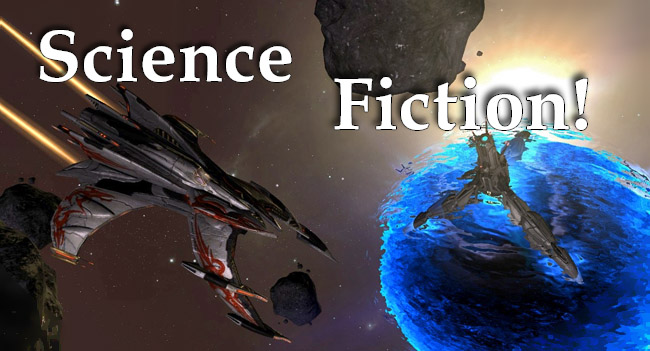
science-fiction
image from http://balldini.wordpress.com

On BBC America on 4 Saturdays starting 19th April at 10 pm ET
SEASON PREMIERE: EPISODE 1 – ROBOTS

Episode 2 premieres Saturday, April 26, 10:00pm ET
EPISODE 2 – SPACE

Episode 3 premieres Saturday, May 3, 10:00pm ET
EPISODE 3 – INVASION

Episode 4 premieres Saturday, May 10, 10:00pm ET
EPISODE 4 – TIME

“The four-episode programme will appear on BBC Two (times and dates to be announced).”

“Among those taking part are:
William Shatner (Star Trek),
Nathan Fillion (Firefly),
Zoe Saldana (Avatar, Star Trek),
Steven Moffat (Doctor Who),
Richard Dreyfuss (Close Encounters of the Third Kind),
Chris Carter (The X-Files),
Ronald D Moore (Battlestar Galactica),
John Landis (An American Werewolf in London, Schlock),
David Tennant (Doctor Who),
Christopher Lloyd (Back to the Future),
Rutger Hauer (Blade Runner),
John Carpenter (Dark Star, The Thing),
Karen Gillan (Doctor Who),
Neil Gaiman (The Sandman, Stardust),
Kim Stanley Robinson (Mars Trilogy),
Scott Bakula (Quantum Leap, Star Trek: Enterprise),
Ursula K Le Guin (The Left Hand of Darkness),
Syd Mead (Blade Runner),
Kenny Baker (Star Wars),
Anthony Daniels (Star Wars),
Nichelle Nichols (Star Trek),
Peter Weller (Robocop),
Edward James Olmos (Blade Runner, Battlestar Galactica) and many more.”

“The documentary focuses on everything from Star Wars to Star Trek and of course Doctor Who. Gatiss reminds us how good sci-fi engages audiences on a emotional level. It isn’t just jaw-dropping special effects and aliens but a way to address social issues, big ideas and human issues.”

For more details, episode summaries, trailers and more, follow the link, below, and see the BBC official website on The Real History of Science Fiction.

Read full article, watch trailers and get links to more info here:
http://www.peter-capaldi-news.com/blog/new-trailer-real-history-science-fiction/?utm_source=whonews&utm_medium=whonewsapp

Unknown's avatar

#BBC’s The Real History of Science Fiction starts April 19

BBC America’s The Real History of Science Fiction starts April 19!

“Co-produced by BBC America and BBC 2, The Real History of Science Fiction series is narrated by Mark Gatiss, the writer and actor who appeared on Doctor Who and created last year’s An Adventure in Space and Time, the TV movie about the creation of Doctor Who. He also acts and has co-created the BBC series Sherlock starring Benedict Cumberbatch and Martin Freeman.”

science-fiction
image from http://balldini.wordpress.com

On BBC America on 4 Saturdays starting 19th April at 10 pm ET
SEASON PREMIERE: EPISODE 1 – ROBOTS

Episode 2 premieres Saturday, April 26, 10:00pm ET
EPISODE 2 – SPACE

Episode 3 premieres Saturday, May 3, 10:00pm ET
EPISODE 3 – INVASION

Episode 4 premieres Saturday, May 10, 10:00pm ET
EPISODE 4 – TIME

“The four-episode programme will appear on BBC Two (times and dates to be announced).”

“Among those taking part are:
William Shatner (Star Trek),
Nathan Fillion (Firefly),
Zoe Saldana (Avatar, Star Trek),
Steven Moffat (Doctor Who),
Richard Dreyfuss (Close Encounters of the Third Kind),
Chris Carter (The X-Files),
Ronald D Moore (Battlestar Galactica),
John Landis (An American Werewolf in London, Schlock),
David Tennant (Doctor Who),
Christopher Lloyd (Back to the Future),
Rutger Hauer (Blade Runner),
John Carpenter (Dark Star, The Thing),
Karen Gillan (Doctor Who),
Neil Gaiman (The Sandman, Stardust),
Kim Stanley Robinson (Mars Trilogy),
Scott Bakula (Quantum Leap, Star Trek: Enterprise),
Ursula K Le Guin (The Left Hand of Darkness),
Syd Mead (Blade Runner),
Kenny Baker (Star Wars),
Anthony Daniels (Star Wars),
Nichelle Nichols (Star Trek),
Peter Weller (Robocop),
Edward James Olmos (Blade Runner, Battlestar Galactica) and many more.”

“The documentary focuses on everything from Star Wars to Star Trek and of course Doctor Who. Gatiss reminds us how good sci-fi engages audiences on a emotional level. It isn’t just jaw-dropping special effects and aliens but a way to address social issues, big ideas and human issues.”

For more details, episode summaries, trailers and more, follow the link, below, and see the BBC official website on The Real History of Science Fiction.

Read full article, watch trailers and get links to more info here:
http://www.peter-capaldi-news.com/blog/new-trailer-real-history-science-fiction/?utm_source=whonews&utm_medium=whonewsapp