Unknown's avatar

Grateful for Musicians, Singers, Musical Leaders who “keep on keeping on” in “The Movement(s)”

Grateful for Musicians/Singers/Leaders
who “keep on keeping on” in “The Movement(s)”


from http://www.lovethispic.com/image/150339/keep-on-keeping-on

I spent a wonderful (but kind of sad; see below) evening last week (Friday, May 4), at Emerson Unitarian Universalist Chapel in St. Charles, Missouri, USA, listening to the fabulous Roy Zimmerman sing, talk, and cleverly satirize many social, political, cultural and legal developments and issues from the last several decades.


Roy Zimmerman, ReZist show, performing in St. Charles, MO, 5/4/18

Roy Zimmerman is the most recent addition to my life’s intentional collection of dozens of extremely talented and special musicians, writers, filmmakers, poets, playwrights, other artists and performers and, of course, political/social leaders who continue to inspire, encourage and demonstrate commitment to whatever movements they believe most in. These often outspoken heroes and heroines also collaborate with and support others day after day, week after week, year after year, decades on decades.

Is there a category—a title—for such a role in our culture? I wish I knew what it is or could invent one. IDEAS HERE, please: http://www.sallyember.com/blog

I wanted to take a moment, here, to name the ones I can remember best who have personally inspired, entertained, encouraged and led me, and without whom I would certainly have given up feeling optimistic and collectively working for positive change a long time ago.

“Big Mike” Lainoff

—My first and most treasured inspiration is the recently-deceased and much-missed former director of the four JCCA (Jewish Community Center Association [of St. Louis]) summer camps I attended as a child and teen: Camp Council (a day camp), and residential Lake of the Ozark area camps, Camp Hawthorn, Red Bud Camp and their successor, Camp Sabra, Harold “Big Mike” Lainoff (I wrote about him prior to this). In addition to being a recreation manager/leader, Big Mike was a gifted guitar player/singer/songleader and storyteller who could captivate, involve and educate a mess hall or a campfire of over a hundred rowdy kids, teens and staff for long periods of time despite pouring rain, high humidity, blazing heat and roaring wind. Amazing.
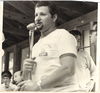

“Big Mike” Lainoff, circa 1965, Camp Hawthorn, Kaiser, MO (Lake of the Ozarks)

When I first heard Pete Seeger and Woody Guthrie‘s songs and stories, I thought they had stolen them from Big Mike (I was 7 when I met Big Mike…). Later, I realized it was the other way around. But, who cares? Big Mike brought Pete Seeger, Bob Dylan, Woody Guthrie, Arlo Guthrie, Bob Dylan, Joan Baez, Peter, Paul & Mary, Phil Ochs, John Lennon, Tom Paxton, Donovan, Jackson Browne, Tom Lehrer, Judy Collins, Odetta, Buffy Sainte-Marie, Joni Mitchell and many more USA civil rights’ and social activists’ songwriters’ lyrics and melodies directly to us—mostly Jewish kids, from the suburbs of St. Louis, in the 1960s—while we learned to swim, make campfires, pitch tents, hike, canoe, sail, waterski and so much more.

I grew to love these songs whose lyrics explained class differences, racial injustices, yearnings for peace and equality, deep and abiding love for each other and for a special person, recognitions of mistakes and ways to rectify them, inchoate longings for a better world and to be a better person. I learned the words and melodies and sang them to myself all year long, for decades. I still remember most of them: “Banks of Marble,” “Blowin’ in the Wind,” “Respect,” “The Song is Love,” “Both Sides Now,” “Fountain of Sorrow,” “Changes,” “Peaceful Easy Feeling,” “Reel, Oh Reel,” “Oleanna,” “Ain’t Gonna Study War No More,” “Summertime,” “Leavin’ on a Jet Plane,” “If I Had a Hammer,” “We Shall Overcome,” “There But For Fortune,” “The Draft Dodger’s Rag,” “Imagine,” “One Tin Soldier,” “The Sounds of Silence,” “This Land Is Your Land,” “Universal Soldier,” “Big Yellow Taxi,” “Black and White,” “What Have They Done to the Rain?” “Oh, Freedom,” “Hair,” “The Power and the Glory,” “I Ain’t Marchin’ Any More,” “Waist Deep in the Big Muddy,” “Outside Of A Small Circle Of Friends,” “The Circle Game,” “Fixin’ to Die Rag,” “Turn! Turn! Turn!” “We Shall Not Be Moved,” “Four Strong Winds,” “Where Have All the Flowers Gone?” “I Can’t Help But Wonder (Where I’m Bound),” “The Last Thing on My Mind,” “Ramblin’ Boy,” “Last Night I Had the Strangest Dream,” “Eve of Destruction,” “How Can I Keep From Singing?” “Let There Be Peace on Earth.” I can’t ever list them all.

Big Mike helped create and then raised my social consciousness, informing without indoctrination so that we became subliminally aware of social/political music and key movements: 1963 was the height of the Civil Rights Movement in the USA, and the middle- to late 1960s were the Vietnam War’s protests’ heydays.

I hadn’t yet heard of the Freedom Riders (which was going on every summer I was first at camp!), I was too young to march in anti-war protests (14 in 1968) even if I had known about them. I was old enough to understand “Jim Crow” segregation and discrimination laws in St. Louis, Missouri, and HATED them. Big Mike and other camp songleaders chose songs whose lyrics’ sentiments felt right to me. I needed to sing, to protest, to be wishing and working for everyone’s equality and freedom. I was excited that more people felt that way I did than I had ever known existed.

At the above-mentioned camps, joining and adding to Big Mike‘s contributions, were several talented musical counselors and staff: special shout-outs to the Kean brothers, Ron and the late Mike (“Nix”); the cook, Maxine; “Fitz“; “Howdy” (Howard Schwartz) and “Twinkle” (Laura Resnick), for international and Israeli folk dancing fun; and, so many more, for adding to the songs and artistic experiences.

Big Mike‘s stories and songs my nascent ideas about social justice, fairness, anti-racism, anti-war, collaborating for peace and practicing nonviolence were developed and nurtured first. Blessings on Big Mike and his inspirations as well as his heirs and successors, forever.

Some places and people are pivotal in our lives, right? These people formed the foundations for mine, preparinhg me for the ones who came later.


Further creating a foundation and launching me into adulthood was a group of people I met in several places in the late 1970s in New England. Many of these key people lived at/founded or attended events at Boston’s mid-1970s spin off of Project Place, the Another Place Conference Center in Greenville, New Hampshire, and its spin-off, Spring Hill, Massachusetts, were then and later became great leaders of artistic social and political movements, personal growth and community-building for me and many others. Here are the “stars,” below.

Robert Gass

—It was through Another Place that I got to go to Spring Hill and meet Robert Gass and The Wings of Song band. Briefly, I performed with and sang in the band’s chorus (I am listed as “Sallie Fleishmann [neither name spelled correctly] on their first album, Many Blessings, pressed in 1980). Singing with this chorus was my first experience of spiritual uplifting through song. It had happened without my understanding it through some camp songs; Robbie‘s songs were intentionally written and selected to raise up the singers and the listeners, the audience and the dancers. We were inspired, connecting, infused with desires to serve and to love.

Robbie and his wife, Judith Ansara (Epstein) and a few others, created the formats for the popular personal growth Opening the Heart workshops (which I attended with my then-partner in 1979) which morphed into their current work, Sacred Union. Robert (as he became known, later) still sings, makes albums and leads people to inner and outer growth (now living in Colorado). Judith is also a dancer and a poet.


Robert Gass, circa 1989

I still hum and sing some of Wings of Song‘s tunes/songs to myself, but I can’t find my favorite anywhere online or for sale. Sad.

“Not My Will, but Thine” is the first line of the chorus, but I don’t know what title the song actually has. Perhaps “Teach Me to Love,” or “Kindle my Heart’s Flame” (all in the lyrics)?

If you know where to find a recording of this song, please email me at sallyember AT yahoo DOT com

Medicine Story

—I also met Medicine Story (Manitonquat, Francis Story Talbot) at Another Place in 1978. He is an author and storyteller as well as Native American activist who also lived at Another Place. Story, with his then-wife, Emmy (Emilia) “Rainwalker” Ianniello and their first son, formed the nucleus of the second of my many communal households in New England. Story and Emmy introduced me and dozens of others to Native American sweat lodges (building, experiencing ceremonies in, learning about) and to living in wiki-ups (outdoor structures more sturdy than tents), as well as to praying and connecting with the earth and animals and many other sacred rituals, origin songs and songs/chants.

Add these sweat lodge experiences to my Finnish saunas in Rhode Island (1977-78) and the Dutch-esque saunas at Stepping Stone Farm in the 1980s. When I went camping with some friends in the 1980s and 1990s (before hypertension took me out of the game) who were offering sweat lodges, they wondered how a Jewish girl from St. Louis knew so much about how to build them, use them, be in them? Why was I so comfortable with nudity in high heat and various ceremonial rituals that involved sweating and chanting? I mentally thanked Emmy and Medicine Story.

We would go into the sweat lodge to settle conflicts, build teams, get inspiration, celebrate a birth or birthday, prepare for a marriage, strengthen commitments, purify, cleanse, dream, remember, honor, be grateful, grieve, pray, sing and chant. Some participants used mind-altering substances in small amounts before or during; I did not. Many would fast beforehand; it’s recommended not to go into a sweat lodge on a full stomach.

This photo, below, is of a sweat lodge that looks a lot like the ones we built.
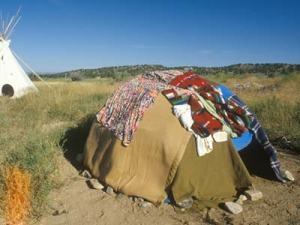

image from and FMI: https://adventure.howstuffworks.com/sweat-lodge.htm

If you’ve never built, prepared and then been in a sweat lodge, it’s probably impossible to imagine how close relative strangers can get and the kind of bonding that occurs during such experiences: unmatched.

Story and his second wife, Ellika Lindén, a playwright, actor, director, and collaborator, created Circle Way and currently travel around the globe to raise awareness of earth-related preservation and community-building.


Medicine Story and Ellika Linden

Bill Whyte and Katie Schwerin

—Several other songleaders, ritual organizers and community activists lived at and were my friends from that era, including those who shared our first New Hampshire collective household with Story, Emmy and their first son. Katie Schwerin and Bill Whyte and Katie’s daughter joined our group to live in Sharon, NH, in 1978-79.

In addition to learning many songs and chants from each of them, I also credit them with showing me how to live collectively, since we shared a household for two more years after that in several SW NH locations. We were pregnant at the same time and had our two home births (Katie‘s second; Bill‘s first and my only) in one of those homes in 1979-80 in Stoddard, NH. Katie and Emmy, with Cindy Dunleavy, all lay midwives, then (Cindy still delivers babies), attended the homebirth of our son.

Katie, along with director an co-creator, Pamela Faith Lerman (also someone I met in 1978 at Another Place), with about eight other women and I were in a show in Peterborough, NH, in 1980 that included poetry, songs and dramatic scenes from many feminist artists and sources, a fundraiser for a women’s health center we were trying to start for the Monadnock region.

Katie and Bill also founded and, with two of their adult daughters, operate the family-friendly Badger Balm, a “B” (Benefit” Corporation, that “makes certified organic and all-natural body & skin care products including healing balms, natural sunscreens, skin moisturizers, muscle rubs, aromatherapy and other personal care products,” Bill Whyte and Katie Schwerin, who run the business with their award-winning two daughters, Emily Schwerin-Whyte and Rebecca Hamilton.


Badger Balm‘s 2016 founders, family and staff

Katie and Bill taught me a lot about organic food (gardening and cooking), herbal and natural healing, nutrition, raising children respectfully and living collectively, starting me on a life-long path in those areas, beginning in 1978. Bill also introduced me to creative visualization and “green” building via his company, Whyte Light Builders.

Additionally, Katie brought Waldorf education (Rudolf Steiner’s schools) and the Unitarian Universalist (UU) community into our family’s life. Because of her influence and connections, I was hired to accompany the Eurythmy movement program classes for one year, in 1987, at the newly created Monadnock Waldorf School in Keene, NH, where we then lived. The following year, our son attended the Monadnock Waldorf School from 3rd – 8th grades (1988-1994). I took over the Director of Religious Education (DRE) position at the Keene UU Church in 1988 from her when Katie left on maternity leave and then to go back to school for her master’s in Waldorf education, where I stayed until 1990, when I decided to return school to get my master’s and doctorate in education myself.

FUN FACTS:
1) The Monadnock Waldorf School‘s Eurythmy teacher then is the mother of ER and The Good Wife star, actor, Julianna Margulies;
2) Before he became my Buddhist teacher, Wyn Fischel (Lama Drimed)’s first wife, Susan, was a Eurythmy teacher;
3) Before I met him, Wyn taught woodworking at the other nearest Waldorf school, Pine Hill, in Wilton, NH.
4) For several dramatic productions, both I and my then-partner, Christopher Briggs Ember, helped with music, blocking, directing, make-up and other aspects of the plays for Monadnock Waldorf School.

It is not an exaggeration to say that my entire adult life would have been different (and much smaller and less satisfying) had I not had the great good fortune to become involved with the Schwerin-Whyte family. I am so grateful to know them. We all had so much hope, optimism, energy, faith…

Mario Cossa

Katie is also a performer whose interest in drama brought me to my long-time collaboration with Mario Cossa, playwright, actor, performer, dancer, singer, lyricist, songwriter, director, choreographer, and nonprofit manager who became a counselor and then psychodramatist.

Mario Cossa is yet another person I met at Another Place in 1978 whose contact with me altered my life’s trajectory profoundly and for the better.

Because of and often with Mario, I was able to earn money through part-time and full-time work in areas I loved and have many amazing experiences, including:

  • working in several youth-serving nonprofits;
  • co-writing and -directing, performing in, narrating/facilitating audience-interactive performances for and touring with several plays and dozens of improvisational scenes (the play I wrote, Crystal Dreams, won a prize that featured a performance of it at a professional public theatre, the Portsmouth Theatre-By-The-Sea, in 1984);
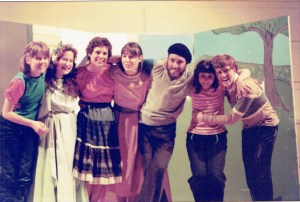

    Cast of Crystal Dreams, 1984

  • learning to tap dance;
  • learning some A.S.L. (American Sign Language) and using it in a few plays;
  • learning to and performing as a clown;
  • becoming involved in Co-Counseling International (CCI);
  • meeting Caroline Myss, who became a close friend of mine for many years;
  • practicing and learning more about conflict resolution and mediation;
  • improving my storytelling and writing;
  • expanding my repertoire for improvisational acting;
  • learning about and leading prevention/mitigation and education groups on topics ranging from substance/alcohol abuse/use, pregnancy postponement, HIV/AIDs, suicide, teen homelessness/running away, Tourette’s Syndrome, learning and behavioral disorders to family systems conflicts;
  • co-leading groups for kids, youth & adults/families that utilized expressive arts;
  • participating in collaborations with other organizations and individuals;
  • becoming more familiar with and meeting/working with interns and faculty at Antioch/New England Graduate School who were part of the Dance Movement Therapy profession (which my daughter-in-law graduated from in 2016, over twenty-five years after my first exposure to it);
  • taking groups of students to see live musical theatre productions in Boston and New York City for several years (we saw Rent, Big, Miss Saigon, and a murder mystery audience-interactive play whose name I can’t remember);
  • conducting ethnographic research on gender and sexual orientation social identities that became the basis of my dissertation for my doctorate degree;
  • co-writing, editing and figuring out how to get our nonfiction book about improvisational scenework for educational groups published, in 1996 (my first traditional publishing credit): Acting Out: The Workbook–A Guide To The Development and Presentation of Issue-Oriented, Audience-Interactive, Improvisational Theatre
  • editing and assisting with other pieces and books Mario wrote which also were published in the 1990s and 2000s;


    Acting Out book cover

  • learning to write grants (to solicit funding from individual donations and family foundations for as low as $50 to multi-million/multi-agency federal proposals);
  • developing/designing and implementing program evaluations;
  • preparing and managing budgets; and,
  • working in outreach/marketing for nonprofits (something I did for many years for several other nonprofits).

Mario founded and runs Motivational Arts Unlimited, based in Bali, Indonesia, and travels around the globe doing psychodrama and sociodrama trainings, educational programs and certifications.
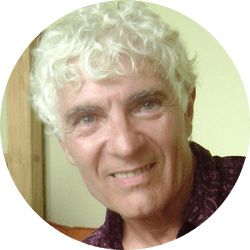

Mario Cossa, circa 2008

More in each about the impact, feelings, uses, singing spiritually

Holly Near

Ellen Fleischmann, my singer/songwriter, conductor/pianist middle sister, introduced me to Holly Near in 1978. THANK YOU, again!

I had told my sister that I was bored and needed music because I worked as a packer for a wholesaler/warehouse that packaged and shipped herbs, spices and essential oils to specialty and health food shops all around the USA, Attar, in New Ipswich, New Hampshire. I spent 30 hours each week NOT using my college degree in elementary education, having been burned by several jobs and needing a break. All day, I hefted huge barrels, bags and bottles and wrestled their contents into smaller containers/bags, boxed, labeled and prepared the boxes for shipping. I was usually there alone since it was a “mom-and-pop” shop and they had a young child. So, very under-stimulated, I craved music. Ellen sent me tapes from her dorm room at Brown University to play on my boom box.

—Oh, Holly! What a revelation it was to hear Holly Near‘s amazing voice, lyrics and energy pouring into my otherwise silent space. She also sent me tapes of James Taylor, Carole King and a few others, but it was Holly I kept coming back to and memorizing. “It Could Have Been Me,” from A Live Album, 1974, inspired by the government-sanctioned murders of college students at Kent State University in Ohio during an anti-Vietnam War demonstration in 1970, made me cry, rage and want to continue to/return to ACT UP.

Her songs included sentiments about being bisexual and discovering her love for women for the first time in “Imagine my Surprise,” moved me because it spoke directly of my experiences. After my male partner and I had a child, her song “Started Out Fine,” made me laugh and cry. So many songs, so many inspirations, such great lyrics.

Holly‘s songs have supported and propelled movements, such as the “zipper” song (we can insert other lyrics in key places and keep singing): “We are a gentle, angry people, and we are singing, singing for our lives,” which became the AIDS’ activists’ anthem and the LGBT-rights’ marching song. I also memorized and sang, often:

We will have peace;
we will because we must;
we must because we cherish life, and believe or not, as daring as it may seem, it is not an empty dream, to walk in a powerful path;
either the first nor the last, on the Great Peace March:
Life is a great and mighty march.
Forever, for love and tor life, on the Great Peace March.

from “The Great Peace March,” by Holly Near

I listened to Holly for several more albums/years, but never got to see her live. UNTIL I found out that my good friend, the dearly missed Jaye Alper (her death anniversary/Yahrzeit was this past Tuesday, 5/8/18; gone 6 years; I miss her all the time), had a connection. Her mother, Jackie Alper, had been an original member of the singing group, The Weavers, which had included Ronnie Gilbert, Lee Hays, Fred Hellerman , and Pete Seeger (Jackie had left the group to stop touring when she became pregnant with Jaye and to help fight the HUAC (McCarthy-era “witch hunts”).
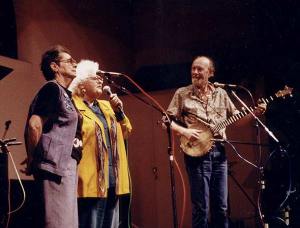

Jackie Alper, Ronnie Gilbert, Pete Seeger,
the remaining Weavers, reunited, circa 1998.

Jackie had stayed active in the social justice/women’s music scene, having her own radio show (“Mostly Folk” on WRPI) for decades, helping start and run the Old Songs Festival (see below) in the Albany area, and staying friends with “Aunt” Ronnie, as Jaye knew her.

In the 1990s, Jaye contacted Ronnie, since Ronnie was performing, making albums and touring with Holly, and they were coming to the Boston area (where Jaye then lived). Jaye brought me backstage to meet them. I stood, starstruck, as Jaye and Ronnie hugged and talked. Holly was standing in the doorway, smiling at me and eating spaghetti, which she offered (I declined).

Holly Near, 1970


Holly Near, 2017

Holly started Redwood Records in 1972, “to produce and promote music by ‘politically conscious artists from around the world.'” She has included so many political activists/musicians on her albums, tours, and concert stages over the decades, many of which I was lucky enough to attend.

I learned a lot more about or heard for the first time the musicians affiliated with dozens of worthy causes around the world, their songs and political/social movements in the USA and elsewhere, that I never would have, otherwise, through Holly and her musical colleagues, including:
—the late Pete Seeger,
Arlo Guthrie,
—the late Mercedes Sosa,
Bernice Johnson Reagon (of Sweet Honey in the Rock),
Bonnie Raitt,
Jackson Browne
Holly Near, Arlo Guthrie, Ronnie Gilbert and Pete Seeger performed as HARP to raise money for various causes,
Meg (Shambhavi) Christian,
Cris Williamson,
Linda Tillery,
Joan Baez,
—the late Phil Ochs,
Harry Belafonte,
Emma’s Revolution (which includes Pat Humphries), and
Inti-Illimani.

Beyond being a renowned and beloved singer songwriter, Holly is a former TV/film/Broadway star and ongoing political activist, still going strong at age 68. Holly Near has mentored dozens of others (see below) and continues to fill my life with inspiration and songs. THANK YOU!

In addition to introducing me directly to Holly Near, Jaye and Jackie Alper had invited me and my family to the Albany-area’s annual Old Songs Festival (officially, the Old Songs Festival of Traditional Music and Dance in Altamont, NY) where we got in free to help Jaye (as “Crystal,” the name she had gone by in the 1970s) sell iced tea and her famous baklava, chocolava and maplelava each June. The musicians there played music which has often been featured or discussed in Sing Out! magazine walked amongst and camped with us. We encountered, met, had lunches with and heard the late Utah Phillips, Sally Rogers, The Amidon Family, Arlo Guthrie, Pat Humphries, Cheryl Wheeler, John McCutcheon, Tom Chapin, and many more. Quite a scene, for a folk music lover like me!

Olivia Records

Beyond and including Holly Near, I met fans of “women’s music” through friends, lovers, colleagues and family members throughout the 1980s and 1990s, attending many concerts/performances and enjoying festivals outdoors when possible, which expanded my repertoire to include Margie Adam. “The Unicorn Song,” “We Shall Go Forth,” “We Are The Women We’ve Been Waiting For,” “Sweet Friend of Mine,’ and many excellent piano-accompanied songs became favorites I learned to sing and play on the piano (and lead in sing-alongs, sometimes).

After I moved to California in 2002, I went to many concerts and performances that featured Holly 9she lived about an hour from where I lived) and felt lucky to be able to see her perform and hear her speak so often. She was always on top of knowing what cause needed championing, available for fundraisers, awareness-raising shows and gatherings of all kinds. Holly always remembered me; in the smaller venues, she would smile and come over to say “hello” after her last encore. Before the spring of 2012 (when Jaye passed away), she had always asked about Jaye.

Both Jaye and Jackie had passed on before Pete Seeger (who left us in the winter of 2014), so I went to the Freight & Salvage in Berkeley to attend the tribute concert for Pete, which Ronnie, ill and using a cane, also performed in and which Holly was the emcee and main performer for; Holly and Ronnie had organized most of it. During intermission, Holly came over to me and we shared a few tears and a hug. What treasures these people are/were!

Cris Williamson, solo and with Meg Christian, Teresa Trull, Tret Fure, Barbara Higbie, Linda Tillery, Lucie Blue Tremblay, and many more great women musicians, brought me and my family the inspiring and beautiful, fun-to-sing songs from Cris‘ albums, The Changer and the Changed and the musical play, Lumiere, and other amazing songs, like “Waterfall,” “The Changer and The Changed,’ “The Rock Will Wear Away,” “Lullaby” (“Like a Ship in the Harbor”), and “Lean On Me (I Am Your Sister).”
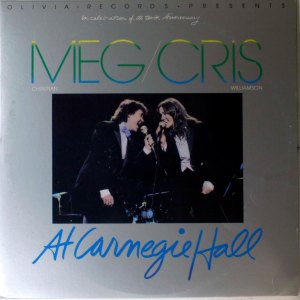

Meg & Cris at Carnegie Hall, 1982, album cover

I learned so much about feminism, bisexuality, intersectionality, positive parenting, social activism, many types of love, community and collective efforts from these wonderful musicians.

—The talented brothers, the late Happy Traum and the late Artie Traum were some of the musicians I met when I worked at Camp Med-O-Lark in Washington, Maine, in the early 1980s, because of my enduring friendship with yet again a contact from Another Place from 1978, Zea Moore. In addition to getting me and my then-partner two wonderful summers with jobs at this camp (because her then-partner, Neal Goldberg, owned and directed it), Zea introduced me to Wiccan & Goddess Chants, Libana, and so much more of the newly emerging women’s spirituality music and rituals.

Civil Rights, Environmental/Social Activist Musicians & Storytellers

Thanks to these live music venues, without whom I would not have heard most of these singers live: The Folkway (Peterborough, NH), The Iron Horse (Northampton, MA), The Colonial Theatre and the Keene State College’s 1990s Coffeehouse (Keene, NH), The Common Ground (Brattleboro, VT), Temple Mountain Ski Area (Temple, NH, outdoor concerts in the not-snowy weather), Passim Coffeehouse (Cambridge, MA), Brighton Music Hall (Brighton, MA), The Freight & Salvage (Berkeley, CA), ACTING OUT’s 1990s coffeehouse series (Keene, NH), and many more.

PLUS, radio stations that play and support “Americana,” “Women’s Music,” “Folk Music,” and many other overlapping genres that play music to inspire and activate us all. Here are some: KPFA (“Across the Great Divide” and “American’s Back 40” are my favorites, there); KRCB (used to have many shows; now, not so many); other NPR affiliates, everywhere; KDHX; WRSI; college/university radio stations also often have shows/D.J.s that feature great music like this. Check our your local or online options.

SUPPORT LIVE MUSIC!
—If you haven’t heard Christine Lavin‘s story songs, parodies and other political music, please give her a listen!
Please also go find and listen to the songs of any of the amazing individual singer/songwriters/activitists who also sometimes play as the group that includes Lavin, 4 Bitchin’ Babes:


4 Bitchin’ Babes (Christine Lavin, Sally Fingerett, Megon McDonough, Julie Gold), 1993

Patty Larkin (“Not Bad for a Broad,” “Metal Drums”)
Megon McDonough (“Amazing Things,” “Wake Up And Dream”)
Sally Fingerett (“Home is Where the Heart Is,” “Here’s to the Women”)
Julie Gold (“From a Distance,” “America,” “The New World,” “Love is Love is Love,” “Goodnight, New York/Ellis Island”)
and others have comprised this fun, talented quartet.

Also, these musicians/singers/songwriters are great to find/remember:
Nanci Griffith (“Cold Hearts/Closed Minds,” “If These Old Walls Could Speak”),
Fred Small (who began his career as a lawyer and later became a Unitarian Universalist minister and climate change activist/leader; “Peace Is,” “Only Love,” “No More Vietnams,” “The Peace Dragon”),
Judy Small (unrelated to Fred, and a judge of the Federal Circuit Court of Australia who was previously an Australian entertainer, folk singer, songwriter, and guitarist. Known for her feminist, often patriotic, and political songs, usually following a traditional theme, she produced twelve albums) (“You Don’t Speak for Me,” “How Many Times?” “Montreal, December ’89 (What is it about men?”),
—the late Rosalie Sorrels (“I am a Union Woman,” “Always a Lady,” “The Baby Rocking Medley”),
—the late Stan Rogers (“The Wreck of the Edmund Fitzgerald,” “The Mary Ellen Carter”),
RosenShontz, Bill Shontz and the late Gary Rosen (“Hugga Hugga,” “Share It!”)
Betsy Rose (“I Can’t Imagine Life Without … (Popcorn),” “For the Mothers,” “Welcome to the Circle,” and who shares others’ songs, such as, “Return Again,” “Sending You the Light”),
—the late Malvina Reynolds (“Little Boxes,” “It Isn’t Nice,” “Turn Around,” “What Have They Done to the Rain?” “Magic Penny”),
—the late Peggy Seeger (half-sister to Pete, full sister to Mike) (“I Want to be an Engineer”),
—the late Dave van Ronk,”The Mayor of MacDougal Street,” who re-arranged and covered many “traditional” and others’ songs so well,
Gould and Stearns (Stephen Stearns and Peter Gould),
Ani DiFranco, founder/owner of Righteous Babe record label, a la Redwood Records and Oliva Records,
Ruth Pelham, founder of “The Music Mobile,” which “brought singalongs, simple musical instrument construction, merriment and a message of hope to generations of youths at inner-city parks” in the Albany area for 39 years (“Look to the People,” “The Turning of the World,” “Under One Sky”),
Bill Staines (“The Roseville Fair,” “A Place in the Choir,” “Child of Mine,” “River”),
David Mallett (“The Garden Song,” “Open Doors and Windows,” Parallel Lives”),
The Roches–Maggie, Terre, and Suzzy Roche (“Dear Mr. Sellack,” “Another World”),
Eric Bogle (“The Band Played ‘Waltzing Matilda,'” “No Man’s Land/The Green Fields of France”),
Cosy Sheridan (“Quietly Led,” “The Losing Game,” “Sharp Objects”)
Catie Curtis (“People Look Around,” “Truth from Lies”),
Dar Williams (“When I Was A Boy,” “The Christians and the Pagans”),
Lucy Kaplansky (“This Morning I am Born Again,” “Reunion”),
Susan Werner (“Sunday Morning,” “Help Somebody,” “Heaven So Small,” “Did Trouble Me”),
Cry Cry Cry, = Dar Williams, Lucy Kaplansky and Richard Shindell, with many others accompanying/doing back-up vocals (“Arrowhead,” “Ascent” — Shindell; “I Know What Kind of Love This Is,” “Fall on Me”—Cry Cry Cry),
Molly Scott—not the politician! (“Centering Home,” “We Are All One Planet”),
Si Kahn (“Gone, Gonna Rise Again,” “Aragon Mill”),
Sarah Pirtle (“Earth, My Body” and more, here: http://sarahpirtle.com/hope-sings/index.htm)
Susan Osborne, Paul Winter, David Darling and the rest of the Paul Winter Consort,
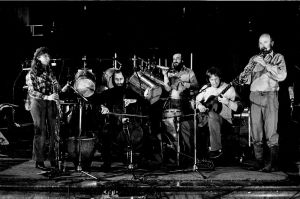

image of Paul Winter Consort band, circa 1978, from http://www.paulwinter.com/the-consort/

and many others previously mentioned in this post or which you find while wandering around YouTube and the internet listening to these. These singers/musicians share songs that are inspiring, moving, intelligent, funny, thought-provoking and insightful as well as musically very fine.

—There are many ministers, singers and song leaders I met through the Unitarian Universalist (UU/UUA) Association’s events and fellowships/churches, starting with Rev. Rick Paine (co-founder of Spring Hill and co-creator of the Opening the Heart workshops, with Robert Gass, Judith Epstein and others) and Rev. Sydney Amara Morris (co-founder of Another Place, with Bill Whyte and Mark Sarkady). Later, I met and sang with Nick Page (who doesn’t love to sing “More Love”?), and so many others. In 2011, the UUA published a great compilation of their music, 50 YEARS OF UU MUSIC, available here: https://www.uua.org/ga/past/2011/worship/185029.shtml , which features “Let It Be a Dance”). Also, check here: https://www.uua.org/worship/music and here: http://www.recessionals.org/ and here: https://www.uua.org/worship/music/hymnals

—Have to mention the great storyteller, singer, performer, Jay O’Callahan, since his stories and songs kept us happy on long car trips across the country in the 1980s, and we got to see him perform live in Boston during that time.

A Cappella Women’s and Other Choruses Respecting Socially Conscious Diversity

—I sang with and joined several choirs that are part of the Threshold Choirs as founded and formatted by Kate Munger,who led two groups I was part of in California in the mid 2000s. If you know someone ill, dying, or giving birth, that is the time these singers will come when asked (if there is a choir near you): A Capella singing at its best.

—The A Cappella singing of the singers of Sweet Honey in the Rock inspired many women to start community women’s choruses, and I was lucky enough to belong to two: the /Brattleboro Women’s Chorus, founded and conducted by Becky Graber, and Keene, NH’s Animaterra Women’s Chorus, founded and conducted by Allison Aldrich Smith (but now also conducted by Becky since 2016, after Allison moved to Maine), in the 1990s.

I miss those groups a lot and have never found any like them since then that met close enough to other places I have lived. If you are looking for a women’s chorus like these, check out this site and see if you get fortunate enough to live near one!

The Sister Singers Network is an international, “cooperative web of feminist choruses and ensembles, composers, arrangers, and individual singers working together to support and enrich the women’s choral movement.”
http://www.sistersingers.net/index.shtml#.WvNEeKQvypo

The Threshold Choirs (see above) are a part of this network, but have a specific mission.

[NOTE: I found and temporarily joined Charis: The St. Louis Women’s Chorus here in St. Louis, MO, and it is all females (except for the conductor, which I found odd), but the style, the music, the format, the ambiance weren’t at all like the A Cappella choirs in New England that I’d loved, so I dropped out after a few months. Not for me. Many love it, though, so if you’re local, you should try it out!]


As I said at the beginning of this post, this is what I meant when I said that attending and listening to Roy Zimmerman‘s lyrics and being at that performance was somewhat sad, bittersweet, in this horribly disappointing, discouraging, horrifying period in our lives.

Our generation, and specifically, some of the people I knew and admired enough to mention in this and other posts, HAVE accomplished a lot. However, so much of what we fought for and won is threatened, unraveling, already destroyed beyond repair: it’s happening RIGHT NOW.

What else can do besides sing, listen to and make music? VOTE! ORGANIZE! MARCH! OBJECT! RESIST! Please?

I end with this, one of my favorites, written by Sally Rogers, who also gives us “What Can One Little Person Do?” “In the Name of All of Our Children,” and so many more great songs,

“Love Will Guide Us”: https://www.youtube.com/watch?v=8xWMnf9SYjo or

Unknown's avatar

“THE READING ROOM” 2018 WOMEN’S FICTION PRIZE SHORTLIST announced

<

p align=”center”>“THE READING ROOM” 2018 WOMEN’S FICTION PRIZE SHORTLIST announced

<

p align=”center”>

FMI: https://www.womensprizeforfiction.co.uk/reading-room/news/revealing-2018-womens-prize-shortlist

Mazel Tov to the Finalists!

Elif Batuman, The Idiot

Imogen Hermes Gowar, The Mermaid and Mrs. Hancock

Jessie Greengrass, Sight

Meena Kandasamy, When I Hit You: Or, A Portrait of the Writer as a Young Wife

Kamila Shamsie, Home Fire

Jesmyn Ward, Sing, Unburied, Sing

They are all WINNERS, IMO!

<

p align=”center”>

Unknown's avatar

“4 Ways Music Can Enhance Your Writing”: Guest Blog Post by Dan Buri

4 Ways Music Can Enhance Your Writing

by Dan Buri

If you find your writing is becoming stale—and let’s face it, we all find our writing is stale from time to time—sit back and enjoy music. I mean that quite literally. Lean back in your writing chair, turn on a song you love, close your eyes, and enjoy the music.

Music has a way of seeping into the soul more viscerally than any other form of art. Let music inspire the words you are writing.

In my recent book, 40 Tips on Creative Writing, I provide an inspirational guide for writers aiming to write their first, second, or even twentieth book.

In any creative endeavor, we all have moments of keen inspiration and moments where our well of creativity seems all but dried up. I wrote the book because of reader requests to consolidate some of the tips and tricks I use to continue to find daily motivation in my writing.

Music is a tried-and-true way for me to find my motivation on days when I find it might be lacking. When I’m not listening to music I’ve purchased and downloaded on my devices, I gravitate toward a couple of different streaming services, including Pandora and Spotify. Here are 4 Ways Music Can Enhance Your Writing.

1. Music Taps Into Our Creative Mind-Wandering Mode.

In Daniel J. Levitin’s book, This is Your Brain on Music , he describes the brain as having two primary modes: (1) paying attention closely and (2) mind-wandering. It is believed that most creativity happens when we are in mind-wandering mode.

This shouldn’t be surprising. When do you usually stumble upon your best ideas? If you’re like me, it’s not when we are laser focused on a task, but instead, when we’re in thoughtful, unorganized contemplation. It’s during these times that our brains will connect two seemingly disparate things and a spark of creativity will occur to bridge them.

There are plenty of ways to get yourself into mind-wandering mode, but as Levitin says, “Music is one of the most exquisitely effective ways of allowing you to enter the mind-wandering mode.”

If you’re looking to inject a spark of creativity into your writing, listen to music you enjoy. You will find your mind entering a realm of creative ideas.

2. Music Increases Verbal Intelligence

In a 2011 study published by the Department of Psychology at York University, researchers found that 90% of children had a significant increase in verbal intelligence after only one month of music lessons. Sylvain Moreno proposed that there is a transfer effect that happens in our ability to understand language from music training, particularly for kids.

What writer wouldn’t like to have a better grasp of language? I know my writing could use a boost in writing and reading comprehension. The more I can increase my verbal intelligence, the better I’ll be as a writer to see the big picture and connect all the dots for my readers.

3. Music Lowers Stress

We now know that music helps to open up creative avenues in the mind, but it also lowers stress levels (just like spending time in nature does). Let’s face it: we writers find ourselves in a variety of stressful situations, like, a deadline is rapidly approaching, or we’re unable to find a journal or website to publish our latest article, or our book is not getting into the hands of readers. If it’s not one stressful encounter in our writing life, it’s another.

A large number of studies have found that listening to music that you enjoy will decrease levels of cortisol—the stress hormone—in the body. One 2002 study from the National Center for Biotechnology Information found that active participation in music produces a significant boost in the immune system.

Sing away, my friends!

4. Music Enhances Memory

I keep a lot of notes. In fact, my wife often gives me a hard time about the number of journals I have floating around the house at any given time. If I don’t write it down, I’ll forget it. I have to jot it down so I can refer back to it later. I now know, however, that my listening to music is helping me remember things as well.

Researchers have found that listening to pleasurable music activates areas of the brain implicated in emotion and reward. They discovered that there’s a correlation between listening to music and our ability to remember or memorize things.

Want to be a smarter writer? Want to increase your vocabulary? Listen to music!


Dan Buri (@DanBuri777 on Twitter) is a trusted resource for writers to gain insight into the difficult world of indie publishing. Dan is a founding member of the Independent Writers Guild, a worldwide organization of writers and publishing professionals dedicated to promoting the interest of indie writers by encouraging public interest in, and fostering an appreciation of, quality indie literature. His website (<a href="http://www.Nothinganygood.com&quot;http://www.Nothinganygood.com<) provides quality advice for all stages of the writing process, from the brainstorming and writing process, to becoming published, to marketing your writing and reaching readers.

Dan Buri’s latest book, 40 Tips on Creative Writing, is currently available in ebook and print formats. His first collection of short fiction, Pieces Like Pottery, which has been recognized on multiple Best-Seller lists, is an exploration of heartbreak and redemption.

His nonfiction works have been distributed online and in print, in publications including Pundit Press, Tree, Summit Avenue Review, American Discovery, and TC Huddle. He is an active IP attorney in the Pacific Northwest and lives in Oregon with his wife and two young children.


DAN BURI

LINKS
Dan Buri email: danburi777@gmail.com
Blog for Indie Writers: Nothing Any Good
Books: Pieces Like Pottery and Newly Released 40 Tips on Creative Writing
Twitter: DanBuri777
Goodreads: Dan Buri

Unknown's avatar

#Finalists for the 2018 #HugoAwards for #ScienceFiction

The #finalists for the 2018 #HugoAwards were announced on March 31, 2018, by members of the World Science Fiction Convention (#WorldCon) for #sciencefiction of all lengths and types.


http://www.thehugoawards.org/

Winners of the Hugo Awards, the award for best young adult (YA) book, and the John W. Campbell Award for best new writer will be announced at Worldcon 76 on August 16, 2018.

Main Categories: Best Novel, Best Novella, Best Graphic Story, Best Series, Best Related Work, Best Novelette, Best Short Story, and Best Young Adult Book. Finalists lists, below.

FMI and the lists of finalists in all categories: http://www.thehugoawards.org/2018/03/2018-1943-hugo-award-finalists-announced/#more-3163

John W. Campbell Award for Best New Writer

Katherine Arden
Sarah Kuhn
Jeannette Ng
Vina Jie-Min Prasad
Rebecca Roanhorse
Rivers Solomon

BEST NOVEL

The Collapsing Empire (The Interdependency) by John Scalzi

New York 2140 by Kim Stanley Robinson

Provenance by Ann Leckie

Raven Stratagem (Machineries of Empire) by Yoon Ha Lee

Six Wakes by Mur Lafferty

The Stone Sky (The Broken Earth) by N. K. Jemisin

BEST NOVELLA

All Systems Red: The Murderbot Diaries by Martha Wells

“And Then There Were (N-One)” by Sarah Pinsker (Uncanny, March/April 2017)

Binti: Home by Nnedi Okorafor

The Black Tides of Heaven (The Tensorate Series) by JY Yang

Down Among the Sticks and Bones (Wayward Children) by Seanan McGuire

River of Teeth by Sarah Gailey

BEST GRAPHIC STORY

Bitch Planet, Volume 2: President Bitch, written by Kelly Sue DeConnick, illustrated by Valentine De Landro and Taki Soma, colored by Kelly Fitzpatrick, lettered by Clayton Cowles

Black Bolt, Vol. 1: Hard Time, written by Saladin Ahmed, illustrated by Christian Ward, lettered by Clayton Cowles

Monstress, Volume 2: The Blood, written by Marjorie M. Liu, illustrated by Sana Takeda

My Favorite Thing Is Monsters by Emil Ferris

Paper Girls, Volume 3, written by Brian K. Vaughan, illustrated by Cliff Chiang, colored by Matthew Wilson, lettered by Jared Fletcher

Saga, Volume 7, written by Brian K. Vaughan, illustrated by Fiona Staples

BEST YOUNG ADULT BOOK

Akata Warrior by Nnedi Okorafor (DOUBLE FINALIST)

The Art of Starving by Sam J. Miller

The Book of Dust: La Belle Sauvage (Book of Dust, Volume 1) by Philip Pullman

In Other Lands by Sarah Rees Brennan

A Skinful of Shadows by Frances Hardinge

Summer in Orcus by T. Kingfisher

Best Novelette

“Children of Thorns, Children of Water” by Aliette de Bodard (Uncanny, July-August 2017)

“Extracurricular Activities” by Yoon Ha Lee (Tor.com, February 15, 2017)

“The Secret Life of Bots” by Suzanne Palmer (Clarkesworld, September 2017)

“A Series of Steaks” by Vina Jie-Min Prasad (Clarkesworld, January 2017)

“Small Changes Over Long Periods of Time” by K.M. Szpara (Uncanny, May/June 2017)

“Wind Will Rove” by Sarah Pinsker (Asimov’s, September/October 2017)

Best Short Story

“Carnival Nine” by Caroline M. Yoachim (Beneath Ceaseless Skies, May 2017)

“Clearly Lettered in a Mostly Steady Hand” by Fran Wilde (Uncanny, September 2017)

“Fandom for Robots” by Vina Jie-Min Prasad (Uncanny, September/October 2017)

“The Martian Obelisk” by Linda Nagata (Tor.com, July 19, 2017)

“Sun, Moon, Dust” by Ursula Vernon (Uncanny, May/June 2017)

“Welcome to your Authentic Indian Experience™” by Rebecca Roanhorse (Apex, August 2017)

Best Series

The Books of the Raksura by Martha Wells

The Divine Cities by Robert Jackson Bennett

InCryptid by Seanan McGuire (DOUBLE FINALIST)

The Memoirs of Lady Trent by Marie Brennan

The Stormlight Archive by Brandon Sanderson

World of the Five Gods by Lois McMaster Bujold

Best Related Work

Crash Override: How Gamergate (Nearly) Destroyed My Life and How We Can Win the Fight Against Online Hate by Zoë Quinn (PublicAffairs)

Iain M. Banks (Modern Masters of Science Fiction) by Paul Kincaid
A Lit Fuse: The Provocative Life of Harlan Ellison by Nat Segaloff

Luminescent Threads: Connections to Octavia E. Butler edited by Alexandra Pierce and Mimi Mondal

No Time to Spare: Thinking About What Matters by Ursula K. Le Guin

Sleeping with Monsters: Readings and Reactions in Science Fiction and Fantasy by Liz Bourke

Unknown's avatar

My Notes, Thoughts, Resources and Recommendations for “Trauma-Informed” Education/Care and ACEs (Adverse Childhood Experiences)

My Notes, Thoughts, Resources and Recommendations
for “Trauma-Informed” Education/Care
and ACEs (Adverse Childhood Experiences)

For those of us old enough to remember or who have studied sociology, psychology and/or education prior to 2000, there were precursors to this research: Risk Factors, which ACEs are a subset of, as well as Protective Factors and Resilience. For more about this important research, go here or https://youth.gov/youth-topics/youth-mental-health/risk-and-protective-factors-youth:

Relevant to ACEs are the Common Risk Factors for Childhood and Adolescent Problems, by Level of Influence


image from Devereux Center for Resilient Children

  • Environmental Risk Factors Factors
    —Laws and norms favorable to antisocial behavior
    —Poverty and economic deprivation
    —Low economic opportunity
    —Neighborhood disorganization
    —Low neighborhood attachment
  • Interpersonal and Social Risk Factors Factors
    —Family communication and conflict
    —Poor parent–child bonding
    —Poor family management practices
    —Family alcohol and drug use
    —School failure
    —Low commitment to school
    —Rejection by conforming peer groups
    —Association with antisocial peers
  • Individual Risk Factors Factors
    —Family history of alcoholism
    —Sensation-seeking orientation
    —Poor impulse control
    —Attention deficits
    —Hyperactivity
  • Adapted from Fraser et al., 2004; Jenson & Howard, 1999; and Hawkins et al., 1998
    from https://us.corwin.com/sites/default/files/upm-binaries/5975_Chapter_1_Jenson_Fraser__I_Proof.pdf

    Some heart-wrenching causation connections between childhood stress and adult medical problems have already been made:
    —“…[M]ost adult women with fibromyalgia [emphasis mine]… have had stressful childhoods as reported by the journal, Stress and Health in 2009….The early chronic experience of stress appears to exert a much larger influence in contributing to the pain of fibromyalgia than any current stressful life event, as a 2006 study reported in the journal, Psychoneuroendocrinolgy. from http://medicalhealthnews.info/fibromyalgia-linked-childhood-stress-unprocessed-negative-emotions-2/

    The relationships between childhood experiences (“nurture”) and adult health have long been the subject of research. One precursor to ACEs research, for almost thirty years, the information derived from the biannual Youth Risk Behavior Survey (YRBSS) has been instrumental in determining what communities’ needs were, what prevention areas to focus upon, and how prevalent certain risky behaviors were over time because the USA government, in conjunction with state and municipal authories and school systems, began administering the YRBSS in 1990 and continues to this day, in odd years. Much of the data from the YRBSS overlaps with data needed and gathered about ACEs. See below.

    The YRBSS (https://www.cdc.gov/healthyyouth/data/yrbs/overview.htm) was developed in 1990 to monitor priority health risk behaviors that contribute markedly to the leading causes of death, disability, and social problems among youth and adults in the United States. These behaviors, often established during childhood and early adolescence, include

    • Behaviors that contribute to unintentional injuries and violence.
    • Sexual behaviors related to unintended pregnancy and sexually transmitted infections, including HIV infection.
    • Alcohol and other drug use.
    • Tobacco use.
    • Unhealthy dietary behaviors.
    • Inadequate physical activity.

    In addition, the YRBSS monitors the prevalence of obesity and asthma and other priority health-related behaviors plus sexual identity and sex of sexual contacts.

    From 1991 through 2015, the YRBSS has collected data from more than 3.8 million high school students in more than 1,700 separate surveys.

    ACEs research and subsequent work are building on all of these studies their data to help us advance in our understands, prevention, intervention and mitigation of trauma. The ACEs researchers began with this survey and its 10 categories (see below).

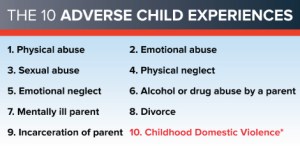
    The 10 ACEs (Adverse Childhood Experiences) are, in summary form:


    image from https://cdv.org/what-is-cdv/adverse-childhood-experiences/

    If you want to have each category be more fully defined (and some of them do include aspects you might not usually consider, so I recommend reviewing these if you haven’t, yet), go here, where you can actually “fill out” the survey at the same time:
    https://www.ncjfcj.org/sites/default/files/Finding%20Your%20ACE%20Score.pdf

    However, if you find all this obvious, so is your score: you get one point for each of the ACEs that occurred in your childhood (before age 18 years old). The total of these = your ACEs score.

    This ACEs number is important for examining the likelihood (statiscally speaking) of your having adverse consequences later in life (see below). The stats have three sections:
    —> 0, 1 or 2 ACEs
    —> 3 – 7 ACEs
    —> more than 7 ACEs

    The statistics tended to group in these ways in recognition of what types and how many negative consequences were most likely to occur for those with those ACEs numbers. Below is a description of the original study.

    The Adverse Childhood Experiences (ACEs) Original Research:

    “From 1995 to 1997, Kaiser Permanente’s Health Appraisal Clinic, in collaboration with Centers for Disease Control and Prevention, implemented one of the largest studies ever conducted on the origins of risk factors that have negative health and social consequences and the cumulative incidence and influence of psychological and physical abuse including: neglect, sexual abuse, witnessing violence, exposure to substance abuse, mental illness, suicidal behavior, and imprisonment of a family member (independent variables) on dependent variables that were measures of both mental health (depression, suicidality) and physical health (heart disease, cancer, chronic lung disease, skeletal fractures, liver disease, obesity) and health-related behaviors (alcoholism, drug abuse, smoking, high numbers of sexual partners) and poor self-rated health (Felitti et al. 1998).

    “The ACE questionnaire was constructed using selected questions from published surveys (American Journal of Preventive Medicine, 2017). Prior to the survey there had been little study of the relationship between early childhood adverse experiences and adult medical problems and behaviors (Felitti et al. 1998).

    “The ACE survey data was collected by mail from two waves of a sample of 17,000 adult members of Kaiser’s Health Maintenance Organization in San Diego, California between 1995 and 1997. The sample size itself was impressive. The release of the study findings was shocking to many when they showed the extent to which adverse childhood events negatively shaped future social and physical health outcomes, including life expectancy.

    “Perhaps less surprising, the findings showed that the more negative events a child experienced the higher the likelihood s/he had as an adult of suffering an array of health and behavior problems including alcoholism, chronic pulmonary disease, depression, illicit drug use, liver disease, adolescent pregnancy and many more (Centers for Disease Control and Prevention 2014a, b). Further, adults with the highest level of ACEs had a life expectancy 20 years less than those without high levels of ACEs. The study sample did not consist primarily of low-income minority adults, a demographic often found to be “at risk.” It was mainly comprised of white, middle and upper income employed people; people who might be expected to have had more stable childhood environments because of parents’ employment and income.

    “The original ACE study has generated more than 70 scientific articles, scores of conference presentations, and has shaped the design of research and as well as social programs. It is beyond the scope of this article to present a comprehensive review of the studies of the ACE survey, but ACEs Too High (2017) provides a list of ACE studies by year.

    “Studies using the ACE questionnaire have expanded beyond Kaiser’s sample of white, HMO patients to include, for example, special populations such as children of alcoholics (Dube et al. 2001), and children with an incarcerated parent (Geller et al. 2009) and have found higher prevalences of ACEs than in the original Kaiser sample.

    “ACE Studies of justice-involved populations (Baglivio et al. 2014; Messina and Grella 2006; Miller and Najavits 2012; Reavis et al. 2013) including juvenile justice-involved youth (Dierkhising et al. 2013) are raising awareness of the association of early childhood trauma and offender behaviors and needs, as are studies of justice-involved samples that include a focus on childhood trauma without using the ACE questionnaire (Wolff and Shi 2012). The studies consistently find elevated rates of childhood trauma in incarcerated populations and offender groups. For example, the Reavis et al. study (2013) of incarcerated males found ACE scores above 4 to be four times higher than in a normative male population.

    “By bringing attention to the powerful impact that negative childhood experiences have on future health and functioning, the ACE study demonstrates the importance of gathering information early in the lives of children and their families and designing early intervention programs that target violence and neglect. It also points to the importance of collecting trauma histories from clients and highlights the essential role of prevention in program design. A particularly important contribution the Ace survey has made to offender and incarcerated groups is to emphasize the importance of trauma-targeted interventions in jails and prisons as well as in diversion programs.”

    FMI: https://www.ncbi.nlm.nih.gov/pmc/articles/PMC5409906/

    More about How ACEs Operate in Our Lives

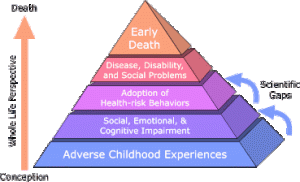
    This is a depiction of ACEs and their impacts in the form of a “pyramid of bad consequences”: if 3 or more ACEs form our lives’ “foundation,” we are much more likely to have a lot of other problems, including physical and mental health issues, suicidal ideation, criminal tendencies to the point of incarceration, and possible early death in our futures.

    Even having 1 or 2 ACEs can wreck a person’s life and/or health if enough mitigating factors aren’t present, especially when the adverse experience was
    —horrific,
    —happened at a formative time, and/or
    —was prolonged/repeated.


    image from https://www.communitycommons.org/2014/08/aces-adverse-childhood-experiences/

    This excellent 2014 TEDMED talk on ACEs from a health care perspective
    is on video, with presenter, Dr. Nadine Burke Harris, MD

    Burke offers the best summary of the study, its origins and findings, and their immediate and long-term applications for health care and other professionals as well as anyone affected by multiple ACEs.

    “Childhood trauma isn’t something you just get over as you grow up. Pediatrician Nadine Burke Harris explains that the repeated stress of abuse, neglect and parents struggling with mental health or substance abuse issues has real, tangible effects on the development of the brain.

    “This unfolds across a lifetime, to the point where those who’ve experienced high levels of trauma are at triple the risk for heart disease and lung cancer. An impassioned plea for pediatric medicine to confront the prevention and treatment of trauma, head-on.”

    Worth your time to watch: https://www.ted.com/talks/nadine_burke_harris_how_childhood_trauma_affects_health_across_a_lifetime

    ACEs High Scores Linked
    to Adult Emotional and Physical Health Problems

    There is a cycle regarding ACEs that usually occurs. Learning about how this cycle works is first. Then, figuring out how to intervene, interrupt and contravene the impacts can occur next.


    image from https://dribbble.com/shots/2214296-Adverse-Childhood-Experiences-infographic

    Know that Adverse Childhood Experiences (ACEs) are common

    In case you were wondering about the prevalence of ACEs, here are some recent statistics from a small but supposedly representative sample and their source.

    Of the 17,337 individuals surveyed, here is the prevalence of each possible adverse experience, from most to least, represented as a percentage:

    —Physical abuse towards the child – 28.3%
    —Substance abuse in the household – 26.9%
    —Parental separation/divorce – 23.3%
    —Sexual abuse toward the child – 20.7%
    —Mental Illness in the household – 19.4%
    —Emotional neglect towards the child – 14.8%
    —Domestic violence in the household – 12.7%
    —Emotional abuse towards the child – 10.6%
    —Physical neglect towards the child – 9.9%
    —Imprisoned household member – 4.7%

    ACEs are linked with a greater risk
    of many problems in later life

    These include:

    • Alcohol abuse and dependence
    • Early smoking initiation and current smoking status
    • Illicit drug use
    • IV drug abuse
    • Obesity
    • Suicide attempts
    • Depression
    • Anxiety
    • Hyperactivity
    • Sleep Disturbances
    • Hallucinations
    • Eating disorders
    • Suicide attempts
    • Post-traumatic stress disorder
    • Conduct disorder
    • Teen or unintended pregnancies
    • Intimate partner violence
    • Improper brain development
    • Impaired learning ability and general cognitive difficulties
    • Attention and memory difficulties
    • Visual and/or motor impairment
    • Lower language development
    • Impaired social and emotional skills
    • Poorer quality of life

    Nikki Gratix offers more links and stats about ACEs and long-term effects, with our first glimmers of hope (link is below the text, here):
    “Another long-term study indicated that approximately 80% of young adults who had previously been abused qualified for at least one psychiatric diagnosis at the age of 21 (Silverman, Reinherz & Gianconia, 1996).

    “Neglected or abused children are also
    —59% more likely to be arrested during their childhood,
    —28% more likely to engage in criminal behaviour as adults, and
    —30% more likely to engage in violent crime as an adult (Widom & Maxfield, 2001).

    “Abuse and neglect during childhood can also negatively impact the ability of individuals to effectively establish and maintain healthy romantic adult relationships (Colman & Widom, 2004). As relationship warmth and social connection are key protective factors for long-term health and happiness, many of these greater risks could at least be partially explained by the greater risk of interpersonal conflict, disconnection and isolation.

    “Individuals who have had negative experiences during their childhood can still grow and flourish as adults, and can also be more resilient as a result of learning how to overcome significant challenges when they are younger.

    This diagram, below, depicts the Risk Factors, Protective Factors and Resilience interactive model clearly:


    image from https://www.slideshare.net/PreventionWorks/bc-pc-december-13-2012, The InterdisciplinaryScience of Prevention Bernalillo County DWI Program Planning Council Meeting December 13, 2012 Frank G. Magourilos, MPS, CPS, ICPS Prevention Works

    “A major longitudinal study even found that what goes right during childhood is often more important than what goes wrong [emphasis mine], and having even one safe, stable and nurturing figure in a child’s life can reduce the later risk of psychological and physical health problems [emphasis mine] (Vaillant, 2015).

    “Creating safe, stable and nurturing environments (SSNREs) is the key to having a positive impact on reducing ACEs going forward.”

    LINK to the above: https://www.nikigratrix.com/silent-aces-epidemic-attachment-developmental-trauma/

    FMI: “Steps to Create Safe, Stable, Nurturing Relationships and Environments,” 2014, https://www.cdc.gov/violenceprevention/pdf/essentials_for_childhood_framework.pdf

    4 Quadrants/Types of Attachment:

    I found this set of connections (below) to be a very helpful rubric for understanding the ways trauma impacts our ability to choose appropriate partners/friends, even colleagues and form positive relationships when we suffer from many ACEs because it brings in the main principles of John Bowlby‘s attachment theory quite intelligently.

    • secure = consistent, responsive early care
      = low anxiety, low avoidance
      = positive views of self and others; comfortable relying on others, easily comforted
    • preoccupied = inconsistent early care
      = high anxiety, low avoidance
      negative view of selves but positive views of others; emotionally dependent, negative affects, hyper vigilance, low self-esteem
    • dismissive = early unresponsive care
      = low anxiety, high avoidance
      positive view of selves (see selves as resilient and not needing others), but negative views of others; uncomfortable with closeness, denial of attachment needs, avoidance of closeness, intimacy, dependency or close relationships; high self-reliance and independence
    • fearful = frequent rejection/abandonment by early caregivers
      = high anxiety, high avoidance
      seek social contact but inhibited by fear of rejection; approach/avoidance behavior in relationships; high negative affects and poor self-esteem

    INTERVENTIONS & SOLUTIONS:
    Trauma-Informed Care vs. Ordinary Care

    As mentioned previously in this post, Protective Factors contribute to Resilience, and both are great predictors of how well a child or adult will do when affected by ACEs (or any other Risk Factors). The basic formula is that when any of the Risk Factors is present (and the higher the number, the worse the situation is for that person), increasing the number and types of Protective Factors for that person is very likely to increase their Resilience, which, in turn, decreases the likelihood that the person will succumb to peer pressure or inner motivation to engage in risky behaviors or fall victim to other risks and those consequences.

    Similarly to Risk Factors (see above), researchers have divided Protective Factors into three categories: Individual, Family and Community

    Researchers are also discovering that these same Protective Factors, particularly those that arise from within the Community and Individual (since Family is presumed to be the source/cause of the ACEs) can increase that person’s tendency toward Resilience, which then can mitigate the effects of ACEs as well.

    Individual Protective Factors include:
    —Positive physical development
    —Academic achievement/intellectual development
    —High self-esteem
    —Emotional self-regulation
    —Good coping skills and problem-solving skills
    —Engagement and connections in two or more of the following contexts: school, with peers, in athletics, employment, religion, culture

    Family Protective Factors include:
    —Family provides structure, limits, rules, monitoring, and predictability
    —Supportive relationships with family members
    —Clear expectations for behavior and values

    Community (School, Neighborhood, and Community) Protective Factors include:
    —Presence of mentors and support for development of skills and interests
    —Opportunities for engagement within school and community
    —Positive norms
    —Clear expectations for behavior
    —Physical and psychological safety
    from: https://youth.gov/youth-topics/youth-mental-health/risk-and-protective-factors-youth

    Some researchers have further divided these Factors into three age groupings: Early Childhood (ages newborn – 5 or 6 [school-age]), Childhood (ages 5 or 6 – 11 or 12 [ending before middle school or junior high school age]), and Adolescence (middle/junior high school and high school ages, 11 or 12 – 18). This classification is used to study each sector and period of a youth’s life more closely.



    image from http://buncombeaces.org/

    “Once you know your ACEs score and its impact, there are personal strategies and community resources that exist to help you. Asking for help, developing trusting relationships, forming a positive attitude, and paying attention to your instincts and feelings are ways to improve your life. These can assist in breaking the cycle of ACEs in your family.

    Reaching out to a trusted member of your community such as a doctor, a counselor, a teacher, or a church or spiritual leader is another way to get help [emphsis mine]….Using these suggestions, both early in a child’s life and as an adult, can lessen the impact of ACEs on you and your family.”

    10 Key Components of Trauma-Informed Care:


    image from https://www.chcs.org/resource/10-key-ingredients-trauma-informed-care/

    “Trauma-Informed” (for educational settings, care, caregivers, institutions, youth programs, prisons, juvenile detention centers, court and police officers, etc.) is the newest way to describe what we MUST create and strengthen given our understanding of ACEs and the impacts of trauma throughout one’s lifetime. When society has better methods for prevention, we hope this won’t be as necessary. Until then, we are in dire need of more training, better programs, and more awareness.
    https://www.rchc.net/wp-content/uploads/2017/08/Trauma-Informed-Care-slides.pdf

    Research confirms that a person’s ability to Cope with trauma (and the neurodevelopmental effects) is rooted in the presence or absence of these circumstances and factors:

    Frequency – Single vs. repeated trauma (obviously, even one trauma is terrible, but more often is worse)
    Age when trauma occurred or began (the younger a person is, the worse off the person is likely to be)
    Agent – natural vs. human (weather disasters, earthquakes and fires are horribly traumatic, but war, interpersonal and domestic violence (being the victim OR the witness), and other human-inflicted harm are WORSE than “natural” causes of trauma when it comes to effects on the victims)
    Nature of the trauma – accidental vs. purposeful (particularly when the perpetrator was supposed to have been trustworthy and purported to “love” the victim, intentional harm is the worst type of trauma for a child)
    Environmental supports – Innate Resilience (there is some evidence in the fairly new field of epigenetics that some of us are “naturally” more resilient, particularly when it comes to resisting or lessening the effects of ACEs in the forms of bad health/diseases. Let’s find out WHY!)

    A lot of research on what contributes to resilience is happening NOW and recently.

    From 2017, we can read: “Epigenetic Embedding of Early Adversity and Developmental Risk,” from Marla B. Sokolowski, PhD, F.R.S.C., W. Thomas Boyce, MD, Co-Directors of the Child and Brain Development Program, Canadian Institute for Advanced Research (CIFAR), Canada, who discovered: “[T]he embedding of adversity-related epigenetic marks is associated with increased susceptibility to compromised development and mental health….

    “[A]dverse conditions in early childhood affect the number and placement of epigenetic marks on the DNA sequence. The developmental and health effects of early exposures to adversity and stress are socioeconomically partitioned, with children from the lower ranks of social class sustaining greater and more severe threats to normative development. Epigenetic processes that affect gene expression almost certainly have an impact on adversity-related, maladaptive outcomes….

    “Adverse early childhood experiences can leave lasting marks on genes that are involved with stress responses, immunity and mental health, underscoring the importance of creating an optimal early childhood environment for each and every child.”

    Other researchers created two categories of children to show the differences in fragility, “‘orchid children’…are more sensitive to both negative and positive environmental factors than their more resilient counterparts, called ‘dandelion children,'” which the above researchers utilized in their studies.
    http://www.child-encyclopedia.com/epigenetics/according-experts/epigenetic-embedding-early-adversity-and-developmental-risk

    A great podcast/radio show, On Being, with host, Krista Tippett, provides many informative, entertaining and important audio experiences. This one is very relevant, here: RACHEL YEHUDA talks about “How Trauma and Resilience Cross Generations.”

    “The new field of epigenetics sees that genes can be turned on and off and expressed differently through changes in environment and behavior. Rachel Yehuda is a pioneer in understanding how the effects of stress and trauma can transmit biologically, beyond cataclysmic events, to the next generation. She has studied the children of Holocaust survivors and of pregnant women who survived the 9/11 attacks.

    “But her science is a form of power for flourishing beyond the traumas large and small that mark each of our lives and those of our families and communities [emphasis mine].”

    Read the transcript and/or listen to podcast: https://onbeing.org/programs/rachel-yehuda-how-trauma-and-resilience-cross-generations-nov2017/

    If you have more time and prefer the video format, Bruce McEwen, Ph.D., talks about “The Resilient Brain: Epigenetics, Stress and the Lifecourse,” at Cornell University in 2017.

    For science geeks, this study is awesome! “Epigenetic modulation of inflammation and synaptic plasticity promotes resilience against stress in mice”: https://www.nature.com/articles/s41467-017-02794-5

    “Three key neuroscience concepts are recommended for inclusion in Trauma-Informed Care programs and practices in ways that can enrich program design and guide the development of practical, Resilience -oriented interventions that can be evaluated for outcomes.

    “A Resilience -oriented approach to TIC is recommended that moves from trauma information to neuroscience-based action with practical skills to build greater capacity for self-regulation and self-care in both service providers and clients.”

    Another source of info about ACEs comes from this report, below (audio-only, with some text), from my former home-town public radio station, KRCB, in the North Bay, San Francisco Bay Area, California:


    image from http://radio.krcb.org/post/educating-fellows-counter-adverse-childhood-experiences#stream/0

    Individual Protective Factors and Professional Training and Environmental Factors that Assist with Coping with ACEs are:
    —Social support
    —Supervision and consultation
    —Resolution of one’s personal issues
    —Strong ethical principles of practice
    —Knowledge of theory
    —On-going training
    —Emotional intelligence/regulation
    —Awareness of the potential and impact of Violent Trauma (VT).

    https://damonashworthpsychology.com/2017/09/14/the-10-things-you-need-to-know-about-the-adverse-childhood-experiences-study/

    Then, of course, we have Oprah weighing in (finally) a few weeks ago:

    Oprah’s 60 Minutes segment on ACES, 3/11/18

    image from https://www.chcs.org/project/advancing-trauma-informed-care/

    Oprah (and others) talk about how we need to shift our focus from “What is wrong with you?” to “What happened to you?” with all traumatized individuals.
    https://www.cbsnews.com/news/oprah-winfrey-treating-childhood-trauma/

    This video also mentions two important area of research about the brain and mental health related to ACEs or positive experiences. Good to know, but I’m still wanting more about what HELPS post-ACEs. Here we go!

    “Winfrey speaks to Dr. Bruce Perry, a psychiatristand neuroscientist who authorities have consulted on high-profile events, such as school shootings. She also visits two organizations that treat their clients with the so-called “trauma-informed care” approach shaped by Dr. Perry. Both the agencies, SaintA and the Nia Imani Family Center, are in Milwaukee, where Winfrey spent part of her youth and experienced her own instances of childhood trauma.”

    So, we know that chaos, threats, inconsistency, uncertainty, neglect, violence each constitutes a kind of traumas for children, and experiencing even one of these increases vulnerability in later life to many types of issues (academic, physical and mental health, interpersonal difficulties, employment problems).

    That is the reason we need to move from focusing on consequences to preventing/mitigating early traumas/wounds.

    One main “movement” is to bring in more institutions that provide “trauma-informed care.” Installing these changes is the best way to transform education, social and human services programming and treatment.

    ACEs and I

    I have written about ACEs before, disclosing that I have a very high ACEs score (9.5 out of 10). By the statistics reported since the early 1990s (see below), I should be in prison, institutionalized, or already dead. But, I’m not. Why is that?

    Again, we need to ask “what happened?” rather than “what’s wrong?” to/with a child. Then, we need to build on strengths rather than focus on deficiencies or problems.

    Why do some of us not have PTSD after many ACEs? Our reactions seem to be proportional to the numbers and frequency of whatever positive, protective, nurturing relationships we have had in early life. I am an example of an unusual case. See below.

    I decided to look more deeply into this topic: what fosters Resilience? How do children and youth with high trauma scores not be completely unhealthy or miserable as adults? My discoveries are in this post and will keep coming.

    Please comment on my site, on this post, regardless of where you’re reading this. The post is available starting 4/11/18: http://www.sallyember.com/blog or https://wp.me/p2bP0n-27w

    Other Resources

    Alice Miller‘s work = relevant because her main recommendation and research evidence are in alignment with ACEs’ researchers and therapists: it only takes ONE significant adult in a traumatized child’s life to greatly mitigate and even ameliorate the effects and later consequences of the trauma. I can attest to that truth.


    Drama of the Gifted Child by Alice Miller

    Here is a great post about this book and Miller‘s work: https://www.psychologytoday.com/us/blog/suffer-the-children/201206/the-drama-the-gifted-child

    Some local/regional resources (near both USA coasts), and more on their site, from CHCS (Center for Healthcare Strategies):

    Center for Youth Wellness, San Francisco, CA, will implement adverse childhood experiences (ACE) screening, care coordination, and data management strategies to further its integrated care approach for addressing the physical and behavioral health needs of families with ACE exposure.

    Greater Newark Healthcare Coalition, Newark, NJ, will establish care coordination, trauma screening and treatment, professional development, and data integration practices.

    Montefiore Medical Group, Bronx, NY, will train all staff within its 22-practice outpatient ambulatory care network in trauma-informed approaches to care using a multi-disciplinary train-the-trainer model including patient representatives.

    San Francisco Department of Public Health, San Francisco, CA, will develop a leadership model, learning community, and collaborative work group that will infuse trauma-informed systems’ principles and practices into public health and other child-, youth-, and family-serving agencies.

    Stephen and Sandra Sheller 11th Street Family Health Services, Philadelphia, PA, will train all staff to adopt a standard approach to collective mindfulness practice and use an integrated mind-body treatment model in working with patients who have experienced trauma.

    Women’s HIV Program at the University of California, San Francisco, CA, will develop a formal service integration partnership with the Trauma Recovery Center at San Francisco General Hospital to address the effects of lifetime trauma on adults.

Unknown's avatar

Young Adults With Type 1 Diabetes Show Abnormal Brain Activity (reblogged)

“The harrowing conclusion from the study authors is that even young, healthy adults with type 1 diabetes [born with the disease rather than “acquired” it later in life; often called “juvenile diabetes”] ‘already have aberrant neural processing [emphasis mine] relative to their non-diabetic peers, employing compensatory responses to perform the task, and glucose management and duration may play a central role.’

“What would be the findings among type 1s who keep their A1c in non-diabetic range, one might wonder? This study suggests it is likely that elevated blood sugar over time is what changes the brain activity [emphasis mine]. These effects are possibly compounded over time in those with comorbidities like obesity and high blood pressure.”

Having diabetes may affect the way our brains work. Research is taking place to find out exactly how this occurs. In a recent study, researchers describe how tying diabetes to cognitive impairment is tricky because many people with diabetes have other conditions like high blood pressure and obesity, which also affect cognition. That’s why they […]

via Young Adults With Type 1 Diabetes Show Abnormal Brain Activity — SOMEONE SOMEWHERE

Unknown's avatar

#TEDGlobal2017 line-up, here

On August 27, 2017, an extraordinary group of people gathered in Arusha, Tanzania, for TEDGlobal 2017, a four-day TED Conference for “those with a genuine interest in the betterment of the continent,” said curator Emeka Okafor. As Okafor put it: “Africa has an opportunity to reframe the future of work, cultural production, entrepreneurship, agribusiness. We…

via Sneak preview lineup unveiled for Africa’s next TED Conference — TED Blog

Unknown's avatar

#TEDtalk #neuroscience DBS (Deep Brain Stimulation) breakthroughs

As usual, the TED community has lots of news to share this week. Below, some highlights. Surface-level brain stimulation. The delivery of an electric current to the part of the brain involved in movement control, known as deep brain stimulation, is sometimes used to treat people with Parkinson’s disease, depression, epilepsy and obsessive compulsive disorder.…

via A noninvasive method for deep brain stimulation, a new class of Emerging Explorers, and much more — TED Blog

Unknown's avatar

Free online course from the grandmother of all creative writing courses – the University of Iowa — Writer’s Treasure Chest

Originally posted on BRIDGET WHELAN writer: The very first creative writing workshops were pioneered at the University of Iowa in the 1930s and they still have a mighty reputation today. They are now offering a free open online course to explore Walt Whitman’s writings on the American Civil War, looking at how writing and image…

via Free online course from the grandmother of all creative writing courses – the University of Iowa — Writer’s Treasure Chest

Unknown's avatar

“Wild, Wild Country,” a Documentary about Spiritual Guru, Bhagwan Shree Rajneesh, and His Followers: My Opinions, Personal Experiences and Reactions

Wild, Wild Country, a Documentary about Spiritual Guru, Bhagwan Shree Rajneesh, and His Followers: My Opinions, Personal Experiences and Reactions

There are many similarities between “traditional” or “organized” religions around the world and all their sects and cults. The valuation of these distinctions depends entirely on the describer’s perspective, the point in history they existed, who is doing the defining, what the underlying politics and economics are for such definitions, what fears already lie in wait, and what the circumstances surrounding the group’s existence were/are.


image from https://triangulations.wordpress.com/2014/03/13/cults-vs-religions/

UPDATED RESOURCE from 8/1/18: UPDATED RESOURCE from 8/1/18: “Why are Cults so Difficult to Oppose?” https://buddhism-controversy-blog.com/2018/08/01/why-are-cults-so-difficult-to-oppose/ is a great, informative blog post/article about definitions of the continuum that includes cults and other organizational dysfunctions. Worth reading!

Watch Jesus Christ Superstar or Godspell to see the cult of Jesus in effect, with songs and dances. Study the modern-day equivalents, such as the disasters that occurred when the USA government went against Waco‘s (around David Koresh) or Ruby Ridge‘s cults, or the suicide cult of Jim Jones and The People’s Temple, or Charles Manson and the murders he inspired, to see modern-day versions of the Jesus cult’s influences. Visit any Mormon polygamy family or group to see Joseph Smith‘s influence morphed into a cult. On and on.

There are many intentional religious communities, such as the Mormons, the Shakers, the Essenes, that would be (or are) considered cults. There are other groups of individuals that decided to live together in communes, communities, even towns or cities, whose organizations were eventually legitimized politically and socially, such as Puritans, Quakers, Twin Oaks, Findhorn and others.

Many first came to the USA from other countries to escape religious persecution. In their countries of origin, they were undoubtedly banned and were definitely considered dangerous criminals, heretics and illegal, which motivated or forced their unethical occupation of these lands. Even if these people had been exiled to the “New World” as recently freed or still-incarcerated prisoners, they soon formed or joined “colonies” that, after a bloody revolutionary war to declare independence, became “states” or “commonwealths.” When does incorporating legitimize a cult?

“History is written by the victors,” proclaimed Winston Churchill, the former Prime Minister of Great Britain (when it was still the heart of a formidable United Kingdom)…. He should know. Nothing we hear or read regarding controversial historical events can ever be exactly what it seems.

Howard Zinn‘s A People’s History of The United States proves repeatedly and painfully how many lies are told by the “winners” to justify and glorify their victories. The actual stories of the invaders and thieves who came to the Western Hemisphere’s continents and islands and subsequently raped, pillaged, enslaved, lied, kidnapped, burned down and stole their ways across and all around these lands—which were already occupied—was recast to frame these criminals and slave-owners and those who benefited from/were related to them as “explorers,” “Pilgrims,” “colonists,” “settlers,” “Pioneers,” “plantation owners,” “farmers,” etc.

We want the divine to be visible on earth. We want a Messiah. We want to belong and be inspired. These are human desires.

Watching the six episodes of Wild, Wild Country, I was flooded with memories, emotions, thoughts and observations due to my own connections to these and similar people and groups. In this post, I reveal my own herstory and also share my opinions, observations and emotions stimulated by my viewing of this documentary about the Rajneeshees.

Wherever you are reading this, please post your own experiences, comments, insights here, or find the post’s comments section on my site on or after April 5, 2018: http://www.sallyember.com/blog


My herstory, with full disclosures:

—By the definitions, checklists and assessments offered as to what constitutes a “cult” (listed and quoted at the end of this post), I have been a member of, somewhat involved in, or around leaders/members of about twenty of these so-called “cults” in my life already. A few were great, start to finish/currently. Others started out all right and turned bad. Several started out weird and became familiar and helpful. There were many that exist(ed) somewhere in between these poles of experience.
—I have had personal friends, acquaintances and known several community members who were very involved with and were staunch supporters/members of the Rajneeshees Oregon community (featured in this documentary), although none of them lived there for very long or had only visited. I called them “Orange People” and treated them with varying degrees of indulgence, disrespect, acceptance, interest, derision, bewilderment, curiousity.
—I was born into the edges of one “traditional religious” cult that my brother and his family are all happily members of—Modern Orthodox Judaism—but I’m sure they would object to having their portion of Judaism classified as a cult, even though it meets most of the criteria.
—In addition to Rajneeshees`, I have known well/had reconnections with more than 100 roommates, friends, family members, colleagues and acquaintances involved in cults and cult-like groups since 1972.

Here are the key groups I have been connected to over these decades:

  • The self-proclaimed Reverend Sun Yung Moon‘s Unification Church‘s (followers known as “Moonies”) bought and took over the University of Bridgeport (UB) in Connecticut in the late 1970s.
    I earned a Bachelors degree right before their takeover and was friends with a professor there who stayed through the takeover and after they departed. He did not become a Moonie, but during their administration, he became a Dean, then Provost, before retiring a few years ago.
    I became ashamed to have earned my B.A. from the place that became known as “Moonie U.,” always hastily adding after being forced to admit I had graduated from UB that I had left before the Moonies had come.

    The Cultiversity of Bridgeport
    article at https://theness.com/index.php/the-cultiversity-of-bridgeport/

  • I joined the teaching staff of a small but vibrant parent cooperative, private elementary educational institution, The Learning Tree School, that was nested within a larger community in southeastern Rhode Island and southeastern Massachusetts. The staff and parents had created some living situations that included at least three multi-member households.
    I joined one that had a single parent, her daughter and her partner (brother of one of my co-teachers), a VISTA (AmeriCorps, now) volunteer for the school, myself, and a man who knew many of these people and needed a place to live who would become one of my life partners (see below).
    I first learned about many things that became central to my life while part of this community: Finnish saunas (VERY hot, with steam on wood stovetops in outdoor buildings, and always done while naked and with the cold /ice water interludes), massage, chiropractic care, The Ovulation Method of fertility awareness, medicinal herbs and organic gardening, vegetarianism, macrobiotics, Re-Evaluation Counseling (RC; see below), communal households and collective living (which I lived in/organized from 1977 – 2005), “open” relationships/non-monogamy, positive classroom discipline, collaborative/consensus decision-making, arts in education, “free” school philosophies, child-centered classrooms and so much more.
    The aforementioned male addition to our collective household and I started a relationship that continued for almost twenty years. He is the father of my only child, a Mevlevi Sufi (see below), and still a good friend.
    But, interestingly, as a somewhat traditional teacher and person going into this teaching position and community, I remained an outsider. They decided that I was too “strict” when I objected to the other teachers’ lack of supervision of the children during icy recess afternoons or at the beachfront (our school occupied the former boathouse of a mostly inactive convent in Tiverton, Rhode Island), and not “loose” enough with the students (I didn’t like it when they got u[ and left in the middle of a lesson and called them back inside). We parted ways after only one year.

  • Followers of Prem Rawat, known as “The Maharishi,” (followers known as “Premies”) included my first-year college roommate, my former brother-out-law and his wife, several of their friends and a housemate’s sister. Although I participated in a few satsangs (Hindu-esque rituals, listening to audio or watching video of the teacher, chanting, singing, incense), this was not at all appealing to me.
  • I know three types of Sufis:
    1) those who started The Abode of the Message—one of the places my partner and I considered living—an “Eco-Sufi Village,” in Lebanon, New York, which spun off into Omega Institute for Holistic Studies, a “New Age” educational conference center in Rhinebeck, New York, and now, five other locations all still operating today. Both centers’ leaders follow(ed) the now-late Pir Vilayat Khan, and, later, his successor, Vilayat Inayat Khan but Omega welcomes all traditions, hosting many other leaders and educators.
    We weren’t drawn to The Abode community when we visited, so I didn’t return until I attended a week-long educational seminar at Omega in Rhinebeck about twenty years later. Great place! Just not for me;


    image of indoor meeting space, Omega Institute, Rhinebeck, NY

    2) those who are considered Mevlevi, often Turkish, who follow the teachings of the late poet, Rumi (Jalal ad-Din Muhammad Balkhi-Rumi). I knew/know many of these Sufis, including their now-deposed (due to a sex scandal) leader, Kabir [Ed] Helminski, in southwestern New Hampshire and southeastern Vermont (because my son’s father is a follower).
    My son’s father became a world-renowned master among the specialized Sufi Dancers known as Whirling Dervishes. He has traveled all over the world to whirl, starting in the mid-1980s, including at Carnegie Hall in New York City.
    Despite attending numerous Sufi family events and Semas, I never felt drawn to this path, either;
    and,
    3) students/followers of Sufi Sam Lewis (also known as Murshid Samuel Lewis and Sufi Ahmed Murad Chisti), who helped invent a type of spiritual dances that were done in circles with partners and groups, in spirals and other patterns, which he called “Sufi Dancing.”
    My son’s father had lived at and known Sam at the Lama Foundation in New Mexico before Sam’s death in 1971. I first encountered and participated in Sufi dancing at Another Place Conference Center in 1978 (see below).
    Sufi dancing has spread throughout the USA and Canada and the world. In several USA places on both coasts and in New Mexico for over thirty years, I learned a lot of these dances and songs, some in English, some in Arabic. I love them because they were easy to learn and the dancing/singing quickly infused us dancers with sweet messages of love, hope, peace, joy and community camaraderie.
    But, group arts activity is not a path and nothing about it appealed to me besides the Sufi dancing.


    image from https://triangulations.wordpress.com/2014/03/13/cults-vs-religions/

  • I was friends with and knew personally several leaders/founders of the Contact Improvisation Dance groups and Dance/Movement Therapy that inspired “Dance Free” (in Cambridge, MA), “Dance New England,” dance camps, “Dance Spree” at Keene State College in New Hampshire, and the Counseling Psychology/Dance Movement Therapy Masters’ degree program at Antioch New England Graduate School in Keene, New Hampshire.
    I have had several housemates and good friends who taught at and/or attended Antioch New England’s various graduate programs, including this one, and the DMT/CP program is the one from which my daughter-in-law graduated in 2016.
    But, since I hurt my leg severely in high school and suffered greatly from nerve pain for about twenty years, vigorous dancing was not my path, either.

  • MSIA (Movement of Spiritual Inner Awareness) founded by John-Roger, “The Mystical Traveler” (a close associate of Arianna Huffington), had many other well-known followers/adherents. Jack Canfield of Chicken Soup for the Soul was an early leader.
    One of my sisters was very involved with this in the late 1970s. After she graduated college, she and her partner (later, husband) moved to Los Angeles, California, and that’s where she met up with these people. She decided to earn a master’s degree in counseling from their questionable and uncertified Koh-I-Nor University in Los Angeles. She worked for and was friends with Jack Canfield and his second wife for a year or so, then started having children and didn’t go back.
    My sister’s involvement scared more than appealed to me. I was glad when she left the group.

  • Re-Evaluation Counseling (RC), founded by Harvey Jackins, was created from what Harvey stole from the work, philosophies and techniques of Gestalt/Fritz Perls, Psychodrama/J.L. Moreno, L. Ron Hubbard/Scientology/Dianetics, and Alcoholics Anonymous/”Bill,” and the Big Book. Harvey and a few other “peer counselors” began to “train”and recruit participants and local, regional and global leaders (“Reference Persons”) through free introductory workshops, then pushing members into increasingly expensive beginning and required classes, that become more elite (and costly). The sequences of more “advanced” classes (like EST, Esalen, and many other groups/conference centers, what they offer gets pricey; see below) keep the organization funded. RC is a “peer counseling” technique which became the foundation of an international movement of anti-oppression, especially social, political, personal growth and activism, which I greatly appreciated and learned about intensively. Based in Seattle, Washington, the organization continues to this day and still sells information through Rational Island Publishers. A lot of the anti-oppression, anti-isms movements’ language, concepts, techniques and workshop leadership sprung from RC roots.


    images from https://www.rc.org/

    After Harvey‘s death in 1999, his son, Tim Jackins, took it over as the newly selected “International Liberation Reference Person.” RC leaders started multiple magazines/newsletters and used their increasing political savvy and leadership influence to help/staff many of the most significant civil rights and improvement movements of the 1950s, 60s, 70s, 80s, 90s, and the new millenium (environment, feminism/sexism, ableism, racism, sexual abuse memory recovery, ageism, peace and social justice, to name a few) that are still having an impact and still active worldwide.
    I started with RC in 1980 despite having had bad experiences with it in The Learning Tree School community (some co-counselors did not maintain confidentiality, e.g.; see above), then left it in 1984 to join and become a leader of CCI. I credit my ability to deal effectively and with courage when my own and others’ emotions arise, my raised consciousness (now called being “woke”) regarding all types of internalized and external oppression, my first understanding of the “isms,” social and political systems, leadership, group dynamics, catharsis (known as discharge, here) and much more to my experiences in RC and CCI.
    I met some great people who became lifelong friends, colleagues, inspirations and mentors for me through these organizations. I am eternally grateful that these organizations existed and were accessible to me in my early adult and new parent years. My first teachers and co-counselors earned my gratitude forever: Bonnie Insull, the late Jaye Alper, Anna Aasgard, Diane Balser, Katie Schwerin, Emmy Ianello, Sydney Amara Morris, Bill Whyte, Zea Moore, Jeremy Youst, Mario Cossa, Pamela Lerman, Susan Link, Beth Pearson, Thom Herman, and David Eisenberg.
    But, the rigidity turned me off, so I turned to CCI (see below).

  • Co-Counseling International (CCI) was a spin-off/rip-off of RC that formed in 1973 when a few disgruntled leaders and practitioners of RC didn’t want to follow the “blue pages” (stolen from Alcoholics Anonymous‘ “Big Book,” these were originally printed on blue paper; these list the guidelines/rules for social conduct for AA groups that Harvey adapted for RC groups), particularly rebelling against the strictly enforced rules that forbid socializing/befriending and having sex with people whom co-counseling participants knew only through RC as leaders or co-counselors. CCI-ers also wanted more respect for and inclusion of the “spiritual” component than Harvey and his co-leaders seemed to value or would permit. Adding the spiritual component and escaping the rigidity of RC appealed to me, so I switched alliances in 1983.
    I rose quickly in the local ranks, leading/teaching classes and workshops, weekend conferences and other events. However, there was too much irresponsible and non-monogamous sex going on among co-counselors, especially at weekend workshop events, even for me (who was in “open” relationships for more than half my adult life), For example, there were many public displays of kissing and fondling, seemingly required at the end of some weekend conferences in a kind of good-bye dance line set-up, that made me very uncomfortable. I usually declined to participate in these “group gropes,” but, as a co-leader, I wish I had tried to stop them completely.
    I stayed about three years with CCI, but left CCI once I started going to traditional therapy in 1986 (after the Choy/cult experiences—see below—destroyed my main friendships and co-teaching partnerships within CCI).

  • Some Sikhs were those who followed Yogi Bhajan and Kirpal Singh and his successors. Some started and ran the Golden Temple of Conscious Cookery restaurant in Cambridge, Massachusetts.
    One of these Sikhs was a 3-year roommate (1987-1989) and friend of mine in New Hampshire.
    Being a complete vegan did not appeal to me, nor did that eating plan work for my body. I didn’t like the worshipping a human teacher aspects much. Plus, the turbans were a big turn-off.

  • The Farm in Summertown, Tennessee, founded and led by Stephen and Ina May Gaskin, inspired/wrote Spiritual Midwifery. The Farm was one intentional community that my partner and I considered living in and visited in 1978. But, while we were visiting, they were experiencing a hepatitis outbreak: big turn-off.


    Spiritual Midwifery by Ina May Gaskin of The Farm

    We knew several couples who had lived there but who had left and moved to New Hampshire and Massachusetts in the late 1970s (two couples had been in a “four-marriage,” which meant each of them had fathered a child with the other’s wife, but that child was raised as in ignorance until adulthood, believing him/herself to have been the child of the originally married couple). One of the families that we knew well (because my partner had been college friends with the mom) had had one of their children’s birth stories featured in the midwifery book.
    Because of The Farm‘s great information dissemination, we had access to one of the best books on home births, a great cookbook for home cooking for vegetarians (especially how to cook beans, tips on using pressure cookers, recipes for making everything from scratch), pamphlets on making/using tofu (The Farm community was instrumental in popularizing the use of soy in many forms). I became an excellent vegetarian cook, we had a home birth for our son, and we had several friends who were lay midwives (three midwives attended our son’s home birth).


    My son, his father and I, he in a Native American-style, homemade (by two of our midwives) cradleboard, May, 1980, Stoddard, New Hampshire

    I am very grateful to the Gaskins and their followers for all they have contributed to my and many others’ lives.

  • I knew a lot of “Mukties,” followers of Muktananda—born Krishna Rai— who was the founder of Siddha Yoga and popularized the spiritual residential centers known as “ashrams” in the USA.
    Students of Muktananda and his successors were leaders/members of several groups I was affiliated with, including Another Place Conference Center, Spring Hill Community, Opening the Heart, and Robert Gass and the Wings of Song band/chorus in the late 1970s and early 1980s (I am listed as “Sallie Fleischman,” a chorus member, on the second album, Many Blessings, released in 1980; I performed with the band from 1978 – 1980). We also had two Siddha Yoga practitioners for housemates. I also knew some Buddhist sangha members who were Siddha Yoga practitioners/leaders (known as “Swamis”) who had lived at the main ashram in New York state.
    But, other than the chanting and singing kirtan (Hindu sacred music), I was never drawn to visit an ashram or practice in this path.

  • Mettanokit (a Wampanoag—Native American—language name given to several communal households that were part of an intentional community in southwestern New Hampshire that my partner and I moved from Massachusetts to be a part of, attracted by this flyer:


    Mettanokit flyer, circa 1978

    This community was started by Native American activist and author, Medicine Story (Francis Story Talbot, Manitonquat, who has written extensively on his philosophies ad done a lot of work in the world related to these concepts), and his then-wife, Emmy Ianello, and several others. I lived in collective households with some of these members (Story, Emmy, Toqueem [child], Katie, Bill, Mia [child], Charlie, Aaron [child], Christopher and I were in the first group household, in Sharon, New Hampshire, 1978-79) in some combination for three years (and there were several home births in these households, including ours; see above).
    Although the community splintered and some moved to form other households—in Massachusetts, Another Place Conference Center (where many had lived prior to this; see above and below) who then bought and ran it for years, in other parts of New Hampshire, and some scattered—I became lifelong friends with the family who founded and still run Badger Balm, Bill Whyte, Katie Schwerin, and their daughters, Emily Schwerin-Whyte and Rebecca Hamilton, and Katie‘s daughter, Neumia Mason Burroughs.
    Joining this community was the reason I landed in New Hampshire, and these connections formed the foundation for my adult life, parenting and community for over twenty years. I am very grateful to have known and been a part of this venture at its inception.

  • Wiccans: I was close friends with several practicing witches whose beliefs were sometimes labeled “Wiccan,” “Pagan,” and “Womancraft.” I attended a workshop with USA’s most famous modern witch, activist and author, Starhawk, and visited and did rituals with several covens and Goddess groups that practiced “White Magic” in the 1980s.
    I learned to read Tarot cards, scry (see visions in crystal balls), do healings with placing crystals on people’s bodies and faces, cast a circle (create a safe/sacred space for rituals) and use the tools of Wicca. I had several crystals, crystal balls and my own athame (ritual dagger) as well as specific types of candles and incense.
    I learned a lot and enjoyed some of the rituals and gatherings, but when my closest friends who were committed practitioners of the Craft moved away, my interest dwindled.

  • Shamanism: (the Michael Harner-/Brant Secunda-inspired types). I knew a few who had studied with these leaders who brought the techniques back to New Hampshire.
    I attended some drumming/shamanic dreaming/vision circles in the 1980s.
    But, I had more interest in one of the drummers than the path, and when our friendship blew up (see Choy experience, below), my interests in Shamanism and drumming vision quests ended as well.

  • Robert Bly followers/drum circle men permeated several communities I was part of in southwestern New Hampshire and northern California.
    As a woman, this was not for me.

  • Radical feminism: I am still an adherent.
    I belonged to several feminist groups over the years, including the Rising Sun Feminist Health Alliance, which had founding members who were in the Boston Women’s Health Book Collective (the authors of Our Bodies/Ourselves) as its leaders. I was also briefly on the Board of New Hampshire-NARAL (National Abortion Rights Action League). I also visited and/or belonged to vision groups, study groups, Grandmothers’ groups, Goddess groups, several women’s choruses, women’s groups, lesbian-bisexual women’s groups, LGBT groups, and feminist activist organizations in five states (some of which overlapped with Wicca, above).
    I attended a weekend workshop at Rowe Conference Center in Rowe, Massachusetts, in 1990, led by ex-communicated, feminist, former two-time presidential candidate, public speaker and author, Sonia Johnson. Sonia kissed any participant who wanted to kiss her at the closing circle ceremony. I did not volunteer.


    image from Citizens’ Party

    Because of my having attended a panel of the authors of Women’s Ways of Knowing and a workshop with Carol Gilligan and some of her co-authors and researchers of In A Different Voice in the 1980s, I decided to return to school to earn my masters’ and doctoral degrees in the early 1990s. I briefly belonged to the AWP (Association of Women in Psychology) feminist professional organization during that time.
    I have been a feminist since 1957, when I objected to traditional Reformed Jewish rituals and traditions that excluded or marginalized girls/women. I am still a feminist.

  • Eco-warriors and Peace Activists: I knew/was friends with some of the original recyclers, permaculturalists, organic farmers, people who started several food co-ops, a founder of Erewhon Natural Foods, founders/members of the New England Organic Farmers Association [NOFA], several environmental educators/faculty at Sargent Camp and Antioch/New England Graduate School in southwestern New Hampshire, and members of several similar groups I was loosely affiliated with for many years. Anti-war/Peace activism: included me and fellow high school students, starting in 1969 for the first Moratorium Day (anti Vietnam War national demonstration, for which I was suspended from school for wearing the black armband; 10/15/69), and continued for every war after that.
    I wish we prevailed more often.

  • Anti-nuclear power activists: I was a member of The Clamshell Alliance, which helped stop the building of the Seabrook, New Hampshire, nuclear power plant’s second tower, close down the Rowe, Massachusetts, aging plant, and stop the building of several others around the USA in the 1970s-1980s, particularly successful after the Harrisburg, Pennsylvania, nuclear power plant meltdown/disaster.
    Again, I wish we prevailed more often.

  • I learned T.M. (Transcendental Meditation, as taught by the followers of the Beatles’ guru, Maharishi Mahesh Yogi), right after graduating high school in 1972, but I didn’t join the group. I practiced T.M. twice daily for over 20 years.
    I have had friends and acquaintances who went to live at the USA’s T.M. center in Iowa, attended Maharishi University there and lived at the center in India. Some became leaders in the T.M. movement.
    But, I was in my thirties before I realized that this was a Hindu-based meditation practice, since I had stayed out of the groups (and was glad I had). I did the practice, which turned out to be a component of shamatha meditation (calm abiding) in Buddhism, but not the Hindu path.

  • Scientology briefly grabbed my brother’s attention in 1970, but he didn’t continue pursuing it after high school. In 2013, I met some colleagues who had been more involved in that and its spin-off, Dianetics, but who had also left by the time I worked with them.
    Neither of these appealed to me at all.

  • I was in, around, friends with, sent my child to daycare/preschool and school at/with several intentional communities in southwestern New Hampshire between 1978 – 1998, including Rudolf Steiner/Waldorf Schools/Anthroposophism groups (which I did not join, myself, but many friends became Waldorf teachers). I was the accompanist for the Monadnock Waldorf School‘s (MWS) Eurythmy program in 1987-88, before our son became a student there. Our son attended MWS from 1988-1994 (3rd – 8th grades), and we were active parents. I helped with drama productions, sex/health education, conflict resolution, craft fairs and childcare.
    I appreciated MWS‘ existence in our community, and most of my friends sent their kids to this and other Waldorf schools. But, I always felt like an outsider/dissenter to Anthroposophism because I never bought in completely. The Christian components, especially in the MWS school/community, were excessive and oppressive to me, as a Jewish Buddhist. I was relieved to be “done” with MWS when our son graduated.

  • In 1983, I first met author, channeler/clairvoyant, public speaker and workshop leader, Caroline Myss [pronounced “Carolyn Mace”] when she agreed to meet with me and my friend/colleague, Mario Cossa, to discuss the lost city of Atlantis for two children’s /youth plays we were writing. We became very good friends from then on, seeing each other almost weekly until she left New Hampshire to return to Chicago in 1992.


    Caroline Myss, from her website

    I also met and became friendly with the other founders and staff at Stillpoint Publishing, where she and Meredith Young (author of Agartha: Journey to the Stars) wrote and worked and two other friends of mine soon worked. I coordinated a workshop for Caroline to lead that took place at Another Place Conference Center (see above) in the fall of 1985 on the topic of her second book, Sacred Contracts and Your Archetypes, and I am mentioned in the forewords of three of her books.
    It was from Caroline and Meredith that I first learned about and became interested in “channeling,” so I was ripe to meet with and study with Lisa Leghorn in the early spring of 1985 (see below).

  • I have happily been a member and practitioner, myself, of another cult-like group (according to many definitions), Vajrayana Tibetan Buddhists, as led by the late His Eminence Chagdud Tulku Rinpoche. I spent about fifteen years co-leading and living in/participating in several of Chagdud Gonpa‘s meditation groups/centers (since 1988–first meetings/1996–joined up). First studying with Lama Lisa Leghorn/Lama Shenphen (see below), my then-partner and I helped start, lead, coordinate, sat on the boards of, and lived in several of these Gonpas (meditation centers/communities).
    I have done several “long” retreats—up to eleven weeks, all in silence—and many that lasted two – three weeks or a long weekend. I attended three 10-day Drubchens and several Drubchods (closed or open retreats with music, chanting, dancing and other rituals that lasted 24 hours a day), weekly or daily meditation sessions (pujas), and even trained to be and functioned as the leader (umzei) for these weekly sessions at several centers. I spent ten years exchanging English language tutoring for Tibetan language tutoring with a Tibetan man I met through one of these centers who became a good friend. I learned to read and write in Tibetan, but not to speak much and was never fluent.
    After philosophical differences among its leaders/Lamas caused schisms (between 2007 – 2009), I “spun-off” with Rinpoche‘s successor, who was already my main/”root” Lama, Lama Padma Drimed Norbu ([Al]Wyn Fischel; see below). He left Chagdud Gonpa‘s main center, Rigdzin Ling in Junction City (northern California, near Redding), in 2009 and moved to the San Francisco Bay Area of California, where I already had been living for about seven years.


    Lama Drimed (Wyn Fischel), my teacher

    I returned to Missouri in August, 2014, after the accident that caused a TBI for me in the spring of 2014; up until then, I met with Lama Drimed about once every few months for most of those years. Since I moved, I only returned to California once, in 2016, when I did get to meet with him. Otherwise, we email and have phone calls periodically and I still consider him to be my spiritual teacher. There are a few Buddhist groups here in St. Louis that I have visited, attended some events and kind of affiliated with, but none is the exact same kind of Vajrayana Tibetan Buddhism as mine, although three are very close “cousins.” I’ve gotten used to being a solo practitioner, though, at this point (spring, 2018).


    image from http://www.vijayatemple.orgA Tibetan Vajrayana Buddhist class, similar to the ones I attended for many years

    I practice meditation in the Tibetan Vajrayana Buddhist tradition daily and throughout the day, formally and informally, to date (April, 2018), and plan to continue through my death and into other lifetimes.

  • I have always really wanted to be a part of a healthy intentional community, but NOT a cult. I knew the editors/founders of Communities Magazine, Paul Freundlich and his then-partner, in 1978.
    I knew and visited dozens of people who lived at variously located small- and large-group intentional community experiments, always searching for the “right” one for me.
    I was part of a group that tried to get a co-housing community started in 1990-91, but we disintegrated.
    I still long to live in that kind of setting and wish I could find the right community.

There are many more cult-like groups and people affiliated with them that I’ve known, but I’m stopping, here, since these are the main ones, including the story, below.


My Worst Cult-like Experience, with the Same Two Leaders as my Best

Some local teachers, Lisa Leghorn, with whom I was already studying, and, later, Wyn Fischel (who later were briefly married to each other), were pivotal influences in my life, beginning in 1985. They brought me into meeting and studying Tibetan Vajrayana Buddhism with H.E. Chagdud Tulku Rinpoche because they each became Buddhist teachers/Lamas; see above), which saved and enhanced my life and spiritual development, unlike anything I have ever known before or since (and, by now, you can see I’ve “known” a lot of “paths”).

Lisa and, secondarily, Wyn were the connections that led me to meet with and join what became a briefly formed cult. This group centered around a Filipino faith healer known as Choy who lived in Baguio City, the Philippines. [NOTE: I can’t remember his real name. A Google search didn’t turn up any mention of him by his nickname. The only photos I have are personal, casual or posed group shots.]

This part of my cult experiences story started for me in March of 1985.
I had seen some flyers and ads and then heard from several friends about a “Psychic and Spiritual Development” teacher from Hillsborough, New Hampshire, Lisa Leghorn, who was going to speak and teach in Peterborough, New Hampshire. Lisa apparently offered private psychic readings by “Channeling” her “Spirit Guides” (this was very big in the 1980s). She taught classes in giving readings as well as how to dowse, use crystals for healing and focusing our energies, and learn to “awaken our psychic potentials. The flyers said that Lisa was going to give an introductory lecture and start a series of weekly classes in April of 1985. Since I had been seeing/hearing about it multiple times, it seemed significant and I was interested. I brought about a dozen people with me to this first meeting/lecture, a meeting that turned out to be momentous for many of us.

For Lisa, the story started when, in the fall of 1984, she had first met this Filipino faith healer, “Choy,” because a friend of hers had invited him to teach a workshop in northern New Hampshire which Lisa had attended. It was around that same time that Lisa started dating Wyn Fischel.

Lisa taught her Peterborough classes for about a year; Wyn started attending ours and her other one, in Hillsborough, then teaching his own classes himself in Keene, which several of my friends attended, in the summer of 1985. Lisa and Wyn then invited all their students to meet Choy when he came back to New Hampshire to lead another weekend workshop in September, 1985.

During Lisa‘s weekly psychic and personal development classes (which I attended from April, 1985, to March, 1986) and Choy‘s workshop, I discovered that I had strong and accurate clairvoyant medical and psychological diagnosis skills, similar to those of Caroline Myss (who was a close friend of mine for several years, while she and I both lived in New Hampshire; see above). In these class, I learned about chakras, energy fields, ley lines, light bodies, “layers of the field” of our auras and auras in general, NLP (Neuro-Linguistic Programming), polarity, past lives and regression, dream interpretations, and much more.


image from http://theawakenedstate.tumblr.com/post/72106305704/auras

These were all topics that interested me a lot, so I soaked in all in and returned for more, signing up for advanced classes, weekend workshops, and eventually, the trip to the Philippines (see below).

Lisa arranged for a group of us to go study with Choy in Baguio City, but we had to wait because of political unrest in the Philippines. While waiting for Ferdinand and Imelda Marcos to be deposed and flee and Corazon Aquino to be elected President, a dozen of us led by Lisa prepared through evenings, weekends, long weekends, and even a one-week retreat, under Lisa‘s tutelage, with weekend seminars and more classes during the late fall and winter of 1985-86. When it was safe, we went with Lisa and Wyn to study with Choy. Everyone stayed for one month; eight stayed longer; four of us stayed for two months.

After we had all returned, Lisa and Wyn (now married) hosted Choy Choy at Wyn‘s property (which had two buildings, a house and a studio/classroom) for Choy to do healings/see patients and teach weekly classes, which occurred three or four times each week through early September of 1986. The classes included a mix of esoteric/mystical Catholicism, shamanism, psychic/personal development and “New Age” components. I became somewhat of a “senior student” due to my quickly developing skills and knowledge of the local community. I and others brought many friends and family members to Choy‘s groups/classes or to see him as a patient. We sometimes had over 100 people coming visiting Wyn‘s Temple, NH, property per week, for about twelve weeks.

Near the end of that time, however, Lisa and Wyn, then those close to them, began to hear disturbing reports from patients and students: Choy was somewhat of a healing fraud. Turned out that he had told some patients that their conditions were “cured,” but these patients had come back, irate, waving CAT scans showing that their cancers had spread, for example. Worse, we found out that Choy had been sexually abusing some of his patients and my fellow students.

While I and others were first learning of the extent of Choy‘s horrendous behaviors and lies, it turned out that Lisa and Wyn were not so new to this information. They had known about some of the “lesser” sexual improprieties since the first impropriety, back in Baguio City. Then, for months, they had hidden that and other complaints from the rest of us, allowing Choy to stay while their silence protected and enabled Choy to continue and to escalate his abuses.

The ways that these lies were exposed imploded my community. In the aftermath, my credibility and trust between me and some of my friends were destroyed, since some of them believed—I was so close to Lisa and Wyn, how could I not have known what they knew?—that I had known more and sooner than I had. I completely understood their skepticism and mistrust; I was feeling that about Lisa and Wyn, myself, and I was furious with and felt horribly betrayed by Choy. These betrayals and abuses of trust devastated several key friendships and CCI (see above) co-teaching relationships for me and damaged my friendships with and trust for Lisa and Wyn for years.

The group-think that developed around Choy and the related events were, by far, the most cult-like of my personal experiences, and the worst. Some of my relationships never recovered because I was not believed or forgiven.

Even more difficult, Lisa and Wyn left soon after this all blew up. They said they had to go looking for a true spiritual teacher and community. They left me, and with them gone, I got all the blame and was the recipient of everyone’s hurt feelings for months after they left. This caused me great stress and sent me into traditional therapy (see above).

One good part: since I had already learned a lot and seemingly had a lot of clairvoyant and counseling/teaching skills, and as one of the most successful and senior students, many asked me to take over/help them out, and I was very willing and able to do that. Not everything Choy had done or taught was fraudulent, at least, not for me and many others.

That is often the case with cults: things with the leader/group start out good or even great, or everything is a mix of good/bad, until it all goes sour. I was traumatized and grieving, but through therapy, I began to heal.

I agreed to continue seeing clients, doing the counseling/hands-on healings/diagnoses, first in New Hampshire at my own home, then at offices I borrowed and eventually rented in Cambridge/Watertown, Massachusetts, once a week. I also started teaching classes that were very similar to Lisa‘s, which I had liked a lot and learned so much from that I wanted to share all that with others. I worked in this field for about two years.

In 1988, after two of my sponsors, who had also been clients and friends, were brutally murdered while on vacation, I stopped abruptly—out of overwhelming grief and guilt—because I had had no premonition of their being in danger. This tragedy and my powerlessness to prevent or protect them from it, as well as my increasing realization that these “classes” and “counseling” were not empowering, but rather, making my clients dependent on me, destroyed what had remained of my faith, motivation and confidence. So, I quit it all.

Meanwhile, in the summer of 1987, Lisa and Wyn returned briefly to New Hampshire to pack up and sell their homes. Their search had succeeded: they had discovered Tibetan Vajrayana Buddhism as taught by H.E. Chagdud Tulku Rinpoche (see above), and his sangha (spiritual communities) had met with their approval. They had started studying with him right away and then decided to move to California to join his sangha. They helped to create the main center in Junction City, which was bought, up and running by early 1988.

Their decision to leave New Hampshire was not completely understandable, and I was devastated, furious, sad and bewildered. How could they do this? Another Asian male teacher? Really? I was derisive and disgusted.

Wyn did try to teach me some of what they had been learning (“The Four Thoughts That Turn the Mind”) before they left, even though I was less than receptive. This short “conversation,” which we had while he was hanging laundry outside to dry, was my first Buddhist teaching from him.

We did not part on great terms, but we stayed in touch (mostly, Lisa and I did, then Wyn and I). First Lisa was my Buddhist teacher, starting in Colorado in 1996, continuing in New York City and Boston when she and Rinpoche came to teach and give empowerments and Refuge. Lama Lisa was our guiding lama when I lived at and helped coordinate Buddhist centers in the Chagdud Gonpa Foundation network, one in Maine (1998-99) and two in Arizona/New Mexico (1999-2001).

While I was finishing my doctoral degree and then working full time, 1996-1998, I meditated daily to complete the Preliminary Practices (ngondro) and other accumulations of 100,000 mantras, utilizing visualization and other meditation techniques that qualified me to attend the first-year Dzogchen (“Great Perfection”) retreat with Lama Drimed as its leader. That is the way that Wyn became my “root” Buddhist Lama.


Lama Drimed and I, 1999, at Rigdzin Ling, Junction City, CA

This part of our journey took almost 15 years (see above). THAT is some strong karma, eh?


However, first, I felt very alienated from Buddhism for many years, even though I had met Rinpoche and his wife, Jane (who became Chagdud Khadro when he ordained her as a Lama) when Rinpoche and Jane came to Hew Hampshire at the invitation of my best friend (who had been involved with Lisa, Wyn, Choy, the Philippines, etc., then gone to study with Rinpoche at Lisa‘s request) in 1988.

Missing them and wanting to see what they had created and where they were living, I had even gone out to Rigdzin Ling (see above) to visit Lisa and Wyn, see their new Center/Gonpa, and to attend a 10-day Bodhisattva Peace Training that Lisa had insisted I go to, in the winter of 1989. But, it “didn’t take.” I wasn’t moved to start practicing.

I continued to see Lisa when she came to the East Coast with Rinpoche, as his attendant and translator (he had terrible English that few could understand) almost every year. During one visit, I half-jokingly told Lisa I wouldn’t start studying Buddhism until SHE started teaching it. In 1995, Rinpoche ordained Wyn as Lama Padma Drimed Norbu (Lama Drimed), whom he also made his “lineage heir” (an unheard-of move, since Rinpoche already had an adult son who was a Lama whom he bypassed for this honor) along with another senior student, Lama Tsering. Rinpoche was one of the first to ordain Western women (starting with Lama Inge Sandvoss) and continued to ordain Westerners until his death in 2002.


image from http://theind.com/article-permalink-1428.html of Rinpoche and Lisa, circa 1994

In 1996, Lisa was ordained by Rinpoche. She became Lama Lisa, then Lama Shenphen Drolma, and started teaching. I kept my word.

For more about this journey, see my two-part series, published online in 2015 in Buddhist Door, “A Reluctant Buddhist: How it Took Me Eight Years to Start Practicing in This Life,” Part I and Part II.


So, watching this documentary, Wild, Wild Country, about Rajneesh and all that, was a little like watching my own and others’ lives. Some of the Orange people/Rajneeshees were close friends, housemates, co-counseling partners, community acquaintances and others whom I had known and understood very well (see above). I had already read some books about this group, but there were a lot of facts and footage that shocked me during my viewing.

The Rajneesh meditation community started out so sweetly, with so much love, hope, utopian visions and plans, in the late 1970s and early 1980s, in India and then many other countries, before they started the community/city in Oregon, USA.


image from documentary/Netflix; Ma Anand Sheela and Rajneesh, early years, in Poona, India

But, watching this documentary and remembering the friends and others I knew who had been involved with Rajneeshees made me feel so much sadness, anger, ad compassion. I was hurting for those—like the people I knew personally—who had been innocent followers and believers but who had been horribly betrayed, led astray, influenced unduly to do atrocious things or didn’t even know about them.

Some of what they set out to accomplish, some of the good they wanted to do in the region and world, did occur. But, so much damage was also done.

Watch, and do more research. Then, do more, if you want. Decide for yourselves. Here are my observations, reactions and options. See what you think…


Episodes 1 & 2, late 1970s – early 1980s:
—The promise, the joy, spiritual path and personal growth work, music and dance that infused the gatherings and parties. Recruitment, voluntary joining, friends and family members joining together made this lifestyle seems to appealing to many around the world.
—There were interviews, videos and photographs that showed so many people’s involvement being touted as “the best thing that ever happened to them.”
—They built an amazing, somewhat utopian-seeming city in a very short amount of time and housed and fed thousands. They lived without crime and seemingly in harmony for a few years while the numbers of those who followed Rajneesh exploded worldwide.

Episodes 3 & 4, 1983 – 1984:
Depicting all the ways in which it all goes to shit.
—Rajneeshpuram sent buses and advocates to many cities in the USA in the summer of 1984 to recruit homeless people into its community. They welcomed all of these formerly abandoned people (mostly males) and gave them a lot that they had been missing: security, housing, food, work, friends, respect. But, they did this in order to get these new residents to register to vote so the Sannyasin could take over government by choosing the leaders of Oregon.
—Wasco County, Oregon, refused to allow these newly legitimate residents to register to vote in the November, 1984, election, which shows how crazy the politicians and leaders of Oregon had become.


Rajneeshpuram, 1985, Welcome sign

Bhagwan was instructing Sheela; she did not act on her own or from her own ideas, solely.
—One of these new residents, a formerly homeless man who was mentally ill and violent, attacked and almost strangled Sheela to death. He was quickly removed from the community completely.
Sheelaand other leaders of Rajneeshpuram then made the decision to secretly (without the knowledge or consent of the affected community members) put Haldol (a strong anti-psychotic and sedative) into the homeless residents’ drinks (beers, mostly), which shows how crazy Rajneeshpuram leaders had become.
Ma Anand Sheela and other leaders soon evicted most of the “street” people/homeless people, only keeping those who could/would follow the rules. Sannyasins left the violent, mentally ill Rajneeshpuram rejects in nearby Oregon towns and cities, mostly Portland, showing automatic weapons to those who tried to stop these drop offs.
—Law enforcement came to “inspect” Rajneeshpuram. They were met with roads that were blocked by sannyasin vehicles and “road closure” signs. Officers’ cars went off-road and attempted to enter some buildings, but weren’t allowed in (“We can’t find the keys”), so they left. They missed seeing the labs in which bio-terrorism weapons were being developed.
Sheela planned and sannyasin carried out attacks, which included bio-terrorism (putting salmonella into the food of several salad bars in Portland) prior to the election in order to keep legitimate voters from voting in the November election. 750 people became ill in The Dalles from food poisoning. Many had to be hospitalized.
Sheela and other leaders continued to exhort the sannyasin into even more heinous acts (more threats to Oregonians, violence, including murders). Some sannyasin rebelled/refused or left; some followed her edicts and acted as her “soldiers.” They had disguises, safe houses, weapons, plans for assassinations and other crimes (including bombings) to be carried out against politicians and USA lawyers/leaders.
—Oregonians succeeded in outmaneuvering and thereby, outvoting the sannyasins, some of whom then refused to vote. So, their political take-over plan failed.
—Conflicts escalated after the election, with Sheela‘s making comparisons between Oregon’s leaders and citizens to Nazis and Hitler occurring frequently.
—Oregon set up a “hotline” for people to report possible crimes and dangers, statewide.
—Sannyasins committed arson in Wasco.
—Poisoned chocolates from Rajneeshpuram were delivered to Oregonian activists.
—Sannyasins poisoned water of USA attorneys and other Oregon leaders.
Ma Anan Hasya (a part of the so-called “The Hollywood Crowd”) became one of Rajneeshees‘s spokespeople and fundraisers and married Bhagwan’s doctor. Hasya helped sannyasins to buy mansions in Los Angeles and throwing huge parties to recruit members and donors. Huge amounts started to be spent to give Rajneeshees Rolls Royces, jewelry, property, and money. These gifts gave them access to Bhagwan, without Sheela.
—Divisions arose surrounding Bhagwan, with the starting of new corporations and leaders, creating jealousies, anger, and even more craziness among sannysins and leaders, between the LA and Oregon communities.
Bhagwan began using and became addicted to mind-altering drugs, His talks became less coherent. He became more paranoid, predicting chaos and dystopian futures. Talks began about building underground compounds, etc., to survive the apocalypse.
Sheela tried to get Bhagwan off the drugs, tried to rein him, to keep the police away. He refused her help and advice.
Sheela became more paranoid, distraught, isolated and dispirited, according to followers, in which many more factions/ divisions arose.

Episodes 5 & 6, 1984 – 1990 – 2018: Discovered, caught, arrested, imprisoned, freed, sold, disbanded, resurging, continuing
Sheela and her soldiers had electronically eavesdropped on Bhagwan‘s home and meeting rooms, every phone call, and every building in Rajneeshpuram, for years.
Bhagwan and his doctor were recorded discussing how to inject drugs to kill people, that they had ordered the drugs and buried them in Bhagwan‘s garden and began to build a crematorium.
Sheela believed Bhagwan and his doctor were planning Bhagwan’s death. Sheela asked who would kill the doctor to prevent this?
—One sannyasin volunteered, gathered the injection and syringe, planned and carried out this doctor’s attempted murder during the summer festival of 1985, believing she was saving Bhagwan, but only after that (in September, 1985) did she and Sheela and about 18 others loyal to Sheela leave Rajneeshpuram, fleeing their crimes and leaving a leadership vacuum.
—The USA government became even more intent on destroying/removing Rajneesh and Rajneeshpuram. Immigration, the IRS, zoning and other departments, including the DEA (Drug Enforcement Administration) and the Bureau of Alcohol, Tobacco and Firearms (the ATF, famous for blowing up many other communities in the USA), and the FBI conducted investigations.
—Investigative journalists helped provide the necessary clues and evidence which brought about the demise of the plans, leaders and the city of Rajneeshpuram. The FBI and other departments within the USA and Oregon government law enforcement groups uncovered crimes going back to their time in Poona, India (money-laundering, immigration fraud, theft, tax evasion, weapons charges, financial crimes of other kinds).
Rajneesh (sometimes called “Osho“) and the followers who didn’t flee with or feel loyal Sheela threw her “under the bus,” blaming Sheela and her alone for every bad thing the community members had done. They publicly burned her robes, called her horrible names, stated that she had written one of “his” books and burned those, and vilified Sheela.
—It was soon discovered that Bhagwan had actually ordered Sheela to do most of the illegal and unethical things she and some others had done. Bhagwan’s claims of innocence and ignorance were false.
—Public speaking, media appearances and newspaper interviews with accusations by Sheela and Bhagwan, each making claims against the other, continued for months.
—It always comes down to money. Sheela‘s posing naked for magazine spreads was one of her “exile” activities meant to earn/raise money.
—The former mayor of Rajneeshpuram, KD, had left and secretly made a deal with the Federal government. He pled guilty to some crimes to avoid other charges and got some immunity as well as placement in Witness Protection by testifying against both Sheela and Bhagwan and 5 others involved in planning/plotting the poisonings, wiretapping/eavesdropping, immigration fraud, financial misdeeds and murder attempts.
—The presence of multiple firearms, explosives and other weapons on each side made violence seem inevitable if authorities had tried to enter Rajneeshpuram.
—Ten followers who still lived in Rajneeshpuram were supposed to be arrested there along with Bhagwan but Bhagwan and they had fled using their own Lear jets, heading to Bermuda where they would not have been extraditable. But, both planes had to refuel. The FAA discovered their plans and arrested them when the planes landed to refuel while still in the USA (Charlotte, North Carolina). They had $50K, a lot of jewelry, his “throne,” and personal belongings.
Sheela and 2 others were arrested and extradited from Germany to the USA on the same day as Bhagwan was arrested in the USA.
Sheela pled guilty to all charges. She paid fines, did some prison time, then was deported after her release.
—Although Bhagwan had been allowed in 1984 to remain in the USA as a “religious teacher/leader,” he was found, arrested and brought up on on criminal charges in 1985.
—Many considered Bhagwan to have been a political prisoner, religiously persecuted and unfairly prosecuted and sentenced.


Rajneesh arrested in 1985. Image from http://www.oregonlive.com

—While under arrest, Bhagwan was brought to several prisons, strip-searched repeatedly, put into cells with dangerous criminals, and paraded before the media while “being returned to Oregon.” They had him on buses, planes, cars for almost three weeks, succeeding in forcing him to “surrender.”
Bhagwan and his attorneys made a plea deal instead of going on trial, even though the case against him was very weak. He probably would have won, but they settled because they believed the USA government would never have stopped going after him and his health wasn’t good enough for a protracted trial or legal fight.
—In November, 1985, Bhagwan agreed to be permanently deported back to India rather than go on trial or serve more prison time in the USA. His departure was filmed and his followers were very sad to see him go, but some followed him to India later.
—Sannyasin began to leave Oregon soon after Bhagwan‘s departure.
—The city/ranch was shut down, then sold. Some of later became a Christian summer camp and retreat center.
Bhagwan was only 58 when he died, in 1990, of heart disease…or, was he murdered by his physician and looted by this doctor and his “inner circle,” as Sheela and others claim?
—There are still Rajneesh individuals and groups of followers, new and original, worldwide: devotees, readers, meditators who learn(ed) about and do the practices Osho and his leaders promulgate(d), with the Osho Foundation and many other ways to earn/collect money continuing, to date, 2018.
Bhagwan was powerful and leading groups for not even 20 years; only about 4 of those years was he active and in the USA. Yet, Bhagwan/Rajneesh/Osho attracted, gathered and still has hundreds of thousands of followers/believers, some who have remained loyal to him and his “vision” for over thirty years.


Part of Rajneesh‘s (then called Osho) obituary, in 1990: “Baghwan [sic] Shree Rajneesh, the Indian guru who attracted thousands of followers at his Oregon commune in the early 1980’s before being deported from the United States, died yesterday of heart disease at his commune in Poona, in southern India, members of his entourage there told reporters. He was 58 years old.” from The New York Times, https://www.nytimes.com/1990/01/20/obituaries/baghwan-shree-rajneesh-indian-guru-dies-at-58.html


For more info on the film

An interesting article, written not long after the movie dropped on Netflix includes a video interview with the filmmakers:
“This Is The Part Of Wild, Wild Country That You Didn’t See,” by KAITLIN REILLY, from 3/29/18, link is below.
https://www.refinery29.com/2018/03/195090/wild-wild-country-life-of-sannyasin-rajneeshpuram?bucketed=true

My comment on this article was left on the article’s site and reprinted, here:

I was personally friends and housemates with several “orange people” who went back-and-forth between Southwestern New Hampshire (where we lived) and Oregon during Rajneeshpurim’s heydey. I knew them “before,” “during,” and “after.”

Seeing this documentary brought back some powerful memories and even more questions. Many of the people I knew had already decided not to continue as sannyasin (renunciates; members of this spiritual community) and stop following Bhagwan years prior to the collapse and prosecutions, but some had continued and may still, to this day, in some form, follow those meditation and therapeutic practices.

How many local groups have continued for these 30+ years and how they managed interests me.

It’s really sad, to me, that the purer motivations, missions and plans of the committed, dedicated members of this community were hijacked and destroyed by the powerful and pathological leaders in the group. The conflicts created by them with the town were not inevitable, since I know of several Buddhist communities who came and co-existed peacefully, even as they grew, with small towns in Oregon, California and Washington during and after this same time period.

In my view, and I think in the view of the filmmakers, this intense, creative, innovative and very spiritual community DID become a dangerous cult, but it did not start out that way and it didn’t have to become that. This transformation was very sad for all involved and affected.

Best to you all.


For further reading, learning, discussing:

{NOTE: I haven’t read these books so I can’t comment on or recommend them. For more info, you can find many other summaries and references via Google, Wikipedia, etc.]

Charisma and Control in Rajneeshpuram: A Community Without Shared Values
by Lewis F. Carter
His blurb for the book, on Goodreads (link, below):

The Rajneeshpuram religious community established in Oregon attracted national attention when the group leaders were arrested and subsequently deported. The spiritual leader of the internationally based sannyasin religious group, guru Bhagwan Shree Rajneesh, founded Rajneeshpuram as a model of sannyasin community formation. The sannyasin deny the legitimacy of all human institutions, accepting neither any general code of conduct nor any shared system of beliefs. This book is a narrative account of the controversial methods of group formation and control practiced by the sannyasin and of the events that resulted in the violence between the settlement and the surrounding community that led to the group’s dissolution. Based on first-hand observation and interviews, the book describes the conditions of life in the settlement and the causes of conflicts both within the community and with outsiders. The author argues that the sannyasin method of group control, relying on confrontation among members, the threat of banishment, and charismatic authority, restricted the sannyasin in resolving conflicts with outsiders for whom these methods of control were ineffectual. The first treatment of the subject informed by sociological scholarship, this study provides unique insight into the importance of shared values in regulating group processes and relationships with other groups.

https://www.goodreads.com/book/show/8625715-charisma-and-control-in-rajneeshpuram

The Rajneesh Chronicles: The True Story of the Cult that Unleashed the First Act of Bioterrorism on U.S. Soil, by Win McCormack
https://www.amazon.com/Rajneesh-Chronicles-Story-Unleashed-Bioterrorism/dp/098256919X
The book’s blurb:

The Bhagwan Shree Rajneesh and his followers were involved in nefarious activities including prostitution, drug smuggling, sexual abuse of children, and murder conspiracy. The Rajneesh Chronicles explains this behavior–and why the cult that committed the first act of bioterrorism in the U.S. was trying to cultivate a live AIDS virus.

Bhagwan Shree Rajneesh, widely known as the “sex guru,” fled India in 1981 and came to settle on a ranch in central Oregon, where he and his followers established the illegal city of Rajneeshpuram. In their effort to preserve the city, the Rajneeshees attempted during the 1984 election to take control of the Wasco County government by poisoning two county commissioners and over 700 potential voters in The Dalles, the county seat, with salmonella―the first act of bio-terrorism in U.S. history. Armed to the teeth with semiautomatic weapons, they threatened to defend the city to the death against any governmental intrusion, and hatched a plot to assassinate a U.S attorney. When the commune finally imploded and authorities arrived on the scene, they discovered that the Rajneesh nurse who had cultivated salmonella bacteria in the commune’s biological warfare laboratory was also trying to cultivate a live AIDS virus―–which deranged group leaders clearly hoped to unleash on the rest on the world.

The Rajneesh Chronicles is a collection of in-depth investigative and analytical articles published in Oregon Magazine covering the entire period from the time of the cult’s arrival in Oregon in mid-1981 to its dramatic disintegration at the end of 1985 (with an introductory chronology that extends the story up to the present). While most press treated the cult’s antics as a humorous sideshow typified by the Bhagwan’s dozens of Rolls-Royces, editor in chief Win McCormack and other of the magazine’s writers systematically exposed the full range of the Rajneeshees’ depraved behavior, including their involvement in prostitution and international drug smuggling, sexual exploitation of children, abuse of homeless people they imported into Rajneeshpuram to register as voters, and the use of brainwashing techniques bordering on torture. The tale of the Rajneesh has become an amorphous legend few inside or outside of Oregon actually understand. The Rajneesh Chronicles fully illuminates the shocking reality behind that legend.

[Books on Amazon written by other followers and journalists are listed below these titles.]

Don’t Kill Him!: The Story Of My Life With Bhagwan Rajneesh Paperback: A Memoir By Ma Anand Sheela, 2013
https://www.amazon.com/DonT-Kill-Him-Bhagwan-Rajneesh/dp/8172344449
Her book’s blurb:

As His personal secretary between 1981 and 1985, and the second-in-command of His organization, Ma Anand Sheela enjoyed an enviably close relationship with Bhagwan Shree Rajneesh. Bhagwan called upon her when He wanted to discuss personal issues, crucial administrative matters, run minor errands, and to even place an order for a new Rolls-Royce. Ma Sheela was His confidante, His closest aide, the person He trusted more than anyone else. She ruled the entire commune under His guidance… until differences crept up. What followed next, soon became part of Bhagwan‘s infamous history, as after years of loyal service, Ma Sheela resigned from her position, left the commune, and fled to Europe with fellow members. An infuriated Rajneesh wasted no time in accusing her of planning a bio-terror attack, conspiring to murder important public officials, and running away with fifty-five million dollars. Ma Sheela pled guilty to some of the charges in court and spent thirty-nine months in prison. Now, almost two decades later, Ma Sheela, still in love with Bhagwan and His teachings, finally tells her side of the story, claiming that the truth was very different, and sheds light on that part of Bhagwan‘s life which has so far been shrouded in a cover of secrecy and darkness.

—Many books written by Rajneesh himself are also still available online and in libraries.


Cult or Not a Cult?

from https://www.theatlantic.com/national/archive/2014/06/the-seven-signs-youre-in-a-cult/361400/, we have this: “Several years ago, the founder of IHOP [International House of Prayer], Mike Bickle, created a list of seven ways to recognize the difference between a religious community and a cult. Written down, the signs seem clear.” (see below)

7 Ways to Recognize a Cult:
1. Opposing critical thinking
2. Isolating members and penalizing them for leaving
3. Emphasizing special doctrines outside scripture
4. Seeking inappropriate loyalty to their leaders
5. Dishonoring the family unit
6. Crossing Biblical boundaries of behavior (versus sexual purity and personal ownership)
7. Separation from the Church

from https://www.tennessean.com/story/news/religion/2016/09/15/what-makes-cult-cult/90377532/, we have: “What is a cult? A cult is a group or movement held together by a shared commitment to a charismatic leader or ideology. It has a belief system that has the answers to all of life’s questions and offers a special solution to be gained only by following the leader’s rules. It requires a high level of commitment from at least some of the members.”

4 dimensions to a cultic group:
1) Charismatic leader
2) Transcendent belief system
3) Systems of control
4) Systems of influence

from http://andynaselli.com/sociological-characteristics-of-cults we have: “Sadly, some Christian groups share these characteristics to some degree.”

6 Sociological Signs of a Cult:
1) Authoritarian Leadership
2) Exclusivism
3) Isolationism
4) Opposition to Independent Thinking
5) Fear of Being “Disfellowshiped”
6) Threats of Satanic Attack

from http://www.csj.org/infoserv_cult101/checklis.htm, we have: “This checklist [has been] published in the [new] book, Take Back Your Life: Recovering from Cults and Abusive Relationships, by Janja Lalich and Madeleine Tobias (Berkeley: Bay Tree Publishing, 2006). It was adapted from a checklist originally developed by Michael Langone.”

Checklist of Cultic Characteristics includes:
1) The group displays excessively zealous and unquestioning commitment to its leader and (whether he is alive or dead) regards his belief system, ideology, and practices as the Truth, as law.
2) Questioning, doubt, and dissent are discouraged or even punished.
3) Mind-altering practices (such as meditation, chanting, speaking in tongues, denunciation sessions, and debilitating work routines) are used in excess and serve to suppress doubts about the group and its leader(s).
4) The leadership dictates, sometimes in great detail, how members should think, act, and feel (for example, members must get permission to date, change jobs, marry�or leaders prescribe what types of clothes to wear, where to live, whether or not to have children, how to discipline children, and so forth).
5) The group is elitist, claiming a special, exalted status for itself, its leader(s) and members (for example, the leader is considered the Messiah, a special being, an avatar�or the group and/or the leader is on a special mission to save humanity).
6) The group has a polarized us-versus-them mentality, which may cause conflict with the wider society.
7) The leader is not accountable to any authorities (unlike, for example, teachers, military commanders or ministers, priests, monks, and rabbis of mainstream religious denominations).
8) The group teaches or implies that its supposedly exalted ends justify whatever means it deems necessary. This may result in members’ participating in behaviors or activities they would have considered reprehensible or unethical before joining the group (for example, lying to family or friends, or collecting money for bogus charities).
9) The leadership induces feelings of shame and/or guilt iin order to influence and/or control members. Often, this is done through peer pressure and subtle forms of persuasion.
10) Subservience to the leader or group requires members to cut ties with family and friends, and radically alter the personal goals and activities they had before joining the group.
11) The group is preoccupied with bringing in new members.
12) The group is preoccupied with making money.
13) Members are expected to devote inordinate amounts of time to the group and group-related activities.
14) Members are encouraged or required to live and/or socialize only with other group members.
15) The most loyal members (the �true believers�) feel there can be no life outside the context of the group. They believe there is no other way to be, and often fear reprisals to themselves or others if they leave (or even consider leaving) the group.

from https://aeon.co/essays/theres-no-sharp-distinction-between-cult-and-regular-religion, we have: “Often (just as with pornography), what we choose to see as a cult tells us as much about ourselves as about what we’re looking at….Groups that have approved, ‘orthodox’ beliefs are considered legitimate, while groups whose interpretation of a sacred text differs from established norms are delegitimised on that basis alone. Such definitions also depend on who is doing the defining.”
and
“There might not be Satanists lurking round every corner, lying in wait to kidnap children or sacrifice bunny rabbits to Satan, but the dangers of spiritual, emotional and sexual abuse in small-scale, unsupervised religious communities, particularly those isolated from the mainstream or dominant culture, is real enough.”
and
“Of course, the uncomfortable truth here is that even true church (large, established, tradition-claiming church) and cult aren’t so far apart – at least when it comes to counting up red flags. The presence of a charismatic leader? What was John Calvin? (Heck, what was Jesus Christ?) A tradition of secrecy around specialised texts or practices divulged only to select initiates? Just look at the practitioners of the Eleusinian mysteries in Ancient Greece, or contemporary mystics in a variety of spiritual traditions, from the Jewish Kabbalah to the Vajrayāna Buddhist tradition [happens to be mine]. Isolated living on a compound? Consider contemporary convents or monasteries. A financial obligation? Christianity, Judaism and Islam all promote regular tithing back into the religious community. A toxic relationship of abuse between spiritual leaders and their flock? The instances are too numerous and obvious to list.”
and
“…no amount of commonsense reasoning can amount to a legitimate deterrent [to a member of a cult]: the ultimate cosmic meaningfulness of one’s actions transcends any other potential need. And to be in a community of people who can help reinforce that truth, whose rituals and discourse and symbols help not only to strengthen a sense of meaningfulness but also to ground it in a sense of collective purpose, then that meaningfulness becomes more vital still: it sits at the core of what it is to be human.”
and, finally
“Cults don’t come out of nowhere; they fill a vacuum, for individuals and, as we’ve seen, for society at large.”

Unknown's avatar

Help for #newauthors and #socialmedia

Originally posted on Morgan S Hazelwood: Part 1 | Part 2 | Part 3 | Part 4 | Part 5 Part 2: Creating Your Author Website and How To Start Blogging Last week, I shared my descent into social media and my guiding philosophies for interacting with others on the internet. Now, I’m going to…

via A Starter’s Guide For Fiction Writers Trying To “Establish A Social Media Presence” Part 2 — Viv Drewa – The Owl Lady

Unknown's avatar

Mazel Tov to the Finalists of the “Foreword Reviews”‘ 2017 Indies Book of the Year Awards!

Mazel Tov to the Finalists of the “Foreword Reviews”‘ 2017 Indies Book of the Year Awards

image from https://www.forewordreviews.com/articles/article/foreword-reviews-announces-finalists-for-2017-indies-book-of-the-year-awards/

I take issue with the use of the term “Indies” to categorize these finalists, since many were published by traditional publishing companies (university and other presses that are quite well-known).

I also strenuously object to the missing names of many authors for this list: where are the creators? Why do they get so good at listing the ISBN (which I deleted from the list, here, but you can find them on the original listings on the Foreword website) and publishers but not the writers? Very odd, that.

Finally, why are some finalists listed in more than one genre? Seems unnecessary.

Special congrats to:
Joy Passanante, older sister of Jean Passanante (classmate and lifelong friend of my older brother; also, an award-winning daytime dramas writer), for her first book’s being selected, and
William Least Heat Moon, author of a favorite nonfiction book of mine, Blue Highways, for his first novel’s being included.

As part of its mission to discover, review, and share the best books from university and independent publishers, Foreword Reviews is pleased to announce the finalists for the 2017 INDIES Book of the Year Awards.

More than 2,000 entries spread across 68 genres were submitted for consideration. The list of finalists was determined by Foreword’s editorial team. Winners are now being decided by a panel of judges across the country, reflecting Foreword’s readership of booksellers and librarians.

The complete list of finalists can be found, below, with live links and details at:

https://www.forewordreviews.com/awards/finalists/2017/

“Choosing finalists for the INDIES is always the highlight of our year, but the job is very difficult due to the high quality of submissions,” said Victoria Sutherland, founder/publisher of Foreword Reviews. “Each new book award season proves again how independent publishers are the real innovators in the industry.”

Winners in each genre—–along with Editor’s Choice Prize winners and Foreword’s INDIE Publisher of the Year—–will be announced June 15, 2018.

Foreword Reviews
March 20, 2018

FULL LIST OF 2017 FOREWORD INDIES FINALISTS

ADULT FICTION

Erotica
Covet, Riptide Publishing
Dangerous Affections, by Deanna Moore-Lopez, Sway Publishing Los Angeles
Her Best Friend’s Sister, by Meghan O’Brien, Bold Strokes Books
Snapdragon, by Kilby Blades, Luxe Publishing
The Master Will Appear, Self-Published

Fantasy
Falling, by Dawn Davis, FriesenPress
GODS’ Fool, GB Publishing.org
Kasper Mützenmacher’s Cursed Hat, by Keith R Fentonmiller and Eugene Teplitsky (illustrator), Curiosity Quills Press
Nite Fire, by C.L. Schneider, CreateSpace
Shadow Mountain, by Tess Collins, BearCat Press
The 53rd Card, by Virginia Weiss, Richard L. Goettling (illustrator), and James Monroe (designer), Beaver’s Pond Press
The Case of the Green-Dressed Ghost, by Lucy Banks, Amberjack Publishing
The Deeds of Pounce, by Benjamin Wachs, Beating Windward Press
The Infinite Now, by Mindy Tarquini, SparkPress
The Legend of the Albino Farm, by Steve Yates, Unbridled Books
The Mountain Goddess, by Shelley Schanfield, Lake House Books
The Rite of Wands, by Mackenzie Flohr, BHC Press
The Walmart Book of the Dead, Vine Leaves Press

General
Ash Falls, by Warren Read, Ig Publishing
Celestial Mechanics, by William Least Heat-Moon, Three Rooms Press
Grounds for Tenure, by Barbara Lalla, The University of the West Indies Press
Our Tiny Useless Hearts, by Toni Jordan, Text Publishing
Red River, iUniverse
Tangier, by Stephen Holgate, Amphorae Publishing Group
The Lemon Jell-O Syndrome, by Man Martin, Unbridled Books
The Runaway, by Claire Wong, Lion Fiction
The Sasquatch Murder, by Jeffery Viles, Beaver’s Pond Press
To the Stars through Difficulties, by Romalyn Tilghman, She Writes Press
You and I and Someone Else, by Anna Schachner, Mercer University Press

Historical
A Bit of Candy in Hard Times, by Blaine Beveridge, Promontory Press
Agrippa’s Wake, by Ralph Jackman, Knox Robinson Publishing
Amah & the Silk-Winged Pigeons, by Jocelyn Cullity, Inanna Publications
Botticelli’s Muse, Juiceboxartists Press
David and the Philistine Woman, by Paul Boorstin, Top Hat Books
Liar’s Winter, Kregel Publications
South California Purples, by Baron R. Birtcher, The Permanent Press
The Fairness of Beasts, by Gar LaSalle, Solipsis Publishing
The Indigo Girl, by Natasha Boyd, Blackstone Publishing
The Three Pleasures, Anvil Press
This Is How It Begins, by Joan Dempsey, She Writes Press
Tiger Pelt, by Annabelle Kim, Leaf~Land
What Is Forgiven, by C.F. Yetmen, Ypsilon & Co. Press
Where My Body Ends and the World Begins, by Tony Romano, Allium Press of Chicago
Windigo Moon, by Robert Downes, Blank Slate Press

Horror
A Debt of Survival, by L.F. Falconer, Outskirts Press
Blackwell, by Alexandrea Weis and Lucas Astor, Vesuvian Books
City of Ghosts, by J.H. Moncrieff, DeathZone Books
Habitat for Human Remains, by Scott A. Lerner, Camel Press
Shadows and Teeth, Volume 3, Darkwater Syndicate
The Muse, by Arjay Lewis, Arjay Entertainment

Humor
Don Quixote and Candide Seek Truth, Justice, and El Dorado in the Digital Age, by Stefan Soto, W & B Publishers
Fanny on Fire, by Edith G. Tolchin, Michelkin Publishing
Insomniac Dreams, Outskirts Press
Lala Pettibone’s Act Two, by Heidi Mastrogiovanni, Amberjack Publishing
Lying to Children, Fitzwilde LLC
MAD Librarian, Madison Press
Muir Woods or Bust, by Ian Woollen, Coffeetown Press
The Moskowitz Code, by Joel Bresler, Tasfil Publishing

LGBT
Back to You, by Chris Scully, Riptide Publishing
Bend, by Nancy J. Hedin, Rachel Haimowitz (editor), and May Peterson (editor), Anglerfish Press
Beulah Land,by Nancy Stewart, Duet Books
Earth as It Is, by Jan Maher, Indiana University Press
Heart Stop, by Radclyffe, Bold Strokes Books
Large Animals, Catapult
Olympia Knife, by Alysia Constantine, Interlude Press
Postcards from the Canyon, by Lisa Gitlin, Bywater Books
Sappho’s Bar and Grill, by Bonnie J. Morris, Bywater Books
Stealing Home, by Tom Mendicino, Kensington Books
The Ada Decades, by Paula Martinac, Bywater Books
The Infinite Now, by Mindy Tarquini, SparkPress
The Night Language, by David Rocklin, Rare Bird Books
The Winter Loon, by Lori Henriksen, Book Savvy Studio (editor), and Maggie McLaughlin (designer), Cougar Creek Books

Literary
A Loving, Faithful Animal, Catapult
Cages, by Sylvia Torti, Schaffner Press
Glory Days, by Melissa Fraterrigo, University of Nebraska Press
Near Haven, by Matthew Stephen Sirois, Belle Lutte Press
Olympia Knife, by Alysia Constantine, Interlude Press
Once in a Blue Moon, John F. Blair, Publisher
Purchase, by Christopher K. Doyle, Blank Slate Press
Queen of Spades, by Michael Shou-Yung Shum, Forest Avenue Press
Show Her a Flower, a Bird, a Shadow, by Peg Alford Pursell, WTAW Press
The End We Start From, by Megan Hunter, Grove Press
The Lost Daughter Collective, by Lindsey Drager, Dzanc
The Silence of the Spirits, by Wilfried N’Sondé and Karen Lindo (translator), Indiana University Press

Multicultural
Amah & the Silk-Winged Pigeons, by Jocelyn Cullity, Inanna Publications
Kill the Ámpaya, by Dick Cluster (translator, editor), Mandel Vilar Press
Lucia Zárate, by Cecilia Velástegui, Libros Publishing
Mary Poser, by Angel A and Lori Draft (editor), Angel’s Leap
Moon Goddess, Loose Moose Publishing
Murder under the Fig Tree, by Kate Jessica Raphael, She Writes Press
So Many Olympic Exertions, Kaya Press
The Coyote Hunter of Aquidneck Island, by James Conroy, The Permanent Press
The Hour of Daydreams, by Renee Macalino Rutledge, Forest Avenue Press
The Shores of Our Souls, by Kathryn Brown Ramsperger and Estella Vukovic (designer), TouchPoint Press
The Wrong Kind of Indian, by Jey Tehya, Wyatt-MacKenzie Publishing
Yasmeen Haddad Loves Joanasi Maqaittik, by Carolyn Marie Souaid, Baraka Books

Mystery
A Negro and an Ofay, by Danny Gardner, Down & Out Books
Deadbomb Bingo Ray, by Jeff Johnson, Turner Publishing Company
Full Service Blonde, by Megan Edwards, Imbrifex Books
Getting off on Frank Sinatra, by Megan Edwards, Imbrifex Books
Gumshoe for Two, by Rob Leininger, Oceanview Publishing
Heaven’s Crooked Finger, by Hank Early, Crooked Lane Books
Murder under the Fig Tree, by Kate Jessica Raphael, She Writes Press
My Darling Detective, Houghton Mifflin Harcourt
Operation Light Switch, by John Wemlinger, Mission Point Press
Red Earth, by Lisa Canfield (editor) and A.J. Canfield (illustrator), joined at the hip inc.
Sing for the Dead, by Cynthia Drew, Water Street Press Books
THE RULES OF BACKYARD CRICKET, by Jock Serong, Text Publishing
Tune Up, by Joe Klingler, Cartosi

Religious
David and the Philistine Woman, by Paul Boorstin, Top Hat Books
Foy, Material Media
If We Make It Home, Kregel Publications
Last Things, Montemayor Press
Love Big, Be Well, Wm. B. Eerdmans Publishing
Papa Luna, Friesen Press
Pistaco, In Extenso Press
Tethered, CrossLink Publishing
The Believers In The Crucible Nauvoo, Myfourleggedstool Publishers
The Elusive Miss Ellison, Kregel Publications
The Transmigrant, Kristi Saare Duarte
Waiting for Butterflies, by Karen Sargent, Amphorae Publishing Group

Romance
All That Makes Life Bright, by Josi S. Kilpack, Shadow Mountain
Chasing Mercury, by Kimberly Cooper Griffin, Night River Press
Eyes like Those, by Melissa Brayden, Bold Strokes Books
Heart Stop, by Radclyffe, Bold Strokes Books
In The Land of Eternal Spring, by Alan Howard, Harvard Square Editions
Lickety Split, by Damon Suede, Dreamspinner Press
Love Is Heartless, by Kim Fielding, Dreamspinner Press
New Hand, Riptide Publishing
Roxie & Fred, by Richard Alther, Regent Press
Set the Stage, by Karis Walsh, Bold Strokes Books
Shelter My Heart, by L.G. O’Connor, Collins-Young Publishing
Strings, by Megan Edwards, Imbrifex Books
The Curse of the Braddock Brides, by Erica Obey, Walrus Publishing
The Dog Walker’s Diary, by Kathryn Donahue, North Star Editions
The Nobleman’s Daughter, by Jen Geigle Johnson, Covenant Communications
The Truth about Goodbye, by Russell Ricard, Wise Ink Creative Publishing

Science-Fiction
Age of Order, Plebeian Media
Alvar’s Spear, by Charles Freedom Long, Silver Star Press
Ardulum: First Don, Ninestar Press
Caveman at the End of the World, by Brad Rau, SmallPub
Dog Logic, by Tom Strelich, Owl Canyon Press
Escape, by Gun Brooke, Bold Strokes Books
Fata Morgana, Blackstone Publishing
Hell Divers II: Ghosts, Blackstone Publishing
Near Haven, by Matthew Stephen Sirois, Belle Lutte Press
Skeet Love, by Craig Francis Power, Breakwater Books
Space Fandango, by Henry Mosquera, Oddity Media
The Punch Escrow, by Tal M. Klein, Geek & Sundry
The Stargazer’s Embassy, by Eleanor Lerman, Mayapple Press

Short Stories
Annie Muktuk and Other Stories, by Norma Dunning, The University of Alberta Press
China Girl, by Ho Lin, Regent Press
Dolph the Unicorn Killer & Other Stories, by Martin Lastrapes, Cannibal Press
Magic for Unlucky Girls, by A.A. Balaskovits, Santa Fe Writers Project
States of Motion, by Laura Hulthen Thomas, Wayne State University Press
The Museum of Possibilities, by Barbara Sibbald, Porcupine’s Quill
The Things We Do That Make No Sense, Switchgrass Books, an imprint of NIU Press
The Truth about Me, by Louise Marburg and Peg Alford Pursell (editor), WTAW Press
The Widow’s Guide to Edible Mushrooms, by Chauna Craig, Press 53
There’s So Much They Haven’t Told You, by Michelle Ross, Moon City Press
These Are Our Demands, by Matthew Pitt, Engine Books
Things We Do When No One Is Watching, BkMk Press, University of Missouri-Kansas City
To Lay to Rest Our Ghosts, by Caitlin Hamilton Summie, Fomite Press
You Are Not Needed Now, Anvil Press

Thriller & Suspense
Blood Truth, by Matt Coyle, Oceanview Publishing
Cashed Out, by Michael H. Rubin, Fiery Seas
City of Ghosts, by J.H. Moncrieff, DeathZone Books
Come Home, by Patricia Gussin, Oceanview Publishing
Deadbomb Bingo Ray, by Jeff Johnson, Turner Publishing Company
Do Not Ask, by Elaine Williams Crockett, BookBaby
Give Up the Dead, by Joe Clifford, Oceanview Publishing
Hard Dog to Kill, WildBlue Press
Inside V, by Paula Priamos, Rare Bird Books
Naked We Came, by Robert Lane, Mason Alley Publishing
The Han Agent, by Amy Rogers, ScienceThrillers Media
The Killing Files, by Nikki Owen, Blackstone Publishing
The Point of a Gun, Edition Barenklau

War & Military
Altar of Resistance, by Samuel Marquis, Mount Sopris Publishing
Operation Light Switch, by John Wemlinger, Mission Point Press
Seven Wings to Glory, by Kathleen M. Rodgers, Camel Press
Sheppard and the French Rescue, Koehler Books (Battle Flag imprint)
Sins of the Fathers, Suspense Publishing
The Chords of War, White Whisker Books
The Fairness of Beasts, by Gar LaSalle, Solipsis Publishing
The General’s Women, by Susan Wittig Albert, Persevero Press
The Trumpets of Jericho, by J. Michael Dolan, Monochrome Books
War, Spies & Bobby Sox, by Libby Fischer Hellmann, The Red Herrings Press
Wickwythe Hall, by Judithe Little, Black Opal Books

ADULT NONFICTION

Adventure & Recreation
Base Camp Las Vegas, by Deborah Wall, Imbrifex Books
Brewed in Michigan, by William Rapai, Wayne State University Press
Sea Trials, by Wendy Hinman, Salsa Press
The Dragon Run, University of Alberta Press
True North, by Lou Marincovich, Bering Press

Architecture
100 Midcentury Chairs, by Lucy Rider Richardson, Gibbs Smith
Creating Biophilic Buildings, by Amanda Sturgeon, Ecotone Publishing
Designing Detroit, by Michael G. Smith, Wayne State University Press
Designing Your Perfect House 2nd Edition, Dalsimer Press
Mosques, Rizzoli
The Detroit Public Library, by Barbara Madgy Cohn and Patrice Rafail Merritt, Wayne State University Press

Art
Botanical Visions, by Julie Sasse and MF Cardamone (illustrator), Pomegranate
Cast, by Jen Townsend, Renée Zettle-Sterling, Smith Publicity (publicist), and Jamie Elfrank (marketer), Schiffer Publishing
Chip Kidd: Book Two, Rizzoli New York
Expanding Tradition: Selections from the Larry D. and Brenda A. Thompson Collection, by Shawnya Harris and David Driskell, Georgia Museum of Art
Golden Kingdoms, by Joanne Pillsbury (editor), Kim N. Richter (editor), and Timothy Potts (editor), Getty Publications
Kuniyoshi X Kunisada, MFA Publications, Museum of Fine Arts, Boston
Matisse in the Studio, MFA Publications, Museum of Fine Arts, Boston
Menage, SF Design / FrescoBooks
Michelangelo, The Metropolitan Museum of Art
Monongraph by Chris Ware, Rizzoli New York
Primal Beauty, by Lawrence Stoller, Cameron + Company
Richard Diebenkorn, by Scott A. Shields and Richard Diebenkorn (illustrator), Pomegranate
The Art of Mondo, Insight Editions

Autobiography & Memoir
Derby Girl, by Sammi Jones, North Dakota State University Press
Doing Time Like A Spy, by John Kiriakou, Rare Bird Books
House Built on Ashes, by José Antonio Rodríguez, University of Oklahoma Press
How to Be an Indian in the 21st Century, by Louis V. Clark III (Two Shoes), Wisconsin Historical Society Press
Hummingbird, Rare Bird Books
Kill The Gringo, Rare Bird Books
Life Detonated, by Kathleen Murray Moran, Amberjack Publishing
Necessary to Life, by Louisa Leontiades, Thorntree Press
Of Bulletins and Booze, Texas Tech University Press
Open Midnight, Trinity University Press
Punk Avenue, by Phil Marcade, Three Rooms Press
Raven Walks around the World, by Thom Henley, Harbour Publishing
Self-Portrait with Dogwood, by Christopher Merrill, Trinity University Press
Siberian Exile, University of Nebraska Press
This Is Just My Face, Houghton Mifflin Harcourt

Biography
A Mother’s Tale, by Phillip Lopate, The Ohio State University Press
A Witness to History, Texas Tech University Press
Dream of a House, George F. Thompson Publishing
Eleanor, Westminster John Knox Press
Frank Little and the IWW, by Jane Little Botkin, University of Oklahoma Press
Hemingway’s Brain, University of South Carolina Press
Jackie Robinson, Westminster John Knox Press
Maximum Volume, by Kenneth Womack, Chicago Review Press
Say To These Mountains, Light Messages Publishing
The Rebel in the Red Jeep, West Virginia University Press
Through a Long Absence, by Joy Passanante, Mad Creek Books/The Ohio State University Press
Wilde’s Women, by Eleanor Fitzsimons, The Overlook Press

Body, Mind & Spirit
Aging with Wisdom, by Olivia Ames Hoblitzelle and Larry Rosenberg (contributor), Monkfish
Change the Story of Your Health, by Carl Greer, Findhorn Press
Claiming Anishinaabe, by Lynn Gehl, University of Regina Press
Healing Civilizations, by Nadim Shaath, Cameron and Company
Hidden Blessings: Midlife Crisis as a Spiritual Awakening, by Jett Psaris, Sacred River Press
I’ve Decided to Live 120 Years, by Ilchi Lee, Best Life Media
Right Here Right Now, by Amy G. Oden, Abingdon Press
Spirit of the Earth, by Joseph A. Fitzgerald and Michael O. Fitzgerald, World Wisdom
The Alchemy of Illuminated Poetry®, by Xianna Michaels (author, illustrator), Alcabal Press, LLC
The Ayurveda Way, by Ananta Ripa Ajmera, Storey Publishing
The Surrender Prayer, by Kristian Lynch, Surrendered Publishing
The Yogi Diet, by James Morgante and Richard Smoley (contributor)
Whispers in the Wilderness, by Erik Stensland (author, photographer), Janna Nyswander (editor), and Jerry Dorris (designer), Morning Light Photography

Business & Economics
Beyond Default, LID Publishing
Collaborating with the Enemy, Berrett-Koehler Publishers
Happier at Work, by Gayle Van Gils, She Writes Press
Humility Is the New Smart, Berrett-Koehler Publishers
Pacing for Growth, Berrett-Koehler Publishers
PLAN COMMIT WIN, QuestFusion Publishing
Raise Capital on Your Own Terms, Berrett-Koehler Publishers
Set for Life, by Scott Trench, BiggerPockets Publishing
Tax Guide for Short-Term Rentals, by Stephen Fishman, NOLO
The Clean Money Revolution, by Joel Solomon and Tyee Bridge, New Society Publishers
The Disabled Workforce, CreateSpace
The Millennial Myth, Berrett-Koehler Publishers
Wealth by Virtue, by Chad Gordon, 7209361606

Career
Always Eat Left-Handed, Ideapress Publishing
Ask Outrageously!, Berrett-Koehler Publishers
Crowdfunding Basics In 30 Minutes, i30 Media Corporation
Culture Infusion, Peaceful Daily
Get the Most Out of Retirement, American Bar Association
Great Jobs for Everyone 50+: Finding Work That Keeps You Happy and Health…and Pays the Bills Updated Edition, Wiley
SPIKE, LID Publishing
The Academic Gateway, by Timothy Sibbald (editor) and Victoria Handford (editor), University of Ottawa Press
The Workplace Writer’s Process, by Anne Janzer, Cuesta Park Consulting
Up Is Not the Only Way, Berrett-Koehler Publishers

Coloring Books
Color Your Way Content, HIC Books
Enchanting Mandala Mazes, Get Creative 6
Inkspirations Mindful Living, HCI Books
The Historical Heroines Coloring Book, White Wave Press
Twilight Garden, by Maria Trolle (illustrator), Gibbs Smith
Wonder Body, Got G’nads Press

Cooking
Breakfast, Lunch, Dinner…Life!, Rizzoli New York
Cooking with the Wolfman, by David Wolfman and Marlene Finn, Douglas & McIntyre
Perfectly Aged, Taste of Texas
Recipes from the Herbalist’s Kitchen, by Brittany Wood Nickerson, Storey Publishing
Stock the Crock, by Phyllis Good, Time Inc. Books
The Sioux Chef’s Indigenous Kitchen, by Sean Sherman and Beth Dooley, University of Minnesota Press
The Walking Dead: The Official Cookbook and Survival Guide, Insight Editions
What Can I Bring?, by Elizabeth Heiskell, Time Inc. Books
Wholefood Heaven in a Bowl, by David Bailey and Charlotte Bailey, Gibbs Smith
YumUniverse Pantry to Plate, by Heather Crosby, The Experiment

Crafts & Hobbies
Extreme Stickering Day of the Dead, by Any Puzzle Media, Printers Row Publishing Group
Journal Sparks, by Emily K. Neuburger, Storey Publishing
Mosaic & Lace Knits, Stackpole Books
Stitching Pathways, Landauer Publishing

Ecology & Environment
A Temporary Refuge, by Lee Spencer, Patagonia
Being the Change, by Peter Kalmus, New Society Publishers
Compact Farms, by Josh Volk, Storey Publishing
Dawn Again, by Doniga Markegard, Propriometrics Press
Grass Roots, by Nick Johnson, Oregon State University Press
Malama Honua, Patagonia
Megafire, HMH
One Man’s Maine, Green Writers Press
Rising Tides, by John R. Wennersten and Denise Robbins, Indiana University Press
The Green Amendment, by Maya K. van Rossum and Mark Ruffalo (contributor), Disruption Books
The Magnificent Nahanni, University of Regina Press

Education
Beyond Testing, Teachers College Press
Cultivating Mindfulness in the Classroom, Marzano Research
EMPOWER Your Students, Solution Tree Press
Infant-Toddler Social Studies, Redleaf Press
Messy Maths, Independent Thinking Press
Mr. Clark’s Big Band , by Meredith O’Brien, Wyatt-MacKenzie Publishing
Realizing the Distinctive University, by Mark Roche, University of Notre Dame Press
Softening the Edges, Solution Tree Press
Teaching, Learning, Literacy in Our High-Risk High-Tech World, Teachers College Press
The Complete IEP Guide, by Lawrence M. Siegel, NOLO
The Lazy Teacher’s Handbook – New Edition, Independent Thinking Press
When the Adults Change, Everything Changes, Independent Thinking Press

Essays
A Man’s World: Portraits, by Steve Oney, Mercer University Press
Accidental Gravity, by Bernard Quetchenbach, Oregon State University Press
American English, Italian Chocolate, University of Nebraska Press
Don’t Come Back, by Lina María Ferreira Cabeza-Vanegas, Mad Creek Books / The Ohio State University Press
Flutterpoint, by Erik Anderson, Zone 3 Press
Most American, by Rilla Askew, University of Oklahoma Press
Ordinary Skin, Texas Tech University Press
Pain Woman Takes Your Keys and Other Essays from a Nervous System, by Sonya Huber, University of Nebraska Press
The Long Weeping, by Jessie van Eerden, Orison Books
Vintage Saints and Sinners, by Karen Wright Marsh, InterVarsity Press
Where the Tiny Things Are: Feathered Essays, Punctum Press
Woodland Manitou, by Heidi Barr, Homebound Publications

Family & Relationships
Come to Life! Your Guide to Self-Discovery, Porterville Press
Evolutionary Relationships, by Patricia Albere and Katherine Woodward Thomas (contributor), Oracle Institute Press
Filling Her Shoes, She Writes Press
Garden of the Lost and Abandoned, Houghton Mifflin Harcourt
Grow Together, by Josette Luvmour, Create Space Independent Publishing
I’m the One Who Got Away ,by Andrea Jarrell, She Writes Press
Lost in the Reflecting Pool, by Diane Pomerantz, She Writes Press
Motherprayer, by Barbara Mahany, Abingdon Press
Positive Parenting 101, Bayou Publishing
The Happiest Kids in the World, The Experiment Publishing
The Place of Peace and Crickets ,Twisted Road Publications
The Stuff of Family Life, by Michelle Janning, Rowman & Littlefield

Grief/Grieving
A Friend Indeed, by Amy Florian and Jessica Chipkin (contributor), Corgenius
At Death’s Door, by Sebastian Sepulveda and Gini Graham Scott (contributor), Rowman & Littlefield
Bearing the Unbearable, by Joanne Cacciatore, Wisdom Publications
Breaking Sad, by Shelly Fisher (editor) and Jennifer Jones (editor), She Writes Press
Expecting Sunshine, by Alexis Marie Chute, She Writes Press
I Know It in My Heart, by Mary E. Plouffe, She Writes Press
Resilient Grieving, The Experiment Publishing
Should I Still Wish ,University of Nebraska Press
The Greater Weight of Glory, by Robin Farnsworth, Create Space

Health
Back to Balance, by Halee Fischer-Wright, Disruption Books
Change the Story of Your Health, by Carl Greer, Findhorn Press
Don’t Eat This If You’re Taking That, Skyhorse
Medicare For Dummies, Wiley
Move Your DNA, by Katy Bowman, Propriometrics Press
Pain Woman Takes Your Keys and Other Essays from a Nervous System, by Sonya Huber, University of Nebraska Press
Second Chance, She Writes Press Inc.
The No-Meat Athlete Cookbook, The Experiment Publishing
The Secret Life of Your Microbiome, by Alan C. Logan and Susan L. Prescott, New Society Publishers
The Sweet Bloods of Eeyou Istchee, by Ruth DyckFehderau, Cree Board of Health& Social Services of James Bay
The Thinking Woman’s Guide to Breast Cancer, Jane Thomas Press
Yoga for Diabetes, by Rachel Zinman and David Young (photographer), Monkfish

History
A Hero for the Americas, by Robert Calder, University of Regina Press
Beauty in the City, by Robert A. Slayton, Excelsior Editions
Chief Seattle and the Town That Took His Name, Sasquatch Books
Detroit 1967, by Joel Stone (editor), Wayne State University Press
March 1917, by Aleksandr Solzhenitsyn, University of Notre Dame Press
Road Through Time, University of Regina Press
Spirit in the Rock, by Jim Compton and Bill Stafford (photographer), Washington State University Press
The Blue Shirts, by Hugues Théorêt and Ferdinanda Van Gennip (translator), University of Ottawa Press
The Burr Conspiracy, Princeton University Press
The Iaşi Pogrom, June–July 1941, Indiana University Press
The Truth of the Russian Revolution, by Konstantin Ivanovich Globachev, Sofia Nikolaevna Globacheva, and Vladimir G. Marinich (translator), SUNY Press
World War II and the Caribbean, by Karen E. Eccles and Debbie McCollin, The University of the West Indies Press

Home & Garden
Designing Your Perfect House 2nd Edition, Dalsimer Press
Don’t Repot That Plant!, by Will Creed, Button Street Press
Garden Wisdom 365 Days, by Cheryl Wilfong, Heart Path Press
Homegrown Pantry, by Barbara Pleasant, Storey Publishing
My Smart Home for Seniors, Pearson
The Grumpy Gardener, by Steve Bender, Time Inc. Books
Welcome to the Farm, Lyons Press

Humor
A Die Hard Christmas, Insight Editions
A Doorman’s Memoir, Dick Candy Productions
Fierce, Funny, and Female, by Marti MacGibbon, Stay Strong Publishing
Lexicon: American Style 2, Outskirts Press
The Full English, 220 Publishing
Uncle John’s OLD FAITHFUL 30th Anniversary Bathroom Reader, Printers Row Publishing Group
Vagabonding with Kids: Brazil, by AK Turner, Brown Books Publishing

LGBT
¡Cuéntamelo!, by Juliana Delgado Lopera (editor), Aunt Lute Books
2Brides 2Be, by Laura Leigh Abby, Archer
A Sinner in Mecca, by Parvez Sharma, BenBella Books
Accidental Activists, by David Collins, University of North Texas Press
Derby Girl, by Sammi Jones, North Dakota State University Press
Finally Out, by Loren A. Olson, Oak Lane Press
Gay Pioneers, by Jack Fritscher and Mark Hemry (editor), Palm Drive Publishing
Handbook of LGBT Tourism and Hospitality, by Jeff Guaracino and Ed Salvato, Columbia University Press
Lesbian Decadence, by Nicole Albert, Nancy Erber (translator), and William Peniston (translator), Harrington Park Press
LGBTQ-Inclusive Hospice and Palliative Care, by Kimberly D. Acquaviva, Harrington Park Press
Queer Threads, by John Chaich and Todd Oldham (editor), AMMO Books
Solace: Writing, Refuge, and LGBTQ Women of Color, by S. Andrea Allen (editor) and Lauren Cherelle (editor), BLF Press

Multicultural
Accomplice to Memory, by Q. M. Zhang, Kaya Press
Beyond Colorblind, by Sarah Shin, InterVarsity Press
Black Domers, by Don Wycliff (editor) and David Krashna (editor), University of Notre Dame Press
From the Kingdom of Kongo to Congo Square, University of Louisiana at Lafayette Press
Jacob Isaac Segal, by Pierre Anctil and Vivian Felsen (translator), University of Ottawa Press
Mestizos Come Home, University of Oklahoma Press
THE GOOD FIGHT, Against All Odds Productions
The Myth of Equality, by Ken Wytsma, InterVarsity Press
Wonder Girls, by Paola Gianturco, Alex Sangster, and Foreword by Musimbi Kanyoro, powerHouse Books

Nature
A Temporary Refuge, by Lee Spencer, Patagonia
Alaska’s Mendenhall Glacier, by Nick Jans and Mark Kelley (photographer), Mark Kelley Photography
Dawn Again, by Doniga Markegard, Propriometrics Press
Deep into Yellowstone, by Rick Lamplugh, Rick Lamplugh
Great Hiking Trails of the World, Rizzoli New York
How to Read Nature, The Experiment Publishing
Into Africa, Insight Editions
Leaves Surface Like Skin, by Michelle Menting, Terrapin Books
Nature, Love, Medicine, by Gary Paul Nabhan, Nalini Nadkarni, Elisabeth Tova Bailey, Stephen Trimble, Thich Nhat Hanh, Thomas Lowe Fleischner (editor, author), Jane Hirshfield, Alberto Búrquez, Gwen Annette Heistand, Brooke Williams, Laura Sewall, Edie Dillon, Sarah Juniper Rabkin, Mitchell Thomashow, Alison Hawthorne Deming, Judith Lydeamore, Saul Weisberg, Pablo Deustua Jochamowitz, Peter H. Kahn, Jr., Lauret Savoy, Jana Richman, Melanie Bishop, and Robin Wall Kimmerer, Torrey House Press
Spirit of the Earth, by Joseph A. Fitzgerald and Michael O. Fitzgerald, World Wisdom
Wild and Scenic Rivers, by Tim Palmer, Oregon State University Press

Performing Arts & Music
Blood on the Stage, 1800-1900, Rowman & Littlefield
Create!, by Ronald Rand, Wyatt-MacKenzie Publishing
Dirty Windshields, by Grant Lawrence, Douglas & McIntyre
Dolly Parton, Gender, and Country Music, Indiana University Press
Guillermo del Toro’s The Shape of Water, Insight Editions
Maximum Volume, by Kenneth Womack, Chicago Review Press
Totally Scripted, by Josh Chetwynd, Lyons Press

Pets & Animals
Dog as My Doctor, Cat as My Nurse, by Carlyn Montes De Oca, She Writes Press
How to Speak Chicken, by Melissa Caughey, Storey Publishing
Lina Unleashed, Beaver’s Pond Press

Philosophy
Alan Watts – In the Academy, by Alan Watts, Peter J. Columbus (editor), and Donadrian L. Rice (editor), SUNY Press
Edgar Allan Poe, Eureka, and Scientific Imagination, by David N. Stamos, SUNY Press
Heretics!, Princeton University Press
Mountains, Rivers, and the Great Earth, by Jason M. Wirth, SUNY Press
Your Evolving Soul, by Byron Belitsos, Origin Press

Photography
American Firefighter, Welcome Books
Arrête pas la musique!, University of Louisiana at Lafayette Press
Indiana Across the Land, Indiana University Press
Irving Penn, The Metropolitan Museum of Art
London Rock: The Unseen Archive, Insight Editions
Marfa and the Mystique of Far West Texas, University of Louisiana at Lafayette Press
On an Acre Shy of Eternity, by Robert Dash, Hyla Press
People of Yellowstone, Elm Grove Press
Raghubir Singh, The Metropolitan Museum of Art
Straight Bourbon, Indiana University Press
Tending the Fire, by Christopher Felver (photographer), University of New Mexico Press
The Edge of the World, Falcon

Poetry
American Purgatory, Eyewear Publishing Ltd.
Body, in Good Light, by Erin Rodoni, Sixteen Rivers Press
Calling a Wolf a Wolf, by Alyssa Neptune (editor), Alice James Books
Matria, Black Lawrence Press
Please Bury Me in This, Four Way Books
Silencer, by Marcus Wicker, HMH
Street Calligraphy, by Jim Daniels, Steel Toe Books
The Bird-While, by Keith Taylor, Wayne State University Press
The Woods Are On Fire, by Fleda Brown, University of Nebraska Press
This House That, by Peter Grandbois, Brighthorse Books
Village Prodigies, by Rodney Jones, Houghton Mifflin Harcourt
What It Done to Us, by Essy Stone, Lost Horse Press

Political Science
A Land without Borders, by Nir Baram, Text Publishing
Being Kurdish in a Hostile World, by Ayub Nuri, University of Regina Press
China’s Great Migration, Independent Institute
Flash Points, by Jade Wu, Excelsior Editions
Mediatized Political Campaigns, by Indrani Bachan-Persad, The University of the West Indies Press
The Capital Times, Wisconsin Historical Society Press
The Resistance Handbook, by Markos Moulitsas and Michael Huttner, Disruption Books
Toward Truth, Freedom, Fitness, and Decency, Greenleaf Book Group

Popular Culture
Gay Pioneers, by Jack Fritscher and Mark Hemry (editor), Palm Drive Publishing
Let’s Get Monster Smashed, by Jon Chaiet, Marc Chaiet, and Meghan Schaffer (marketer), Schiffer Publishing
Rei Kawakubo / Comme des Garcons, The Metropolitan Museum of Art
The 100 Best Celebrity Photos, by Editors of PEOPLE magazine, Time Inc. Books
The Dark Crystal: The Ultimate Visual History, Insight Editions
UFOs, Chemtrails, and Aliens, by Donald R. Prothero and Timothy D. Callahan, Indiana University Press

Psychology
Anger anonymous, MSI Press
Beyond Bedlam’s Door, Thunder Lake Press
Change the Story of Your Health, by Carl Greer, Findhorn Press
Emotional Resiliency in the Era of Climate Change, Jessica Kingsley Publishers
Sabina Spielrein, by Angela M. Sells, SUNY Press
When It’s Never About You, Harte & Co

Reference
Blood on the Stage, 1600-1800, Rowman & Littlefield
Inside Story: Everyone’s Guide to Reporting and Writing Creative Nonfiction, by Julia Goldberg, Leaf Storm Press
Origins of a Story, by Jake Grogan, Cider Mill Press Book Publishers
Oscar’s Favorite Actors, McFarland
San Diego County Mammal Atlas, San Diego Natural History Museum
Social Security For Dummies, Wiley
The Essential Poet’s Glossary, by Edward Hirsch, Houghton Mifflin Harcourt
The Legal English Manual, Second Edition, by Kathrin Weston Walsh (editor), Julian Cornelius (contributor), Jenna Bollag (contributor), Sandra Kuhn-Schulthess (contributor), Alison Wiebalck (contributor), Richard Norman (contributor), and Clemens von Zedtwitz (contributor), BarWrite Press

Regional
Baja’s Wild Side, Sunbelt Publications
Beauty in the City, by Robert A. Slayton, Excelsior Editions
Bodie, Sunbelt Publications
Campaign Crossroads, by Andrew Stoner, Indiana Historical Society Press
Greetings from Detroit, by Dan Austin, Wayne State University Press
Hauntings of the Underground Railroad, Indiana University Press
Mississippi and the Great Depression, The History Press
Natural Wonders of Assateague Island, by Mark Hendricks and Tracee Groff (marketer), Schiffer Publishing
Picturing Harrisonburg, George F. Thompson Publishing
The 1928 Bunion Derby, by James R. Powell, Seascape Publishers
The Adirondack Architecture Guide, Southern-Central Region, by Janet A. Null, Excelsior Editions
Yosemite People, by Jonas Kulikauskas, A Thousand Words Press

Religion
A Bigger Table, Westminster John Knox Press
Abducted in Iraq, by Saad Sirop Hanna, with Edward S. Aris, University of Notre Dame Press
Disarming Beauty, by Julián Carrón, University of Notre Dame Press
Image and Presence, Stanford University Press
Invisible Hosts, by Elizabeth Schleber Lowry, SUNY Press
My Jewish Year, by Abigail Pogrebin and A. J. Jacobs (contributor), Fig Tree Books
Religious Agrarianism and the Return of Place, by Todd LeVasseur, SUNY Press
Satan and Apocalypse, by Thomas J. J. Altizer, SUNY Press
Serving Others, by John E. Koenig and Fr. John F. Kamwendo, Outskirts Press
Single, Gay, Christian, by Gregory Coles, InterVarsity Press
The Great Re-imagining, by Theodore Richards, Homebound Publications
The Wisdom of Not Knowing, by Estelle Frankel, Shambhala
Vindicating the Vixens, Kregel Academic

Science
A Brief History of Everyone Who Ever Lived, The Experiment Publishing
Angle of Attack, by Roger Rapoport and Shem Malmquist, Lexographic Press
Cerebrum, Dana Press
Move Your DNA, by Katy Bowman, Propriometrics Press
San Diego County Mammal Atlas, San Diego Natural History Museum
See It with a Small Telescope, by Will Kalif, Ulysses Press
Strange Science, Printers Row Publishing Group
The Driver in the Driverless Car, Berrett-Koehler Publishers
The Runaway Species, Catapult
This Phenomenal Life, Lyons Press
Tides, Trinity University Press

Self-Help
Bearing the Unbearable, by Joanne Cacciatore, Wisdom Publications
How You Learn Is How You Live, Berrett-Koehler Publishers
I’ve Decided to Live 120 Years, by Ilchi Lee, Best Life Media
Jeffrey Gitomer’s Little Gold Book of Yes! Attitude, updated new edition, Sound Wisdom
Prisoners of Our Thoughts, Berrett-Koehler Publishers
Rules For Mavericks, Crown House Publishing Ltd
The Body Image Blueprint, Jenny Eden Coaching
The Launch Book, LID Publishing
The Mindful Way to a Good Night’s Sleep, by Tzivia Gover, Storey Publishing
The Wisdom of Not Knowing, by Estelle Frankel, Shambhala
Treasure Hunt, Watkins Publishing
Wild Ideas, by Cathy Wild, Standing Place Press

Social Sciences
Back to Balance, by Halee Fischer-Wright, Disruption Books
Dig Where You Are, by Nan Alexander Doyal, Casper Press
Federal Prison Handbook, by Christopher Zoukis, Middle Street Publishing
Firsts, by Editors of TIME, Time Inc. Books
Lean Media, by Ian Lamont, Zach Gajewski (editor), and Monica Thomas, TLC Design (designer), i30 Media
Mean Men, by Mark Lipton, Voussoir Press
THE GOOD FIGHT, Against All Odds Productions
The Great Vanishing Act, Fulcrum
When Parents Are Incarcerated, American Psychological Association

Sports
A Mountaineer’s Life, Patagonia
Dynastic, Bombastic, Fantastic, Houghton Mifflin Harcourt
Hard To Grip, Schaffner Press
Sports Illustrated Football’s Greatest Revised and Updated, by Editors of Sports Illustrated, Time, Inc. Books
Stories from the Dirt, Falcon
The Streak, Hmh
The Year of the Pitcher, Houghton Mifflin Harcourt

Travel
Alaska’s Mendenhall Glacier, by Nick Jans and Mark Kelley (photographer), Mark Kelley Photography
Arlington, John F. Blair, Publisher
Beyond Mile Zero, by Lily Gontard and Mark Kelly (photographer), Harbour Publishing
Four Seasons in a Day, DJWorking Unlimited Inc.
Holy Rover, by Lori Erickson, Fortress Press
Ireland, by Matt Walker and Zeneba Bowers, Little Roads Publishing
Patagonian Road, by Kate McCahill, Santa Fe Writer’s Project
The 1928 Bunion Derby, by James R. Powell, Seascape Publishers
The Best Women’s Travel Writing, Volume 11, Travelers’ Tales
The World’s Most Travelled Man, by Mike Spencer Bown, Douglas & McIntyre
Trappist Beer Travels, by Caroline Wallace, Sarah Wood, Jessica Deahl, and Meghan Schaffer (marketer), Schiffer Publishing
Uncorked, Sea to Sky Books (self)
Yellowstone Treasures, Updated Fifth Edition, by Janet Chapple, Granite Peak Publications

True Crime
Gaslight Lawyers, by Richard H. Underwood, Shadelandhouse Modern Press
In Vino Duplicitas, by Peter Hellman, The Experiment
Sidetracked, by Richard T. Cahill Jr., Wildblue Press
The Pinks, by Chris Enss, TwoDot
Trial by Fire, by Kaia Anderson, Pyxis Press
When Normal Blew Up, by Joni Foster, Red Raku Press

War & Military
Canada’s Dream Shall Be of Them, by Eric McGeer and Steve Douglas (photographer), Wilfrid Laurier University Press
Compassionate Soldier, by Jerry Borrowman, Shadow Mountain
Dispatches from the Pacific, Indiana University Press
Foxtrot in Kandahar, by Duane Evans, Savas Beatie
Navigating a Life, BkMk Press, University of Missouri-Kansas City
Rebel Bulldog, by Jason Lantzer, Indiana Historical Society Press
The Last Veterans of World War II, by Richard Bell and Harrison Lutz (marketer), Schiffer Publishing
The World Turns to War, by Jay Wertz, Monroe Publications

Women’s Studies
Ask, by Kitty Stryker, Thorntree Press
Feminine Genius, by LiYana Silver, Sounds True
Fierce, Funny, and Female, by Marti MacGibbon, Stay Strong Publishing
Matria, Black Lawrence Press
Violence Against Indigenous Women, by Allison Hargreaves, Wilfrid Laurier University Press
Why They Stay, by Bonnie Britt (editor), C.J. Burton (photographer), Janet Michaud (designer), and Sara Morsey (narrator), Ogunquit Press
Wonder Girls, by Paola Gianturco, Alex Sangster, and Foreword by Musimbi Kanyoro, powerHouse Books

ANTHOLOGIES

Anthologies
Adam’s Ladder, by Michael Bailey (editor), Darren Speegle (editor), Jeffrey Thomas (contributor), Brian Evenson (contributor), B.E. Scully (contributor), Gene O’Neill (contributor), Ramsey Campbell (contributor), Tim Lebbon (contributor), Erinn L. Kemper (contributor), Roberta Lannes (contributor), Rena Mason (contributor), John Langan (contributor), Laird Barron (contributor), Lisa Morton (contributor), Damien Angelica Walters (contributor), Chaz Brenchley (contributor), Scott Edelman (contributor), Mark Morris (contributor), Paul Meloy (contributor), and Mark Samuels (contributor), Written Backwards
Ask, by Kitty Stryker, Thorntree Press
Challenges to the Dream , by Jim Daniels (editor), Carnegie Mellon University Press
Edge of Morning, by Jacqueline Keeler (editor), Torrey House Press
Forgotten Women, by Ginny Lowe Connors (editor), Grayson Books
Pie & Whiskey, by Samuel Ligon (editor) and Kate Lebo (editor), Sasquatch Books
Poetry of Presence, by Phyllis Cole-Dai (editor) and Ruby R. Wilson (editor), Grayson Books
Pope Francis and the Caring Society , Independent Institute
The Music of the Soul Lives On , by Henry Mackaman, Beaver’s Pond Press
The Obama Inheritance, by Gary Phillips (editor), Walter Mosley (contributor), and Nisi Shawl (contributor), Three Rooms Press
The Soul of a Great Traveler, Travelers’ Tales
The World Is Just A Book Away, USC Libraries Press

GRAPHIC NOVELS & COMICS

Graphic Novels & Comics

Daddy Hall, by Tony Miller, The Porcupine’s Quill
Diary of a Reluctant Dreamer, by Alberto Ledesma, Mad Creek Books/The Ohio State University Press
Encyclopedia of Black Comics, by Sheena C. Howard, Christopher Priest (contributor), and Henry Louis Gates, Jr. (contributor), Fulcrum
Flutter, Volume Three: Rid of Me, by Jennie Wood, Jeff McClelland (editor), Jeff McComsey (illustrator), and Chris Goodwin (contributor), 215 Ink
I, Parrot, by Deb Olin Unferth and Elizabeth Haidle (illustrator), Black Balloon Publishing
John Carpenter’s Tales for a HalloweeNight Volume 3, Storm King Productions, Inc.
Jurassic, RexTooth Studios
Knights of the Skull , by Wayne Vansant (author, illustrator) and Harrison Lutz (marketer), Schiffer Publishing
M.F.K., Insight Comics
Renegade, by Andrea Grosso Ciponte and Dacia Palmerino, Plough Publishing House

CHILDREN’S

Juvenile Fiction
Embers of Destruction, by J. Scott Savage, Shadow Mountain
Esme Dooley and the Kirkkomaki Circus, by Jane Donovan (author, illustrator) and Holly Trechter, Sky Candle Press
From Ant to Eagle, by Alex Lyttle, Central Avenue Publishing
If My Moon Was Your Sun, by Andreas Steinhöfel and Nele Palmtag (illustrator), Plough Publishing House
Mosquitoes Don’t Bite Me, by Pendred Noyce, Tumblehome Learning
Slug Days, by Sara Leach and Rebecca Bender (illustrator), Pajama Press
The Beginning, by M. J. Thomas, WorthyKids/Ideals
The Forbidden Temptation of Baseball, by Dori Jones Yang, SparkPress
The Magnificent Flying Baron Estate, by Eric Bower and Agnieszka Grochalska (illustrator), Amberjack Publishing
The Seasons of a Giant, by Pamela Hartley, CreateSpace Independent Publishing Platform
The Splendid Baron Submarine, by Eric Bower and Agnieszka Grochalska (illustrator), Amberjack Publishing
The Strange Round Bird, Bancroft Press
Veronica and the Volcano, by Geoffrey Cook and Gabrielle Shamsey (illustrator), Violet Moon

Juvenile Nonfiction
Chef Roy Choi and the Street Food Remix, READERS to EATERS
Fairy House Cooking, Down East Books
Hedy’s Journey, by Michelle Bisson and El Primo Ramon (illustrator), Capstone
Hockey , by Editors of Sports Illustrated Kids, Time Inc. Books
If You Were Me and Lived in … the Mayan Empire, by Carole P. Roman, Chelshire, Inc.
Lights On!, by Cynthia Simmerlink Becker and Benjamin Hummel (illustrator), Filter Press
N is for Never Forget, by Nancy Polette and Paul Dillon (illustrator), Elva Resa Publishing
One Minute Mysteries: Short Mysteries You Solve with Math! • Misterios de un Minuto: ¡Misterios Cortos que Resuelves con Matemáticas!, Science, Naturally!
Standing up for Civil Rights in St. Louis, by Amanda E. Doyle and Melanie A. Adams, Missouri History Museum Press
Stormy Seas, Annick Press
The Curse Ends, by Jeff Attinella and Mike Pascale (illustrator), It Had To Be Told Publishing
The Football Fanbook, by Gary Gramling, Time Inc. Books
The Girl Who Ran, Compendium
The Survival Guide for Kids in Special Education (and Their Parents), by Wendy L. Moss and Denise M. Campbell, Free Spirit Publishing
The True Story of Jim the Wonder Dog, by Marty Rhodes Figley, The RoadRunner Press
What I Can Learn from the Incredible and Fantastic Life of Steve Jobs, by Melissa Medina, Fredrik Colting, and Natsuko Yoneyama (illustrator), Moppet Books

Picture Books
BabyLit: Anne of Green Gables, by Jennifer Adams and Alison Oliver (illustrator), Gibbs Smith
Dream Big, by Kat Kronenberg, Greenleaf Book Group
Dust Flowers, by Lisa Gammon Olson and Kyle Olson (illustrator), Eifrig Publishing
Elisapee and Her Baby Seagull , by Nancy Mike and Charlene Chua (illustrator), Inhabit Media
Grandpa Alan’s Sugar Shack, Page Education Foundation
Hello Humpback!, by Roy Henry Vickers (author, illustrator) and Robert Budd, Harbour Publishing
I Dreamed I Was a Dog, by Joel Nakamura (author, illustrator), Leaf Storm Press
I Love My Purse, by Belle DeMont and Sonja Wimmer (illustrator), Annick Press
I See You , Magination Press
It’s Just So…Little!, by Brenda Faatz and Peter Trimarco (illustrator), Notable Kids Pubishing
Marielle in Paris, by Maxine Rose Schur and Jeanne B. de Sainte Marie (illustrator), Pomegranate
Maybe God Is like That Too, by Jennifer Grant and Benjamin Schipper (illustrator), Sparkhouse Family
My Beautiful Birds, by Suzanne Del Rizzo, Pajama Press
Plume, Eerdmans Books for Young Readers
So Many Cuddles, by Ruth Austin and Clare Owen (illustrator), Compendium
So Many Smarts!, Magination Press
The Day I Ran Away, by Holly L. Niner, Shari Dash Greenspan (editor), and Isabella Ongaro (illustrator), Flashlight Press
The Lonely Mailman, by Susanna Isern and Daniel Montero Galván (illustrator), Cuento de Luz
Think Circles!, by Karen S. Robbins and Tracee Groff (marketer), Schiffer Publishing
Wakem the Rooster: Up All Night, by David FitzSimmons and Richard Cowdrey (illustrator), Wild Iris Publishing

Picture Books, Early Reader
A Different Pond, by Bao Phi and Thi Bui (illustrator), Capstone
Alice’s Adventures in Wonderland, Applesauce Press Book Publishers
Kohana, Fahrenheit Books
Moby Dick, by Mandy Archer and Annabel Tempest (illustrator), Gibbs Smith
My Dad Got Hurt. What Can I Do?, Lulu.com
Nile Crossing, Eerdmans Books for Young Readers
Princess Sophie and the Six Swans, Wisdom Tales Press
Robyn Boid: Architect, by Maree Coote, Melbournestyle Books
Space Pilgrim, by Ryan Winch (author, illustrator) and Elizabeth Winch (editor)
The Rock Maiden, by Natasha Yim and Pirkko Vainio (illustrator), Wisdom Tales
The Watcher, Eerdmans Books for Young Readers
Unraveling Rose, by Brian Wray, Shiloh Penfield (illustrator), and Tracee Groff (marketer), Schiffer Publishing
Wild Zoo Train, by Carmela LaVigna Coyle and Steve Gray (illustrator), Muddy Boots
Wonderful Nature, Wonderful You, Dawn Publications

Young Adult Fiction
Afterdeath, by Benoit Chartier and Cryssy Cheung (illustrator), Trode Publications
Archie of Outlandish, by Lynnette Kraft, Abigail Kraft (illustrator), and Jared Kraft (Composer) (contributor), New Wrinkle Publishing
Bend, by Nancy J. Hedin, Rachel Haimowitz (editor), and May Peterson (editor), Anglerfish Press
Beulah Land, by Nancy Stewart, Duet Books
Grrrls on the Side, Interlude Press
Seeking Mansfield, by Kate Watson, Flux
Starswept, by Mary Fan, Snowy Wings Publishing
The Big Lie, by Julie Mayhew, Candlewick Press
The Road to Winter, by Mark Smith, Text Publishing
The Rules and Regulations for Mediating Myths & Magic, by F.T. Lukens, Interlude Press
Those Who Run in the Sky, by Aviaq Johnston and Toma Feizo Gas (illustrator), Inhabit Media
Trell, by Dick Lehr, Candlewick Press
Zero Gravity, by Tom Lamarr, Marcinson Press

Young Adult Nonfiction
#NotYourPrincess, Annick Press
Come Sunday, University of Louisiana at Lafayette Press
Feminism From A to Z, Magination Press
Green Card Youth Voices, Green Card Voices
How to Be Happy, by David Burton, Text Publishing
Project You, by Aubre Andrus, Switch Press
Release Your Inner Drive, by Edward Watson and Bradley Busch, Crown House Publishing

GENERAL

Augmented Reality
THE GOOD FIGHT, Against All Odds Productions

Child Author (17 and Under)
The Day Tajon Got Shot, by Beacon House Writers, Shout Mouse Press,
The Global Warming Express, Terra Nova Books

Unknown's avatar

“I didn’t want to marry him; I wanted to BE him!” What attracts us to others?

“I didn’t want to marry him; I wanted to BE him!”

The above statement was yelled by a major character in the Jessica Jones series, Trish (played wonderfully by Rachael Taylor), when asked by Jessica (played amazingly by Krysten Ritter) why Trish hadn’t said “yes” to her lover’s very public, romantic, planned-out, catered marriage proposal. It certainly was appropriate, as explanations go, since Trish’s aspirations were to transition from being a radio talk show personality into becoming a serious journalist (which her erstwhile fiance already was).

Interestingly, this sentiment also gave me pause, personally and as a writer. That contemplation urther inspired me to pose the following questions, to myself and to you all:

What causes us to fail in relationships?

What attracts us to others?

Could what attracts us and what dooms us be the same?


image from: https://everydayfeminism.com/2016/01/dealing-with-unrequited-love/

Are YOU attracted to people who have qualities you wish YOU possessed, in an unconscious attempt to acquire those qualities for yourself? This can apply to people you are cultivating as friends, people you work with or for, and/or people you are considering as lovers.

These types of feelings of attraction could have elements of:
—admiration (personal)
—respect (professional)
—envy (wanting what they have but not wishing they would lose it)
—jealousy (wanting what they have and wanting to take it from them, believing they do not deserve to have it as much as you do)
—intimidation (feeling inferior or afraid)
—possessiveness (showing off your connection to this person, “owning” their time or status as yours)
—sexual lust (perhaps believing your becoming lovers gives you power over this person)
—status hunger (wanting to improve your own and/or share theirs)
—aspirations for greatness (believing being closer to this person elevates you)
—desire for more intimacy (see above)
—wishes for shared glory (believing stardom “rubs off”)
—bids for approval (parentifying this person, to some degree)
and many more complications to simple attraction, most of which are based in our own insecurities.


image from https://theotherhubby.com/2015/08/28/insecurity-relationships/ INSECURITY

A list of the usual qualities that could be aspects of that person which you believe that you lack and they already have include:

—components of physical appearance/style
—personality traits, especially charisma/star quality
—social or professional status
—employment/work situation
—education/training/skills
—property/finances
—talents
—fame/celebrity
—community respect or position
—family or other relationships
or, any other accomplishments/circumstances

The next question: How well does it work to hook up with, become friends or lovers with, even commit to, someone in order to gain one or more of the above for oneself?

Speaking for my own experiences, this quest doesn’t work at all, or not for very long.

When people have attempted to do that with me, it was like the situation described, but in reverse: they wanted what I already seemed to possess. At first, they admired me, liked me, complimented me, wanted to “show me off” to others. However, inevitably, they grew to resent me. They seemed to feel increasingly jealous of me. They ascribed negative motivations to me, believing I was patronizing or condescending to them (even though I was not feeling or thinking in those ways at all). Usually, we ended with their being intimidated by me or afraid of my view of them to the point of ruining our relationship.

I had one intimate friend beg me: “Stop looking at me with those eyes!”
I protested, perplexed: “These are the only eyes I have!”
Turned out, he was unable to cope with my seeing him as clearly as I did. Apparently, his self-esteem was so low that the ways I reflected him were unbearable to him. His fears and self-loathing are what destroyed our friendship.

“Comparison kills joy”
image from: http://international-relations-cliches.blogspot.com/2014/02/there-is-icky-us-car-commercial-that-is.html

When I have been attracted to someone’s “star quality,” wishing I could be more like them in their profession, have their talent, or enjoy their status, I would initially be so happy to become their friend or lover. But, as we grew closer, it became clear that I did not gain what I had hoped to gain. Our relationship never availed me of their circumstances.

I often would make myself indispensable to them, hoping to maintain our connection. This tactic often worked, as long as I could tolerate the unrequited nature of my love and they could appreciate my contributions to their life/work.

While I did enjoy getting to know each of them better and usually felt special for having been chosen to be closer to them, for however long it lasted (usually, not long), I was not as positively changed as I had wished to be; certainly, I was not turned “into” them by our intimacy.

Luckily, I am not the jealous or envious type to the point of losing my own self-regard to those feelings. So, often, we would become good friends or lovers and enjoy each other’s company, IF they could tolerate my fawning over them…. If not, we parted.

When we could work all this out, we continued in some capacity as companions, sometimes becoming life-long friends (you know who you are!). I continue to admire them; they seem not to be bothered by my adulation. I suppose they have their own reasons for enjoying me, for which I am grateful.


What’s your story?
Comment here, please! http://www.sallyember.com/blog

Unknown's avatar

What are our “roads not taken”? In some other timelines, we take them!

What are our “roads not taken”? In some other timelines, we take them!

“Everything that can happen IS happening,” in the simultaneous times of NOW in our multiverses’ alternate timelines. (Great video/book citation, here, from particle physicist and author, Brian Cox, Ph.D.: http://www.abc.net.au/radionational/programs/scienceshow/the-quantum-universe/4376486 .)

What other lives are you living, particularly in your work/professional sectors?
What if…?


CHOICE POINTS image from http://bigpicturequestions.com/what-is-linear-time-vs-nonlinear-time/

For more about this and other aspects of the lived multiverse in a fictional context, please pick up my ebooks or paperbacks in the utopian science-fiction/romances for adults/NA/YA in The Spanners Series; links, blurbs, trailers, covers, more for the first three Volumes {Volume I, This Changes Everything, is permafree in ebook format} are here: http://www.sallyember.com/Spanners

My current and alternate timelines’ professions/work activities:
(I have worked as/in most of these, but not to the extent of having any be the focus of my entire life. My Curriculum Vitae [professional rèsumè] is over 5 pages long!)

How would my life have been different had I worked in/stayed longer in any one of these?

—recreation leader
—field hockey coach
—girls’ softball coach
—cheerleading coach
—camp counselor/camp director
—WSI [Water Safety Instructor]/waterfront director/lifeguard trainer/supervisor/swimming teacher
—canoeing instructor
—umpire (home plate and base), adult softball leagues
—classroom teacher (elementary, middle or high school) through retirement
—college professor (writing, teacher education) through tenure and retirement/Emerita status
—preschool teacher through retirement
—adult/community education instructor through retirement
—mother of more than one (birthing, fostering, adopting, step-parenting)
—world traveler
—princess/queen


cast of Crystal Dreams, a play I wrote, directed and narrated
1984, Keene, New Hampshire

[I am second from the left, as “The Woman from the Well of Memories.”]

—political leader (elected, appointed)
—community/political organizer
—union representative/organizer
—psychic consultant (for individuals, police, organizations)
—spiritual teacher/leader/group member
—Buddhist nun
—meditation teacher
—research scientist
—medical doctor
—medical clairvoyant diagnostician
—psychotherapist
—bookkeeper/data processor/entry clerk
—multilingual translator (Spanish, Italian)
—nonprofit manager
—nonprofit event planner/cook


cast of Rainbow Over the Junkyard, a play I starred in, co-wrote songs for and accompanied, conceived and directed by Mario Cossa
1983, Keene, New Hampshire

[I am in the back row, second from the left, as “Megan Andrews” and the color, orange.]

—actor/director
—article & news writer/freelance reporter
—editor/proofreader
—playwright (dramas/musicals)
—poet/lyricist/parody writer
—singer/songwriter
—film/theatre/TV critic
—theatre teacher/director (dramas/musicals)
—musician (pianist)
—piano teacher/music teacher (beginners/children)
—storyteller/performer


I am reading from This Changes Everything, Volume I of The Spanners Series
2013, Fremont Writers’ Group, BookSmart, Newport Mall, California


What about yours?

Unknown's avatar

You need to double your Amazon security

Two-step verification may be necessary. WAPIMA (What a pain in my …).

Thanks, Jean, and Ape for posting/researching.

Jean M. Cogdell's avatarJean's Writing

You heard right.

Time to double security and protect your books on Amazon. 

Now, not only do I need to work on this year’s taxes, but looks as if I may need to work on my Amazon account.

What the hell? Hackers are now invading Amazon? You’ve got to be kidding me.

I feel as if I’m playing Wack-a-Mole trying to avoid hackers and stupid people. This is getting ridiculous. I change my passwords from time to time, but now I’ve got to do more to keep these crooked jerks out.

Thanks to Janice Hardy over at Fiction University for the warning.

Here’s what I learned today about Amazon Security…

  • Kindle Direct Publishing (KDP) accounts are linked to my regular Amazon account.
  • Hackers attempt to break into customer Amazon accounts every single day.
  • If a Hacker gains access to my Amazon account they have access to my KDP.
  • A Hacker will…

View original post 155 more words

Unknown's avatar

Google Changes Images Policy

Very important for bloggers, like me, who use Google Images. Probably switching to Pixabay or always choosing “VISIT” and attributing Google Images to their sources from now on.

Thanks for posting, Sweet Nicholas! Sharing!

Sally

Nicholas C. Rossis's avatarNicholas C. Rossis

As Shannon Connellan explains on Mashable, Google recently made a subtle change to its image search — but one that may have big repercussions for copyright. The company has now removed the “view image” button from image search, which will make it trickier to save copyrighted images directly. Once a direct link to a high-resolution version of your chosen image, the “view image” button was a concern for photographers, publishers and stock image sites alike, as it allowed people to access a high-res version of the image without visiting the source site.

With Google’s elimination of the tool, you’ll still be able to visit the source of the image with the remaining “visit” button, but it’s this additional step that’s hopefully meant to make people less likely to steal copyrighted material — seeing images in their original context could be a red flag for users.

Google Images Tweet | From the blog of Nicholas C. Rossis, author of science fiction, the Pearseus epic fantasy series and children&#039;s book Click to view tweet

The Getty…

View original post 198 more words

Unknown's avatar

Nominees Announced for Some of #Scifi ‘s Highest Honors, the 52nd Annual #NebulaAwards, 2017

Competition for some of #scifi ‘s highest honors, the 52nd Annual #NebulaAwards, has moved forward!

“The Science Fiction and Fantasy Writers of America (SFWA) has released its nominees for the 2017 Nebula Awards, and it’s an impressive reading list that is once again dominated by women writers.


SFWA Nebula Awards logo

“The Nebula Awards are issued annually by #SFWA to the best works in genre novels, novellas, novelettes, and short stories published in the last year, alongside the Andre Norton Award for Young Adult Science Fiction and Fantasy and the Ray Bradbury Award for Outstanding Dramatic Presentation. The Nebulas are a sort of industry award, determined by professional authors….The winners will be announced on May 19th at this year’s Nebula conference, which will be held from May 17th–20th in Pittsburgh, Pennsylvania.”

Mazel Tov to all the nominees, some who were nominated in more than one category! Go to link for full list, or keep reading, below.

Original list and more info about awards process, schedule of announcements, prizes, etc.: https://nebulas.sfwa.org/2017-nebula-award-finalists-announced/

BEST NOVEL
Amberlough, Lara Elena Donnelly (Tor)
The Strange Case of the Alchemist’s Daughter, Theodora Goss (Saga)
Spoonbenders, Daryl Gregory (Knopf; riverrun)
The Stone Sky, NK Jemisin (Orbit US; Orbit UK)
Six Wakes, Mur Lafferty (Orbit US)
Jade City, Fonda Lee (Orbit US; Orbit UK)
Autonomous, Annalee Newitz (Tor; Orbit UK 2018)

BEST NOVELLA
“River of Teeth,” Sarah Lee Gailey (Tor.com Publishing)
“Passing Strange,” Ellen Klages (Tor.com Publishing)
“And Then There Were (N-One),” Sarah Pinsker (Uncanny 3-4/17)
“Barry’s Deal,” Lawrence M. Schoen (NobleFusion Press)
“All Systems Red,” Martha Wells (Tor.com Publishing)
“The Black Tides of Heaven,” JY Yang (Tor.com Publishing)

BEST NOVELETTE
“Dirty Old Town,” Richard Bowes (Magazine of Fantasy & Science Fiction 5-6/17)
“Weaponized Math,” Jonathan P. Brazee (The Expanding Universe, Vol. 3)
“Wind Will Rove,” Sarah Pinsker (double nominee!) (Asimov’s 9-10/17)
“A Series of Steaks,” Vina Jie-Min Prasad (Clarkesworld; 1/17)
“A Human Stain,” Kelly Robson (Tor.com 1/4/17)
“Small Changes Over Long Periods of Time,” K.M. Szpara (Uncanny 5-6/17)

BEST SHORT STORY
“Fandom for Robots,” Vina Jie-Min Prasad (Author) (double nominee!) (Uncanny 9-10/17)
“Welcome to Your Authentic Indian Experience TM,” Rebecca Roanhorse (Author) (Apex 8/17)
“Utopia, LOL?,” Jamie Wahl (Author) (Strange Horizons 6/5/17)
“Clearly Lettered in a Mostly Steady Hand,” Fran Wilde (author) (Uncanny 9-10/17)
“The Last Novelist (or A Dead Lizard in the Yard),” Matthew Kressel (Author) (Tor.com 3/15/17)
“Carnival Nine,” Caroline M. Yoachim (Author) (Beneath Ceaseless Skies 5/11/17)

THE RAY BRADBURY AWARD FOR OUTSTANDING DRAMATIC PRESENTATION
Get Out (Written by Jordan Peele)
The Good Place: “Michael’s Gambit” (Written by Michael Schur)
Logan (screenplay by Scott Frank, James Mangold, and Michael Green)
The Shape of Water (Screenplay by Guillermo del Toro and Vanessa Taylor) [already won film awards from Hollywood]
Star Wars: The Last Jedi (Written by Rian Johnson)
Wonder Woman (Screenplay by Allan Heinberg)

THE ANDRE NORTON AWARD FOR OUTSTANDING YOUNG ADULT SCIENCE FICTION OR FANTASY BOOK
Exo, Fonda Lee (double nominee!) (Scholastic Press)
Weave a Circle Round, Kari Maaren (Tor)
The Art of Starving, Sam J. Miller (HarperTeen)
Want, Cindy Pon (Simon Pulse)

The Nebula Awards will be presented during the annual SFWA Nebula Conference, which will run from May 17th-20th and feature seminars and panel discussions on the craft and business of writing, SFWA’s annual business meeting, and receptions. On May 20th, a mass autograph session will take place at the Pittsburgh Marriott City Center and is open to the public.

The Nebula Awards recognize the best works of science fiction and fantasy published in the United States as selected by members of the Science Fiction and Fantasy Writers of America. The first Nebula Awards were presented in 1966.

In addition to the Nebula Awards, SFWA will present the Bradbury Award for Outstanding Dramatic Presentation, the Andre Norton Award for Outstanding Young Adult Science Fiction or Fantasy Book, the Kate Wilhelm Solstice Award, the Kevin O’Donnell, Jr. Service to SFWA Award, and the Damon Knight Memorial Grand Master Award.

Unknown's avatar

Sexual Predators or Impatient Young Adults?: What to do with Adults who Date Teens?

Sexual Predators or Impatient Young Adults?: What to do with Adults who Date Teens?

And, what to do with “violators” when mores, laws, policies, attitudes and values change but behaviors are slower to “catch up”? How do we judge others when the context changes before the people do? What we have here is a conflict between Absolute and Relative Values, right?


from http://slideplayer.com/slide/1647742/

I ask for myself (see below), many men and some women caught up in the #MeToo explosion of accusations and reports, and a former student of mine (see below).

I welcome your considered opinions, but PLEASE don’t waste my time (and I will delete your comments) with diatribes or accusations of your own. I also am NOT inviting your stories of being victimized or being a perpetrator/violator. I am ONLY accepting and asking for actual suggestions on ways to handle these difficult categories of behavior during tough transitions in cultural norms.

Sexism/double-standards, ageism, and changing standards of what is legal and what is proper all enter into these stories.

Trying to decriminalize teen sexual activity is one thing; protecting teens from “adults” who prey upon teens who are only a few years older than they are is another. How much of an age difference is “too much,” and when does that change? Can one partner be 20 and the other 30? What about 23 and 53? What about 14 and 34? 60 and 30?

Does the gender of either partner matter? Why or why not?

Isn’t the policing of teens’ sexual activity mostly about prevention of teen pregnancy, which is really about policing teen GIRLS?

What about international age of consent differences? Regional USA age of consent differences?

Are people that different in maturity or their ability to give consent or “deserve” to be prosecuted merely by living in another location?

You see some of these thorny issues?


When I was teaching adults in the Brattleboro, Vermont, Corrections education program for parolees and probationers during the 1990s, I encountered a student whose crimes were difficult to understand. At first, I was disgusted, having only heard that he had been convicted and was now on parole for “L & L with a minor,” which means he had been caught having some kind of sex (Lewd and Lascivious behavior) but not intercourse (so not “statutory rape”), with an underage (at that time, under 16) girl in his rural area. When I met “Jack,” he was almost 40. I learned that he had committed this “crime” at age 34, when his girlfriend/fiance was 14. Sounds shocking, right?

So, I asked him, in the third or fourth class, once we had established a kind of rapport, what had happened? This is his story (paraphrased).

Jack lived in an area of Vermont that his family and neighbors had inhabited for many decades, perhaps over 150 years. According to tradition, males in that area dated and married “late,” which meant that boys and girls hung out in groups and went to dances or parties until well over 25-30 years old, with teens and peers in their 20s and 30s all mixing together at these events. Eventually, each male was expected to find a girl (yes, GIRL) of about 13 – 16 to get engaged to and marry, usually by the age of 35.

Generation after generation, this “May-December” arrangement had been their way. All were fine with it, supposedly, until the laws changed around them and no one had told Jack. Doing what everyone around him and before him had “always done” now landed him in jail for “L & L with a minor.”

What had he actually done? He said they had “made-out in my pick-up truck after every party and dance,” since they were engaged and that was what everyone did. No one who respected their ways and their partners went “all the way” until after the wedding. Jack and his teen sweetie had been adhering to that restriction with great discipline and pride, but a jealous girl who wanted Jack for her own AND who had paid attention to the changing laws had called the police and gotten him caught, arrested, jailed. Jack’s parents, his girlfriend’s parents and community members were outraged and spoke on his behalf, but “the law was the law” and that was that. He spent five years (!?!) in jail/prison, and had just gotten out when I first met him.

Jack’s story appalled and saddened me, and made me rethink my own prejudices and biases a lot. This all also had reminded me of one of my own stories, which was not all that different, in many ways, but had taken a very different turn, decades later.


When I was almost 24, I met an almost-16-year-old boy who was the son of a neighbor. Said neighbor, about 38 herself, was a long-time friend of the man I was newly dating/living with, who was then almost 34.

If you do the math, here, you’ll see that there was more of an age difference between me and MY partner (10 years) than there was between me and this teen boy (8 years), whom I’ll call “Alan.” If we had waited to be sexual 2 more years, no one would have looked twice at us, particularly if I had been the male and Alan had been the female.

My primary partner and I had agreed to have an “open” relationship (it was 1978) with regular communication and many opportunities to be with others that we optioned (temporarily, usually) while together as “primaries.” This agreement predated my meeting Alan by many months, but meant my considering having other sexual partners was not unusual at that time.

I lived near Alan for about 6 months; for the last three months or so, he periodically came on to me, begging me to have sex with him. At first, I had laughed; I told him “no” many times. As a middle-school teacher in the years prior to that, I told him, I had students his age. It felt too weird, I told him, and I just couldn’t manage to feel good about our age gap. He kept point to me and my primary and calling me a hypocrite, and I couldn’t totally disagree with that assessment.

As we continued to spend time together: we hung out, smoked pot (his), attended neighborhood birthday parties and other events with others and became friends, of a sort: we talked, sharing books we had read; I let him use my 1967 VW Bug to learn to drive a stick shift for his driver’s license; we took beach walks.

In early August, after Alan’s repeated requests for sex for weeks and our having gotten to know each other better, I relented. I told him that we could make out a little but nothing further. Plus, we could only do that after he turned 16 and I turned 24 (later that month).

I reminded him that my partner and I were moving out of state in September or October. He told me that was fine with him, since he was going to go to an elite boarding school that fall for his junior and senior years, also out of state. It all felt very casual and short-term to us both, I thought.

With a sense of “summer romance” cast over our time together and an impending separation, after both of our birthdays we had a few “make-out” sessions, but never intercourse, as agreed. Our sexual encounters were brief, seemingly fun, and mostly involved smoking pot (again, his) and talking.

That fall, we parted ways for our northerly moves.

Turned out that his boarding school was only a thirty minutes’ drive from where we moved, so we got in touch later that fall. I visited him once at his new campus. I saw his dorm room, took him off campus for dinner (a rare treat for a boarder and much-appreciated), brought him back. No sex nor a hint of it, just friendship.

My partner and I moved further north soon after that. Alan and I drifted apart, as people at different stages in their lives do. My partner and I intentionally became parents about a year later and moved in with several others to live in community for many years. I assumed Alan had graduated high school, had gone on to college and had had his own life. I was correct: my partner had kept in touch with Alan’s mother over the years and would update me.

A few years ago, when we were both in our 50s, I received a PR notice about a film and a book she thought I’d like, by another friend who didn’t know I had known Alan. Alan had become somewhat famous: he had written/published one book, and a documentary of his book and life had been produced. The film was available online, so I then watched it. After viewing it and reading some reviews of his book, I visited his website. I got his email address from that and wrote to congratulate him.

To my shock, I received an angry email from Alan. He claimed in his message that I had “sexually abused” him when he had been 14. He said that it had taken him “years to get over it.” He was indignant that I would “get back in touch as if everything were fine between us.” He said that I “should have been arrested.” He demanded that I never contact him again.

I was flabbergasted.

I reviewed my memories and considered how to respond. Then, I emailed Alan back. I told him that I was very sorry that he felt that way and that he was so upset with me, but that he had gotten the facts wrong.

I then informed him/reminded him of these facts:
—First, I hadn’t even known Alan when he had been 14. I had met him in the winter of 1978, when he had been 15 1/2. I had only lived near him for those 6 months, until just after his 16th birthday.
—Second, while I realized that many laws and attitudes had changed since 1978, at that time it had not been all that unusual and had certainly not been illegal or abusive for us to have had sexual contact.
—Third, we had been a part of a larger community that had multigenerational skinny dipping, nude-optional Finnish-style saunas and pot lucks afterwards, and many other events that put teens and young adults together socially.
—Next, he had pursued me.
—Finally, even though he had not been “the adult,” I had not been that much older than he had been at that time and I certainly did not prey upon him (or anyone else).

I also admitted that perhaps I had not used the best judgment in agreeing to be sexual with him a few times, but he had been persistent and I, too, was a survivor of sexual abuse and didn’t have a lot of clarity at that age. I apologized, again, for any pain I may have caused him.

I sympathized, I told him, because of my own history, and I had no doubt that something abusive and inappropriate must have happened to him when had been 14 or even younger, but that the perpetrator was not I. Somehow, he had conflated the two situations and people.

I ended by honoring his wishes: I agreed not to contact him further and I wished him well.

He wrote back that I was forbidden ever to contact him again, but he did not respond directly to my corrections or apologies.

I have not contacted him since then (this was about five years ago).

Having remembered and had extensive therapy for all the sexual attacks, harassment, assaults and other problems I have actually endured/suffered in my life, I now wonder: What should I have done differently when Alan emailed me those accusations? Should I have merely apologized and slunk away? Was it wrong or irrelevant for me to have corrected his “facts”?

Can someone retroactively be considered a sexual predator or to have broken a law that did not yet exist when the actions occurred?

What about intentionality? Mutuality?

Some say an older teen (15-17 years old) cannot “give consent” because only adults (18+ years old) can give informed consent. BUT many states allow older teens to have adult privileges: teens ages 14 – 17 can (or could, until recently) get married (some without parental/guardian permission), leave high school, attend college, become legally emancipated and otherwise function as adults.

As someone who knows how sexual abuse and memories can become distorted in one’s mind over time, I do believe that Alan had been abused by someone when he was around 14 (or, perhaps, even younger). I am sad for him, but I do not feel guilty about what we did nor did I cause him that trauma.

I feel some regret. I especially felt remorse once I knew (decades later) that he probably had pursued having sex with me because of his having been abused two years or more prior to having known me; confusion and sexual acting out occur a lot in abuse survivors.

But, I did not feel at the time nor do I feel now that I was a “sexual predator” who “abused” Alan at age 16 when I was 24. I also do not think Jack should have been jailed for having sex with his fiance when he was 34 and she was 14, but that age difference is a harder one to accept, still.


What do we do, how do we talk to and treat, these men and women accused in #MeToo? Some of these “perpetrators” are of a different generation, familial or corporate culture, one in which those behaviors, attitudes, values and choices used to fit but do not now find acceptance into current cultural norms. Some of them are even guilty now of breaking laws, but some of those behaviors were “de rigueur” for dozens of years prior to that.

I am NOT excusing rape, child sexual exploitation and/or sexual assault, drugging or forcing a sexual partner (especially one who can’t fight back, is unconscious, is intoxicated). I reject anyone’s engaging in coercing, threatening or exhibitionism that constitutes uninvited and unwelcomed sexual activity, regardless of anyone’s cultural norms. I also do not accept cat-calls, lewd gestures or other sexual “claims” or threats, especially when perpetrated on strangers or one’s students, step-children or employees.

But, what about the “grey areas” of confusion, getting caught in between major changes, meaning no harm but now being found guilty of harm?

What do you think?

Comments appreciated. https://wp.me/p2bP0n-24E or http://www.sallyember.com/blog

Unknown's avatar

Let’s #Swear & #Curse without Demeaning Females, Gays/Lesbians/Transgenders, Sexual Body Parts or Acts, Bodily Functions

Let’s #Swear & #Curse without Demeaning Females, Gays/Lesbians/Transgenders, Sexual Body Parts or Acts, Bodily Functions

from RealLife English

I am very tired of hearing/reading the same old curses and swears which demean, degrade, insult and brutalize females, GLBTs and human body parts, functions or sex acts.

Can’t we please be more creative AND less hurtful to particular groups of people?

I have loosely grouped these by the intentions or origins of their degradation. Any I forgot? Please feel free to add to this list, in the comments (https://wp.me/p2bP0n-24n).

I hereby declare a moratorium on the following words and phrases (when used expletives or insults), and their abbreviations, translations or close cousins.

PLEASE STOP USING THESE AS SWEAR WORDS:

motherfucker, mofo, MF, mother
fuck (in all its forms)
fuck-all
fuck-face
pussy, puss
wuss, wussie
cunt
cunt-licker
cunny
muff-muncher
muff
beaver
beaver-eater
twat
whore, ho
douche
douchebag

ass
ass-hat
ass-face
asshole, A-hole
ass-fucker
ass-licker
reamer
butt
butthole
butt-face
butt-fucker
dick
dick-head
dick-face
dick-wad
cock-sucker
schmuck
putz
schlong-face
pecker
pecker-head
pisher
bugger, buggered
bugger-all

fucker
fuck-head
fuck-wad
fuck-face

jerk
jerk-off

girly, girl, girls
bitch (as a noun), bitchy, bitch-face
slut
girly-man
wimp
gelding (not referring to a horse)
sister
washboard (when referring to small-breasted females)


And, I want us to stop using insults such as these, which demean based on physical limitations:
dummy, dumbo
four-eyes
crip
gimp


I hereby am setting up a challenge:
Let’s come up with NEW ways to curse and swear that actually utilize disgusting traits, behaviors, and values/attitudes of those truly despicable. I’ll start.

Add “damn,” “damned,” “stinking,” “disgusting,” “awful,” “selfish,” etc., to any or all of the following, and combine them any way that feels appropriate:

hypocrite
liar
fraud
fake, faker
pretender
con
thief
cheater
abuser
molester
harasser
rapist
shooter
murderer
killer
creep
crook
criminal


from CollegeHumor

What do you think about the insults that focus on low intelligence or limited functionality? I have negative feelings about these terms, when used to degrade,and mostly do not use these, either:

imbecile
idiot
moron
dope (as an insult, not drugs)
stupid
retard
fuck-tard


Also, feel free to use religion-based swears, if you’re all right with those and no one around you is offended. Do check.

I may also be able to tolerate insults that revolve around bowel movements and their consequences, although I do object to vilifying bodily functions. However, what about:

shit, shitty
shit-head
shit-balls
shit-face (but, with a “d,” it usually means very drunk)
bullshit
bull
fart
fart-face
blow-hard
gas-bag
crap, crappy, crapper


from https://www.slideshare.net/ilmseekers/bad-words


Please feel free to comment here: https://wp.me/p2bP0n-24n or visit: http://www.sallyember.com/blog

Unknown's avatar

#Sexual Coercion/Force vs. Sexual/Peer Pressure: #Assault or Regret?

#Sexual Coercion/Force vs. Sexual/Peer Pressure: #Assault or Regret?

With all the reports pinging us daily—almost hourly—from women and men who report having been sexually assaulted, intimidated, forced/coerced, raped, tormented and otherwise abused by those in power, and with my own personal and professional experiences to add to #metoo, I am a great proponent of #timesup and have posted about my excitement about this cultural change before this.

LINKS HERE to previous posts:
#metoo AND #justyournumber and #wherewhatwhowhen from October, 2017
https://sallyember.com/2017/10/16/justyournumber-and-wherewhatwhowhen/
and
REPOSTING: TEN Ways to Encourage #Victims of Any Age to #Report #Sexual and Other #Abuse, from December, 2017, and 2014 (original post)
https://sallyember.com/2017/12/07/ten-ways-to-encourage-victims-of-any-age-to-report-sexual-and-other-abuse/

HOWEVER, there are some cases in which an adult was NOT forced, not raped, not assaulted, but somehow felt pressured during or regret/remorse after a sexual encounter. Unfortunately, this person had apparently not verbally or physically clearly communicated to said partner their desire for the sexual activity to stop.

Those types of experiences are unpleasant for the person who felt less-than-good after the sexual encounter. However, these occurrences are NOT criminal or ethical violations of any kind and MUST NOT BE REPORTED as such.

I can’t emphasize enough how sympathetic and compassionate I am and hope others are for those who feel regret after having a sexual encounter. I certainly have had experiences like that, myself. BUT, it is unfair, illegal and inappropriate to blame, accuse or report to legal authorities that an incident was a sexual assault when it was not.

—Yes, we can, as adults (especially when younger, less powerful, beholden to the partner), feel intimidated and enter into sexual activity against our own preferences or better judgment.
—Yes, we, as adults, can and do feel or have been silenced by our own conditioning, wishes, emotions, family or trauma histories, into “going along” with someone else’s sexual lead.
—Yes, we, as adults, may frequently feel helpless, overwhelmed, unable to say “no” to sexual activity, particularly when we have been ambivalent about being sexual at that time with that person.
—We may repeatedly have gotten ourselves into sexual situations that we then regret but we were unwilling to leave or say “stop.”

BUT, the above situations (and their aftermaths) ARE NOT OUR PARTNERS’ FAULTS.

Who is responsible for the way we feel after being sexual with someone?

Ask yourself:

  • Was I clear?
  • Was I audible?
  • Was I putting into action what I said after I said “NO”? That is, did I leave, call for help, fight, yell? Unless we are being threatened with harm, these follow-ups are always options that should be utilized to enforce a “no” statement.
  • Was any force involved?
  • Was I threatened in any way?
  • Does this person have power over me, my job, my grade, my status, and therefore, made me feel forced to comply?

We can see which of these puts the responsibility onto us and which onto the other person. It should be obvious which are actually assault and which are not.

Here are some ways NOT to say “NO”: behaviors and statements that do not communicate “NO” clearly: and should not, by themselves, be expected to get our partners to stop or to know that we want to stop sexual contact or activity.

  1. Saying: “I’m pretty tired…” or “I’ve got to go…” and nothing else, then NOT LEAVING.
  2. Pushing our partners away but not getting up to leave when we physically can.
  3. Saying: “I don’t really want to…” but not getting up to leave when we physically can and not saying “NO, I don’t want to do that!” forcefully and clearly.
  4. Laughing when we say “Stop!” or “No!” or “Come on!” and only half-heartedly protesting (spaghetti-arms pushing instead of iron-arms pushing and punching, when necessary)—THESE are what make people think “NO” doesn’t mean “NO.”
  5. Crying but not saying anything, even when asked “Why are you crying?” Some people cry during orgasm, cry when in love and/or happy, cry when frustrated or otherwise upset but not objecting to sex. Clarify verbally and clearly WHY we are upset.
  6. Moving things along: Helping our partners take off our own or taking off our partner’s clothes, putting our partner’s hands on our body, kissing our partners and acting as if we like having sexual contact. These do NOT communicate “NO,” regardless of how little we actually enjoy(ed) the sexual contact.
  7. Telling our partners “I’m scared,” but not saying “I want to STOP… [sexual activity] RIGHT NOW!”
  8. Pretending we’re (or actually)
    —a) having our periods
    —b) saying that we are not feeling well
    —c) indicating that we have to leave early
    —d) showing that we have to take this call, etc.

    Any of these COULD stop sex, but may not, especially when we are NOT LEAVING when we physically can and have not said “NO” or “STOP!”

When we have not been clear with our partners, we cannot blame our partners for our dissatisfaction, unhappiness, regret or anger afterwards.


from http://whisper.sh/whisper/0519fe273aee4c114380778ad9cb73d2849864/Sexual-regret-is-not-rape-Anyone-that-makes-that-claim-should-be-prose

We HAVE TO communicate clearly and verbally when we do not want to be sexual at a particular time. Even once sex starts or even if we have had sex with this person before, we have every right to stop sexual activity, any time, anywhere. BUT, there is no way for our partner to be certain that they should stop if we do not SAY “STOP.”

I am very disturbed by this dilemma. I have heard reports from people I love, admire, respect and trust (and I do not trust many people, believe me!) who have told me that they have been falsely accused of sexual misconduct. I BELIEVE THEM (even though my first instinct is to believe those who claim to have been mistreated) because they tell me there was no communication that let them know that their partner was unhappy or wanted to stop the sexual encounter at the time.

We are complicated beings. We often have “buyer’s remorse” or we feel “morning after” regret after we have been sexual with someone. However, FEELINGS are not FACTS. Just because you felt pressured does not mean that you were forced.

Once we have our clearer-sighted review of our actions and the accompanying feelings, we could feel terribly sad or bad about having been sexual with that person. BUT, these feelings do not become actual reasons for us to accuse our sexual partners—quite unfairly and illegally—of having assaulted us. WE HAVE TO STOP DOING THAT.

Everyone who abdicates our own responsibility and falsely accuses someone of sexual assault puts all legitimate reports of sexual assault at risk of being disbelieved.


from http://whisper.sh/whisper/04f9efff45ae1599221816c2357ed4ad95bef/Were-you-forced-into-sexsexual-acts–Then-yesDo-you-regret-sleeping

If we decide to be sexual with someone and later regret it, or, even in the moment, feel ambivalent but continue, anyway, we have no one to blame but yourselves. We need to get some therapy, some personal support, not an attorney.

FREE ADVICE:

GET CONSENT! If the person you are wanting to be sexual with is a minor (not a legal adult), or is not in their right mind, or is passed out or asleep or otherwise unable to give consent, DO NOT HAVE SEX. Simple.

Stop being sexual if you are drunk, on drugs, too tired or somehow unable to advocate for yourself.

Be celibate until you can be responsible. THAT is a decision you will not regret.

Unknown's avatar

My response to an extremely disturbing and misleading post about #meditation and #yoga

My response to an extremely disturbing and misleading post about #meditation and #yoga: “Meditation and Yoga: A deeper Look into Practices that are Deceiving Christians Today.” Link to full post, below.

#Meditators, #Buddhists, #Hindus, and anyone who practices either #Christianity or yoga will be particularly interested in this “discussion.”

Warning one: if you are a #Christian who meditates or does yoga, this entire situation will REALLY bother you in ways I can’t even begin to predict. I do apologize, even though none of this is on me except for my response, below (which the blog posters probably will delete, so that is the reason I post it all here).

Warning two: the full article is extremely lengthy. If you don’t want to read it all, I certainly understand.

If you’d like to know more and TRUE information about meditation or yoga, please find a reputable source, such as a qualified and experienced yoga or meditation teacher near you, and/or read accurate books, such as Gates to Buddhist Practice or Being Peace, or pick up a magazine that focuses on either topic which has been around for many years, such as Yoga Journal or Lion’s Roar, and/or talk to actual people who have spent many years practicing/teaching meditation or yoga.

Please leave comments HERE, since these posters will probably delete yours as well: http://www.sallyember.com/blog or here: https://wp.me/p2bP0n-23k

MY RESPONSE:

Apparently, you and Carolyn consider yourselves to be the only types of legitimate “Christians” who are allowed to exist and be safe from “satan” and wrong thinking; somehow, you have deemed yourselves entitled to tell everyone else how wrong their practices, beliefs, churches, leaders and family members are. The sin of PRIDE mean much to you?

Also, there are so many false and misleading statements in this article, particularly those things listed under the headings “Truth” and your so-called “definitions” of words you know nothing about, that I can’t even go point by point: it would take weeks.

Since you both believe in hell, you will undoubtedly burn in hell for all eternity for spreading this kind of deceptive, hateful, untrue, ridiculous and disgustingly ignorant message disguised as “helpful information about ‘meditation’ and ‘yoga.'” You are horribly wrong IN EVERY WAY and you are hurting people (many of whom ARE actually Christians) who are tremendously benefiting from having these practices in their lives.

The best I can hope for you two is that, after you die, you both reincarnate as BUDDHISTS to find out how wrong you are.

If you have any integrity at all, you will NOT delete this comment. I expect, however, that it will disappear. SO I am copying it and pasting it onto my blog, with your link, and that will cross-post to dozens of places and reach thousands of people.

LINK TO THE FULL ARTICLE:
https://wordpress.com/read/blogs/127642918/posts/5538

Unknown's avatar

#GoldenGlobes’ best #MeToo and #TimesUp Moments

#GoldenGlobes‘ best #MeToo and #TimesUp Moments

Maybe you, like me, don’t care at all about the awards shows and find them boring and ridiculous. BUT, this year’s Golden Globes Awards show had some great moments. IMO, #Oprah‘s speech was the BEST!

Someone put these speeches all together so you can watch just those and save yourself the time of fast-forwarding through the entire show to find these gems (which I already did):

https://soundbooks.org/2018/01/08/metoo-moment-leads-at-the-golden-globes/

and, another highlight reel: https://soundbooks.org/2018/01/08/2018-golden-globes-video-highlights-seth-meyers-monologue-oprahs-lifetime-achievement-speech-more/

Unknown's avatar

#JoanBaez is a global treasure; talks about her newest and possibly last album, here

#JoanBaez is a global treasure; talks about her newest and possibly last album, here:

https://www.rollingstone.com/music/features/joan-baez-on-first-album-in-a-decade-retiring-from-the-road-w514872

Unknown's avatar

At Least 5 Reasons NOT to get a #Flu Shot This Year (or any year)

At Least 5 Reasons NOT to get a #Flu Shot This Year (or any year)

Yes, you can find hundreds of articles that tell you that everyone between 6 months and 100 years old MUST get a flu shot. But, if you read the references for those articles, they are clearly paid for and written by those who work for the mainstream medical/pharmaceutical industries.

Here are some that are NOT from those sources, but are nonetheless reliable, factual and important to read before deciding to get a flu shot this year (or any year).

BTW: If you’re reading this on January 1, 2018, it is almost officially too late in most of the world to have a flu shot be effective (it takes 2 – 3 weeks to work, IF it works; flu season is generally thought to be over by the end of January).

Some good reasons:
—There is little proof the flu vaccine is effective.

—Vaccines contain harmful adjuvants and preservatives, and possibly viral proteins.

—Influenza is not a serious threat.

from: Why Not To Get the Flu Shot
http://www.sophiahi.com/why-not-to-get-the-flu-shot/

And, more or similar reasons:
—Studies Consistently Show Flu Shots Don’t Work

—There has been no decrease in deaths from influenza and pneumonia, despite the fact that vaccination coverage among the elderly has increased from 15 percent in 1980 to 65 percent today.

—The flu vaccine was no more effective for children than a placebo.

from: Why You Should Not Get the Flu Shot
https://www.drdavidwilliams.com/why-you-should-not-get-the-flu-shot

These are my favorite reasons, here:
—It’s not effective for children under age 18 or for adults over 65.

—Between ages 18 to 65, it is only 30-50% effective in an average year (which means it fails between 50-70% of the time) and up to 80% in a perfectly matched year (a much lower number than most vaccines). THIS iS NOT a “perfectly matched year” by anyone’s reckoning (2017-18).

—There is no decrease in flu transmission rate or hospitalization rate for people who have gotten the flu vaccine.
from: Why Smart Doctors Don’t Get Flu Shots
http://thinkingmomsrevolution.com/smart-doctors-dont-get-flu-shots/

IF YOU DO GET A FLU SHOT, do not get it too “early,” since it is only effective (IF it is effective that year) for about 2 – 3 months.
ALSO, do not wait too long (since it takes 2 – 3 weeks to “kick in,” IF it is even for the current strain of flu that year (which it often is not).
THESE facts are from the CENTER FOR DISEASE CONTROL.

Good luck, drink lots of fluids, wash your hands and cover your coughs.

Unknown's avatar

#Ebooks #Smashwords End-of-Year Sale! #Free, 50 – 75% off! TWO MORE DAYS! Ends 1/1/18

#Ebooks #Smashwords End-of-Year Sale! #Free, 50 – 75% off!
TWO MORE DAYS! Ends 1/1/18

logoAuthorsDen
The Spanners Series first three Volumes of utopian science-fiction/romance by Sally Ember, Ed.D. are on sale NOW! Proud member of Clean Indie Reads #CR4U and Fantasy and Science-Fiction Network #FSFnet

The Spanners Series‘ cover art and logo by WillowRaven: http://www.willowraven-illustration.blogspot.com/

Smashwords is having its annual End-of-Year Sale and The Spanners Series‘ ebooks in every format (reader’s choice) are either
free (Volume I) or
only $2.00 (Volume II) COUPON CODE for Volume II, good on Smashwords, only, 12/25/17 – 1/1/18: FN38E
only $1.00 (Volume III) COUPON CODE for Volume III, good on Smashwords, only, 12/25/17 – 1/1/18: MG79Y or

(usually $3.99 each for ebooks) for the the last days of 2017 and New Year’s Day, 2018! See below for links and more info.

And, go browse on Smashwords for other great discounts and sales for the December holidays and the end of the year, 2017!

Whether you’re sweating, freezing, rained or snowed on or anywhere in between, there is still time to READ!
Give books for gifts for birthdays, graduations, holidays, anniversaries, vacations: any time!

The paperbacks of all three Volumes are in the Kindle Match/Kindle Matchbook program at Amazon!
See below for links, details and coupon codes (on Smashwords, only) for each of the Volumes.

SpannersVolume1coverfinal
This Changes Everything, Vol. I, The Spanners Series

Dr. Clara Ackerman Branon, 58, begins having secret visits from holographic representations of beings from the Many Worlds Collective, a consortium of planet and star systems in the multiverse. When Earth is invited to join the consortium, the secret visits are made public. Now Earthers must adjust their beliefs and ideas about life, religion, culture, identity and everything they think and are.

Clara is selected to be the liaison between Earth and the Many Worlds Collective and she chooses Esperanza Enlaces to be the Chief Media Contact. They team up to provide information to stave off riots and uncertainty. The Many Worlds Collective holos train Clara and the Psi-Warriors for the Psi Wars with the rebelling Psi-Defiers, communicate effectively with many species on Earth and off-planet, eliminate ordinary, elected governments and political boundaries, convene a new group of Global Leaders, and deal with family’s and friends’ reactions. 

In what multiple timelines of the ever-expanding multiverse do Clara and her long-time love, Epifanio Dang, get to be together and which leave Clara alone and lonely as the leader of Earth?

This Changes Everything spans the 30-year story of Clara’s term as Earth’s first Chief Communicator, continuing in nine more Volumes of The Spanners Series.

Are YOU ready for the changes?

Volume I, This Changes Everything:
Ebooks are PERMAFREE on Smashwords:
https://www.smashwords.com/books/view/376197
and Amazon: http://www.amzn.com/B00HFELTG8 

These paperbacks are in the Kindle Match program on Amazon. This means that if you purchase both the ebook and its paperback counterpart (in this case, download Volume I for free), you get a discount for the total package. Vol I Amazon link: http://www.amzn.com/B00HFELTG8

Spannersvolume2coverfinal
This Changes My Family and My Life Forever, Vol. II, The Spanners Series

Intrigued by multiple timelines, aliens, psi skills, romance and planetary change? Clara and the alien “Band” are back in Volume II, This Changes My Family and My Life Forever.

Now as Chief Communicator, Clara leads the way for interspecies communication on- and off-planet. Fighting these changes are the Psi-Defiers, led by one of the oldest friends of the Chief of the Psi-Warriors, its reluctant leader, Rabbi Moran Ackerman. Stories from younger Spanners about the first five years of The Transition fill Volume II.

How would YOU do with the changes?

Volume II, This Changes My Family and My Life Forever:
EBOOKS now $2.00, 50% off the regular price of $3.99, using COUPON CODE FN38E on Smashwords, any ebook format (reader’s choice).

These paperbacks are in the Kindle Match/Kindle Matchbook program on Amazon. This means that if you purchase both the ebook and its paperback counterpart, you get a discount for the total package. Vol II Amazon link:: http://www.amzn.com/B00KU5Q7KC

Spannersvolume3coverfinal
This Is/Is Not the Way I Want Things to Change, Vol. III, The Spanners Series

Clara, Moran, Espe, Epifanio and the alien Band of holos are back in This Is/Is Not the Way I Want Things to Change, Volume III of The Spanners Series. Psi-Defiers launch increasingly violent protests during this five-year Transition, attempting to block Earth’s membership into the Many Worlds Collective. Earth’s nations and borders must dissolve and Psi-Warriors must strengthen in their battle against the rebels.

Clara, as Earth’s first Chief Communicator, also juggles family conflicts and danger while creating psi skills training Campuses to help Earth through the Psi Wars. Clara timults alternate versions of their futures as the leaders’ duties and consciences force them to make difficult choices across multiple timelines, continuing to train and fight.

Will the Psi-Warriors’ and other leaders’ increasing psi skills, interspecies collaborations and budding alien alliances be enough for Earth to make it through The Transition intact? If there is no clear path for Clara’s and Epifanio’s love, does she partner with Steve or go it alone?

What do YOU do with wanted/unwanted changes?

Volume III, This Is/Is Not the Way I Want Things to Change:
EBOOKS now $1.00, 75% off the regular price of $3.99, using COUPON CODE MG79Y on Smashwords, any ebook format (reader’s choice).

These paperbacks are in the Kindle Match/Kindle Matchbook program on Amazon. This means that if you purchase both the ebook and its paperback counterpart, you get a discount for the total package. Vol III Amazon link:: http://www.amzn.com/B0177Z1KRM

3 paperbacks
The Spanners Series‘ three paperbacks.

Smashwords Logo


Print editions and ebooks published under Timult Books

logo Timult Books


REVIEWERS: Ask for FREE Ebook coupon codes for Volumes II and III on Smashwords any time: sallyember AT yahoo DOT com


For more information about Sally Ember, Ed.D., her bio, books, blog, video talk show (CHANGES conversations between authors), guest blog posts and guidelines, links to author interviews, book trailers and more: http://www.sallyember.com

Unknown's avatar

REPOSTING: A #Jewish #Buddhist for the #Christmas/ #Chanukah/ #Solstice/#Kwanzaa Season

REPOSTING, from 2016, with some minor changes: A #Jewish #Buddhist for the #Christmas/ #Chanukah/ #Solstice/#Kwanzaa Season

Christmas and I are not friends. We are not even good neighbors. I was raised Jewish in predominantly Jewish neighborhoods, school systems, summer camps and other social encounters. This made me an outsider in an insider world every December.

win_20160822_092924

Despite about 75% Jewish population in our local public schools, the relentless Christian-ness of the USA permeated. Most of our teachers and all of the school administrators were not Jewish. Therefore, we Jewish students were forced to learn and sing Christmas carols alongside our Christian classmates every year in music classes and choirs in our classes and assemblies. I mouthed but would not sing songs with lyrics like “Jesus, our God,” or “Christ, our King.” I refused to “celebrate,” but I would go along as required.

I hated it.

All of my childhood and most of my young adult life, I also hated Christmas. I hated the trees, the lights, the candy canes, and, especially, the incessant carols on muzak almost everywhere we went. I hated the silly fashion and accessory affectations (reindeer hats, Santa sweaters, elves in snow globes on chains, fake snow on windowsills) and the massively wasteful appropriation of space and time every December. This extravaganza has gotten worse over the decades, now beginning prior to Hallowe’en and including some year-round “Santa Villages,” “Christmas” stores and such.

Appalling.

I-Hate-Christmas-272x480

Christian adults still post and say ridiculous, ignorant things to me and other non-Christians, like: “Christmas isn’t religious; it’s American.” And, “It’s not a Christmas tree. It’s a holiday tree.” Or, my personal favorite, “You can celebrate Christmas and still be Jewish. I know lots of people who do!”

I belong to several authors/writers groups online and in person, and without exception, they are filled with eager, interesting people. Except, at Christmas. Then, they devolve into ignorant, unaware bigots who claim things like: “If we call it a ‘Holiday’ sale instead of a ‘Christmas’ sale, we’ll get fewer hits on Google”; and, the most appalling, “We did it your way last year. This year, it’s a ‘Christmas’ sale/program/event.”

The most insulting? “You are included if you feel included. Your choice.”

For every kid who feels oppressed by the pervasive and invasive Christmassification of everything for almost two months every year, it’s difficult to separate hating the holiday-ness from despising the people who rightfully celebrate it. I often did/do not succeed in making that distinction. I breathe a sigh of relief every December 26.

keep-calm-christmas-is-almost-over-2

Yippee!

I celebrated the Solstice for a few years. We were tentatively friends, paganism and I. I even created a Solstice “advent” calendar with thirteen paper strips as “rays” of the sun to be unfolded, one on each of the thirteen days prior to December 21. I liked this because each “ray” jad written on it a quality or positivity we wanted to affirm or invite into our lives. That was fun and interesting, and I liked the symbols and intention, but Solstice and I did not remain friends, either.

Winter Solstice

For about twenty years, after our son was born, we—my son’s Christian (Episcopalian-raised)/Sufi and somewhat Muslim father and sometimes members of his family—celebrated a kind of Christmas, usually when at one of their homes.

For two years in the late 1980s, when I worked as the Director of Religious Education for the local Unitarian Universalist “Church,” I/we “celebrated” several December holidays, including Kwanzaa. i even went to church and sang Christmas carols and enjoyed it a little, holding a lit candle and the whole shebang.

Mostly, I hostessed Chanukah parties for my mostly Christian friends and half-Jewish son (not Jewish at all, except by birth). and and then my Jewish/fake Mormon/Buddhist female partner. I did this primarily because I liked to make and eat Chanukah food and give presents. Also, my mom (bless her) mailed (from Missouri) a huge box every year after our son was born that had eight gifts for him and many for us (some were small, like a pair of socks, but still: very welcomed!). So, we needed a way to spread out the opening of these and other gifts so he wouldn’t be overwhelmed and not appreciate any of them properly. I created and shared an English lyric about visualizing miracles to be sung when lighting the Chanukah candles (since the religious parts of the Jewish holidays and I parted ways when I was about ten years old) for each of the eight nights.

latkes

I tried to make Chanukah mine. It only kind of worked, and only for a while (mostly for the years that our son lived in my house or was visiting for the holiday). But, since it wasn’t an authentic, deep relationship, Chanukah and I gradually drifted apart.

Partly, this drift occurred because I became a Buddhist. That made “the holiday season” even more irrelevant. I not only stopped celebrating Christmas, but don’t do much with Chanukah or Solstice any longer, either.

Each fall, when I can afford it, I buy some gifts for friends and family members (honoring whatever they celebrate), and wish people well for whatever they celebrate. But, I also try to keep to myself on the actual days of these holidays, since they’re not “mine.” I really do not celebrate or believe in them.

I do not miss these holidays. I do not feel left out. I do not feel angry. I do not feel deprived, alone, or otherwise sad or depressed. These just aren’t my holidays. I view them with slight amusement and a keen detachment over the last fifteen years, as if I were visiting from another culture (which I kind of am).

This year it is a little more difficult to escape both major holidays because Chanukah and Christmas are coinciding on the calendar: Christmas Eve is the first night of Chanukah and it ends on New Year’s Eve for the first time, ever, in my life. I don’t have much money, but I do want to buy some gifts for loved ones and this is as good of an excuse as any to do so.

I’ve gone through despising, hating, avoiding, celebrating, enjoying, participating, encouraging, hostessing, attending, bowing out to relinquishing December holidays over my six+ decades. I’m quite happy, now, taking the parts I like (mostly some good food and a few songs, gift-giving and receiving, days off) and ignoring the rest.

Buddhist December

Please don’t take it personally that I don’t participate in or celebrate any holidays in the fall “holiday season” the ways you do.

Enjoy your holiday(s). Really.

Just don’t impose them on me. And, by the way, I hate Capitalism, for real.

frabz-christmas-christianity-capitalism-118408

Unknown's avatar

2 personal and 3 national/global feasible #goals and some optimistic personal and national/global goals to reach by 1/1/18 or during 2018

2 personal and 3 national/global feasible #goals and some optimistic personal and national/global goals to reach by 1/1/18 or during 2018

My two personal #feasiblegoals to reach by 1/1/18:
ART: to have completed 365 #coloring pages for 2017 (I am at 354 for 12/16/17; began 1/1/17);
HEALTH: to have attained a body weight of and remain in “onederland” (I am 2 pounds away from that goal, 12/15/17), which represents a weight loss of at least 50# since April, 2017.


Prediction of environmental trends. Scenarios. Goals.
SMART: specific, measurable, attainable, realistic, and time.
Resources. Feasible but stretching.
Actions. Specific, clear, integrated, fit with goals.
Changes: flexible and creative.


from FOUNDATION OF PLANNING, by Shannon Cain, http://slideplayer.com/slide/5299846/

National/Global #feasiblegoals for 2018:
— for the USA Congress to defeat the outrageous “tax cut” bill
— for the USA Congress repeal/outvote the ridiculous, greedy FCC vote so that we can maintain Net Neutrality
— for Special Counsel Robert Mueller to have definitely demonstrated the complicity/treason and guilt of Trump and his sons, Kushner, and VP Pence, signing their subpoenas and guaranteeing their removals, paving the way for a special election in 2018

National/Global #optimisticgoals for 2018:


from davidjrogersftw

world peace/ending/preventing all wars and violent military actions, especially those with USA involvement
— an end to hunger and poverty around the world
— talks about a guaranteed personal annual income to have started in the USA
— cancellation of all student college debt and removal of all those who hold and offer such predatory loans
national healthcare with no limitations and no cost to/for all
— for the USA to implement compassionate addiction programs including the decriminalizing and release from incarceration for all drug and alcohol violations/violators that do/did not involve other crimes (like in Portugal), and more adequate social support and counseling provided, free


from A Green Road Journal, http://www.agreenroadjournal.com/2013/09/drug-laws-in-portugal-more-progressive.html

STOP all sexual harassers/assaulters (make sure they are all revealed, removed, incarcerated, stopped)
— all men removed from leadership/authority positions for sexual misconduct to be replaced by competent women (when possible) and non-offending men (when necessary)
housing for all, such as tiny homes, apartments, platform tents and other appropriate housing provided free to all those without secure housing around the world


from https://www.huffingtonpost.com/2014/11/17/tiny-homes-madison-wiscon_n_6171634.html

freeing of all innocent and unfairly incarcerated individuals, and financial compensation provided to them for all time imprisoned and for losses (of family, jobs, reputation and mental/physical health)
STOP GREED: removal of all tax shelters, foreign bank accounts and other hoarding locations (extra housing, yachts, cars, jewelry) from all who gained their wealth illegally and immorally; release of these ill-gotten gains to pay for many of the above
— release of all “illegal” immigrants from incarceration, no more criminalizing immigration/immigrants. Granting immediate citizenship to all who seek it, unless they are known to be criminals; OPEN THE BORDERS
clean and accessible water and sufficient, healthy food for all those around the world

My personal #optimisticgoals:
WRITING: finish writing and acquire funds to cover the costs of the cover for Volume IV and make a lot of progress with Volume V of The Spanners Series

LIFE: make some more friends/have more of a social life
— do at least one 2-week Buddhist meditation retreat
earn more money! get a PT job and/or find another way to earn more money regularly, within “right livelihood” principles. Could be from editing/proofreading, selling my sci-fi books, writing coaching/tutoring, working at a nonprofit organization, teaching


from Tention Free


If you’d like to help support the attaining of my personal Goals:
please check out my PayPal donation button on my website, http://www.sallyember.com (look right);
or,
go to my Patreon #crowdfunding page: http://www.patreon.com/sallyember Some donations earn “rewards,” which are explained on my Patreon pages.


Your goals? Please comment! http://www.sallyember.com/blog

Unknown's avatar

PLEASE BUY PAPERBACKS in “The Spanners Series” with Amazon discount!

PLEASE BUY PAPERBACKS in The Spanners Series with Amazon discount! Get them NOW! Sci-fi/romance, utopian, multiverse, with psi skills, featuring Buddhist, Jewish and all-age characters. Adults/NA/YA audiences.

Volume I, This Changes Everything, is usually $17.99, https://www.amazon.com/This-Changes-Everything-Spanners-1/dp/0996999809;

Volume II, This Changes My Family and My Life Foreverhttps://www.amazon.com/This-Changes-Family-Forever-Spanners/dp/0996999817

and Volume III, This Is/Is Not the Way I Want Things to Change,  https://www.amazon.com/This-Want-Things-Change-Spanners/dp/0996999825

are each usually $19.99.

Save $5 on ANY purchase over $15. However, you can only use the code once per Amazon account. Use code BOOKGIFT17 at checkout.

Code works on any physical book Amazon sells (shipped and sold by Amazon directly) but excludes Kindle titles (ebooks), audiobooks, commemorative coffee table-type books and collector’s editions.

via Save $5 On Basically Any $15 Book Order From Amazon — Sound Books

Unknown's avatar

#Nobel Prize Winners 2017: Why we need scientists, peace activists, writers more than ever

#Nobel Prize Winners 2017:
Why we need scientists, peace activists, writers more than ever

Thanks to these scientists, researchers, activists and one writer, we can now enjoy advances and new inventions very soon in a variety of areas.
—With the “dumbing down” of the USA and many other places due to climate science-deniers, creationists and other cretins, we are indeed fortunate that scientific advancements are still being honored, supported and achieved around the world.
—Living in our current dystopian reality, we desperately need creative writers to help us understand where we went wrong and how to improve things before it’s too late.

This year, unfortunately, the winners were all men (big surprise, there) and one group. Check out their accomplishments!

2017 Nobel Prize Winners

  • Literature
    Kazuo Ishiguro: “who, in novels of great emotional force, has uncovered the abyss beneath our illusory sense of connection with the world”

    Kazuo Ishiguro

    Kazuo Ishiguro is probably best known to USA citizens because he wrote the book, The Remains of the Day, which was turned into an award-winning movie (starring Anthony Hopkins and Emma Thompson) in the early 1990s. He refers to this process of creating Hopkins’ character and much more here, when he delivered his Nobel Lecture, “My Twentieth Century Evening – and Other Small Breakthroughs,” on 12/7/17 at the Swedish Academy in Stockholm. Watch/listen to it here: https://www.nobelprize.org/nobel_prizes/literature/laureates/2017/ishiguro-lecture.html

    Or, read it, here: https://www.nobelprize.org/nobel_prizes/literature/laureates/2017/ishiguro-lecture_en.html

    My favorite parts:

    I could suddenly see an exciting, freer way of composing my second novel; one that could produce richness on the page and offer inner movements impossible to capture on any screen. If I could go from one passage to the next according to the narrator’s thought associations and drifting memories, I could compose in something like the way an abstract painter might choose to place shapes and colours around a canvas. I could place a scene from two days ago right beside one from twenty years earlier, and ask the reader to ponder the relationship between the two. In such a way, I began to think, I might suggest the many layers of self-deception and denial that shrouded any person’s view of their own self and of their past.

    and, I can relate to this next part very strongly, myself:

    I should say here that I have, on a number of other occasions, learned crucial lessons from the voices of singers. I refer here less to the lyrics being sung, and more to the actual singing. As we know, a human voice in song is capable of expressing an unfathomably complex blend of feelings. Over the years, specific aspects of my writing have been influenced by, among others, Bob Dylan, Nina Simone, Emmylou Harris, Ray Charles, Bruce Springsteen, Gillian Welch and my friend and collaborator Stacey Kent. Catching something in their voices, I’ve said to myself: ‘Ah yes, that’s it. That’s what I need to capture in that scene. Something very close to that.’ Often it’s an emotion I can’t quite put into words, but there it is, in the singer’s voice, and now I’ve been given something to aim for.

    and, also:

    …all good stories, never mind how radical or traditional their mode of telling, had to contain relationships that are important to us; that move us, amuse us, anger us, surprise us….[I]n the end, stories are about one person saying to another: This is the way it feels to me. Can you understand what I’m saying? Does it also feel this way to you?

    Best of all, and making my own points so well:

    It’s hard to put the whole world to rights, but let us at least think about how we can prepare our own small corner of it, this corner of ‘literature’, where we read, write, publish, recommend, denounce and give awards to books. If we are to play an important role in this uncertain future, if we are to get the best from the writers of today and tomorrow, I believe we must become more diverse. I mean this in two particular senses.

    Firstly, we must widen our common literary world to include many more voices from beyond our comfort zones of the elite first world cultures. We must search more energetically to discover the gems from what remain today unknown literary cultures, whether the writers live in far away countries or within our own communities. Second: we must take great care not to set too narrowly or conservatively our definitions of what constitutes good literature. The next generation will come with all sorts of new, sometimes bewildering ways to tell important and wonderful stories. We must keep our minds open to them, especially regarding genre and form, so that we can nurture and celebrate the best of them. In a time of dangerously increasing division, we must listen. Good writing and good reading will break down barriers. We may even find a new idea, a great humane vision, around which to rally.

    Thank you, Kazuo Ishiguro, for your insights, emotional authenticity, creativity and ongoing contributions to our literary and emotional lives.

  • Peace
    International Campaign to Abolish Nuclear Weapons (ICAN): “for its work to draw attention to the catastrophic humanitarian consequences of any use of nuclear weapons and for its ground-breaking efforts to achieve a treaty-based prohibition of such weapons”
    ICAN is needed more than ever, it seems. Sigh.
    Find out more, here: https://www.nobelprize.org/nobel_prizes/peace/laureates/2017/ican-facts.html

    ICAN logo

  • Physics
    Kip Thorne, Rainer Weiss, and Barry Barish: “for decisive contributions to the LIGO detector and the observation of gravitational waves”
    Following up and proving one of Albert Einstein’s more “wacky” theories (about the existence of gravitational waves), these scientists and their teams have done some extraordinary work, here.

    Kip Thorne

    Rainer Weiss

    Barry Barish

  • Chemistry
    Jacques Dubochet, Richard Henderson, and Joachim Frank: “for developing cryo-electron microscopy for the high-resolution structure determination of biomolecules in solution”
    So, freeze stuff and we can see it better. Cool.

    Jacques Dubochet

    Richard Henderson

    Joachim Frank

  • The Sveriges Riksbank Prize in Economic Sciences in Memory of Alfred Nobel; Economic Sciences
    Richard Thaler: “for his contributions to behavioural economics”
    In addition to being brilliant and innovative, Thaler is very funny! Check out some of his humor, here: https://quotefancy.com/richard-thaler-quotes
    Like, “The assumption that everybody will figure out how much they have to save and then will just implement that plan is obviously preposterous.”
    And, “I’m all for empowerment and education, but the empirical evidence is that it doesn’t work. That’s why I say make it easy.”
    For sure, this: “I think the people who’ve been the most overconfident in our business in the last decade have been the people that called themselves risk managers.”
    My favorite: “When an economist says the evidence is ‘mixed,’ he or she means that theory says one thing and data says the opposite.”

    Richard Thaler

  • Physiology or Medicine
    Jeffrey C. Hall, Michael Rosbash, and Michael W. Young: “for their discoveries of molecular mechanisms controlling the circadian rhythm”
    If it helps people sleep better, I’m all for it!

    Jeffrey C. Hall

    Michael Rosbash

    Michael W. Young

Get more info here:
https://www.nobelprize.org/nobel_prizes/lists/year/?year=2017

All info, above, from: http://Nobelprize.org Nobel Media AB 2014. Web. 11 Dec 2017.

Unknown's avatar

REPOSTING: TEN Ways to Encourage #Victims of Any Age to #Report #Sexual and Other #Abuse

REPOSTING, from 2014:
Because of the uproar over the continually surfacing reports of sexual assault perpetrated by [SO MANY MORE THAN] Bill Cosby on now-adult (or then-adult) women, these topics are now front-and-center in the media and, I hope, in private as well. Why do people refrain from reporting right after having been assaulted? Many reasons.

Let’s NOT give them reasons to keep silent any more!

Here are TEN Ways to Encourage #Victims of Any Age to #Report #Sexual and Other #Abuse. Learn, use them, SHARE!

ONE
Believe what they tell you until you’re sure one way or the other. This is the one situation in which the accused should be considered guilty until proven innocent, especially when children are the victims. It is hard enough to come forward with a report of an assault, especially after a long time has passed. The likelihood that this report is false is very low.

TWO
Be outraged on their behalf. Consider that this IS true and this DID happen: aren’t you incensed? This is NOT the time to be doubting or dismissive. If, in the very rare cases that it occurs, this turns out not to be an accurate report or did not happen, you have lost nothing but some time and your trust in this person.

If, however, it is TRUE—a report of assault usually is—this crime or repeated crimes occurred. If you do not respond as an advocate, you will regret it for the rest of your life. It will do irreparable harm to the victim, to you and to your relationship for you to have doubted him/her in a time of great need. If you had been in a position to prevent or protect and you did not succeed prior to this, you are especially culpable. By not believing, you will have doubly failed him/her in a way that is usually unforgivable. If you do not actively support ending the crimes against him/her by continuing to fail to protect, you may actually be liable.

In some states, knowing of assault crimes and not preventing, reporting or otherwise behaving in ways that protect future victimization makes you a criminal: you are seen as a collaborator, an accessory, by knowing what you now know and keeping silent. This makes you potentially likely to be prosecuted yourself.

THREE
Allow your protective, compassionate aspects to prevail. You may feel very intense emotions as you listen to this report of a crime that hurt this person very badly: angry, helpless, scared, worried, anxious. However, this is NOT your time to vent. It is inappropriate to behave in such a way that the attention refocuses on YOU and your “hard time.” Be there for the victim right now, even if you were somehow involved or feel guilty. Control your emotions enough so that you can vent some other time, with someone else.

NOTE: If you know the perpetrator, especially if the perpetrator is someone you are related to by family or friendship, is a workplace or school peer, is someone you live near or have to see often, protect yourself.

DO NOT CONFRONT the perpetrator by yourself unless you are sure you are safe to do so. There are authorities, support groups, other friends or family members who can accompany you or do the confronting. Let them do it.

FOUR
Ignore any past dishonesty, prevarication, or other “reasons” to doubt the reporter or the report. The “rape shield” law is there for many reasons, and this is the major one: the VICTIM’s past behaviors, character or misdeeds DO NOT MATTER here.

The only person responsible for an assault is the perpetrator. Period. No one “made” him/her do it. It doesn’t matter what the perpetrator claims were “causes,” particularly if the perpetrator tries to turn it back on the victim. “She asked for it,” “He liked it,” “We’ve been close like that plenty of times before” are all excuses and do not absolve the perpetrator from criminal charges if an assault occurred. “No” means “No.”

FIVE
Treat sexual assault, abuse of children, rape, child molestation as the CRIMES that they are. Assault is not an “accident,” a “misunderstanding,” a “joke,” a “one-time thing,” “just the way things are.” We each have the right NOT to be violated by another person. Period.

Also, DO NOT AGREE to keep this a “secret,” even if the victim begs you not to tell. Maintaining secrecy is NOT doing any favors for this victim. Really.

If the victim is a legal adult, you can discuss how, when, to whom this report should be made, and ways you can support the further reporting. However, if s/he won’t agree to tell anyone else, you should not promise to maintain this secret. The perpetrator WILL NOT STOP until s/he is forced to stop. Usually, stopping happens only when the criminal is arrested and incarcerated.

Remind him/her: potential future victims could be protected—saved—by this victim’s report because every report helps lead to subsequent arrest, prosecution and imprisonment of the perpetrator.

Reporting is empowering and liberating. Keeping the crime a secret is neither of those.

Some people who are members of religious, cultural or family groups are victimized repeatedly but group sanctions prevent reporting. YOU CAN HELP by following these guidelines and being sensitive to the extra barriers for victims in these groups.

Native American rape stats

image from a Board on Pinterest called “Anti-Rape and Feminism” http://www.pinterest.com/allysuperbee/anti-rape-and-feminism/

For more about reporting requirements when USA adult women are the victims: http://goo.gl/eT2lA2
The National Center for the Prosecution of Violence Against Women
American Prosecutors Research Institute
1-703-549-9222

For more information about male victims of violence in the USA: http://www.ncadv.org/files/MaleVictims.pdf
from The Public Policy Office of the National Coalition Against Domestic Violence
(NCADV)

NOTE: If you are listening to a report from a minor, a child, and you are an adult, in many states ALL adults are “mandatory reporters.” This means you MUST take notes and call or send in your notes to authorities when you hear of child victimization, even if you’re uncertain as to the veracity of the claim. You are a mandatory reporter and MUST report if you work or volunteer in certain occupations in most states. Find your county, province, parish or state’s reporting phone number or email and USE IT.

Ethically, legally, morally, you SHOULD report in order to stop crimes by this perpetrator from recurring and to protect the victim from future assaults. You must try to make sure the child is safe going forward. HOWEVER, if you are NOT a mandatory reporter, not in social services, not a family member, get some advice and support.

SIX
Keep any shame, guilt, humiliation or other baggage of yours or from his/her past OUT of this conversation. Whatever they said/did not say, wore, did/did not do, wherever they were located, however he/she conducted his/her life, THIS IS NOT THE VICTIM’s FAULT.

Rapists rape. Child molesters molest. Assaulters assault. Criminals commit crimes. Period.

Also, use the correct language: language is powerful. Calling someone a “pedophile” doesn’t even sound as bad as “child molester,” so use “child molester” or “perpetrator of sexual assault on a minor child.” Both are accurate and give appropriate weight to the crimes. “Sexual harassment” is NOT the same as “rape,” but they are both crimes. Learn what each of those circumstances includes.

“Date rape,” “acquaintance rape” or “dating violence” labels reduce the significance of the assault by positioning familiarity as the main label. Don’t downgrade the importance and don’t minimize the impact in these ways, because studies have shown that victims who knew their perpetrators suffered longer and more intensely.

Why? Because victims who knew their assaulters were not just physically assaulted, they were often emotionally terrorized prior to and after the assault, devastated by the breach of trust, intimidated and threatened by the perpetrator to prevent reporting, and forced to continue to be in the presence of the perpetrator after the assault occurred or while assaults continued.


SAAM-Pic-_1

image from http://www.reachofmaconcounty.org

SEVEN
Recognize and honor the trust this person is putting in you by revealing this information. THANK THEM for telling you. Become his/her advocate. Guide him/her to understand that secrecy only protects the perpetrator. Strongly, kindly encourage him/her to tell more people, especially police or other legal officials, even if the statute of limitations prevents arrest or prosecution.

NOTE: Almost ALL perpetrators have more than one victim, over many years. Every accusation publicly recorded helps police follow the perpetrator’s trail to a newer victim so that arrest and prosecution CAN occur.

EIGHT
Acknowledge the courage it took for them to come forward, regardless of how long it took them to do so. It doesn’t matter if the assault occurred twenty minutes or twenty years ago: right now, the violation and injury are “current” for the victim. Consider that while they are telling you about their pain, fear, sorrow, confusion, hurt, anger.

NINE
DO NOT ASK them what they were doing, “how it happened,” or any other victim-blaming questions. There will be plenty of time to get the “whole story.” While they talk, you LISTEN. When they are finished talking, help him/her decide what to do next. Speak soothingly. Hold them while they cry. Offer tissues. You are not the prosecutor. It is NOT your role to cross-examine or overly question them at this time. Be kind. Remember your relationship.

Causes of Rape

image from https://www.tumblr.com/tagged/rapists-cause-rape

TEN
Encourage them to go/go with them to a hospital if the assault happened within the last 24-48 hours. This is the critical time to collect evidence, get examined, be treated, etc. If the victim has not yet bathed or showered, convince him/her not to do that until after the forensic and medical exams. Take charge. Drive/accompany him/her.

#metoo


RESOURCES
There are many resources available to educate yourself and others with more than these ten recommendations. Here is a great one, The Pennsylvania Coaltion Against Rape (PCAR): http://www.pcar.org/blog/common-victim-behaviors-survivors-sexual-abuse

Here are some more:

USA “hotline” reporting phone numbers:

National Domestic Violence Hotline 1-800-799-SAFE

National Sexual Assault Hotline 1-800-656-HOPE

National Child Abuse Hotline 1-800-4-A-CHILD

For more information and to report assault of USA women (applies to men as well): Rape and Sexual Assault Reporting Laws, from The National Center for the Prosecution of Violence Against Women (NCPVAW) http://www.ndaa.org/pdf/the_voice_vol_1_no_3_2006.pdf

and, [during the OBAMA administration, there was a report generated by the] USA White House in January, 2014, Rape and Sexual Assault: A Renewed Call to Action, for assaults against women and girls (applies to males as well): http://www.whitehouse.gov/sites/default/files/docs/sexual_assault_report_1-21-14.pdf

For more information and to understand the laws about reporting crimes against USA children/youth:
Child Help USA (for victims, offenders and parents) 800-4-A-CHILD or (800-422-4453)

Help for USA youth victims:

National Youth Crisis Home (a referral hotline for youth in crisis)

1-800-HIT- HOME (800-448-4663)

I hope this post helps you and future victims experience better receptivity, support and aid. SHARE.

Unknown's avatar

#TaxResistance2017: STOP PAYING USA TAXES or REDIRECT THEM!

The illegal administration of #45 and his cohorts in Congress—NOT actually elected by popular vote in many cases—are subjecting the American people to skewed, biased and illegal changes to the USA tax code that only benefit the rich. WE MUST RESIST!

We can do that in many ways, but I strongly suggest a time-honored method, tax resistance: #TaxResistance2017: STOP PAYING USA TAXES or REDIRECT THEM!

If you need inspiration…
“Some tax resisters refuse to pay all or a portion of the taxes due, but then make an equivalent donation to charity. In this way, they demonstrate that the intent of their resistance is not selfish and that they want to use a portion of their earnings to contribute to the common good.

“For instance, Julia Butterfly Hill [environmental activist famous for living in a threatened-to-be-cut-down tree, to save it] resisted about $150,000 in federal taxes, and donated that money to after school programs, arts and cultural programs, community gardens, programs for Native Americans, alternatives to incarceration, and environmental protection programs. She said:

“‘I actually take the money that the IRS says goes to them and I give it to the places where our taxes should be going. And in my letter to the IRS I said: I’m not refusing to pay my taxes. I’m actually paying them but I’m paying them where they belong because you refuse to do so.‘”


photo and quote from Julia Butterfly Hill
from Moved to Refuse | National War Tax Resistance Coordinating Committee, http://www.nwtrcc.org

Above article and quotes from: https://en.wikipedia.org/wiki/Tax_resistance

Or, to get encouraged…
Read some theories about how disastrous the newly altered tax code and provisions will be (if they do become law) for FUTURE GOP candidates (YAY!):
Blue-State Republican Revolt Over Tax Bill Could Come Back to Haunt GOP by Ed Kilgore, <em>New York Magazine, 11/16/17
http://nymag.com/daily/intelligencer/2017/11/blue-state-republican-revolt-against-gop-tax-bill-grows.html


shirt and image from the National War Tax Resistance Coordinating Committee

If you are too afraid to refuse to pay or redirect your taxes but live in a state/district for which your GOP federal officials are up for re-election, VOTE in 2018!


image from Rachel Murphy Azzara

Unknown's avatar

2017 Winners of the National Book Award: Kudos to these Authors!

2017 #Winners of the National #Book #Award: Kudos to these #Authors!


National Book Foundation, presenter of the National Book Award
Website: http://www.nationalbook.org/

from the story on NPR:
“[F]our writers emerged with one of the world’s most illustrious literary prizes, the National Book Award:
—Jesmyn Ward’s “Sing, Unburied, Sing,” won for fiction;
—Masha Gessen’s “The Future Is History: How Totalitarianism Reclaimed Russia,” for nonfiction;
—Frank Bidart’s “Half-light: Collected Poems 1965-2016,” for poetry; and
—Robin Benway’s “Far from the Tree,” for young people’s literature.

“In addition to a bronze medal and statue, each winner receives $10,000 with the distinction. That said, the finalists don’t go home bereft — each author gets $1,000 and a bronze medal of their own.

“…Annie Proulx [is] the novelist who won the medal for distinguished contribution to American letters, the National Book Foundation’s slightly verbose name for their lifetime achievement award.”

FMI: https://www.mprnews.org/story/2017/11/16/npr-books-national-book-awards?utm_campaign=The+Thread_20171117&utm_medium=email&utm_source=sfmc_Newsletter&utm_content=The%202017%20National%20Book%20Award%20winners%20are…

2017 WINNERS and FINALISTS, National Book Award

Fiction
Jesmyn Ward
Jesmyn Ward: Sing, Unburied, Sing = WINNER

Ward’s Amazon Author Page: https://www.amazon.com/Jesmyn-Ward/e/B001JOW9NW/ref=dp_byline_cont_pop_book_1
Ward’s Publisher Website: http://www.simonandschuster.com/authors/Jesmyn-Ward/547648874

FICTION FINALISTS:
Elliot Ackerman: Dark at the Crossing
Lisa Ko: The Leavers
Min Jin Lee: Pachinko
Carmen Maria Machado: Her Body and Other Parties: Stories

Nonfiction
Masha Gessen; Photo: © Tanya Sazansky
Masha Gessen: The Future Is History: How Totalitarianism Reclaimed Russia = WINNER

Gessen’s Amazon Author Page: https://www.amazon.com/Masha-Gessen/e/B001H6MBXK/ref=dp_byline_cont_pop_book_1
Gessen’s Publisher’s Website: https://www.penguinrandomhouse.com/authors/9953/masha-gessen

FINALISTS:
Erica Armstrong Dunbar: Never Caught: The Washingtons’ Relentless Pursuit of Their Runaway Slave, Ona Judge
Frances FitzGerald: The Evangelicals: The Struggle to Shape America
David Grann: Killers of the Flower Moon: The Osage Murders and the Birth of the FBI
Nancy MacLean: Democracy in Chains: The Deep History of the Radical Right’s Stealth Plan for America

Poetry
Frank Bidart; Photo from Sigrid Estrada
Frank Bidart: Half-light: Collected Poems 1965-2016 = WINNER

Bidart’s Amazon Author Page: https://www.amazon.com/Frank-Bidart/e/B001H6W2N4/ref=dp_byline_cont_pop_book_1
Bidart’s Publisher’s Website: https://us.macmillan.com/author/frankbidart

FINALISTS:
Leslie Harrison: The Book of Endings
Layli Long Soldier: WHEREAS
Shane McCrae: In the Language of My Captor
Danez Smith: Don’t Call Us Dead: Poems

Young People’s Literature

Robin Benway: Far from the Tree = WINNER

Benway’s Amazon Author Page: https://www.amazon.com/Robin-Benway/e/B001JP7ZO4/ref=dp_byline_cont_book_1
Benway’s Publisher’s Website: https://www.harpercollins.com/cr-115402/robin-benway

FINALISTS:
Elana K. Arnold: What Girls Are Made Of
Erika L. Sánchez: I Am Not Your Perfect Mexican Daughter
Rita Williams-Garcia: Clayton Byrd Goes Underground
Ibi Zoboi: American Street

Unknown's avatar

Operatico Politico: Rock Opera vs. Trump – Queen Edition — “Alternative Rhapsody”

Vox Populi's avatarVox Populi


.

Is this the real life? Did he just post that Tweet?

Well, it’s been exactly one year since Donald Trump was ‘elected’.  To mark the occasion, Operatico Politico’s next instalment of musical political satire is here!  This time, we tackle an a capella version of Queen’s epic rock-opera, “Bohemian Rhapsody” with lyrics befitting the insanity of our times! Just in time for the one year anniversary of 45’s election, Operatico Politico is proud to present: “Alternative Rhapsody,” with loads of special guests!

Check us out on FB! https://www.facebook.com/operaticopol…

Singers:

https://www.facebook.com/rebeccanelse… (1st and 3rd singer)

https://www.facebook.com/ericstokloss… (2nd singer)

This channel is not monetised. If you would like to contribute towards the production of this and our future newscasts, please visit: https://www.patreon.com/operaticopoli… or https://www.paypal.me/OperaticoPolitico for one time donations.

View original post

Unknown's avatar

REBLOGGING: A Letter to Survivors of Sexual Assault by JOHN PAVLOVITZ

REBLOGGING: A Letter to Survivors of Sexual Assault
NOVEMBER 10, 2017 / JOHN PAVLOVITZ

A beautifully written, heartfelt, supportive and sympathetic message to/for all survivors of sexual assault and related traumas.

An excerpt: “My friend, I’m sorry for both your initial injury—–and for the way the world causes you further damage when you take the risk of stepping forward, or simply as you endure our daily oblivion. You deserve far better.”
(link to full post, below)

Thanks, John.
#MeToo

https://johnpavlovitz.com/2017/11/10/letter-survivors-sexual-assault/

John’s post has a list of great resources at the end. Here is a review of yet another one, if you like to read:
THE BODY KEEPS THE SCORE by Bessel A. van der Kolk
https://whathasbeenread.wordpress.com/2017/11/10/the-body-keeps-the-score-by-bessel-a-van-der-kolk/

Unknown's avatar

REBLOGGING: “Locally Grown #Book #Marketing for #Indie #Authors” from Author Marketing Expert

REBLOGGING: “Locally Grown #Book #Marketing for #Indie #Authors” from Author Marketing Expert

https://www.amarketingexpert.com/book-marketing-locally-grown/

Unknown's avatar

How to win any vaccine debate – part 1

Levi Quackenboss's avatarLevi Quackenboss

6114-06593619

We’ve all heard the most common talking points of pharma-sponsored vaccine propaganda in the mainstream media, but sometimes it’s hard to conjure up the right response when the same unfounded soundbites come at you in real life.

Save this blog. And the next and the next. I’ve got your answers for you.

#1 When they say, “Scientific studies have proven that vaccines don’t cause autism!”

Then you say, “Despite what you’ve heard in the media, only one shot and one ingredient have ever been studied for their role in causing autism.”

In the following two CDC (Centers for Disease Control) studies, just one shot– out of the ten single and combination shots on the infant vaccination schedule– and one ingredient– out of more than three dozen– have ever been studied in relation to autism. And both studies reek of scientific fraud.

The MMR (measles-mumps-rubella) study

Dr. William Thompson, a scientist…

View original post 1,219 more words

Unknown's avatar

Great #podcast series from #Smashwords’ founder, Mark Coker, for #indie & self-#publishing newbie #authors

Originally posted on CKBooks Publishing: Mark Coker of Smashwords fame has come out with FREE, yes, FREE apple podcasts on self-publishing. I’ve had a sneak peek at the first 5 (he’s going to have new ones each month) and they are helpful to all authors, whether you have yet to publish or you already have…

via Everything You Wanted to Know about Self-Publishing But Were Afraid to Ask — Chris The Story Reading Ape’s Blog