Great to-list for #marketing your #book, especially for #indies.

Great to-list for #marketing your #book, especially for #indies.

I didn’t know about this: International Book Giving Day is this weekend! Buy a book and give it away!
International Book Giving Day is THIS WEEKEND! A whole day dedicated to giving books to children…what could be better?
If you are new to IBGD you can find out more here. You can also download beautifully designed bookmarks and bookplates to tuck into the books you donate. Find them here.


It was IBGD 2013 that inspired the first Rainbow Library. The Rainbow Library has expanded and developed in the last two years and for IBGD this year I will be concentrating on my new partnership with HomestartUK. They are a charity helping families with young children deal with whatever life throws at them. They provide one to one support for parents through their volunteer scheme. This is hands-on support right at the most crucial time in children’s development. I really believe in Home-Start and the difference they make to children’s lives.
Before Christmas I donated a big…
View original post 328 more words

In a post filled with lines calling out our the unmediated #sexism and #objectification of women in our culture, and, in particular, “‘Sports’ Illustrated,” for its ongoing #misogyny, I want to savor and quote, this is my favorite:
“So instead of angering what it perceives to be its base, arguably the nation’s most prominent sports magazine pauses once a year to print up a jerk rag and promote it as some kind of sacred tradition.”Brava and thanks for writing, considering so thoughtfully and well, and posting. MORE of this! You are hereby invited to guest blog on MY site ANY Wednesday (Wednesday is my guest slot day).
best to you,
Sister Feminist,
Sally
Apparently we’re all supposed to celebrate the fact that an average-sized woman will appear in this year’s Sports Illustrated swimsuit edition.
I’m told it’s some kind of triumph that, of the many women pointlessly objectified on the pages of a magazine that’s supposed to be about sports, one will be somewhat heavier than all the others. Sexism is so deeply woven into the fabric of sports in America that this, incredibly, is meant to represent progress.
Never mind that this year’s cover model, in addition to being exactly the size you’d expect her to be, is also waxed to within an inch of her life. Never mind that only average-sized model in the magazine appears not as part of an editorial layout but in an ad. Never mind that both women appear to have been liberally airbrushed, unless you believe neither of their bodies has a single stray hair, birthmark…
View original post 761 more words

@Quantumphysics 101 Excellent!
There is no field in modern science that is misunderstood or misinterpreted more than any other. Two reasons should be mentioned: First, quantum physics deals with the microscopic world, atoms and subatomic particles; it is a world inaccessible to our direct perceptions, to human experience as such. And as much as we like to but our logic and commonsense which are derived from shared human experiences cannot be extended to the realm of atomic phenomena. Even the physicist cannot imagine what an atom looks like. The second reason that has led to much misinterpretation is the desperation of modern man to find meaning, excitement, mystery and surreal phenomena to compensate for the lack of essence in his/her life. Thus, the field is open to people like Deepak Chopra who are the kind to take advantage of the mystery and stick exotic words such as quantum next to whatever it is…
View original post 2,182 more words

What is “Internalized Oppression” and why do I claim we all have it going on?
If you have spent a lot of time in political activism, psychological growth, advocating for social justice/progressive causes and feminism, anti-racism, anti-Semitism and other anti-oppression movements of the ’50s, ’60s, ’70s and continuing, as I have, you would know what I’m talking about and have lived long enough to have unlearned some of the IO we all have. Or, you could have come to learn about IO some other way. If not, or if you’re interested in my perspective and some personal stories, keep reading.
I was first trained in 1977 in Massachusetts via the Movement for a New Society’s (MNS) Nonviolence Activism [http://en.wikipedia.org/wiki/Movement_for_a_New_Society
The members of MNS consciously sought to develop tools and strategies that could be employed to bring about revolutionary change through nonviolent means. The three-part focus of MNS included training for activists, nonviolent direct action and community. The main location for MNS activity was in West Philadelphia. Other locations included Boston, Minneapolis, Seattle, Tucson, Western Massachusetts, and more….MNS was unusual in combining feminist group process, broad analysis of interrelated people’s struggles including class and culture, and personal empowerment techniques ranging from music and street theater as political organizing tools to Re-Evaluation Counseling.
I was also trained via Re-Evaluation Counseling (RC) in Massachusetts and New Hampshire starting in 1978 and continuing through 1986. [http://en.wikipedia.org/wiki/Re-evaluation_Counseling]
RC has ambitious social and environmental objectives, including, “The transformation of society to a rational, peaceful, non-exploitative, classless form world-wide. The preservation of all existing species of life and the re-creation of extinguished species. The preservation of wilderness areas and the creation of a completely benign environment over most of the earth, the oceans, and the atmosphere. The exploration of, and eventually becoming at home in, space.”
In the late 1970s and early 1980s, I was part of the “Clamshell Alliance,” a successful anti-nuclear energy group utilizing MNS and RC techniques and principles. We “Clams” prevented the second “tower” of the Seabrook, New Hampshire, power plant from being built. This and many other “affinity groups” like it across the continent worked throughout the 1970s, ’80s and ’90s to dismantle the stranglehold the nuclear energy capitalists were gaining on energy production in the USA and Canada. We have them/us to thank for how few nuclear disasters there have been in the USA due to there having been fewer power plants built than proposed.
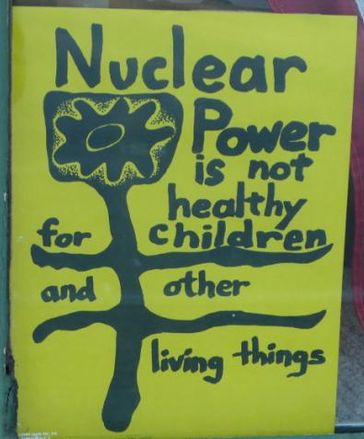
MNS and RC were the grandparents of most modern USA and global social justice movements movements; believe me). Their teaching techniques, training exercises, formats for consensus decision-making, use of nonviolence, understandings of social justice issues and oppression and methods for transforming individuals as well as groups have been incorporated into almost every type of social and political change movement around the globe, including Arab Spring and Occupy.
They taught me about Internalized #Oppression (IO): We All Have It Going On.
Intersectionality thrives via IO, because the overlapping strength of each oppression with insidious inroads into us and each other creates the systemic continuance of them all.
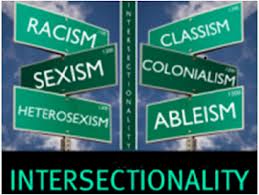
image from http://decolonizeallthethings.wordpress.com
For example, Height-ism. I am short and getting shorter. For a Jewish/Eastern European-roots female born in the middle of the last century, it’s not uncommon. I stopped growing at age 12, at 5′ 1.5″, at which point I was considered somewhat tall. I didn’t even realize I wasn’t going to keep growing, since everyone around me seemed to be, nor that I was short, until we were being arranged in poses for photos for the high school yearbook in the beginning of my senior year (I know; how could I not know? Well, I just wasn’t thinking about my height). People kept telling me to “get into the middle” or would call out: “Short people in front,” pushing me forward. I looked around in shock: “Oh! I really am short!”
I then spent the last four decades comparing my size to many other people’s and always being shocked at who else was actually my size or smaller, because they all appeared to be SO SHORT but I didn’t see myself as that short. In my inner voice, I was contemptuous, ridiculing, and otherwise snobbish about their smallness, as if I were magically exempt from such derision. Luckily (?), I kept these thoughts to myself.
Randy Newman (amazing singer-songwriter and social commentator) did not keep HIS thoughts to himself. We should all be grateful to him…. We need to laugh, sometimes, at how ridiculous prejudice and bias are, without forgetting how damaging and dangerous these ideas can become when enacted or spoken.

That is classic Internalized Oppression (IO): Version 1) believing ourselves to be outside of/better than/not really representative of the groups we actually belong to, we deride our identity group by condemning other members of it; Version 2) we condemn ourselves for traits considered to be endemic of that group.
With both versions, we perpetuate the cultural and institutionalized oppressions that already run rampant, adding strength to stereotypes and assisting the oppression machine to keep churning out misery. We collude with and give power to the oppressors by “owning” their perspectives. IO is so difficult to uncover or recognize that we actually believe these viewpoints are our own opinions, developed on our own, independently of anyone or any influence: that’s how deluded we are.
So it goes.
How does IO play out? Via sexism, racism, ethnocentrism, ableism, ageism, homophobia/heterosexism, transphobia, classism, etc., oppressions reign supreme. When those within these oppressed groups further and enable the oppressors’ aims in putting us down by loathing ourselves and each other for being members of said groups, that is IO at work.
Example: SEXISM: When women/girls, as individuals of an oppressed MAJORITY, FEMALES, adopt society’s negativity towards females, what happens? We then display “our” views of females by scornfully talking about other females at almost every age (and not just because of differing political positions, intellectual differences or disagreements). Worst of all, IO leads women to be the main enforcers/ perpetrators of some of the worst harm inflicted on female children and other women (genital mutilation, forced child marriage, sex trafficking, bride-burning, foot-binding).
Women/girls who live with unmitigated IO will be motivated to compete unfairly, gossip, spread rumors, backbite, jockey for position, believe in scarcity (zero-sum games) and operate in other ways that undermine each other rather than collaborate and support one another. We “sell out” our own gender in a usually unsuccessful attempt to gain favor from men or stand out as superior to other women.
IO rots “sisterhood,” pitting heteronormative (“cisgender”) women against gender-queers and lesbians, motivating lesbians to exclude female bisexuals. IO inspires white women to believe whatever the oppressors tell us if it seems we may “some day” reach feminism’s goals, such as when white men told suffragettes that abolition was “more important” than women’s having the right to vote, that women should “wait our turn”: most white women accepted this.
When women find it acceptable (not speaking up AGAINST this means you find it acceptable) for females to be labeled “bitches,” “whores,” “sluts,” “tramps” and whatever other derogatory monikers current trends are utilizing to put strong, powerful, sexually active, empowered women down, then that is also IO operating within and among us.

image from http://www.hercampus.com
IO is in place when a coach tells a mixed-gender or all-male group of athletes to “stop playing like girls,” and the girls on the team or at the location spew hate on the weaker members, continuing the damage caused by this coach.
When mothers, female teachers, any females who interact with young people, dichotomize the children based on supposed gender-based traits so that the girls are positioned by other females as less important, less competent, less valuable, and are forced to be less active or presumed to be less able than the boys, that is IO in action.
Example: RACISM: Racist IO occurs when those from oppressed ethnic/racial groups have “oppression derbies” to evaluate (usually not in public, but with social media, increasingly in public) the relative status of each individual of that group by applying arbitrary, oppressor-based criteria. Furthermore, we devise ways to determine who has the least number or degree of whatever traits of that group are currently despised (curly hair, darker skin, slanty eyes, large noses, thick or thin lips, argumentative/interrupting speech patterns, accents, higher intelligence or perceived skills in particular areas, glasses, other physical features such as stature, body type, breast size, etc.). Then, we assign higher value to those who “pass” or who are taken for NOT belonging to that group over those who display more/stronger group-identified traits. IO wins, there.

image from http://www.sodahead.com
IO manifests when Black people tell themselves or others (or have TV shows/movies/ music videos/ books which demonstrate) that “lighter skin” is “prettier” or straighter hair is “more professional.”
Best first-read to unlearn racism? A classic, by Professor Peggy McIntosh, “White Privilege: Unpacking the Invisible Knapsack”
http://www.artsci.washington.edu/natsci/Search-committee-materials/unpacking-invisible-knapsack.pdf
ETHNOCENTRISM/ANTI-SEMITISM: When Jewish families determine that their child’s teenage nose is “too large” and encourage or require their child (usually a female) to have plastic surgery to “fix” (break and reshape) their noses, that is IO imposed by the parents onto the children. Similarly, hair-straightening, skin-lightening, lip-thinning or plumping and other feature-changing attempts all stem from some type of racist/ethnocentrist IO most of the time.
Example: ABLEISM: Those with different physical/mental abilities or disabilities position ourselves “above” as many others classified in this way as possible, striving to be seen and appreciated for our strengths, but not giving that same respect and value to those we place “below” us. This classification of individuals within an oppressed group by members of that group is also classic IO in action: we do the oppressors’ work for them.
When a paraplegic calls a quadriplegic a “crip,” that is IO. When we who are older and becoming more hearing-impaired respond with impatience to someone else who can’t hear well, or are self-deprecating about our own inability to hear clearly, that is IO.
AGEISM: When adults presume younger- or -older looking people are teens or elderly and therefore treat them with less respect, that is oppressive. When WE, as members of a targeted age group, have similar negative attitudes because of someone’s actual or presumed age, IO is taking charge.
Telling ourselves (and anyone else) that we/they are less capable, worthy, competent or otherwise valuable because of our/their age (whatever it is) is also IO at work.
HETEROSEXISM: When gay men deride other gay men for being “too faggy” or a “flaming ‘queen,'” or lesbians call other lesbians “bulldykes” or “lipstick lesbians” based on their appearances, that is IO. Being down on ourselves as bisexuals, believing we are “unclear” or people who “can’t make up our minds” means IO has taken over.
Some people believe that oppressed groups can “reclaim” derogatory labels, like “nigger,” “dyke,” “fag,” “kike,” “bitch,” “‘ho'” and others by using them among “ourselves,” but I strongly disagree and so do those who work within the oppression-reduction movements. Using the slave-owners’ terms for the slaves among the slaves does NOT “empower” them: it makes them colluders.

image from http://goodmenproject.com
You don’t “liberate” a derogatory term by using it repeatedly. Instead, we give the oppressors and bigots permission to use horrible names for us publicly and strengthen those terms’ cultural importance because we use those names, too. I don’t use them at all, anymore.
IO gets its main power from us. When we hear messages repeatedly that we aren’t “good enough,” regardless of who we are and how we look, from advertisers that want to sell us products to “make us look better,” these messages creep into our psyches. We then exacerbate and facilitate this brutality onto our own self-esteem when we buy into the ideas that we aren’t attractive because of IO operating on our subconscious.
Example: AGEISM and SEXISM plus LOOKS-ISM: Women and men do not “need” to remove body hair to be “attractive.” Believing that body-hair-free men or women are “sexier” is a social construct, one not followed by most of the world and only recently followed even by modern adults. Body-hair-free adults look more like pre-pubescent children. How is that look perceived as “sexy” by anyone who is mentally healthy?
What can we do to eliminate or reduce Internalized Oppression?
Perhaps you’ll be willing to go on a hunt, excavating your own internal messages and searching for those that are oppressive in order to eradicate or neutralize them. I hope you will.

image from http://www.industrialantioppression.blogspot.com
Read! Listen to Podcasts or watch videos on this topic: there are thousands of ways to recognize and then unlearn the messages we have internalized that build onto institutionalized oppression.
image from http://ink361.com
PEGGY McINTOSh’s article
If your self-improvement efforts are not immediately successful, don’t be discouraged: it can take decades to “unlearn” the oppressive viewpoints which have been inculcated into us all. Just keep trying to notice them and not believe them: that’s a great start. Also, if there are workshops, classes, or other opportunities online or in person (better) to unlearn racism, sexism, etc., or to learn about social justice and oppression, please avail yourselves of them.
It’s never too late to become less biased and to learn to advocate more positively for yourself as well.
Next, don’t allow statements that perpetuate IO to go unchallenged. Speak up. Speak out.
Silence = assent is not just a bumper sticker.

image from http://www.decolonizingyoga.com

Repost from 12/2/13
For me, #writing fiction and poetry always involves digging up artifacts and dirt. My own and others’ buried treasures, junk, secrets and lies are uncovered, examined, deemed worthy “as is” or refurbished, cleaned up and presented within the text.
Writing #ClaraBranon, as her and about her, is the most autobiographical fiction I’ve ever written. I decided to gift Clara with most of my own “stories” and history, to see what would happen when a version of me is involved in the circumstances and relationships Clara encounters. It’s a roller-coaster for me, delving into my own life to pull up people, events, emotions, reactions, wishes, fears, griefs and successes and foist them onto Clara.
Usually, she does a lot better than I do or I already have with these events and has a much higher “success” rate with her conversations and intimacies than I can claim. In many ways, I feel envious of her. I also do not want her life, especially the public part. But, I do sometimes wish I had her personal strength and courage.
Oh, wait; I do. I must. I also have her creativity, the fire that burns within her, since I gave it to her. Of course I do.
Then, why is it so much easier to see this in Clara than in myself? I believe I make a character in my own image and deliberately make her better than I am only to discover that she can’t be better than I am because I made her. Not to put too fine a point on it, but the whole “God-made-humans-in-‘His’-own’-image” story has similar issues, yes?
As a fiction and poetry creator, as a #Buddhist well aware of the illusory nature of all phenomena, as a fabricator and dreamer, I am well aware of the fantasies I make into a semblance of reality with each paragraph or stanza I put into words. I paint pictures of scenes, drawing upon deep emotional bonds and reactions in order to do it, but we all know none of this is “real.” Right? Except for the parts that are true, that is.
The exhilarating, terrifying ride of writing one’s own stories in whatever forms is that others are going to read them and get to know things about me and my inner world I would never tell them, otherwise. My best defense, then, is to mix these true tales with pure fiction.
Sometimes serving up this admixture seems to be a cop-out move on my part, as I feel a taunting voice within me saying: “Na, na: you can’t know me! You don’t know what parts of this are ‘mine’ and which are completely made up. So there! Try and figure it out. I’ll never tell!”
This is the gauntlet every writer throws down to one’s readers: “Catch me, if you can!”
I do leave breadcrumbs for your journey, especially on Pinterest: http://www.pinterest.com/sallyember and here in my blog posts. Happy treasure hunting, readers!
Please let me know what you find and what labels you decide to put on each trinket. We can compare later. Start with Volume I, This Changes Everything (NOW FREE) and ask: “Who is #EpifanioDang?” Move on to “Are there really #aliens coming or already here from the #ManyWorldsCollective?”
http://www.sallyember.com for buy links, reviews, interviews and more. Look right; scroll down.
Continue with a chapter-by-chapter analysis of world history, politics, biology, religions, the arts and meditation and keep going: The Spanners Series has so much to offer you, including Volume II, This Changes My Family and My Life Forever, which released 6/9/14, and Volumes III and IV coming out in 2015!
Enjoy! Write Reviews! Share!

THIS POST IS DEDICATED TO MY MIDDLE SISTER, W. ELLEN E. FLEISCHMANN, A MISSOURI STATE CHAMPION DEBATER, WHOSE BIRTHDAY IS TODAY!
Is all disagreement “negativity”? When did that happen? I DISAGREE, and I am not being “negative,” unless we’re in a debate, in which case my “side” is “con” (as opposed to “pro”).
This issue has arisen in various ways over the last two years or so, since I became a indie author, blogger and online participant. However, in my latest foray into online “conversations,” I engaged in an exchange that has been very disappointing.
An online acquaintance who moderates one of the Facebook groups I belong to has a public website that includes a blog where she often posts reviews. I’ve been following her site and occasionally reading her posts. Otherwise, we don’t know each other.
A bit of background: I don’t usually comment on hers or anyone’s reviews unless one is particularly well-written or I happen to vehemently agree or disagree with it, which was the case, here. This is a public site and she allows for comments.
This reviewer (who shall remain nameless) posted rave comments for the 50 Shades trilogy, including her wish to speak with E.L.James (making it seem as if she had an “author crush” on E.L. James, which I have no issue with at all). It was her calling the main relationship portrayed in 50 Shades “the greatest modern love story” of her time (this reviewer is about 20 years younger than I am, by my estimate; perhaps younger), that compelled me to respond.
I thought carefully about what I felt and thought and how I wanted to convey these bits, edited and revised my comments a few times before I posted them for approval. Then, I went on to my day’s other business.
Unfortunately, I received the following message (see below for our email chain) later that day.
Her decision not to “approve” or post my comment on her site and her intense, personal reaction surprised and appalled me, as you will see by my email response to her.
I’m not trying to start any kind of conflict or flame war. I really want to know what you all think. (See below.) Here are my main questions to you, my blog readers:
—-Are we supposed to withhold responding when we have ANY disagreement between us and any members of our online “community”?
—-Is ALL disagreement “negativity”?
—-Do we have to speak in “soft tones,” “soft-pedaling” anything that might possibly be critical, because so many writers/bloggers seem unable to tolerate being criticized?
—-Are we supposed to keep our sites (and purportedly, our lives) free of all conflictual conversations by not approving critical comments?
—-Do those of us who have criticisms to levy have to refrain or risk being called “trolls,” or banned/kicked out of review groups, comments sections, social network platform groups, etc.?
—-Do only “yes” people and “supporters” feel (and get) welcomed online?
I can’t recreate my exact comment, but here is the gist:
Your post made me feel sad and I feel sorry for you. What world do you live in, that these two-dimensional characters and their dysfunctional sex and interactions constitute any kind of “love story,” much less “the greatest one”? James’ depiction of her disempowered, ignorant female lead character is insulting to women everywhere. The “billionaire” male lead is selfish, clueless about healthy relationships and awful to his “girlfriend.” The “plot,” thin as it is, is implausible. Some of the “play” depicted in the sex scenes is not credible or even possible (people have tried to recreate it with laughable and/or injurious results).
I reviewed and disliked all three books, giving many considered reasons. Please go read my reviews. I also consider E.L. James’ writing among the worst to receive public acclaim, so as an editor, author and reader, I challenge your evaluation of the writing of these novels. Your opinions caused me to feel discouraged.
Here are the first email I got from this reviewer, below, and our exchange below that.
Subject: Blog Comment
“I was really on the fence with whether or not to approve your comment, Sally, or to respond to it. Because realistically the best way to deal with negativity is to not feed into it. So in this case, I’m going to respond privately.
“In answer to your question: ‘What world do you live in?’ I live in a democratic world where everyone is entitled to their own opinion, and since it is my blog, I am free to express it. You chose to read my blog, just as you obviously chose to read Fifty Shades of Grey. And like all readers in the world, we all have different viewpoints on how we interpret a book. You have no right to judge my opinion, just as I have no right to judge yours.
“However, the fact that you chose to try and publicly insult me on my blog, saying that you feel sorry for me for my opinion, that you feel saddened by it, is extremely hurtful.
“I have supported your posts on [the Facebook group I moderate] since its inception, and I am disgusted that you would even try to publicly insult me, as I have never done anything but provide you with support. I did not approve your comment.”

I’m reading this, stunned. Really? These two lines, in the same paragraph, written without irony?
“I live in a democratic world where everyone is entitled to their own opinion…” followed by
“You have no right to judge my opinion, just as I have no right to judge yours.”
If we have a “democratic” right to our opinions, isn’t judgment a form of opinion? Why does she think we “have no right” to judge anyone else’s opinions? That is so absurd I don’t even know where to start with a response.
And, a deletion of my comment follows this “explanation”? I’m sputtering and laughing, both.
What IS a review, if it’s not exactly that: one reader and possibly another writer JUDGING another’s opinions and writing?
What is the function of comments on reviews, if not to JUDGE that review (like it, dislike it, agree/disagree)?
I considered, took some deep breaths, decided it was worth my time to respond. Maybe she could learn something… Maybe not.
I wrote, revised a few times, then responded:
Subject: Re: Blog Comment
“Dear XXX,
“It is your blog, your review and your opinions: all true. But, if the only comments you ‘approve’ on your site are those that agree with you, make you feel good and support your opinions unequivocally, you will stagnate.
“Your choice.
“I did not set out to be nor do you have to take my comments as ‘hurtful.’ I was expressing my dismay, my personal (as a female and feminist who is a lot older than you) and my professional (as a writer who has been writing a lot longer than you) sorrow at your conclusions and approval of those books. I read them all, too. I reviewed them all, too.
“If you want to go and comment on my reviews, please do. Say whatever you want, as a reviewer, a writer and a reader: that is your right. I encourage you to do so.
“Your previous support of my posts is appreciated, but your using that as if you ‘paid’ for my approval forever by doing so is insulting to me. Stop approving, stop supporting, if you think you ‘deserve’ some special and DISHONEST responses from me for doing so.
“If you want to close off conversations between us because you disagree and get hurt feelings when I don’t like what you write or post, I can’t stop you, but please; don’t make it as if I did anything wrong. You have a public blog. Comments are public. I did not ‘publicly insult you.’ I responded to your public post, in public, where comments belong.
“Sheesh.
“Sally”
She wrote back:
Re: Re: Blog Comment
“I will not respond to your negativity, Sally.
“We obviously do live in two different worlds. I’m happy to stay in mine.”
I did not and will not respond directly to her. I gave up on her: not apparently willing to be learning; not worth my time.
Instead, I am writing this post and asking for YOUR opinions.
Maybe I could have phrased my comment more “gently,” in some misguided attempt to protect her, but I would NEVER consider doing that for a man or someone my own age. Wouldn’t I be subjecting her to gender and age bias if I were to withhold, “dumb down” or soft-pedal my considered and professional opinions just because she’s a woman and/or someone younger than I am? She presents herself as a professional in public so I treated her as one.
Why doesn’t she expect some responses that don’t please her and have a better way to manage her own feelings about them? Why can’t she handle disagreement and criticism with more grace, or, even better, engage in a conversation with me about her points of disagreement, defend her opinion, argue her points, instead of playing the “hurt” and “insulted” cards? Why is all right for her to judge my comments but not all right for me to judge her review?
Are we “fellow authors” and reviewers/bloggers really obligated—no; supposed to—send all comments in which we disagree with a blogger to them privately, first? Why?
I vehemently disagree with these ever-expanding hiding-from-public-view practices. I am certain that hiding disagreements results in the disappearance of complex, nuanced dialogue and provides the public with pablum, instead. Then, the only thing readers get is a distorted picture of author engagement, in which we all hold hands and sing “Kum Ba Ya” all the time. When we post only glowing reviews, readers are misled and we breach the public trust.
When some label comments they don’t like as “negativity” and relegate disagreement to the private realm, we are all then left with sanitized, white-washed, dishonest and hypocritical non-dialogue in all public spaces: what is the point of engagement, then? Just keep patting everyone on the back, regardless of value, worth, logic, perceptions?
Not all disagreement is “negativity.” Not all conflicts between us should position one person as “good” and the other as a “troll.” Yes, there are “trolls.” I am not one of them, and this person should realize that. I am not hurt, just pointing out the obvious.
If she really can’t tell the difference between my expressing my honest opinions, while I am respecting but not liking hers; if she can’t see that I am not liking that she came to the conclusions she did or made the choices she did, but I am taking the time to tell her that as one professional to another, then I am led to give up on her.
Authors and bloggers, in my view, do not “earn” uncritical support (or maybe you think you do and you want it, but I do NOT) just by joining a group or getting to know each other online. If you are my professional “friend” or colleague, PLEASE tell me the truth. I don’t want applause; I want critiques and engagement that matter.
Just so you know: I do not go around looking for people to disagree with. I am busy. Most of my posted comments are supportive and positive, and I don’t post a lot of those, either.
HOWEVER, when something disturbs and moves me enough to write to someone about it, that writer should be grateful: I read his/her piece, respected the author enough to consider their opinions or positions, and responded from a thoughtful place.
When I am writing to the reviewer or blogger in order to provide my emotional as well as logical responses, that is further proof that I believe in this author or blogger enough to take MY precious time to craft and post a response.
If this blogger and any others do not understand that all thoughtful comments, however contradictory or critical, are a gift, their censorship is going to make honest dialogue even more rare.
Some writers apparently don’t have the courage to stand by their own public proclamations and engage publicly with people who do not agree with them. I term this behavior “unprofessional” and deem them unworthy of my time and opinions in the future.
BTW: I went to her FB group to see if she (the moderator) had kicked me out, and so far, not. However, she posted and pinned this query, right after our email exchange:
“Since this group is becoming more and more of a spam magnet, and not so much about [the group’s stated topic] anymore, I’m thinking it’s time to put it to rest?
“If anyone cares to keep it open, please respond with a comment, and I’ll see what reception I receive.
“I’m thinking about opening another one using a different name and with a slightly different purpose. Thoughts?”
Shutting down this group and using a different name to start another one?
Coincidence? I doubt it.
PLEASE post your comments here, on my main blog, to this any any other post:
http://www.sallyember.com/blog.
ALL comments that are not SPAM are ALWAYS approved.

image from http://www.phoenixheart.net
Keep writing, keep commenting, keep reading, keep approving.
Best to you all.

Excellent #tips, #advice, #resources and #recommendations. Thanks, Chris McMullen! Best to you! #bloggers #blogging

I first began blogging actively on WordPress in December, 2012.
Only a little over 2 years, and my blog has reached 100,000 views and nearly 4,000 followers. My blog averages over 400 views per day presently, and the viewing frequency steadily accelerates.
If I can do it, you can, too. I believe it.
It’s not rocket science. (Just ignore the fact that I have a Ph.D. in physics. I didn’t use any physics to make my blog.)
In fact, I’m sharing my blogging ‘secrets’ today to help you do the same.
It’s not just me. I meet many other WordPress bloggers with many more views and followers than I have.
If you’re not there yet, don’t worry. You can get there, too.
I’ve created multiple blogs and webpages with WordPress, BlogSpot, GoDaddy, etc. By far my most successful blog or webpage is this WordPress blog. We’re fortunate that…
View original post 4,619 more words

PART FIVE in this excellent series by Susan Toy on The Story Reading Ape’s blog. Thanks, Chris Graham, for posting!


The following is an extract from a talk delivered at the Calgary Public Library in Feb. 2011.
Part 5
Another area of promotion you should consider developing – and only do this if you are comfortable with it – is speaking engagements. Speaking engagements are something your publisher will not arrange for you, unless they are approached directly by a group inviting you to speak. Make sure you are either allowed to sell books or that a bookseller has been asked to look after sales wherever you appear.
Here’s another important statistic I gleaned from reading Get Known Before the Book Deal: Authors who speak at events sell three times as many books. (This book is listed in the bibliography at the end of this post.)
You can give a straight reading from your book, but my preference is to hear an author talk about how…
View original post 1,150 more words

I wish ALL book bloggers were more like Carrie!
Although I honestly had no idea this whole controversy existed until a year or so ago, apparently posting one star reviews is a little controversial in the book blogging community. Some bloggers believe that posting one star reviews is part of an honest and open reviewing process. Others believe one star reviews are a waste of their time or invite unwanted negativity and possibly author attacks. It really varies blogger-to-blogger.
As my regular readers know, I do post one star reviews. Sometimes I’ve posted 0.5 star reviews. Why do I read books I clearly don’t like? Well, like any sane human being I pick up a book because it’s interesting and I think I’ll like it. Sometimes the promise of the blurb and the other reviews encourage me to do so only to disappoint me. When I start a book I don’t like to not finish it. This is in…
View original post 254 more words

And, PART FOUR from Susan Toy, here, for #authors about #marketing. Great series.
The following is an extract from a talk delivered at the Calgary Public Library in Feb. 2011.
Part 4
Okay, now you’ve completed the further editing, the proofs have been approved, and it’s just a matter of waiting for the printer to produce and ship your book. So, what’s been happening at the publishing house all this time? The main thing they’ve been up to is preparing for, and holding, sales conferences for their sales reps. A catalogue page for your book should have been completed and posted online. Be sure to link to this page on your own blogsite, and direct anyone to it who asks about your book. The reps have been told about you, and they have discussed how they can best sell your book to booksellers, libraries, wholesalers and specialty markets. Some of them may have even read the manuscript. If at all…
View original post 1,776 more words

If you are new to or not clear on #ebook #formatting and other structural issues in #self-#publishing, go back and start from the beginning of this great series! Great for all #indie #authors or potential ones!

I had no idea olive oil was being diluted/compromised. Read and share!

That is not to say that it is not natural, or is made from chemicals, but 70% of the “olive oil” on the market — that is marketed as pure olive oil — is not actually pure olive oil. How can this be? This is because olive oil counterfeiters have gotten so good at faking olive oil that most of the professional tasters cannot tell the difference between the real stuff and fake olive oil.
“Fake” olive oil still contains a good portion of “real” olive oil, but is cut with low grade oils from other plants to reduce the cost of the oil. Though the manufacturers save money on creating the oil, they often still sell it as high grade olive oil and for a higher price. This practice has become so prominent in countries…
View original post 416 more words

Thanks so much, Jnana, for featuring me today! I am sharing this widely. Best to you and all the new and continuing followers who join us today and after today. Will love to see responses!
Sally

Look who’s featured on today’s “Wednesday Writer’s” slot on Jnana Hodson’s site? ME!
Never-before-released autobiographical info about ME in today’s feature!
Please visit, comment, follow:
https://frugaljnana.wordpress.com/2015/02/04/1812/

I am hereby and for an undetermined length of time giving low credence to most book reviews, awards, contests and other honors conferred upon books/authors.
Why? I know some of the awardees’ writing. Many are undeserving of any accolades.
“Grade Inflation”—the widespread awards and the exalting of effort—are ruining writing and writers.

image from http://www.wrkcapital.com
Why does anyone reward mediocrity and worse? How many “open mikes” have you attended in which EVERYONE, no matter how badly they perform or how horribly they read aloud or recite poetry, gets wild applause or even a standing ovation? Does the audience believe that everyone deserves the same response regardless of the quality of their presentation?
I do not.
How does it help any author/artist grow when no one is honest with them about the areas they need to improve and all they hear are overly exuberant praises? Neither are we helping authors or keeping faith with readers when so many provide undeserved 5-star “reviews” for shoddy writing. We are helping our writers and performers when we honestly and with specificity critique their work.
We are not doing our children any favors to give everyone who participates a “winner” ribbon, unless everyone understands that showing up and participation are what get awarded. However, I contend that, for professionals, the industry should not be labeling greatness on effort alone.
Grading on effort makes greatness lose all significance and confuses us all. When everyone “wins,” no one does. For evaluations and competitions to matter, the creation being evaluated of any top-ranking writer or other artist must be excellent by objective standards to have earned that award.
When all are given “A”s, or 5 Stars, or First Place, the rankings become meaningless. Participants can’t begin to discern their actual place among their peers or the value of their work in the world when reviewers and judges do not provide accurate, meaningful, thoughtful critiques and feedback, in the form of awards to the deserving.

image from http://cutemonster.com
At the end of a sports event, such as a foot race or team game, the winners and losers are indisputable. Those that swim are racing each other and the clock, which are immutably obvious regarding who swam the fastest for that race and for all recorded events of that type.
Art assessments should not merely be based on the creator’s intention or your affection for the creator.
Exceptions: if the artist is a child or disabled in some way, then that participation alone is sufficient to earn an award. Obstacles that participant has already overcome just to be involved in that competition or performance do deserve to be honored. THOSE types of contests, in which “everyone wins,” I wholeheartedly honor, e.g., the Special Olympics.
BTW: I strongly believe in and promote cooperative games, the postponement of competition, and an “everybody wins” concept for most activities for children and youth. I wish more youth sports and other harshly competitive games would be permanently removed from options so that everyone could play, learn and grow without that pressure.
This post is not to remove those cooperative and noncompetitive games or friendly, networking-type of awards passed around for fun and support. We all need encouragement.
However, when the competition is on a supposedly “level playing field” (more or less: let’s not get into gender, socio-economic class, age, racial and ethnic biases that unfairly prejudice judging and preclude fairness; that’s another subject), I strenuously object to fairly set competitors’ receiving awards, praises, great reviews or any other merit when the subject of the assessment is insufficiently unscrutinized.
I know some awards are merely a matter of “taste” or “current trends,” and that what anyone “likes” is always subjective.
Fine. Let those competitions be labeled clearly as having someone’s personal preferences, not accepted standards of excellence, as the main criteria for winning.
I’m talking about competitions that adults, professionals, and mostly, writers enter that supposedly have criteria that winners have to meet or exceed, in which the “best” is supposed to be honored the most. I wish that all of these competitions would be judged by obvious and agreed-upon standards of excellence and not determine winners based on effort, affection or popularity, or worse, payment of entry fees.
Also, I’m not talking about what people “like.” I’m asking for awards based on what is excellent, as objectively measured as possible.
Maybe it’s easier to talk about what is NOT excellent. I believe these components, below, are not purely subjective measures and therefore can be evaluated fairly and “blindly.”
FYI: For professional writers, grammar matters. Spelling counts. Syntax is significant. Context is not everything.

image from http://the-modern-housewife.blogspot.com
Here are my “what not to award” components for all types of fiction, whatever length.
[NOTE: I do not believe these need any explanations, but comment here or wherever you see this or email me if you are not sure what I mean, below.]
The next time I hear a writer “won” an award, I hope s/he deserved it. I really do.
In case you need a reminder of what quality is and how deserving some authors are…
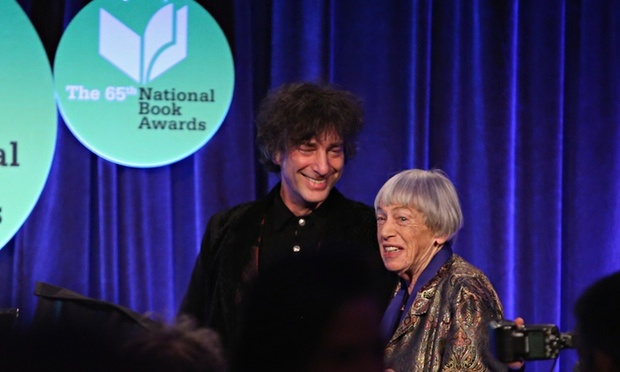
Ursula K. Le Guin and Neil Gaiman at the National Book Awards, 2014, in New York.
image from http://www.theguardian.com Photograph: Robin Marchant/Getty
P.S. I find Gaiman unreadable (personal preference) and adore Le Guin, but I recognize the similar greatness in their writing.

Awesome evidence of the effects #meditation has on our health.

Long overdue. Hope it happens. We should NOT be pandering to China, one of the worst human rights violators in modern society.

Excellent news for Kagyu and other #Buddhist nuns in the #Tibetan tradition. Trashi delek (best of auspicious wishes) to them all and t’huk te je (Thanks) to His Holiness the 17th Karmapa, Gyalwang.

Thanks for posting! I shared!
…there are musicians whose talented gifts surpass JONGGR… in these modern days where we quill-scrapers hear so much about ‘writing in the proper JONGGR,‘ p’raps a wee lesson is to be had listening to these exponents in another field of the artistic arts… if yeez play, sing, write, or perform wonderfully at whatever yeez do, to hell with the JONGGR, I say… Yehudi Menuhin and Stephane Grappelli graced the WURLD with their expertise with their different styles of violin playing… but whomever yeez listened to of the pair, they were outstanding…


 …listen first to this clip, where the two were thrown together for the first time… magical… and the distinctive ‘Voices’ of each of their playing comes triumphantly to the ear…
…now, enjoy Master Menuhin’s talent…
…and compare that of Master Grappelli…
…back in the day, when the rock and roll, beat, and hippy-hippy-shake tsunamis were bouncing…
View original post 73 more words

“#KDP Select #authors can place an advertisement and, in addition to any benefits of the ad itself, receive valuable sales information regarding their books.” Check it out! Thanks, Chris!
 Image from ShutterStock.
Don’t you wish that you could see how many people are viewing your book’s product page at Amazon?
Then you’d be able to see how good your blurb and Look Inside are at closing the deal, or how well a promotion is working.
Well, now you can get tracking data at Amazon.
Amazon marketing services is now available for books enrolled in KDP Select.
For as little as a $100 budget and bids of 2 cents, you can advertise your book on Amazon.
Visit your Bookshelf and click the link under the KDP Select column called Promote and Advertise.
When I did created an advertisement this morning, I received an approval email that said:
This will show how many impressions are made all…
View original post 793 more words

Newbie #authors: Take notes, memorize and be ready for the TEST!
Merry morn to you all! Although, it’s probably not morning where you are. And maybe not so merry. But it will be merry with all these lovely advice videos I handpicked just for you!
Without further ado, the first one is called The Top 5 Mistakes Amateur Writers Make
This one is a crazy length (about an hour and a half) but just pretend you’re at a college lecture – Writing Tips And Advice From Lovecraft Ezine Editor Mike Davis
This one is from a friend of the ‘vlogbrothers’, who are two professional writers who also make videos. It’s called Dare To Suck
This one is called Writing for Magazines: Top Tips by Freelance Writer Linda Formichelli and Editor Laura Pepper Wu
This is from the same channel, called: What a literary agent wants! With Rachelle Gardner

Excellent analysis and insights, here. Share!
I have several relatives and friends who deal with this disease in varying degrees as well as others who have chronic illnesses; many of us have “invisible” physical limitations and other “differences.”
I like this part of your post the best:
“…I don’t think what Townsend did is all that ‘brave’ — it’s just reality. She’s just telling it like it is. This is her reality, this is who she is, and that’s that. We can either accept it or reject it – and we’d be better to accept it.
“And really, this goes for any number of things – people in wheelchairs, people with cognitive disabilities, older people – anyone and everyone. Making snap judgments usually does no one any favors.”

Thanks, EJ! Visited, emailed C.E. Kilgore with my sci-fi/romance The Spanners Series’ two titles and my info right away! Great site! #sfrStation and #scifirom
Sci-fi/romance (SFR) is a bit of a red-headed step-child. Some romance readers turn up their noses at all the “unrealistic” elements of SFR. Some sci-fi purists turn up their noses at the “mushy” romantic elements. But for me, SFR is home. It’s what I want to read. When I read “straight” romance, I’m dreaming of FTL-travel and dystopian societies. When I read “straight” sci-fi, I miss the romantic tension and hope of a happy ending. The blend of science-fiction and romance feels right to me, and always has, even before I knew it was a “genre.”
Feel the same way? There’s a site for that.
 SFR Station is a great new resource for sci-fi readers and authors. A member of the Science Fiction Romance Brigade has undertaken the herculean task of creating a new library for readers who can find authors writing in the genre, including recent releases, free offerings…
View original post 118 more words

New series about #marketing for #authors: check it out!

10 Criteria for Joining #Online #Groups/#Communities for #Writers
What is the value of social networks in easing the loneliness of the solo writer? How do online groups/communities provide opportunities for sharing ideas? How do today’s writers, especially for those newly published or about to seek options in publication, benefit from building communities of virtual friends?
There are now thousands of online groups/communities a writer can join. Some are only available via membership in existing social media sites, such as Goodreads, Facebook, LinkedIn or Google+. Others are stand-alone groups that have their own websites and memberships but may also host a page on any of the other social media sites to attract and inform potential members and continue to post info to members regularly.
Then, there are the groups, chat rooms or fora one can join, lurk on and/or contribute to on Yahoo, KindleBoards, Smashwords, Bublish, Authonomy, Jukepop Serial, Wattpad, and probably hundreds more, Add to that specific professional sites’ groups, such as Romance Writers of America, Science Fiction Writers of America, Mystery Writers of America, etc., plus international groups and marketing sites and it makes one’s head spin.
If you are a blogger as well as a fiction writer, if you are a new and/or indie pub author or just one of millions who has no outside PR firm hired to market your books, you NEED groups/communities to get your “brand” known, find readers, attract followers and fans, get “pingbacks,” improve your ALEXA rating, your KLOUT or SNAP scores, get a Google Page Ranking for your website….
Don’t you?
How does a busy writer wade through all these opportunities to decide where to plant one’s online presence “flag” and still have time to write? The discerning writer who actually wants to protect your time and keep writing while marketing effectively can use these 10 criteria to choose your online memberships.
10 Criteria for Joining #Online #Groups/#Communities for #Writers

image from: http://www.tabularasa.com.au
DECIDE whether or not to:
1. PAY or stick with FREE memberships?
Some groups are free; some start out free or have a free level but change into/have paid memberships that provide additional services or opportunities to those who pay. If you have an unlimited budget or find yourself drawn to one or more of these groups and can afford it, go ahead and become a paid (upper-level) member. Some of these groups’ upper levels really do offer services to authors that are useful; some just say they do but when you read carefully, the “services” are not much more than occasional tweets.
Beware of those that over-promise, do not deliver, or are vague about what paid membership avails members of before paying. Research them: search for the group’s hashtag or tweet handle and then privately message someone [not the leader] about specific ways that being a paid member benefits him/her.
So far, the most I have paid to “belong” to any group or purchase any “marketing” service was $15 and it wasn’t worthwhile. If you do join a group and pay your fees or dues, make sure you’re getting what you pay for and only renew if it’s worth it: no automatic renewals!

2. Participate in “review swaps”?
As a newbie desperate for reviews for seemingly invisible books, I found these groups to be so tempting. They seemed so supportive. They offer REVIEWS, sometimes in great quantity, sometimes with rankings and votes as well. But, free or not, these review “exchanges” come with several “prices,” and I personally decided the prices were too high.
For one, I am not comfortable providing pre-arranged and necessarily positive reviews (usually these swaps require/request a review rating of 4 or higher) for books I haven’t yet read in order to get the same for my own books (which the “reviewers” may or may not fully read). I “got into trouble” for daring to critique the books I read for being under-edited, overwritten, poorly constructed, badly plotted, shallow, etc.
Second, and much more chilling: if you join these groups and participate, you run the risk of having any or all of your reviews summarily removed from Amazon for not being inauthentic (some rightly so).
Third, some social media sites (Goodreads, for one) monitors members’ activities and sends messages to those members it believes are abusing the site, such as by “buying” or “trading” votes on Listopia, for example, or providing “fake” 5-star reviews to numerous members’ books. If you even get accused and especially when caught, you will discover that most sites’ TOS say they can suspend your account permanently and remove your books’ reviews, rankings, votes, etc., often with no warning and no recourse.

Although I joined some of these groups initially, I found out all of this later. Then, I removed myself within a few months of joining. I never paid to join.
If you are comfortable with the risks and conditions, go right ahead and participate.
3. Participate in Blog Hops and other “required” activities?
Some of these are great and worth doing. Others, not so much.
Look around, visit a few, comment, see what happens. THEN, decide.
4. Join a “Tweet” team or use group hashtags when posting?
This is highly recommended by some, disregarded by many. When someone posts nothing on Twitter but lists of others’ handles and the group’s hashtag, NO ONE CARES. Don’t do that.
But, if your group actually retweets, comments, replies, shares, ENGAGES with each others’ tweets or posts, that is worthwhile and those groups are worth joining.
5. Become a regular responder/poster or stay in the “shadows” (read/lurk but don’t comment, “LIKE,” +1 or post)?
I highly recommend lurking/reading many days’ or months’ worth of posts for some “Boards,” Communities or Groups before posting yourself. Get the “culture” of the group: the tone, the topics, the length, the repartee, the purposes. See if these resonate with you and your “brand” or style. If yes, go right ahead and join in the conversation. If not, move on.
Do not join a group to argue, criticize, lambast or attack.
Remember: the internet is “forever”: if you get into a “flame war,” readers/fans and publishers (and employers) can find it years later. Perhaps use a pseudonym for controversial posts.

6. Become a “help offered,” “help requested” or both type of participant?
You can become a resource to others on many sites (Quora, Ask an Expert, Reddit, etc.) or request help yourself.
Respect, assistance and expertise are admired. Whining, complaining, false information or bragging: not.
7. Join as yourself, your brand/books/website, your pseudonym?
EVERYTHING you post becomes part of your brand unless you use pseudonyms. The intentional and judicious use of pseudonyms is recommended, particularly if you write in vastly different genres (children’s books and erotica) or want to comment on controversial topics but not affect your brand.
If you become a “content curator,” offering information, help, creative/fun posts, and these are consistent (or at least not contradictory) with your brand, go for it! Join groups and comment/post frequently as yourself. Get to know/be known by the members, become a fan /follower of theirs.
I belong to several groups whose members and I are becoming virtual friends. We support each other’s efforts.

image from: http://anupturnedsoul.wordpress.com
These are the groups worth joining and continuing to be active in and are valuable even when you have little time. If you comment here with one of yours, I’ll share some of mine!
Dump the rest.
8. Join any genre-specific or topic-specific groups?
If you are a “genre” writer, then, YES: join one or more of these groups.
I belong to sci-fi, romance, paranormal, ebooks, indie pub, fantasy, “clean” indie, female-oriented, YA, speculative fiction, blogger, author, writer, marketing, science, tech, G+ HOA help and many other groups that I interact with, enjoy and learn from weekly.
Be sure to read and follow each group’s posting guidelines carefully to avoid getting disliked, kicked out or otherwise censored.
9. Offer any giveaways, have contests, provide guest spots yourself?
If you have print books or swag, go right ahead and offer it/them. I highly recommend that you think of what you have to offer and start offering (e.g., free PDFs of writing tips, samples of your writing, free passes, discount coupons) whenever you can.
I have a blog (http://www.sallyember.com/blog) and an almost-weekly Google+ Hangout On Air (CHANGES HOA), so I can and do offer guest blog opportunities and guest starring spots. If you’d like to propose a guest blog topic and date and/or be on CHANGES, get in touch with me here: sallyember@yahoo.com
I am also a series ebooks novelist, so I offer the first book in The Spanners Series, This Changes Everything, as “permafree,” which is highly recommended for newbies to do, once we have subsequent books for sale.
When you are doing many other types of writing and interacting regularly with several online groups/communities, you can occasionally plug your own books! Like, NOW!

10. Enter any contests or pay for reviews or marketing?
When a group’s entire purpose is to further its own ends and fill its coffers with entry fees, service charges, etc., these make me suspicious. But, I am naturally cynical.
I decided early on not to pay to enter any writing contests, not to pay for reviews, not to pay for “members’ services” and mostly not to pay for marketing. These are my decisions and not everyone agrees with them.
Some individuals offer a combination of free and for sale services/marketing, so you can decide which you want to participate in/join. I have met several great people and had excellent experiences in some groups in this way: I participated in their free activities and then did not continue when the next steps required payment since I couldn’t afford or did not need those services at that point. I do give these “helpers” regular “shout-outs” and thank them publicly for all they do/have done, actions which I hope make up for my lack of financial support to them.
The professionals left me alone when I asked them to do so. The ones who wouldn’t stop emailing and kept on when I asked them to stop or when I told them I wasn’t buying got relegated to spam and ignored.
You have to decide for yourself. However, if you are considering paying for any of these, please research the contest, reviewers, PR person, etc., thoroughly.

It’s bad enough not to win or not to get what you paid for; it’s worse when you’ve paid a lot. BEWARE!
If/when you find groups worth joining, please comment about them here.
Best of luck to you all!

A repost from 1/30/14 from my own blog.

The above image is entitled “Quantum Buddha,” and it captures the essence of this post: the intersection of Buddhism and modern science. Meditation as medicine, mindfulness for many purposes, research data to support their usefulness seem to be in the headlines almost daily. Some links are below to articles like that.
http://ideas.time.com/2014/01/17/we-need-to-take-meditation-more-seriously-as-medicine/
Being called The Third Metric, and The Way of the Future for politics, leadership, business and family life, mindfulness is now almost mainstream.
http://www.huffingtonpost.com/2014/01/21/third-metric_n_4612396.html
Will meditation cure your depression? Your cancer? Your diabetes? Your stress?
http://www.wildcat.arizona.edu/article/2014/01/heat-the-body-heal-the-mind
What are the facts? What is true? What is correct? How do you know?

There was recently a forum on meditation led by the actor, Goldie Hawn, at a World Economics conference!
You decide, after learning to meditate, researching via personal experience as well as reading and watching videos, attending conferences and talking with others, what YOU believe. The Buddha would want you to do that. Really.

When you have time and want to learn a lot more, watch this amazing documentary. Yogis of Tibet.
https://www.youtube.com/watch?v=DctQTDm-HdU

reblog from post from a year ago: VERY USEFUL TO KNOW during ‘flu season.
http://www.nydailynews.com/life-style/health/fever-reducing-drugs-raise-spread-flu-study-article-1.1588812I and my “alternative health” friends and practitioners have been saying for decades (centuries): FEVER is helpful. Let the accompanying fever do its thing, which is to kill the virus/bacteria, unless a fever is dangerously high.
IMPORTANT: Stay away from people throughout the fever period and for at least 24 hours after fever passes: then, you’re no longer contagious.

I need to print this out and put it on my refrigerator. Yum Yum.

Especially for Inger D. Kenobi and other UK-based new authors!


This is a repost from 8/27/13, since so many new readers are finding The Spanners Series, especially This Changes Everything, Volume I, after its PERMAFREE status began 4/1/14 and have asked for a Glossary.
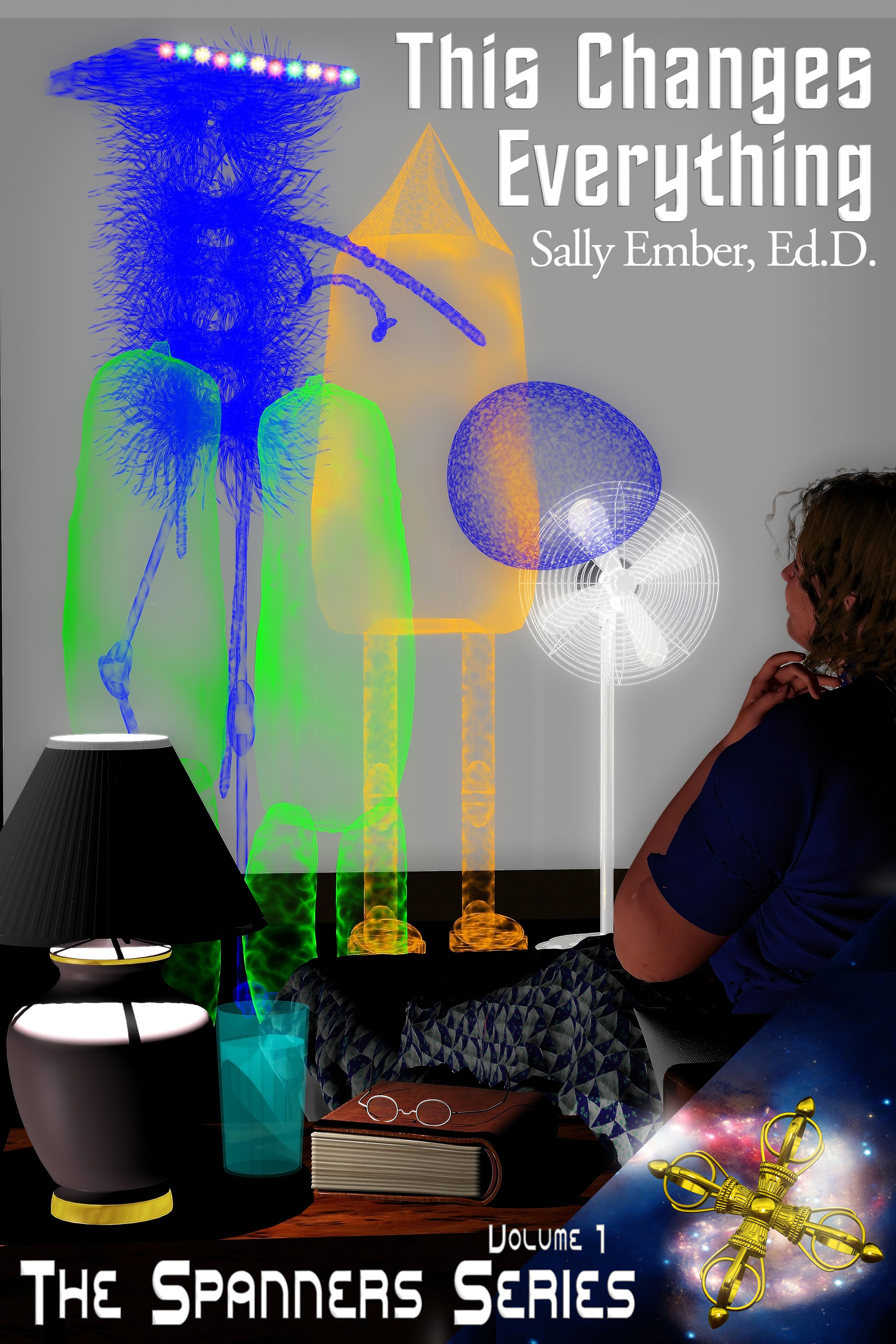
FREE everywhere ebooks are sold. All links, reviews, author interviews, readings and more: http://www.sallyember.com/Spanners Look right; scroll down.
In the back of each Volume, I do update and add to the Glossaries, but here you go:
As explained by Dr. Clara Branon, Ph.D., main narrator
Toughness = how much energy a material (or person) can absorb without breaking. As carbyne’s toughness becomes well-known in the early part of the 21st century on Earth as both the material used most in space travel and interstellar communication (reacts best in temperatures 25º C or lower), carbyne’s toughness becomes the metaphor best understood as the way to describe my experiences as the Chief Communicator. Carbyne is stronger than steel or graphene, thinner yet stiffer than any other form of carbon, including diamonds, and lighter as well; most importantly, carbyne can be “grown” as well as mined.
Fragmenters (“Fraggers” who “Frag”) = Usually Earthers; opposite of well-meaning Spanners. Fraggers disintegrate, pull apart, ruin cooperation, destroy unity, incite conflicts and disagreements, refuse to compromise. They are Conservatives, fear-mongers, and nonbelievers despite ample evidence. They are fundamentalists, entrenched, hence, the Trenchers are their extremists. Being Fragged involves having an individual Fragger or a group of them interfere with and/or ruin Spanners’ plans for peace, harmony, multiverse travel, ESP trainings, intergalactic travel, etc. Can even be used when no Fragger is involved, much the way current Earther humans talk about Mercury’s retrograde status as the “cause” of problems with travel, communications, and planning.
Trenchers = Usually Earthers; extremists among the Fraggers, ones most difficult to deal with. Known for digging in, refusing to listen to reason or information that contradicts their views, being Reactionaries, resorting to violence, abusing dark psi and using other nefarious means (kidnapping, murdering, sabotaging, causing harm in other ways) to prevent the Transition or success of Earth’s inclusion in the Many Worlds Collective or cooperation with the InterGalactic Council and any other worlds’ representatives. Being Trenched involves being sabotaged, kidnapped, murdered, or otherwise seriously harmed by a Trencher or a Fragger.
Psi-Warriors = PWs; Not always Earthers; those with exceptional Psi skills and abilities, with or without the MWC (Many Worlds Collective) ESP(Excellent Skills Program) training. From Spanners’ perspectives, PWs are on the “right” sides of these conflicts, ones who utilize their powers to fight Trenchers and to persuade (sometimes not ethically or properly) Fraggers to alter their opinions. Psi-Wars/Fights/Battles are between PWs and Psi-Defiers.
Psi-Defiers = PDs; ironically, while claiming not to believe in Psi, PDs utilize it as their chief weapon. PDs are usually Earthers, but can be anyone with exceptional Psi skills and abilities, with or without MWC ESP training program. PDs utilize (some say abuse) their powers to oppose Spanners and especially PWs (and other pro-MWC-ers). Spanners view PDs as being on the “wrong” sides of these conflicts. Can sometimes persuade (usually not ethically or properly) by including invading dreams, sowing doubt and fear, and indoctrinating children, others to their cause and gather more Fraggers and Trenchers. PDs are often already Trenchers, so they claim religious freedom, grace from their deities, and other bases for their powers and positions.
OverSeers = OSes (pronounced Oh Essess); those (not usually Earthers, although more join as Earth’s involvement in the MWC continues) with top-level ESP training within the MWC, like the Secret Service for the IGC (InterGalactic Council), who monitor, regulate, and protect members of the MWC from threats, using Psi as well as more conventional methods to control Fraggers, Trenchers, and Psi-Defiers all around the multiverse. Ultimately, OSes can banish intractable enemies of peace and harmony to specifically designated multiverse timelines to keep them there where they are unable to cause further harm. This becomes the way to imprison/sequester the worst criminals, who can’t be rehabilitated, until they Return or are Reinvolved.
OSes include the investigators (OSIs, pronounced OhEssEyes), enforcers (OSEs, pronounced OhEssEes), and espionage/covert ops teams (OSOps, pronounced OhSops) each with their own “stars” in The Spanners Series (mostly in Volumes III, IV, VI and IX).
Sequestering = <strong>Qing (pronounced cueing); the ultimate punishment, deemed necessary when enemies of the MWC refuse to reform and are violent threats to peace and harmony. Qing involves sending individuals or groups to the MWC’s prison-type multiverse timeline, until they Return. Often referred to as being Qed (pronounced cueued), when someone is relegated to one of these timelines as their punishment. OSes (pronounced OhEssess) often use references to Qing as a threat to get information during investigations.
Reminds many Earthers quite negatively of tactics used by secret police in many totalitarian regimes, such as for South American countries’ disappeared, USSR’s sending political prisoners to the Gulag, or USA’s use of “extraordinary rendition” and imprisonment in Guantanamo, all without any legal process. Therefore, Sequestering is very closely monitored.
Decisions for an individual to be Qed must be determined by many judges, with regular imprisonment, first, while awaiting confirmation that Qing is the only option left to preserve public safety (much like the death penalty process, when that was still in use). Or, if you’re a “Warehouse 13” TV show fan, like having a villain “bronzed,” or, if you’re a “Superman” movies fan, similar to the exiling of the criminals who attempted a coup right before Krypton exploded.
Communication after being Qed is quite limited; no former friends or family members have regular access to those who have been Qed. All communication must be pre-approved and go through certified Q Communicators, who are able to timult and communicate with those in alternate timelines. Once an individual has been Qed, s/he never comes back into this timeline until their Return or Reinvolvement. Like reincarnation, Return involves dying to release one’s consciousness out of one’s current physical form, then coming back intentionally in an Earther’s or other form, for a new life, restarting at birth or that form’s beginning stages, to benefit beings; Reinvolvement is more random and carries with it opportunities for improvement of oneself, mostly).

Psi-Penalty = Psi-P; the “price” that I, as the Chief Communicator, and others must “pay” when utilizing ES (Extraordinary Skills) to timult as we discover that we must choose between personal satisfaction or temporary happiness and more lasting, global harmony and peace (Psi-P is the main reason I am not with Epifanio in many timelines). Psi-P reveals a trade that must be made, but it is often made with great sorrow, sacrifice, honor and integrity. Sometimes the Psi-P is known only to the one paying the price; sometimes, others know or are told; some Psi-Ps are quite public, especially during Transition, so most Earthers know a Psi-P is sometimes necessary.
I often mourn or complain by saying that I’ve been “Psi-Ped” (pronounced sigh-peed) whenever I most miss Epifanio.

I received an Advance Review Copy (ARC) of The Self-Publisher’s Ultimate Resource Guide and promised to write and post an honest review here on my own blog and on at lesat one other ebook site (see links, below) in exchange.

According to the co-editors, this Guide “is the first and largest collection of curated and verified resources for independent authors who plan to publish their own books. Produced by a team with long experience in both traditional and independent publishing, the over 850 resources are listed in an easy-to-use format that includes live links, phone numbers, email addresses and brief descriptive copy. The Guide makes vendors and other resources easy to find by separating them into 33 distinct categories within the 3 main tasks the self-publisher must deal with. How to Prepare, Publish, and Promote their books.”
15 reasons I could only give a 2-Star #Review for The Self-Publisher’s Ultimate Resource Guide
PERSONAL NOTE: This Guide already received some excellent endorsements from “heavy-hitters” in the Indie-Publishing industry, several of whom happen to be my unofficial mentors: Mark Coker of Smashwords, Joanna Penn of The Creative Penn, and Joan Stewart, The Publicity Hound, to name a few.
I’m daring to add to and not to agree with these experts’ opinions, here. If I were you, I’d also go read theirs! And, please: I’m trying to be constructive, so I give a lot of recommendations and make many pleas. It’s not just a pan.
I wanted to like this book. I wanted to give it 5 stars. I cannot.
The best thing I can say about this is that the editors promise that they want it to be improved and added to quarterly or annually.
I am NOT trying to be snarky or mean. I genuinely went in with high hopes and expectations, given all the hype and positive endorsements this Guide has had. These hopes were dashed in the first few chapters and it did not get better as I went along.
I hope they will take my critique and others’ feedback to make the Guide better, not just longer.
Here are my 15 reasons for giving Guide only 2 stars:
This book was poorly written and edited. However, the authors’ long, impressive bios (see below) list extensive experiences in editing and proofreading. They also exhort the need for both in this Guide .
However, even though I wasn’t looking for or expecting to find mistakes, find them I did. There were numerous mistakes in grammar, punctuation and syntax as well as inexcusably sloppy and poor writing in almost every one of their brief intros/summaries for each section/chapter. Finding so many problems was surprising and very disappointing.
The editors mention more than once a warning to readers to “read the fine print” if they choose to enter into contracts, but nowhere do they provide any tips or hints about exactly what to watch out for, what to avoid, what to accept. Why?
Their advice is so vague as to be trite and useless; without specifics, they’re not helping anyone. Why not a chapter on “Don’ts” or “Beware of…”?
[It’s as if they started to write a guide and then, halfway through, made it a listing service instead. It makes me wonder if there was some money exchanging hands, ensuring certain listings and keeping out others.
Is that just my inner cynic talking? There is no evidence of resource providers’ purchasing their listings….]
Why did they not include a chapter on authors’ support networking? There are so many indie authors’ forums, Kindle Boards, authors’ groups, etc.
If they take my advice and add that chapter, I hope they make notations as to which resources/ groups/ providers are fee-based and which are free, and what the fee ranges are, if applicable, and what the fees avail members of, specifically.
Fee information is crucial but missing from every chapter.
Also, I hope they weed out the “review swap” groups, since these violate Amazon’s Terms of Service, and I hope they would EXPLAIN the TOS violation consequences (removal of reviews, for example) in their new chapter.
Why is there a chapter on websites for authors? What makes a website for authors particularly unique vs. a website for bloggers, e.g., or vs. any other small business? This claim of distinction is never explained, yet there is a chapter devoted to a list of people they are supporting who supposedly create websites “for authors.”
I’m scratching my head over this. If the editors explained their rationale, I might be on board. However, again, no explanations are given.
There is a chapter devoted to Book Reviews with no mention of the extremely important and controversial issue of paid vs. free reviews, and no annotations as to which of those listed charges authors for providing reviews nor how much they charge.
These omissions are significant oversights. Must correct in future revisions, please.
There are several chapters that are devoted to formatting one’s book—ebooks vs. print vs. Print On Demand vs. “Short Run” [sic]—with no explanation as to the differences among these formats or which to do first and the reasons.
Also, what about the issue of whether or not even to have a print version: why? when? at what cost? Many of us do not have any print versions: what are the consequences of going ebook-only for each genre?
Furthermore, when introducing each type of formatting, there is no explanation about the reasons/ bases for ebooks’ formatting issues or the assistance offered, via Smashwords vs. Amazon, for example, or about difficulties of passing through Smashwords‘ “meatgrinder” successfully and what that success generates in benefits; no mention is made of that nor that Digital2Digital does not use such gate-keeping, for example.
If this is truly going to serve as a guide, MORE ANNOTATIONS and information are needed.
What is a Short Run [sic]? I have never heard of it (since I have no print books, yet) and it was not sufficiently explained (nor hyphenated?). Why include it if not also to explain more completely what it is?
Several key “players” were omitted, which I know can be corrected, but since some of them provided endorsements or reviews, I’m baffled by their absences. Many of those missing are very prominent in the blogosphere, Google+ or Twitter but not so much on Facebook. What about those who shine on Pinterest, Instagram, or Tsu?
Maybe these editors not as active on the other social media platforms? The Book Marketing Tools and its free ebooks listing tool, e.g., were not included.
In order to be an actual GUIDE and not just a list, part of this chapter should include annotations giving pros and cons of authors’ activity on each platform and who the leaders are on each.
Social media platforms are the not the only places authors need to “go” or be “seen.” Start with: Blog Talk Radio shows that feature authors and books, like Indie Books with Will Wilson, The Backporch Writer with Kori Miller, and so many more; Google+ LIVE and taped Hangouts on Air, such as my show, CHANGES, which then go to Youtube; D’vorah Lansky’s and others’ teleseminars and webinars devoted to books, book marketing and authors; The Authors Show, A Book and a Chat and many others on their own “channels”; podcasts and other shows, such as The Author Hangout, with Shawn Manaher and R.J. Adams, via iTunes and other sources, and so many more.
Please request and create a chapter with annotated listings of opportunities of this type and how to access them.
There was no mention of Amazon’s Kindle Unlimited and the controversies/problems indie authors face regarding this, nor was a distinction made between Kindle Select and Kindle Direct.
These are exactly the types of explanations missing from this book that need to be put in, please.
Why was there such a small number of “Social Media Consultants” included? I could come up with more than that, yet I am not one myself nor have I used one.
The editors need to do better outreach, here, and a LOT of annotating, since many who call themselves “experts” are NOT; I know vetting is something these editors say they have been doing, so let’s see the results.
There needs to be more info about money. For example, if the chapter on contests and awards is going to be useful as more then an incomplete list, each entry needs to be annotated to include info on entry fees and deadlines as well as more about the actual value of winning or placing in each.
These contests can take a lot of time: show us what’s required, specifically, to enter, please, and what we might gain from winning.
Great to include a chapter on acquiring funding, too, but that also seemed a bit “light.” There are many more opportunities out there, but at least there were several clearinghouses, like C. Hope Clark’s Funds for Writers, listed.
Such lacks make this book more of a jumping-off point than a guide, though.
I also don’t understand why those who provide services in more than one area (as delineated by these editors) are not dually or triply listed, as often ought to be the case. Readers/users will find resources only in the chapters they go to skim and may not read other chapters at all.
For example, Judith Briles is listed for her private site, but Author U is not listed at all, anywhere I could find.
I know it would make the Guide longer, but there must be a way to show readers that a listing appears elsewhere in the book, or could appear elsewhere (and in what chapters) but editors decided to list each resource only once for space reasons, right?
I do not think Book Promoters are the same as book PR people, but perhaps I’m alone in this. In any case, I think having the word “Promoters” missing from the chapter headings is confusing.
If/when most or all of these omissions, errors and improvements are managed, I’d love to see that version. Or, maybe they should change the title from “Ultimate Resource Guide” to “Resource Compendium” or “Resource Listings.” They’d have fewer changes to make if they did that.
I wouldn’t think that would be as useful, though, as my revised version could be. I hope SOMEONE makes that version!
Meanwhile, although I believe The Self-Publisher’s Ultimate Resource Guide may be worthwhile as a starting point, it is far from being the “Ultimate Resource Guide” at this point.
Any newbie to self-publishing would have to pick up many other and better guides to make this one useful.
On their book’s website, in the FAQs, they state: “We plan to update the ebook edition of The Self-Publisher’s Ultimate Resource Guide monthly after the launch, eventually moving to a quarterly update. The print edition will be updated once each year, so we’ll have a new edition reflecting all the changes at the end of 2015.”
Proof? they post this excellent exhortation/invitation on the “CONTACT” page:
The Self-Publisher’s Ultimate Resource Guide is a living document.
Although we have tried to gather the most valuable resources for indie authors, it’s inevitable that some have been missed, and new products and services are constantly being introduced. We want your help to make it even better. If you know of a person, company, product, or service of value to independent authors that’s not included in this guide, please let us know. You can send submissions to be included in the next edition of The Self-Publisher’s Ultimate Resource Guide by the contact form below. Thank you.
Essential Qualification Guidelines for those who wish to be listed in The Self-Publisher’s Ultimate Resource Guide.
Extensive, professional experience in serving the self-publishing community.
A current, informative, interactive website.
Complete contact information; location (city, state/province, country), phone number, email address, and contact person if applicable.
Outstanding reputation; positive client/customer testimonials and/or reviews.
The final decision on all listings is at the editors’ discretion.Note: Personal connection or recommendation of resource/business, is meant for anyone who is recommending someone else’s business. Say you are an author and use an editor not listed in the book. You can put that into the submission as your connection (I am an author who uses these services) and recommendation (what you think of the services you receive). It would not apply to someone who is asking for their own company to be included.
For more information: http://www.spresourceguide.com/
Ebook Purchase and Review Links:
Amazon (Kindle): http://www.amazon.com/dp/B00QSKUS2Q/
B&N (Nook): http://www.barnesandnoble.com/w/the-self-publisherr-joel-friedlander/1120927172?ean=2940150138957
Kobo: http://store.kobobooks.com/en-US/ebook/the-self-publisher-s-ultimate-resource-guide
Apple (iBooks): https://itunes.apple.com/us/book/self-publishers-ultimate-resource/id950440919?mt=11
The Authors/Editors:
Joel Friedlander
“…is an award-winning book designer and blogger who has been launching the careers of self-publishers since 1994 from his book design and consulting practice at Marin Bookworks in San Rafael, California. Joel is a self-published author and the blogger behind http://TheBookDesigner.com, a popular and award-winning blog on book design, book marketing, and the future of the book. Joel is also the founder of The Self-Publishing Roadmap, a training course for authors, and http://TheBookMakers.com and http://BookDesignTemplates.com, where he provides tools and services for authors who publish their own books. He speaks often at publishing industry events and is a past president of the Bay Area Independent Publishers Association.”

Betty Kelly Sargent
“…is the founder of BookWorks, and the founder of The Educated Author, and writes a monthly column on self-publishing for Publishers Weekly. She is a member of the Independent Editors Group (EIG) and has spent more than 30 years in the traditional publishing business, most recently as editor-in-chief of William Morrow, where at one point she had three books on the New York Times best-seller list at once. She has also been executive editor at HarperCollins, executive editor at Delacorte Press, Fiction and Books editor at Cosmopolitan magazine, and book reviewer for CNN. She is the author of seven traditionally published books and one self-published book. She moderates panels and workshops in New York City and Los Angeles and is passionate about helping indie authors learn to navigate the ever-changing landscape of self-publishing.”

Copyright © 2015 Marin Bookworks, All rights reserved.
CONTACT:
The Self-Publisher’s Ultimate Resource Guide Editors,
Joel Friedlander and Betty Kelly Sargent
Marin Bookworks
369-B THIRD STREET #572
SAN RAFAEL, CA 94901
editor@spresourceguide.com

This post is longer than usual, but it includes personal experiences, research and citations, and my 5-Point Plan. If these topics interest you, well worth your time.
I’ve had it. I’m fed up.
And I know whereof I speak. Three brief, personal experience anecdotes of bad cops:
A) Long-standing problems of prejudice, brutality and out-of-control behaviors by police are rampant and supported by other officers.
I successfully sued my local police department back in the 1980s for false arrest, harassment and attempts to intimidate me out of making a police brutality complaint.
I caught local police officers beating up a juvenile for hanging out in a supermarket parking lot where I happened to be shopping (four: two hitting, two watching and doing nothing). After taking down all the officers’ names and badge numbers, which the abusive ones tried to prevent me from doing, I walked the one block over to the downtown center, where the police station and city park were.
I had just gone swimming with my family prior to shopping. My partner had taken our son to the city park while I shopped, agreeing to meet up after I was finished. The witnessing I had chosen to do had made me about a half-hour late, which is very long by baby standards. The park was right across from the police station, so I met up with my partner and our toddler. As we walked over together, I explained my mission. My son was very hungry and not too happy at my having been delayed in reuniting with him. I sat in the lobby area breastfeeding him, chatting with my partner while waiting to make my formal complaint.
One of the abusive officers happened to walk by as we sat there. When he saw me, he asked the desk officer why I was there. I could hear them talking. A few minutes later, he came toward me, looming over my chair where I sat nursing my son. He was screaming and yelling at me, saying that I was under arrest.
I laughed at him and told him he was out of line, thinking maybe this was a strange idea of a joke. But he insisted he was serious. I looked over at the desk officer, who shrugged, indicating that I had to go with this still-screaming officer.
I asked if I could take my baby, since he wasn’t finished eating, but the officer spit out an emphatic “NO!” Reluctantly, I handed our baby to his father and went with this insane man with a gun to the PD’s basement. What he had in mind, I had no idea, but I could scream very loudly and planned to do so. Having taught junior high school for several years prior to this and having had an extremely abusive father, it took a lot more than screaming to intimidate me.
When we got downstairs, he got out an old typewriter and began to beat out his arrest report, barking and yelling each question, until we got to my age. When I said “27,” he realised that I was not, as he had presumed from my youthful appearance, a teen mom, but was actually older than he was.
He immediately stopped yelling. However, he somehow still felt compelled to continue with this absurd arrest. He took my mug shots and fingerprinted me, then told me to go back upstairs.
With inked fingers, I went back to the lobby and continued to feed my baby. I told my partner what had happened, both of us incredulous and disgusted. The Lieutenant called me in. I told him that I had just been arrested while waiting to make a complaint about police brutality. He asked, “On what charges?” I told him what the officer had told me, not able to withhold my laughter: “‘Resisting arrest, interfering with a police officer, and intimidating a police officer’ were the charges,” I told him. Knowing that I am 5′ tall and the officer is well over 6′ tall, I assume that is the reason this Lieutenant looked startled.
The Lieutenant put his head in his hands and shook his head, apologizing. “That should not have happened,” he told me. He listened and took notes for my formal complaints, now plural.
I found a great lawyer who took my case on contingency and sued. I also testified on behalf of the juvenile and got his arrest expunged.
Due to my lawsuit, which we settled out of court for a sizable sum pending several conditions, these were met as follows: the two main brutalizing officers involved (one of whom arrested me) were fined, reprimanded and left the force; training and supervision for all patrol officers were improved and made mandatory even for veterans; the Lieutenant who balefully and with great chagrin received my actual complaint and acted on it was made Captain of the force, replacing the one who had been ignoring such behaviors by those he supervised.
B) Police do what owners and managers of businesses tell them to do regardless, of actual laws.
I walked out of another courtroom due to false arrest charges’ being thrown out.
Three years later, a manager of a local movie theatre had asked me to stand up while waiting in an ever-growing line, but I had explained, calmly, that I had a bad leg and couldn’t do that. He then asked me to move to the benches lining the walls, but I didn’t want to lose my place in line, so I politely refused. He threatened to call the police. I looked up from the magazine I was reading (happened to be MS.) and asked on what charge? He blustered a while, then yelped, “Trespassing.” I showed him my ticket and told him to go away, call the cops, do whatever he wanted, sure of my legality.
A not-very-assertive officer from this same police force showed up at his call. Despite my showing this officer my ticket and explaining about my disability, he apologetically arrested me. When asked, he told me the charge was “Trespassing,” but even as he said it, I knew he was aware of that charge’s being ridiculous.
As I was being led out by this officer, the manager hurriedly gave me a refund. As the box office worker reclaimed my ticket, the manager loudly claimed that NOW I was trespassing. I pointed out that at this moment, I was standing while apparently under arrest, so which did he want? Standing or leaving? He ordered me to leave.
I hired the same lawyer as in A, above, since our lawsuit had just barely settled at that point. He sent another attorney with me to the so-called trial (he explained the PD couldn’t just throw the case out because of my successful suit). However, the judge viewed the charge otherwise.
Because a contention of “Trespassing” was obviously idiotic and illegal, AND because, once I appeared in court, the judge knew who I was, the case was thrown out during the “testimony” of the theatre people. During the initial questioning, both the manager and the box officer clerk admitted that the theatre had no such “must stand up” rule (I have had many mobility problems and couldn’t stand up for very long at that time). They also agreed, when asked, that the ticket stated right on it: “ADMIT ONE,” which meant I had had the legal right to be in the lobby, waiting to enter the seating area, in whatever way I needed to be waiting (sitting or standing).
Since the case was thrown out, I dropped my suit. Every time I saw the arresting officer around town, he apologized.
C) Police are too-often poorly trained and supervised for making arrests and handing out citations.
A few years later, while I was still living in this same town, a patrol officer stopped me because he believed my car was overdue for the mandated semi-annual inspection. I told him that he was wrong and refused to get out of my car or stop because a 7-year-old friend of my son’s was meeting us after school at our house and, until I got there, no one was home. I told him, if he insisted on giving me a citation, he would have to follow me home (3 blocks away).
He did, and gave me a citation, which I told him was ridiculous. I told him that a new law had gone into effect at the beginning of this month so that motorists had until the end rather than the beginning of each anniversary month to comply, and this was mid-month. He insisted my car was “out of inspection” and must be cited.
A few weeks later, when this ill-informed officer had realized his mistake AND found out who I was (see A and B, above), he sent me a heartfelt, badly misspelled, handwritten apology, withdrawing the citation. In this letter, he claimed that, since officers had to purchase new manuals annually with their own money, he had not yet been able to afford one at the time of my citation. Since then, he assured me, he had done acquired a new manual and reviewed the new laws. He was now aware of the law’s change and told me I had been correct.
I wish my experiences were unique, to be viewed as quaint, cautionary tales from the bad, “olden” days of the last century. Not so.
Apparently, intelligent, educated police offers are BANNED from many jobs in law enforcement. I am not kidding. “…[F]ederal courts have ruled since 2000 that police departments can legally opt to not hire someone simply because he or she scores too high on an intelligence test….[T]hose who eventually become detectives and solve crimes are the same people who were initially allowed to become police officers at least partly because they did not score too high on an intelligence test.”
http://www.mintpressnews.com/can-someone-be-too-smart-to-be-a-cop/192106/
To make matters worse, here is a major website for advice and tips to help potential candidates pass the entrance exam for incoming police, nationwide, http://policelink.monster.com/education/articles/40799-ten-tips-for-the-police-entrance-exam.
Here is an exact quote from the “10 Tips”:
10) Proof read test. Before you turn in your test answer sheet, be sure to check it over. Test takers often leave answers blank and that impacts their final score. This also gives you a chance to go back and answer those hard to figure out answers.
Grade: C-
1) Missing hyphens (“test-takers,” “hard-to-figure-out answers”).
2) “Proof read” as two words.
3) Pronouns with no clear antecedent (“that” in sentence three; “This” starting the fourth sentence).
4) Ending a sentence with a preposition (“over” in second sentence).
Then, we have this site, purporting to provide a “Police Practice Test.” http://lawenforcementjock.com/police-practice-test/ This site’s home page has a typo/misspelling in its first paragraph: “Similar to that of the New York State Police, agency are now ranking applicants based entirely on their test scores.”
There is so much wrong with the following paragraph, same site, I don’t know where to start:
In my experience, a test can comprise true/false questions; fill in the blank; and essay. However, most police departments like the Seattle police department prefer to use multiple choice exams. Such tests are preferred because of their objectivity, allowing the examiner to access the candidate’s ability to perform the duties of a police officer. Furthermore” [their quotation mark at the end, not mine]
How can we expect incoming officers to be smarter than the people who are providing them special assistance for passing these tests? These helpers apparently have substandard vocabularies as well as minimal grasps of usage, common punctuation and sentence structure.
“All right,” you might say, “proper grammar, spelling and correct English aren’t the only signs of intelligence or fitness for being a law enforcement professional.”
I agree.
What about measurements of ethics, honesty, moral fibre, addiction, history of bullying or intimidation tactics used on weaker peers or others? Or, let’s check in on skill levels in key areas, such as problem-solving, decision-making, crisis response and management, communication (both listening and speaking), sensitivity and appropriateness with those unlike themselves: what do we find?
Abysmal performance across the board.
I am not the only one who believes we all need law enforcement officers’ predominantly low levels of skills and education to improve: “Research studies show that police officers with a college degree provide evidence of better overall job performance and better advancement opportunities then their colleagues without a college degree….[H]aving a college degree significantly reduces the likelihood that officers will use force as their first option when gaining compliance. The study also discovered evidence of officers with a higher education background also makes it more likely they will demonstrate the creativity and problem-solving skills needed to make a community-oriented policing model succeed.”
http://exclusive.multibriefs.com/content/why-education-is-crucial-for-modern-police-departments/law-enforcement-defense-security
It’s not just “one bad cop.” There are now too many in too many places to keep track. I can’t remember all their names; can you?

image from http://www.sentrymedicalgroup.org
I strongly recommend that all policing entities implement my 5-Point Plan to Revamp USA #policing: qualifications, training, supervision and accountability as well as record-keeping, ASAP.
Who’s with me?
Even that bastion of conservative moderateness, The Huffington Post, claimed last month (via occasional columnist, Tim Arnold) that “America has lost its soul” attributable to objectionably poor policing.
http://www.huffingtonpost.com/news/bad-cops/
Another Huff Post writer, Jerry Ashton, reported last October on the call for a “National Day of Protest to Stop Police Brutality.” This day will be “[o]verseen by the October 22 Coalition[.] [T]he action is expected to be a historic condemnation of the Department of Justice for its 19-year history of failures to collect and share statistics on the use of excessive force by police officers, even though this action was mandated by ‘The Violent Crime Control and Law Enforcement Act of 1994,’ the largest crime bill in U.S. history.”
http://www.huffingtonpost.com/jerry-ashton/national-day-of-protest-to-stop-police-brutality_b_6021158.html
My “last straw” landed when I heard about NYC’s Police Department’s former employee, Louis Scarcella. Recently, NYPD disclosed that Scarcella had been operating fraudulently and as an extreme racist for DECADES, framing innocent black men by violently coercing and purchasing witnesses and confessions from the innocent. Dozens (probably hundreds) of other cops knew about Scarcella (many helped him do these heinous acts), but turned a blind eye.
http://thegrio.com/2015/01/14/louis-scarcella-nypd-wrongful-convictions/
Unfortunately, this type of story is not even front page news any longer. In city after city, state after state, dozens, hundreds, thousands of cops have been abusing their authority, overusing their weapons and harming citizens to the point of death.
We can all see that the systems of policing and many of the individuals employed by them have been dysfunctional and dangerous for over a hundred years. Did they ever work well anywhere at all?
Selma.
Detroit.
Police who HEAD the Ku Klux Klan.
Los Angeles.
St. Louis/Ferguson
New York City
and on and on, every metropolitan area.
Also, in almost every small town and unincorporated area, all over this country, law enforcement has been populated by a large number of former “jocks,” athletes past their glory days who did not go to college or barely made it through high school. These officers are not, by any stretch of the imagination, very capable or intelligent. Most of them have not been able to make well-considered decisions or have anyone else’s best interests at heart, particularly those they deem “other.”

image from http://www.snapthepix.com
By what strange magnetic force are hundreds of thousands of these men drawn to careers in law enforcement, unsuitable as they are? How are they allowed to “graduate” from being their high schools’ resident bullies to earning money paid by our taxes to be community police? Most barely stop along the way to get any training as police, sheriffs, or marshals, excluding a possible stint in the US military (which makes EVERYTHING worse).
It is now very clear to most of us that law enforcement attracts a disproportionate number of bullies with short fuses who harbor racist and sexist beliefs and who exhibit a horrifying willingness to hurt those they are paid to protect.
There are many reasons for these officers to exhibit bad behaviors, but most do it to bolster their own pride and try to impress their buddies. These “public servants” are terrorizing their targets, many of whom have committed no crimes or may be guilt of very minor offenses.
Far from serving their communities, protecting as they are mandated to do, law enforcement officials are now seen as those who frequently catalyze public and individual resistance. These incidents, with the concomitant lack of oversight and judicial consequences, are tearing communities apart.
A vast number of individuals work within our corrupt legal systems to prop up and support bad law enforcement. “Not Guilty” verdicts abound, giving them license to continue their horrendous behaviors. We repeatedly see manifestations of poor discernment by the decisions of jurors and judges when these officers have clearly broken multiple laws. Our communities now also suffer by these leaders’ misdirecting jurors and other public “servants.”
We have too many police, sheriffs and marshals who are engaged in a reign of terror that has been escalating almost daily. What should we do about it?
Here is my 5-Point Plan to Improve USA Policing:
I. Better Background Checks. II. Better Training. III. Better Supervision. IV. Better Accountability. V. National Databases.
I. Better Background Checks.
I.- A. Refuse jobs in law enforcement to any candidates who have a history of bullying.
We do NOT want to give bullies weapons, authority and clout, ever again. Check school records, arrests and reports, even those for which complaints and accusations did not result in convictions or disciplinary action. Charges that are made but repeatedly dropped or “forgiven” are the telltale signs of successful serial abusers. Look for Restraining Orders. Check school detention and suspensions records. Check military records.
Remember how the Assistant Principal was always threatening that a bad behavior incident would go on our “permanent record” when s/he was trying to deter us? That threat was supposed to make us quake with fear and inspire us to change our ways. Well, THIS is a perfect use, an appropriate application of the contents of that permanent school record.
I.- B. Refuse jobs in law enforcement to any candidates who have a questionable psychological, biological or social history.
Public servants cannot belong to hate groups or who have engaged in behavior that encourages others to participate in hate crimes, harassment, threats or assault based on ethnicity, religion, assumed sexual orientation, age, occupation, disability or other differences, gendered appearances or creed.
Check all the places these records might exist, including the “permanent record” from secondary schools, social media’s and websites’ postings, rosters of memberships in groups and clubs. Check military records, colleges disciplinary actions, any accusations and dropped charges.
Expunge the candidates who do not come up “clean.”
THEN give “clean” candidates a thorough psychological assessment designed to weed out any who harbor such beliefs but who have not yet been acting on them or haven’t yet been caught in the act.
They should also be screened for tendencies to be or actual problems with being alcoholics, drug addicts, thieves, extortionists and other types of criminals as well as for vulnerability to being bribed or unduly influenced.
Police come into daily contact with stolen money, illegal drugs, underage and vulnerable sex workers and a variety of other “tempting” opportunities to behave badly. We must have police who can resist temptation, who are not already addicts, and who do not have the types of personalities that would ever lead them to believe that they are “above the law.”
II. Better Training.
II.- C. Prepare rookies more realistically for what they will face in the field. Rookies should always be accompanied by veterans with good records until they have faced, together, at least two of every type of common incident. If that means longer probation or training periods, so be it.
We should NEVER AGAIN have a cop on patrol who is not up to an appropriately high standard. Why do we ever have police who can’t tell the difference between a toy gun and a real one, who can’t admit when a potential suspect is NOT dangerous and leave them be, who harass someone playing music to the point of injury, who can’t determine when someone is legally blind or hearing impaired, who mistake his/her own gun for a taser, who abuse suspects, and who tamper with witnesses and evidence?
II.- D. Include anger management and extensive therapy as part of the training and ongoing support for officers.
These therapies and group or one-on-one educational sessions must occur at least once a week for a year, at their own expense (via health insurance and/or job training funding) as part of every type of law enforcement rookie’s training requirements. There should also be mandatory “check-ups,” and not just when a cop kills someone or seems to have obvious PTSD or “anger problems.”
Therapy, whether or not they show symptoms of needing it, should be an annual occurrence. Every law enforcement officer at every level should have at least three sessions/year.
If community police are not feeling angry, they’re not paying attention. It’s managing the anger that is at issue, not feeling the emotion.
Making both of these mandatory will weed out the psychopaths and sociopaths within the first twelve months because those candidates either will not agree to participate or will fail the therapeutic portions of the training and ongoing support.
Whoever fails in either of these (where “success” is to be determined by the credentialed leaders/therapists responsible for conducting these sessions) can never be hired as law enforcement. No extensions, no re-takes, no possibility of moving to another locale and starting over.
See V. National Databases, below.
III. Better Supervision.
III.- E. Hold supervisors accountable for their underlings’ mistakes.
Enforce this by making supervisors accountable for decisions that release rookies from probation/ ride-along status (see II, above) so that none is released “too soon” (as evidenced by making too many “rookie” mistakes) without there being repercussions upon the releasing supervisor.
III.- F. Make sure every officer and supervisor is consistently and reliably evaluated.
Written and in-person discussions of the written evaluations should occur without fail at least twice each year for veterans and monthly for rookies for the first 6 months or more, then bimonthly until they are no longer rookies.
Poor evaluations must have immediate, serious consequences. Officers who do poorly must be demoted or have their duties re-assigned until they show substantial improvement within a given time frame. Some must resign/be fired, depending upon how badly they do and how many bad evaluations they have had without improvement.
Guidelines for all of this must be clearly spelled out and followed.
IV. Better Accountability.
IV.- G. Harsher and more permanent penalties must be enacted for officers who break the rules and laws and/or who do not follow procedures and policies properly.
By the time they are released from rookie probation (see II), officers must be immediately and permanently held accountable. Possibly like this: ONE SERIOUS STRIKE and they’re out.
Examples: If they turn off their body or dashboard cameras or do not check to make sure the equipment is working prior to going on a call or on patrol, they are fired. If they are threatening to anyone for no legal reason, harassing and/or harming them, they are fired. If they break laws, do not follow procedures, interfere with fellow officers’ duties, steal or tamper with evidence or incur other serious charges, they are fired.
IV.- H. Reprimands and Sanctions Must Be Strict.
The type of work law enforcement officers do cannot allow for serious mistakes in judgment to happen without having the consequences of strict sanctions and reprimands.
What about like this? One such lapse or error results in temporary restriction or demotion.
If two or three lapses/errors in judgment occur, they’re docked in pay and the demotion is moved to long-term. If these occur twice in any 6-month period, they’re fired.
If these occur twice in any two -year period, they’re put on temporary restriction or demoted, with changes pending results of an investigation to determine fitness for duty.
IV.- I. Supervisors and Department Heads/Chiefs are Responsible for Departments’ Outcomes and Statistics
If outcomes are poor (meaning, officers are behaving in ways that get them sanctioned, reprimanded, arrested, fired and/or jailed, disproportionately to those in comparable geographic/demographic areas) for any six-month period, that manager is demoted or fired.
If poor stats occur in any other 6-month period within two years in that same department under new management, the manager and his/her supervisor are both fired.
V. National Databases.
V.- J. Develop and maintain national databases.
We must do better at collecting data. All individuals’ attempts at being hired in law enforcement must be centralized.
All actions of individuals working in law enforcement while hired must be tracked.
Every departments’ outcomes and patrol statistics must be logged and searchable.
V.- K. Data must be available to the public and to all types of law enforcement. Transparency is key. This occurs via body and dashboard cameras with both audio and video components and frequent checks of said equipment.
All data entry must be supervised and checked regularly.
Most importantly, what should already always be happening, is that good cops and others doing a good job who work in law enforcement should NOT hide, protect or collude with those colleagues who should be fired or jailed.
There are many sectors that do/do not support excellence in law enforcement officers. My post, here, recommends improvements in some key areas, but not all. Let others research and recommend further changes to address areas I have left out, please.

from http://www.slideshare.net/icjia/il-exec-training2012pptfinal

#Feedback please: What is my #brand as an #author of The Spanners Series ebooks, talk-show host (CHANGES) and #blogger?
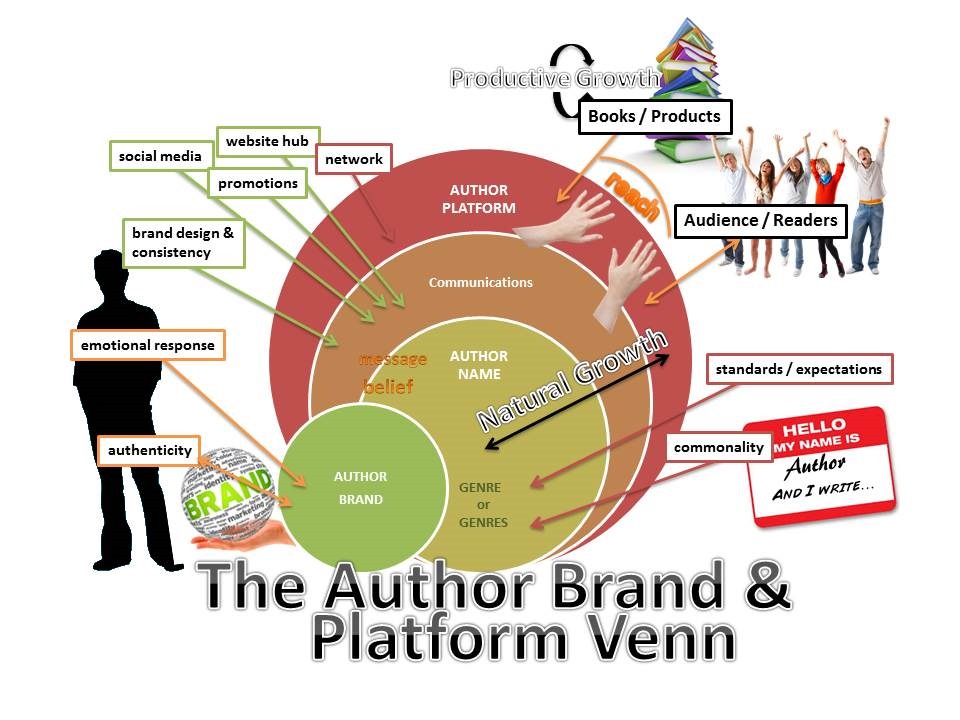
image from http://www.booksandsuch.com
Labels, adjectives, phrases, experiences all welcomed! How do you know me? How well? Where do we usually cross paths? How do we interact?
Send to sallyember AT yahoo DOT com and/or leave your impressions in COMMENTS, here: http://www.sallyember.com/blog
All part of the “30-Day Podcasting Challenge” exercises, which start today, 1/19/15:
http://podcastingsuccesssecrets.com/
Thanks!

image from http://www.bookcovercafe.com

If this is edited, I’m still impressed. If it’s real, COME FURTHER WEST, please! USA MO 63141! #UFO sighting in Western Massachusetts, USA!

#Submissions #authors #scifi #romance Check this out! Follow the link for more info and deadline.
 Length: 2,000 to 7,500 words.
Payment: 2.5 cents/word (US) paid upon publication, promotional biography with two links, and a complimentary quarter-page advertisement.
Deadline for Issue #6: 28 February, 2015.
Rights sought: Six-month exclusive world digital rights from date of publication; non-exclusive thereafter.
Other info: One short story will be published per issue. Please send only edited and polished work. Due to time constraints, we are unable to give personalized feedback on rejected stories.
Stories that tie-in to a previously established world will be considered, but story must stand alone.
All sub-genres of science fiction will be considered.
Any heat level, from sweet to erotic, will be considered. Original, previously unpublished fiction only. No fan fiction, please.
All stories must contain elements of science-fiction, include romance, and have an upbeat ending.
No multiple submissions. Simultaneous submissions are accepted, but please inform us if the story is placed elsewhere.
Submit! Standard manuscript…
View original post 32 more words

Reblogging to watch some time soon. I didn’t even know there was an International UFO conference. Did you?

This is a repost from 8/27/13, since so many new readers are finding The Spanners Series, especially This Changes Everything, Volume I, after its PERMAFREE status began 4/1/14 and have asked for a Glossary.
FREE everywhere ebooks are sold. All links, reviews, author interviews, readings and more: http://www.sallyember.com/Spanners Look right; scroll down.
In the back of each Volume, I do update and add to the Glossary, but here you go:
As explained by Esperanza Enlaces, sometime narrator, Journalist and Media Liaison for Chief Communicator, Dr. Clara Branon, Ph.D. [See “The Dark Side” for other terms and explanations not found here]
ALT = According to Linear Time. Use to explain temporal sequences as opposed to simultaneous nowness, and the use of past or future tense in verbs.
APC = After Public Contact. APC becomes “AppCee,” whose logofication becomes a stylized English “A” superimposed over a lower-case “c.” Vocalize as “AppCee.”
BPC = Before Public Contact (see APC, above). Vocalize as “BeepCee,” spell as “BeePCee.” Logofication is a stylized English “B” over a lower-case “c.”
CC or CeeCee = Chief Communicator. Main Earth Liaison selected by the MWC (Many Worlds Collective) to relay information and be the unofficial leader APC during the Transition and then official Leader for the Member once the MWC membership is established, for a limited term. Dr. Clara Branon, Ph.D., is Earth’s first CC.
ESP Training = Excellent Skills Program education, with 12 levels of paranormal, psi, and extraordinary skills and abilities/talents, details depicted in Volume IV. All forms of what many human Earthers from Western cultures consider extrasensory, siddhis or yogic, in Eastern cultures, or psychic skills by many others, are included. ESP Training is mandatory for all CCs (Chief Communicators) and Officers or Psi-Warriors (see “The Dark Side” for list), and offered to many others APC (After Public Contact).
fish = IntraPlanetary Communication System. Also known as the Interspecies Communication System begins as a semi-acronym, “IntraPlanCS,” which morphs into “i-planCS,” which becomes “i-planX,” and then logofies into a slanted, stylized “i-“ beside an “X,” which Zephyr Branon names the “i–fish,” and then simply the fish. (Thanks to Douglas Adams’ five-volume “trilogy,” The Hitchhiker’s Guide to the Galaxy, in which he introduces multi-language, internal translators called “Babel fish.”)
iD and Access = Individual Access technology. Gives Earthers Access to all information, links, media via one’s own internal Access point or iD to the MWC Resource Library. Symbol is just the slanted “i” leaning onto a very fat “D,” pronounced “eye-Dee,” with the emphasis on the first syllable instead of the second, not to be confused with “Eye-Dee,” for “ID,” emphasis on the second syllable, which still means personal identification for many MWC-ers.
IGC = InterGalactic Council. Governing body of the MWC (Many Worlds Collective), whose reports, Implementations, adjudications and decisions appear in most of these Volumes.
MWC = Many Worlds Collective. Interplanetary association of all sentient beings in the multiverse. Membership is voluntary, to an extent, and usually by issued invitation preceded by many informal and perhaps secret visits/contact over a specified period of time, resulting in the selection and training of a Chief Communicator for that Member (Earth’s first CC is Dr. Clara Branon, Ph.D.).
mwcw = Many Worlds Collective Webview. Also called the ‘verse web, or just the verse. Similar to the Earth’s Internet from the 20th – 21st Centuries, but interplanetary. iDs Access (see above) information from the mcwc, mostly.
Re-set = Changing a timeline’s circumstances, outcomes, or trajectory by focusing on the events’ “previous” “fork” and then changing a pivotal circumstance, choice, decision that precedes or coincides with that fork. A Re-set allow all “future” (ALT, or According to Linear Time) events to unfold slightly and perhaps quite differently, from that fork “onward.” Beings who have the ability (very advanced in the ESP [Excellent Skills Program] training, levels 11 or 12) may focus on a multiverse “fork” and allow for alternate timeline(s) to emerge for experiential, educational or actual living purposes, then choose or collaboratively select which timeline to make primary.
Return and Reinvolvement = A sentient being’s consciousness is separate from its physical form and therefore may be released (“die”) at any time. If the consciousness is going to take physical form again, there are several possible options. The heart/mind may be constrained to Reinvolvement (must become newly incarnated or “born” into a physical form, often a similar species form, due to lessons unlearned or karma unfinished; usually do not retain memories and may lose skills and abilities depending on karma). The heart/mind is eligible to choose to Return (become incarnated with full retention of previous memories, skills, abilities, in order to be helpful to current beings; may change forms from previous depending on need). The heart/mind remains free of physical form for the rest of its awareness, blending with oneness for those who do not incarnate.
<strong>Snap = used to describe the sound and the action of bringing an object to oneself using telekinesisl also, a general term for the sound and effect of using other ESP (Excellent Skills Program) skills.
Spanners = Earthers who are alive as the century turns from twentieth to twenty-first, especially those who live almost equal numbers of our lives’ years in both centuries. Also, all those who are alive both before and after the Transition (see below). For a longer description of all that Spanners signify, see Volume I.
Timult and Timultaneity = Noun/verb, adjective. The act of intentionally viewing, being aware of, knowing of events, people or possibilities occurring in more than one timeline; also, that these multiple timelines exist and have varying circumstances. Terms invented/coined by Zephyr Branon. Also, timulting and other verb forms exist.
Timulters = Beings who can perceive more than one timeline’s occurrences among the multiverse. Dr. Clara Branon is the first known intentional timulter who has no ESP (Excellent Skills Program) training for her first timults, beginning when she is a child.
Transition = first 5 – 10 Earth years APC (After Public Contact) with the MWC (Many Worlds Collective) for Earthers.

Thanks, Inger D. Kenobi, upcoming guest for Episode 20 on 2/4/15 of CHANGES, and my sangha sister, for nominating me for the Versatile Blogger Award! I am so honored!
Here is her posting with all Inger’s nominations:
http://theviridescentconsumer.wordpress.com/2015/01/03/the-viridescent-consumer-receives-the-versatile-blogger-award-fist-pump-mandatory/
The rules are:
- Show the award on your blog.
- Thank the person who nominated you.
- Share 7 facts about yourself.
- Nominate 15 blogs.
- Link to your nominees’ blogs and let them know.
I am going to take the title of this award literally and nominate those whose blogs are versatile and fascinating (to me, of course):
Seven MORE things most people do not know about me…

Sharing books, author voices, and news from the University of Washington Press
Where Adventure, Lifestyle, and Food Come Together
It's a beautiful day in the neighborhood.
Every Second Thursday | 5-8pm
A novelist with a passion for reading and traveling shares his view of the world and his adventures.
Rejuvenate, relax and revitalize with holistic healing.
Information & Analysis on Global Mass Transit Industry
Stories to warm the furry heart and soul
Local Burien News and Stories that support Human Flourishing and Balanced Community Conversations. Topics include Education, Government, Sports, Lifestyle and Community Perspectives.
Updates from King County's School-based Partnerships Program
Community News For All of Seattle's Capitol Hill
News that connects you
An interdisciplinary research project on cities and the night.
Manhattan's little, quieter island and beyond
Smile Always
#Evola #Traditionalism #Metaphysics #Initiation #Esotericism #JuliusEvola #SpiritualHierarchy #Transcendence


 Sally Ember, Ed.D.
You must be logged in to post a comment.