
Originally posted on carsonrenomysteryseries.com: Thanks for your support
via 5 Rules of book reviewing — The Owl Lady Blog

Originally posted on carsonrenomysteryseries.com: Thanks for your support
via 5 Rules of book reviewing — The Owl Lady Blog


Originally posted on BRIDGET WHELAN writer: The very first creative writing workshops were pioneered at the University of Iowa in the 1930s and they still have a mighty reputation today. They are now offering a free open online course to explore Walt Whitman’s writings on the American Civil War, looking at how writing and image…

Chagdud Khadro

is the American-born widow and former student of Chagdud Tulku Rinpoche who was ordained as a lama as well.
I have been with her many times for teachings with her as Rinpoche’s translator and with her as the teacher. For those who don’t know, Chagdud Tulku Rinpoche passed in 2002, but he was my first empowering lama and my root lama’s, Padma Drimed Norbu (Lama Drimed)’s root teacher.
I first learned P’howa (the practice that includes transferring consciousness intentionally at and after the body dies or helping others do that, including those who are brain dead, already dead, or dying/dead animals) from Chagdud Khadro at a three-day event I organized for Chagdud Lhundrup Ling (A dharma center I helped start) in Maine in 1997: she was fabulous. I had the good fortune to attend several other teachings she gave or translated for Rinpoche or rituals she attended as a lama in New York, New Mexico and northern California between 1997 – 2007. I keenly appreciated her humor, knowledge, insight and compassion.
If you live near or can get to any of these events, these teachings and rituals are rare and precious. They are in the Tibetan Vajrayana Buddhist tradition but made accessible to Westerners who speak English. Well worth your time if you’re already a practicing #Buddhist, a meditator or interested in #Tibetan #Vajrayana #Buddhism.
Spread the word! Donations requested; no one turned away for lack of funds.
Chagdud Khadro’s 2016 Summer Teaching Tour
#Buddhism #Teachings
P’howa Retreat
Reno, NV
July 9 – 10
More Information: http://goodnesssake.org/special_events/special_events.shtml#phowa
Looking into the Mirror of Death to Find Purpose in Life and Peace in Dying
La Jolla, CA
July 11
robertrosson2000 @ yahoo DOT com
Rigdzin Dupa Drubchod
in attendance at Ati Ling/PPI – Cazadero, CA
with Tulku Jigme Rinpoche (Chagdud Tulku Rinpoche’s son)
July 13 – 19
More Information : http://atiling.org/events/102-rigdzin-dupa-drubchod-2016
White Dakini Drubchen
in attendance at Tara Mandala – Pagosa Springs, CO
with Tulku Sang-ngag Rinpoche and Lama Tsultrim Allione
August 7 – 16
More Information: http://taramandala.org/program/white-dakini-drubchen-2/
Looking into the Mirror of Death to Find Purpose in Life and Peace in Dying
at Rangjung Yeshe Gomde – Cooperstown, NY
August 20 – 21
More Information: http://gomdecooperstown.org/august-20-21-chagdud-khadro/
Looking into the Mirror of Death to Find Purpose in Life and Peace in Dying
Syracuse, NY
August 22, 7 – 9 PM
More Information: http://chagdudgonpa.org/wp-content/uploads/2016/06/Syracuse-Flier-Khadro-2016.pdf
Looking into the Mirror of Death to Find Purpose in Life and Peace in Dying
&
Emotions as Obstacles; Emotions as Wisdom
Chapel Hill, NC
August 27 – 28(times vary: check flyer)
More Information: http://chagdudgonpa.org/wp-content/uploads/2016/06/Khadro-NC-FINAL.jpg
cindy.palay@ gmail DOT com
Chagdud Gonpa Foundation
341 Red Hill Rd
Junction City, CA 96048 USA
530.623.2714 ext 126

Those of you who read my blog somewhat often know that I don’t usually share anything very personal from my past unless it’s positive. However, this year, due to timing and other factors, I am changing that with this post. If you’re not interested in hearing about my somewhat traumatic childhood or long-deceased father, skip this post! If you are, read on.
If you’d like to leave comments, you are welcomed to do so below this post, on my site: http://wp.me/p2bP0n-1HM [If you leave comments anywhere else that this post may appear (when it’s reblogged or cross-posted), I probably won’t see them very soon, if at all.]
The Mixed Bag of Lessons from My Father
My father died in 1991 at the age I am right now: almost 62. It seemed young even then, when I was only 37. Now, it’s appalling.
Here he is at about the age I was when he died:
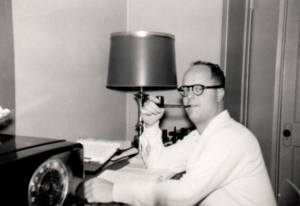
Ira Fleischmann, age 30
Dad died of a massive heart attack while playing doubles indoor tennis. He “was dead before he hit the ground,” according to the three doctors he was playing with at the time. They know this because he fell face forward and hit his forehead but never put out his hands to catch himself in the fall.
Because he had always been a coward about his health and avoided doctors, he died from what was actually a treatable condition (blocked arteries). We found out later that he had been having chest pains for months prior to that and hadn’t done anything about them.
My three siblings (ages 26 – 38 at that time), my dad’s third wife (age 48) and elderly parents (90 and 91), his sister (57) and others in our family and his friends were shocked at his early demise. Understandably, some of us who knew that he had avoided the doctor’s exam and that his death was likely postponable were also angry.
Know this:
FACT: 200,000
At least 200,000 deaths from heart disease and stroke each year are preventable.FACT: 6 in 10
More than half of preventable heart disease and stroke deaths happen to people under age 65.
from http://www.cdc.gov/vitalsigns/heartdisease-stroke/
We became even more frustrated with him when we found out what a mess he had left his financial affairs in and how much his third wife would have to do to clean it all up. Ironically, even though he had sold life and other insurance policies for most of his life, he had cashed in his latest life policy to get quick cash (he was always short on cash) and died without any insurance. He had not only had made no provisions for his demise, but left no Will, either.
We spend the first few days after his death in a haze of mourning but needing to make many decisions. We ended up arguing about basic stuff:
—should there be an autopsy?
—should he be buried (my observant Orthodox Jewish brother insisted on this) or cremated (the rest of us, including his wife, knew that this was what he had talked about wanting)?
—what to do with the chaos of his home office, files, obligations, etc.?
We worked most of it out, but found out some disturbing facts along the way.
We found hundreds of business cards with some other man’s name, which turned out to be our dad’s alias (a mash-up of his two deceased uncles’ first names). The false name of this business and a local address were on letterhead and there were a few other “clues.” We opened file drawers and a desk drawers and compared notes: our dad had had a secret, alter ego, including another “business” of some type, complete with a fake office nearby.
My sisters and I, in a whirlwind of semi-hysterical giddiness and grief, put on our trench coats (literally) and slunk around to peer into this office’s windows: practically empty. No one was there or appeared to have been recently, but his fake name was on the door. The desk and chair looked unused. Nothing else was in this small room: mail drop only. For what? We knew we’d never find out. This was 1991, before Al Gore gave us the full internet, before Google, etc., and we had no money to pay to investigate in ordinary ways, so the trail ended there.

It took almost a year for his wife to make sense of the rest, pay off his numerous debts, settle some lawsuits (he was the defendant or the plaintiff in several). Even though she didn’t have to, she decided to disburse from what was left to us, his three children. It wasn’t much, but we were grateful.
We found out a few years later that our dad had purchased some oil wells in Illinois in the 1970s (yes, there are some!), when we siblings each received a notice about being his beneficiaries: where did we want to have the checks sent? Yippee!? Again, not much, but something.
So much for his financial legacies.
What else did I get from my dad? It was definitely a mixed bag, just like his financial detritus.
Planning for Death
It is cruel and selfish to one’s descendents and mourners to leave one’s affairs unsettled. Since none of us knows when or how we will die and we all know that death and/or incapacitation can happen quite suddenly and unexpectedly, there is no excuse for leaving these things undone when one has children, spouses, property and/or businesses.
The deceased one’s lack of preparedness causes what is already difficult (grieving a sudden or unplanned-for death) to become complicated, making the grieving a longer and more arduous experience for all mourners. Unwinnable arguments, hurt feelings, misunderstandings, and vying for power, money, possessions, property and decision-making victories can take up the time we should be spending in simple grief and storytelling amongst us.

image from http://news.mdl.com.au
Dying Intestate (without a Will)= BAD
Lessons: Prepare for your death NOW
Because of the mess my dad’s disorganized death left, my son’s father and I responded. We both immediately signed up for a small life insurance policy and wrote our Wills when we got back home (our son was 10 at that time). I made sure I signed up to be an organ donor. We wrote our “Living Wills” so others would know our wishes should one of us become incapacitated and we each assigned a healthcare “Power of Attorney.” I have continually updated these documents and my list of whom to contact and what to do in the event of my death and for the disposal of my remains, any service to be held, etc.
Swimming
Our dad taught me and my brother (13 months older than I, so we did most early learning together) to swim when we were three and four, something I always loved from then on. I trained to and became a lifeguard and swimming instructor as an older teen and ran several waterfronts at summer camps as an adult, training lifeguards and teaching swimming myself. I was fortunate to have had intermediate and advanced swimming lessons every summer while a camper and I appreciated passing those skills on to other campers as I got older.
I developed a love of all places watery and being in the water from my dad. I had many years of jobs at summer camps because our parents sent us to them every summer—starting with the same camp, Camp Hawthorn, which I’ve written about on this blog—that he had attended as a child!
LESSONS: Water Love
I still swim many times per week, right here in St. Louis where I grew up, at the same Jewish Community Center where he taught us to swim (but a recently constructed pool replaced the old one). Because I’ve had many injuries to both legs and my back, swimming is my main exercise.
I have loved and swum in dozens of lakes, several oceans and probably a hundred pools around the world.

I am lovin’ my sister, Ellen’s, backyard pool in California, 2013
Abuse and Strength
Our father was often an angry, impatient, intolerant, mean and frustrated person. He had been raised with physical and verbal punishment and passed those horrible habits onto my brother and me (mostly just us two oldest kids, because our younger sisters are very much younger). Our father beat up on us regularly, usually for no legitimate reason (most abusers operate that way), e.g., the TV was “too loud,” we weren’t moving quickly enough, we said something he didn’t like, we were tussling with each other too much, etc.
Our dad also yelled at us and our mother a lot and called us all terrible names. He was both physically and emotionally abusive for all my childhood years. When we got older, he focused on hitting my brother but pulling my very long hair. When he got violent and was looking for a target—any target—, I would tell my little sisters to lock themselves in our bathroom. I’d stand between him and that door, letting him pull my hair and slap me to distract him from going after them.
As soon as I got my driver’s license, I’d take them with me rather than leave them at home with him and my mom, who was very ill a lot of my high school years and not much help. They tagged along to visit my friends as we went to movies or listened to music. I took them to play rehearsals and other activities to avoid having them be at home with no one to protect or supervise them.
Luckily, Dad started having tennis matches (and affairs, we found out later), and was mostly out of the house a lot by the time we were in high school. After one extremely violent episode on the eve of my brother’s leaving for college, my mom finally threw him out. It was the beginning of my senior year.
My ACE (Adverse Childhood Experiences) score is very high, mostly due to my father. A high ACE score has been connected to causes of a myriad of other physical and mental health problems well into adult life, some of which I do have.

ACE (Adverse Childhood Experiences) impact from http://www.npr.org
LESSONS: Lemons into lemonade
I developed tremendous courage, intolerance for abuse, the ability to stand up to anyone, any time. After growing up with and surviving an abusive parent, I would never be intimidated by anyone else.
I vowed never to be like him in those areas. I went out of my way to practice meditation, get counseling and incorporate anger management techniques. I also learned to use many “positive discipline” methods while raising my own son and being a teacher of young people. As a master teacher, I supervised and trained dozens of others and helped them learn the positive discipline techniques I had honed.
I am proud to say that I have never hit my child (who is now 36) or any other child. Furthermore, I intervened whenever I witnessed physical abuse or when I saw that hitting was imminent in public or private places. I do not call children or teens derisive names, nor do I put up with anyone else’s doing it.
I was on the board for a local child abuse prevention task force. I learned and then taught creative conflict resolution techniques and mediation. I also taught parenting classes, mentoring many teen, bio, adoptive, foster and step-parents to help them become more positive and to curtail / end any incipient habits of abuse.
I became an advocate for those being abused. For example, I intervened once when I witnessed several police assaulting a teen and then testified at his trial to get his (bogus) charges dropped. After they falsely arrested me to try to intimidate me out of making a formal complaint against them, I filed a lawsuit which I won. Those assaulting officers were reprimanded and fired. That police department then changed the ways they trained, supervised and managed officers in the field from then on.
Music
My mom and both her siblings and her mom, my dad’s sister and many others in our family were amateur musicians of sorts, mostly piano players or singers. My dad had “flunked out of” his piano lessons, according to him, but he had a great, operatic tenor and loved to sing.
I grew to hate opera because of my associations of his abuse with his favorite music, but I began to play the piano and sing along with many songs and loved music from a very young age. Our dad took us to the symphony a few times (I usually feel asleep, though).
Because of my dad’s commitment to music education, my and my siblings’ love of music was educated (but I still do not like opera, hip-hop, twangy country, bluegrass, free jazz or rap). He paid for my and my sisters’ piano and my brother’s drum lessons and arranged for us to have his own piano teacher to teach me and my sisters for our first years.
Mrs. Rosenblum was ancient, to my young eyes (probably in her 60s!), and a harsh task mistress, but classically trained and very skilled. I became a gifted sight reader due to her tutelage. I won piano competitions and played complicated pieces in her annual recitals, from ages 9 – 16. From ages 16 – 18, I learned theory and improvisation from a different teacher, the talented Herb Drury, who also had his own quartet (my dad also paid for that).
Because of my accomplishments and talent, I was selected to be the accompanist for rehearsals and the annual school musicals in 11th and 12th grades (a great honor). I also sang and accompanied in several of the school choirs as a teen and in/for many community and women’s choruses as an adult.
After I graduated college, I used the small amount of money left to me by my great-grandmother to buy my first piano, one I kept and moved over a dozen times to five different states. I took piano lessons for one year during my first year as a teacher, since I lived alone and had time to practice.
I enjoyed being a paid or volunteer accompanist, musical director, piano teacher and chorus member for most of my adult life. I also have written more than a few songs, am mid-stream in writing a musical (still festering my my files…), performed in and musically directed/accompanied several musicals and cabaret shows and continue to enjoy teaching (rarely) and playing piano.

from http://www.huffingtonpost.com
LESSONS: Music rocks!
Music is a connector: more than a few of my lovers were musicians and/or singers and so is my son, who also composes. His father also plays several instruments and so do many of my friends and all three of my siblings. Music is a language: when I have trouble expressing or finding meaning in some extreme or complicated emotional states, music helps me understand my own and others’ experiences.
Playing piano, especially sight reading, uses both “sides” of my brain. Putting my fingers on a keyboard my son sent me and making music have helped me in my recovery from a Traumatic Brain Injury (from about two years ago).
When my sisters and I get together, we often sing. My son and I have had a lot of fun with “kitchen opera” (the only kind of opera I like), improvising lyrics and melodies as we cook or clean together.
My dad’s later years and my early adult life
Having worked for decades with youth and families, parents and professionals who work with youth in a variety of capacities, both educational and therapeutic, I know that my negative experiences are not even close to “the worst.” I have heard so many horror stories that it puts the difficulties of my life into a proportional perspective. Some of my childhood memories are actually quite positive.

I, our dad and my brother, 1955, Clayton, MO
At this point, I do not deny the problems my father and his problems caused us, but I have grown to appreciate and be grateful for the good things he did provide. I am resilient and stronger due to a lot of help from other adults and friends. I have developed enormous empathy and compassion for others’ pain. I understand many of the conflicts that arise between parents and children of all ages.
For most of my college and early adult years, my dad and I were estranged to a large extent. I didn’t see him very often and we almost never talked on the phone. My sisters were little when he moved out (6 and 11), so they had the whole divorced parents-visitation-dad’s girlfriends things to contend with that my brother and I never had to do since we were already in college when our parents’ divorce came through.
Occasionally, Dad would send me a check for some odd amount (he liked to round off his checkbook running total to all zeros) with no note. Sometimes I’d rip that up, even though I needed the money. I was angry and hurt, unwilling to connect solely over money.
He remarried twice. The first time was when my brother was in medical school and I had just graduated college. He skipped my graduation, but he invited me and my brother to join him and his new wife, with our current dates, at a resort in New England (where my brother and I were both in college) later that summer. I didn’t want to go, but my brother said we had to. That experience was very weird. We played a lot of tennis and ate too much food; that’s about all I remember. The wife was unremarkable.
On the few occasions I did go to St. Louis during their brief marriage, I remember Dad’s being almost the same as when I had lived with him: he was frequently yelling at this woman’s three kids, calling them names, being horrible. I was disgusted.
At one tense dinner, the oldest (a girl) had left the table in tears due to his name-calling. I followed her into the hallway and stood next to her as she cried. When she was a bit calmer, I told her (from the vantage point of my ripe old age of 22 to her 11) that he was a horrible man and that he had been horrible to me and my brother, too. I then said that I’d stand up for her and that she should call me if he ever hit her or her brothers.
I don’t know what I would have done about his abuse of her and her brothers at that time (I didn’t know about child abuse hotlines, if there even were any in Missouri in 1977), but I do know that I would have appreciated it if ANYONE in my family or among my parents’ friends had ever offered any of us an acknowledgement of his abusiveness, any emotional affirmation of the trauma we were suffering, any kind of lifeline like that; no one ever had.
Luckily for those kids, my dad and their mom divorced soon after that visit.
My brother and his wife had their first child in 1979, a year before we had Merlyn, and then they had another one about a year and half later and two more in the next seven years. Our middle sister had her first child in late 1989. Both my sister-in-law and I took had privately taken Dad aside early on and told him, in no uncertain terms, that if he ever yelled at or laid a hand in anger on any of our children, he’d never see them again. He must have believed us, because he never lost his temper with any of the grandchildren.
Throughout the 1980s, my dad loved his 6 grandkids and enjoyed spending time with them. He happened to be visiting when my son was just learning to walk: Merlyn ran/fell into my dad’s arms as he took his first independent steps in August, 1981. Precious.
For his third marriage in 1986, he married a woman with three daughters around my sisters’ ages who was the same age as Merlyn’s dad. That was creepy, but we liked her all right. We later found out that this wife was an active alcoholic who almost immediately went into recovery soon after they got married.
Because of his wife’s personal recovery work, in the last few years of our dad’s life he had begun his own therapeutic journey. He went to some Al-Anon meetings, read some books relevant, talked with her and others.
During her senior year, my youngest sister, Lauri, went to live with them “to get to know our dad better.” Our mom had also remarried a few years prior to that and she didn’t much like her husband or being the only child at home (my middle sister was finished with college and living in California by then), so those were her other motivating factors. She reported during and after that year (1984) that Dad was starting to develop some insights into his own issues and kept his temper better around these teens (only two, Lauri and her youngest, were living at home): no hitting and very little yelling.
I participated in peer counseling (Re-evaluation Counseling, known as “RC,” and then Co-Counseling) from 1979 – 1986 and then had about ten years of regular therapy, starting in 1986. I also kept meditating, attended many other rituals and personal growth workshops and generally began to understand, heal and assimilate the consequences of my childhood’s traumas.
Due to both of our being involved in personal growth work and the mellowing effect of his having grandchildren, my dad and I were finally—very tentatively—having a more connected, positive relationship. This was helped by my living in New Hampshire and his still being in Missouri (distance and very few visits were key).
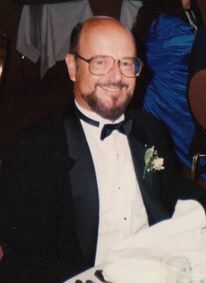
Ira Fleischmann, age 59, at my sister, Lauri’s, wedding, 1988
In the summer of 1990, we were visiting Dad and his wife (as well as my mom and her husband and other family) in St. Louis. My brother and his family still lived there (he had been doing his medical residency at a local hospital). At my dad’s condo’s complex was an outdoor pool. Merlyn and his cousins were frolicking with my brother and Merlyn’s dad in the pool while my dad and I relaxed in the shade on chaise lounges, drying off after our swim.
Suddenly, my dad looked up from the book he was reading on co-dependency and family problems to say, in a surprised and completely unironic tone: “Oh my God! I grew up in a dysfunctional family! Do you have any idea what that’s like?”
I was so shocked at his lack of awareness, I almost lost my breath. But, I could see that he was authentically having this insight for the first time. I didn’t want to discourage him.
Using my most neutral tone, I responded mildly: “I think I have some idea, Dad.”
He nodded and went back to his book. That was one of our last conversations.
In January, 1991, both of his parents, then in their early 90’s, were celebrating their birthdays. The entire extended family gathered in St. Louis to honor them. Unexpectedly, our dad died about 7 weeks after that reunion, so we were very glad that we had had that time all together.
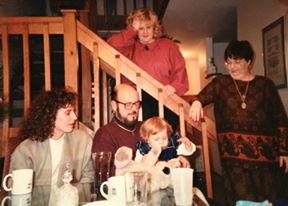
At the last family reunion, January, 1991. Counter-clockwise, from bottom left: our youngest sister, Lauri Stern; Ira Fleischmann with his youngest granddaughter, Ellen’s oldest, Sarah Miranda Kneeland; Dad’s sister, our Aunt Nancy Levin; her middle child, cousin Hillary Levin.

Important info and instructions for preserving #authors’ rights to post #reviews on #Amazon and not be blocked. Thanks, Phoenix Rainez (and Sally Cronin) for posting/re-posting!


Originally posted on Silver Threading ~ Fairy Whisperer ~ : Do you write YA fiction or children’s stories? Read this!❤ Source: 11 Magazines that Pay for Short Stories for Teens and/or Children

How to Estimate Agenda Times for a Meeting/Workshop in the USA
OR
Time Management for the Eternally Optimistic and Always Late Facilitators/Leaders
I have worked in nonprofits, educational and other venues for which meetings (workshops, Board meetings, conference convocations, etc.) are a necessity. I cannot count how many times I have sat through a session run by someone else who could not figure out how to manage the time for the stated agenda, nor how to create an agenda that could actually be completed in the time allotted.
Frustrating, insulting and disrespectful to those in attendance, and otherwise a TIME WASTER.
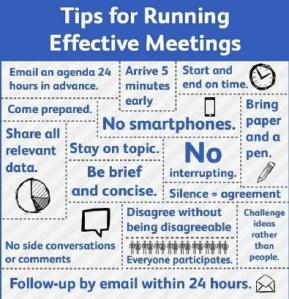
image and meme info from http://www.inspiredemployee.com “Running Effective Meetings”
My friend and colleague, Mario Cossa, and I have coined the term “pre-crastinators” endearingly to refer to ourselves. Pre-crastinators are prepared early so that we are able to and do send out agendae AS PROMISED, distribute minutes or preparatory materials in advance and do not make other wait.
Leaders are training people with every move
—I never start late, even if I and only a few others are on time, because if I did, then I would be dishonoring those who made the effort to be punctual and training participants/members to believe that being on time won’t matter in the future.
—Similarly, I always end on time, unless I have asked the group for permission to extend our time and been granted that.
When an item requires more time
I must notice this so that we can take a break from the agenda to discuss this dilemma PRIOR to the ending time and list what our options are. The members can then let me know if adding a specific number of minutes to complete a specific item/task is acceptable or if we have to postpone that item’s completion.
If we run late, then, it is as a group and not based solely on my decision or due to poor planning. These approaches to time management show respect and organizational control. Therefore, I make sure that I/we can conclude the event and its agenda by the end of our agreed-upon time limit, with designated items labeled in advance that must be discussed at more than one meeting.

image from http://http://www.slideshare.net/gretchenrubin/gr-14-tips-for-running-a-good-meeting-2/2-1_Very_obvious_Start_on “Start and End on Time”
Therefore, I offer my pearls of wisdom from decades of managing time extraordinarily well. Take notes.
Let’s use an hour-long session as the prototype for this list of tips.
Opening, Closing and Pacing a Session

image from http://vismap.blogspot.com “Opening the Meeting”
You actually have only 30 minutes for your “hour-long” session’s actual agenda. Truly. And, that is only if you start and end on time. Schedule more sessions if you need more time.
What about introductions?
—NEVER use your precious session’s time for longer introductions of members’ UNLESS that is the sole purpose of your session.
—When your group has more than five people and you have only scheduled one meeting, you can’t use more than about 15-30 seconds to “meet” each other by way of self-introduction for each person.
—Be clear about that up front and then model the proper format for the group by going first.
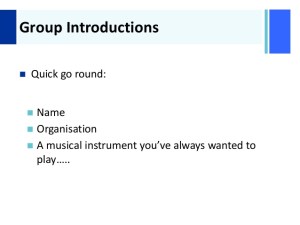
“Quick Introductions”
Generating and Upholding Realistic Time Expectations
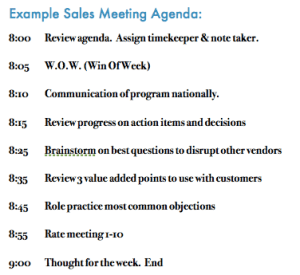
image from http://northboundsales.com “Sample Agenda with Times Listed”
People Management
I do not let others hijack my meetings or workshops with unending stories, unfiltered confessions, boring and repetitious contributions (like your own voice much?) or other time-wasters.
I make sure everyone has a chance to speak who wants to contribute.
When I run the meeting or workshop, everyone can relax, listen and participate well.
I facilitate with humor, grace and firmness.
People LOVE my workshops and meetings because I use their time respectfully.

“Visible/Audible Timer”
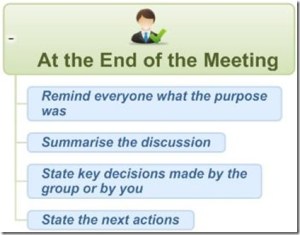
image from http://vismap.blogspot.com “Ending the Meeting”

image from http://www.opensesame.com/ “Signs of a Successful Session”
Good luck!


Dear parents of Brock Turner, and any “supportive” relatives, friends and associates:
You are making things worse and you are horribly wrong to “support” Brock. I hope you can educate yourself and learn to change your position. Treat the woman he brutalized as the victim rather than Brock Turner.

Some facts:
—This supposedly mentally competent young man (Brock was a scholarship student at a prestigious university) did not “make a mistake” when he brutally assaulted an unconscious woman behind a dumpster. His intentions were clear and his actions thought out in advance.
—He did not “accidentally” drag this inebriated young woman off behind said dumpster. He considered his options and chose this as the best place to hide what he was doing to her.
—He was not “confused” when he decided to stick objects and himself into her naked body’s orifices as she lay amidst dirt and pine needles.
—He was not “unclear” about her inability to give consent when he tried to run away because 2 good Samaritans attempted to and did chase and stop him.
When asked about his crimes (which are not in question because there are witnesses and medical records to demonstrate his guilt, which was proven and he was convicted), Brock has lied repeatedly and still has not apologized or shown appropriate (healthy) remorse. These are not good signs.
The legal terminology here is clear: Brock Turner, “with malice aforethought,” “willingly and knowingly” committed “multiple felonious assaults” on a helpless woman.
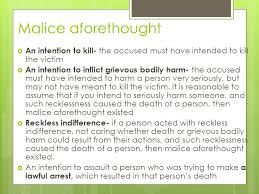
How can you depict Brock as any kind of victim?
His horribly venomous selfishness and inappropriate sense of entitlement (learned and encouraged, no doubt, from many of YOU) are part of a family and community pathology that shows itself in serious misogyny, part of what is termed “rape culture.”
—Do not defend him.
—Do not excuse him.
—Do not attempt to protect him from the consequences of his own actions.
—Do not pretend that this was a one-time event. Ask him. No one does an assault like this only once. He happened to get CAUGHT this time. I’m certain he has done this before, or worse.
“The research team discovered serial rapists are far more common than previous research suggested — a finding that could change how sexual assaults, including so-called acquaintance rapes, are investigated.” Data that are now considered typical; study from one county in the USA: https://www.sciencedaily.com/releases/2016/06/160606122823.htm
—Your entire family and any “supportive” members of your community, religious and civic organizations need counseling to deal with how you have failed him and how your thinking and emotions are completely distorted about him and this tragic crime that he committed. If you/they have not been able to hear/read the entire text of the victim’s Impact Statement, do that. Read her letter repeatedly until you understand the enormous heinousness of his acts and your misguidedness.
—If you have sons, work with young boys or men, or are one, you should learn from this/teach several things:
1) Women are not anyone’s property to do whatever they want with, any time they want. It doesn’t matter how much or what she drinks, ingests, wears, says, looks like or acts like: she is not “yours.”

2) If a potential date or sexual partner can’t communicate coherently or at all, she can’t give consent for sex. Find her a safe friend to be with her and get her safely home.
3) Perpetrating physical acts that are sometimes considered “sex” on someone who has not given consent is NOT sex: these are acts of rape, assault and physical torture and are CRIMES. Do not even consider any other definitions.
4) It is your duty to make sure Brock and others who are legally required to register as sex offenders wherever they go, live and work DO register. Do not let him or others continue to ruin women’s lives.

You can be compassionate about Brock’s pathologies and future problems without condoning what he did or making him “feel better” about it. He should NEVER “feel better” about any of it.
Sincerely,
Everyone else who is sane and compassionate

Each month we aim to provide a helpful round-up of writing competitions, fellowships, publication opportunities and more for writers at all stages of their careers. For new writers, or for anyone seeking a refresher, we highly recommend reading How to Submit Your Writing to Literary Magazines. Deadlines and details do sometimes change, so please check the…
via Opportunities for Writers: July and August 2016 — Aerogramme Writers’ Studio

As a mother of an amazing feminist son who was also a ring-bearer at age 4 (and he HATED it), I applaud this piece and your parenting ideas. I LOVE this piece. Sharing. Wishing everyone who had sons (and daughters) would read it and take parenting classes from you.
Best to you and your family,
Sally

My son was the ringbearer in my brother’s wedding this weekend. The flower girl was, I think, the daughter of one of the bride’s cousins. To say they hit it off was probably a bit of an understatement; they were pretty close to inseparable at the bridal shower a few weeks ago and not much changed at the rehearsal or the wedding. I’d post a picture of the two of them, but I’m not about to post a picture of somebody else’s kid without her permission and plus I plan on using the word rape a lot in this piece and I don’t really feel like having my son’s photo associated with that in Google.
Here’s the thing. Everybody at the wedding was doing that heteronormative thing that people do when two little kids click and oohing and aahing about oh look at his girlfriend and all that nonsense all…
View original post 875 more words

Okay, this is old news but I thought I’d bring it up again. Smart TV’s are smart because they are connected to the Internet. Problem number one: they are connected to the Internet. Problem number two: they are easily hacked. Smart TV hackers are filming people having sex on their sofas – and putting it […]

The winners of this year’s Lambda Literary Awards were announced last night in New York. Most of the categories won’t mean much to you, or me for that matter. However, there are always a few of interest. The science fiction, fantasy and horror category was won by The Gracekeepers by Kirsty Logan. I’ve not read…
via Lammy Winners — Cheryl’s Mewsings

What Matters
As I approach my 62nd birthday (August 22), I reflect on the news stories I see/hear almost daily, now, that corroborate and validate most of my life’s choices, values and beliefs. Sharing, now, so you don’t all have to re-invent the wheel. Mostly I/we were right. Get with it.
Interactions matter. Treating all humans with respect and meeting humans needs (food, clothing, shelter, meaningful and well-paid work, safety) properly are right. Equality, egalitarianism, acceptance, compassion, kindness and respect are the right ways to greet, treat and live with all others, regardless of perceived or actual differences among us and changes in circumstances. Ending oppression, discrimination, bias, prejudice and all forms of subjugation must occur.
image from http://www.tomvmorris.com
Respect
Government and economics matter. Democracy (when it works) and socialism are right: we must listen to and take care of each other.
Conflict resolution matters. War is wrong, especially war that only makes profits for a few corporations and individuals and ruins land, kills/maims people and destroys economies for everyone else. All the “police actions”/wars the USA has engaged in since World War II (and some of our actions during World War I and World War II) were/are horribly wrong. Millions have been harmed or died for NOTHING except to enrich a few. We must learn to communicate better, de-escalate, use diplomacy, engage in dialogue, compromise and yield.

image from http://www.popularresistance.org
Peace
Health matters. Eating healthfully and organically is right: better for us, better for the farmers, better for the environment. Contact sports that cause head injuries must end: change the rules or close down those sports completely for children and teens and give adults information that allows them to make educated choices about participation. Sugary foods and drinks, salty and fatty snacks and other negative-impact foods should be made less available and/or taxed very highly so fewer people can eat/get them so readily.
Other beings matter. Treating animals with respect at all times if we are going to use, eat (which some would argue is wrong), imprison and otherwise subjugate them (less stress and pain during and before slaughter, while being raised and during captivity of all kinds) is right.
Consumers’ choices matter. Choosing to purchase items that are made by people who are paid well, treated well and free to come and go is right. Choosing to purchase items whose production (harvest/manufacture/acquisition) does not harm or destroy the planet, the economy, or the people involved is right.

image from http://arabedrossian.org
Healthy planet
Parenting requires time, effort, knowledge, education and support to be done well. Childcare can be a positive aspect of young children’s lives as long as they also have good parenting.
Minds and bodies matter. Meditation, yoga, stress management, play, listening to each other better, being outdoors more and learning/listening to music/making art all help families, businesses, schools and individuals in every possible way. Beauty, nature and gratitude are important. Learn/include and do these. Drink a lot of clean water. Sleep more and in better conditions.

Healthy choices
Reproductive freedom and rights are integral to a woman’s dignity and independence and are the business of no one else besides each woman and her chosen medical team.
Religions whose leaders or principles restrict the freedom or impinge upon the safety of or intend to demean anyone, inspire divisiveness or hatred, or foment disrespect for non-believers or some members of their own sects because of gender, age, sexual orientation or other characteristics are not to be tolerated any longer and must be ended.

image from http://www.patheos.com
Civil and personal rights
Facts are not subject to opinions. No one cares what anyone thinks about facts. Facts are not optional. People who misunderstand, misuse or misguide themselves or others regarding any facts (about the impacts of climate change, the dangers of fracking, etc.) are not to be given any credibility or listened to by anyone with even moderate intelligence.

Dr. Neil Degrasse Tyson, Ph.D., facts quote
Play time matters. Violence begets violence: video games, TV shows and films, music lyrics that demonstrate/engage users in repeated and frequent incidents of violence (personal, sexual, group) desensitize the viewers/players and generate much more violence overall in the culture. Games/shows that degrade women/girls and depict members of particular ethnic or other groups as “the enemy” or the objects of degradation cause users/viewers to adopt these perspectives and behave badly towards these individuals in actual encounters. Children’s and teens’ time using these games or watching these shows must be curtailed. Bring back more outdoor play, longer and better equipment for recess play indoors and outside. Sports and games that encourage coaches/leaders to discriminate among, exclude or otherwise demean participants or activities in training or play that cause players harm must be changed or stopped.

Play
Excellence matters. Skills, talents, education and intelligence are not all equally distributed or acquired. We are not all the same even though we are to be treated with equal respect. Not everyone wins. Everyone is not equally good at everything. Not everyone can earn an “A.” 49.9% of any group is below average, by definition. Get used to it.
Collaboration matters. Governments, organizations/groups of all types and businesses of all sizes operate more successfully when they utilize collaborative, inclusive engagement rather than hierarchical, exclusionary dominance do better economically, have higher morale, have lower attrition/crime rates and better attendance/participation.

image from http://www.cptwebs.com
Collaboration
I could have provided a lot of research URLs to back up each of these claims, but I don’t need to, any longer. They are all true. YOU do the research.

I LOVE this. Thanks for posting, Jessica Davidson. Best part: “Buddhism isn’t just meditation, it’s a whole moral and ethical worldview that has to be lived day to day for it to be effective. You can’t do it just by reading books, and you can’t do it just by meditating.”
“Mindfulness is the skill of thinking you are doing something when you are doing nothing. One of the good things about mindfulness is that you get to do a lot of sitting down. Sitting down is good for the mind because so much positive energy is stored in the lap.” – The Ladybird Book of Mindfulness
I recently attended a Writing for Wellbeing workshop which was designed to promote “mindfulness and calm.” We did various writing exercises and a little guided visualisation, and were told: “Whatever you write is right for you – when done mindfully.” Well, maybe I was having a bad day, but I didn’t feel calm or mindful.
View original post 1,431 more words

[Cheryl has] received notification of a new speculative fiction magazine that will be launching soon. Titled Persistent Visions, it will be edited by Heather Shaw who has an excellent track record in both short fiction and editing. They plan to pay 7c a word, and their submission guidelines suggest that they are committed to diversity…
via New SF Magazine Launching — Cheryl’s Mewsings


I discovered a great podcast app called Podbean. You can get it free or Android or iOS for Tablet and Phone. It allows you to search for podcasts across the web and subscribe to them. You can also access your favorites from your browser on your computer too. Upon downloading you are asked what type […]
via Podbean – A Great Podcast App — The Tony Burgess Blog


Originally posted on Plaisted Publishing House : First of all what the heck is a synopsis? To many of us it is a book blurb, it is what we write to get a readers interest. Many are found on the back of a book. However, there is much more to this than many realise. Synopsis…
via How to write a Synopsis! — Chris The Story Reading Ape’s Blog


Originally posted on Silver Threading ~ Fairy Whisperer ~ Writer, Poet, & Book Reviewer: Great news! More writing contests with CASH Prizes! WOO HOO!❤ Source: 10 Free Writing Contests with Cash Prizes
via 10 Free Writing Contests with Cash Prizes — Kate McClelland

Art Exhibit, 6/3 – 7/31: “Hidden Messages: The Subtlety of Oppression,” St. Louis, MO USA
My most recent #author guest on CHANGES conversations between authors Darian Wigfall (Episode 49, 6/1/16, on Google+ https://goo.gl/OYRt1H or YouTube https://goo.gl/x5IxVZ), is also an artist, activist and community organizer in St. Louis County. His #art is part of the exhibit that opens TONIGHT, 6/3/16, and runs through July 31, 2016, in St. Louis, Missouri, USA (yes, where #FERGUSON is), with that of many other #artists whose work interacts with #oppression, #activism, #intersectionality and #hope.
GO! TELL OTHERS! Free & open to the public during gallery hours.
Grand Center Arts & Entertainment District
501 N. Grand Blvd. St. Louis, MO 63103
(Closed Mondays and Tuesdays)
Wednesdays 11 AM – 6 PM
Thursdays 11 AM – 6 PM
Fridays 11 AM – 9 PM
Saturdays 10 AM – 5 PM
Sundays 12 PM – 5 PM
June 3 EXHIBIT OPENING, 6 – 9 PM
Poetry and interpretive paintings by Emily Timmerman exploring oppression in the areas of race, class, and gender.
About:
Oppression is being exposed all over the world. From the Arab Spring to Black Lives Matter, people are waking up to the fact that we are being oppressed by those who have the money to control the narrative about people and how they are punished.These paintings are interpretations of the messages that our oppressors have handed down to us to keep us under control. Over time we have adopted these messages for ourselves, reinforcing and perpetrating the oppression against ourselves. The last piece in the 4 stanza poem is a warning that our comfortable lives will be destroyed by the forces that create the artificial comfort we enjoy.

Darian Wigfall
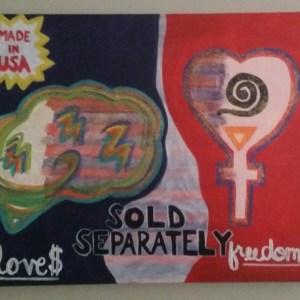
image from gallery’s website
The Kranzberg Arts Center is a non-profit organization located in the heart of the Grand Center Arts and Entertainment District at 501 N. Grand Blvd. It houses three distinct, multi-use spaces: a gallery space dubbed the Kranzberg Arts Incubator, a flex-seat 100 capacity black box theater, and a 100 capacity cabaret/lounge performance space with pro audio & lights. The basement of the KAC is home to the Craft Alliance Center of Art + Design Education Center while the Black Box is the home of resident theater companies UMSL & Upstream.
Connect:
Facebook: http://www.facebook.com/kranzbergartscenter
Twitter/Instagram: @KranzbergArtsFor Inquiries: chris@kranzbergartscenter.org

#Buddhist #meditation Mini-#Retreat at Home: Report from the Homefront
May 27 – May 30, 2016, all-day, four-day mini-retreat at home: YIPPEE! Did it! First one since my TBI (Traumatic Brain Injury)/concussion/broken nose/hurt eyes in April, 2014; first one in St. Louis. [I called it a “mini” retreat because I usually did at least three weeks’ and up to 11 weeks’ retreat, prior to this.]
I offer this post as a description and explanation for newbies and the curious, but I do not discuss the details of my practice with anyone but my teacher and fellow practitioners.
SCHEDULE:
A typical meditation schedule consists of Tüns (meditation/practice sessions) segmented by meals, breaks, exercise, sleep and personal hygiene time. When we do individual retreats, often we set our own schedules. I modeled this summer’s mini-retreat schedule mostly on the same schedules I followed while on individual retreats at the main meditation center (Rigdzin Ling in northern California), and at my residences in Silver City, New Mexico, and Santa Rosa, Sebastopol and Hayward, California, 1999 – 2014.
Home Mini-Retreat Schedule 2016
3:30 – 4:15 AM— Wake up, ablutions, etc.
4:15 – 5:30 AM— First Tün (meditation/practice session)
5:30 – 6 AM— Breakfast
6 – 10:30 AM— Second Tün (with two ten-minute breaks)
10:30 – 11 AM— Lunch
11 AM – 12 PM— Third Tün
12 – 1 PM— Nap (during first third, usually; see below). Otherwise, Fourth Tün
1 – 3 PM— Exercise (swimming/driving to and from) with moving meditation for 35 minutes while swimming
3 – 5 PM— Fourth/Fifth Tün
5 – 5:30 PM— Dinner
5:30 – 8 PM– Fifth/Sixth Tün (with one ten-minute break)
Total meditation time: about 11-12 hours/day, so about 40 hours (I ended before dinner on May 30).
LOCATION:
When I was fortunate enough to be at RZL, I often sat on a cliff overlooking a pond, river and mountains in the distance, above the main buildings of the center. For other types of practices, meditators prefer or must be indoors or even in a cave or place of complete isolation and darkness for most of the time.
Many people doing the dzogchen Tibetan Vajrayana practice of awareness (rigpa) meditation, trek chöd, as I do, prefer to sit where we have an unbroken view of the sky.

NOT what my home retreat looked like at all, this year
There aren’t many cliffs and sky views near where I now live, in St. Louis, Missouri, USA, and I didn’t want to spend a lot of time driving to a spot at which there would be no food, no bathroom, no easy place for this mostly injured body to sit, and no place to swim. Hence, a home retreat. I could almost see the sky, sometimes. I could see trees, bushes, a street and parking lot. Didn’t matter at all. I wasn’t involved with any of it. We keep our eyes open for this type of meditation, but with a “soft focus,” not paying particular attention to anything while noticing everything.

Where I did most of my sitting practice: on the living room couch, learning against these cushions on the left, looking out the glass doors of the patio/deck to the right.
WHAT WE DO and DO NOT DO:
We also hear, smell, feel everything. We are not “checked out,” if we are practicing successfully. We are fully awake while doing our practice, sitting in oneness—in awareness (rigpa, Tibetan)—as often as we are able. We return to this awareness every time our attention wanders. That is the practice of trek chöd (Tibetan), in the simplest terms.
For this type of meditation practice, in retreat, practitioners usually don’t recite mantras, pray (except at the beginning and end of each retreat or even each Tün, if we want), use our malas (Tibetan prayer beads on a string, predecessor of the Catholic’s rosary), chant, visualize, play ritual instruments, enact stories, light incense, fill/offer water bowls, open our shrines or speak. Our practice is stripped-down to sitting and breathing.
The entire retreat is usually conducted in strict silence, which means that we make no eye contact when we do encounter people and we do no talking, writing, reading, or any other communicating (when necessary, we use “functional speech” only). We put away and turn off all cell phones, computers, communication or writing/reading/viewing devices of all kinds. We don’t write letters or answer the phone unless we are in a longer retreat during which we must communicate with family, friends, colleagues, neighbors occasionally to reassure them we are all right or respond to something urgent.
When we are fortunate (and/or wealthy), we have someone to “serve” our retreat: they shop for, prepare and serve our meals, sometimes even cleaning up for us, leaving us free to meditate for more time each day. That is part of the wonderful service that active meditation centers often provide retreatants. Sometimes, though, during non-busy times, when I was at the center, I still had to cook and clean up after my own meals, but I didn’t have to shop.
For home retreats, I have to do it all myself. I manage that by cooking a great big pot of soup and another big amount of something I can dole out each day for my two main meals and then have something small (a bowl of cereal, e.g.) for dinner.
Eating lightly at night is important for me, anyway. During a sitting and silent retreat like this, unlike the more active ones, our appetites get smaller and smaller as the retreat progresses, so we need less food.
THE RETREAT COMMITMENT:
It is important to make a firm commitment to one’s retreat by scheduling the entire period in advance and sticking to it. It is also important to make a daily schedule and adhere to it. Many also maintain/take a vow of celibacy to maintain during retreat (no sex or sex acts); some do not.
We all abstain from intoxicants (recreational drugs, alcohol) during retreat. If we have taken Layperson’s Buddhist Vows (or Five Main Precepts), as I have, we also never get intoxicated/inebriated. I don’t drink or use drugs, anyway, but for many meditators, retreat boundaries include that they refrain from engaging in the use of these substances during retreat.
Even if we get sick, someone dies, and/or there are other seemingly significant events that occur, we strive not to break our retreat commitments. Unless it is to save our own or someone else’s life or involves getting medical care to restore our health so that we can practice better afterwards.
It is important to let our friends, family and neighbors know, especially if we are doing a home retreat, that we won’t be answering phones or responding to texts or emails, for example, during these times/these days so they don’t worry. That way, we prevent someone from getting “wrong view” about meditation/meditators (e.g., not understanding our commitment, they think we are rude, unkind, insensitive, unless we communicate to explain).
We do not waver from this commitment or break our silence for any reason. These commitments and guidelines are called “retreat boundaries.” At the risk of generating “static” and negativity for our next potential retreat, we do not leave the grounds of a closed retreat (the “cloister”) or end our retreat prematurely. Some teachers give dire warnings about practitioners’ breaking boundaries that will result in creating negative future retreat karma, but I don’t like responding to threats. I maintain commitments because I want to do it.
Making and keeping these commitments strengthen the practitioner’s practice foundation and create/maintain a strong “container” for successful meditation practice. I feel good when I keep my chosen boundaries.
This time (or for any other home retreats), I did not have a completely strict, cloistered retreat: just isn’t possible. I drive to and from the pool, shop on the the first day for food and cook when necessary (more often on longer retreats). I also responded to a few communications from people who didn’t know I was in retreat and/or to reschedule things I had forgotten to reschedule. But, mostly, I did keep the strict retreat boundaries and commitments.
THE RETREAT EXPERIENCE:
Buddhist teachers talk about the entire retreat’s span of time as being divided roughly into three parts: “getting in,” “being in” and “rising out.”
“Getting in” is the first third. During this, we acclimate to being on retreat, letting go (sometimes slowly, sometimes more readily) of our daily concerns, activities, personae, thoughts, obligations and settling in to the schedule.
We always “open” our retreat with setting our intention and reaffirming our motivation and with gratitude, with prayers and thanks to our teachers. Usually, other directions are given to us in advance by our teachers.
Sometimes, we make offerings and/or have a ritual feast and prayers (tsog). Sometimes we continue our daily practices for the first day or so. Sometimes we do some preparatory readings (from teachings, notes, books) to remind us of the practice we are about to engage in and how to approach it.
Frequently, a lot of tiredness manifests early in this first third. If so, it is recommended that we nap a lot, recovering from the stress and strife of our usual lives’ demands. The peace, quiet and low-key nature of retreat bring us to a recognition of how exhausted and depleted we have gotten. Extra sleep is then necessary to restore ourselves and to be able to practice better for the rest of the retreat.
The middle third is “being in.” By then, accustomed to the schedule, needing fewer or no naps, we are ready and eager to practice for each Tün. We know what we are doing, we are glad to be doing it, it’s working as well as it will. Depending upon how long this period is and how quickly we are able to dive in, we can get very deeply immersed or only partially, but this is the main part of our retreat’s practice time. Whatever signs of accomplishment we may get usually begin to show up in this portion.
The last third is “rising out.” Sometimes gradually, sometimes more quickly, our minds and bodies begin to leave the depths and rise to the surface, preparing us for returning to our daily lives. For longer retreats, we spend part of this time still in retreat and the last part of it again in practices of formal gratitude. We “close” on the last day with offerings and/or a ritual feast and prayers (tsog), and dedicate the merit (the blessings and benefits of our practice) to all beings.
For the last day/hours or so, we are actually not still in retreat, exactly, but beginning to engage again in the more “ordinary living” aspects (whatever we haven’t been doing and must return to, such as driving, doing laundry, talking/communicating again).
We often don’t realize how deeply we are “in” until we begin to “rise out.” When we have been in a strict retreat for more than a few days, this gradual “return to duties” is very important for safety and acclimating to ordinary life. Otherwise, we can get into serious trouble or even accidents if we go back too suddenly to our busy, complicated home lives and schedules.
WHAT’S NEXT?
We usually meet with our teachers during or after our retreats (when we are so lucky as to be able to do that), to “offer our retreat experience” to the Lama by telling him/her about our experiences, insights, possible signs of accomplishment and/or knowledge acquired/applied successfully. We also bring questions, problems, concerns and “stuckness” that occurred during our retreat to this same meeting (or whenever we next meet) so that we may request guidance and answers from our teachers.
Usually during these meetings or subsequent ones, we get instructions, guidance for the next period of our practice, assignments/options for reading and/or attending live or video teachings. We might even schedule our next retreat(s).
I didn’t get to meet with my teacher at the end of this retreat, but I did see him for a private interview just last month, so I feel very blessed.
HAVING A MEDITATION TEACHER:
Tibetan Buddhists stress the importance of meditating under the guidance of and with instruction from a qualified meditation teacher. I completely agree with this. It is not sufficient to talk with other meditators, read books, listen to teachings on video or audiotapes or in person and then put ourselves into retreat and get ourselves out and go back to our lives.
Without a teacher who is more experienced and qualified to teach and guide us to listen to our experiences and direct our practice, we are certainly running the risk of there being a lot we will miss, misunderstand, misinterpret or just plain get wrong.
There are many qualified teachers in many parts of the world, now. I have put live links to some of them, above, when listing my teachers or main center. There are listings of some centers in Buddhist magazines, websites and other places online.
If you are not lucky enough to have found a teacher with whom you work well or you don’t live close enough to any teachers or centers who host visiting teachers, keep looking/trying. It is well worth the effort.
Where are the Buddhists Around Here?
There are several centers who host qualified teachers in the St. Louis area and throughout the Midwest, of all Buddhist traditions. Very close to where I now live is a Tibetan Buddhist practice group that includes some people who have met some of my own teachers and who use some of the same practice texts that I do. There are two others groups that are “cousins” to my lineages/practices and some of those people have also met some of my teachers and share some practices with mine. Khentrul Lodrö T’hayé Rinpoche‘s main center, Katag Chöling, is about a six-hour drive from here, in Arkansas. These are listed, below:
—Blue Lotus Dharma Center somewhat eclectic, mixed Tibetan Vajrayana and Chan (Chinese Zen) practices Blue Lotus Dharma Center
—Do Ngak Chöling Tibetan Nyingma Vajrayana Buddhism http://dongakcholing.org/
—Katag Chöling Khentrul Lodrö T’hayé Rinpoche‘s main center, https://katogcholing.com
—Kagyu Droden Kunchab—Saint Louis, Mahayana and Vajrayana Buddhism, http://www.kdkstl.org
MY TEACHERS:
I am beyond-words grateful to my teachers.
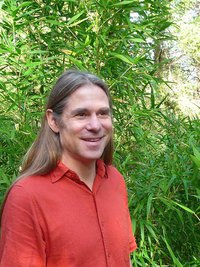
My beloved Buddhist teacher, Lama Padma Drimed Norbu (Lama Drimed), about 2012
Whatever I was able to accomplish from this mini-retreat or any other part of my practice was entirely due to the blessings, teachings, support and care from my dear teachers, particularly Lama Drimed and the late H.E. Chagdud Tulku Rinpoche (photos above and below), as well as my mom (in whose home I now live), other Lamas, especially Lama Shenphen Drolma and Khentrul Lodrö T’hayé Rinpoche, and sangha (spiritual community of fellow practitioners scattered now around the world) of meditating sisters and brothers: THANKS to you all!

the late His Eminence Chagdud Tulku Rinpoche, my first empowering lama and my teacher’s teacher, about 2001, and his Yangshi (designated and recognized reincarnation), about 2013
I dedicate the merit (benefits) of my retreat to all beings.


My Book Blog Tour is still ongoing. Yesterday, Write on Sisters published a guest post I wrote for them about Leia Organa’s portrayal in Star Wars: The Force Awakens and how her character has evolved over the years. You can read ‘General Leia: Aging on the Silver Screen’ here. This post ties to some of…

When after words fail or hide themselves, When after emotion has taken its hue, When after streaks of splendor mingle in haze, This love I have still burns for you When after I’ve read and after I’ve written, When after my greens finally turn blue, When after I’ve enslaved myself to ambition, This love I […]


Leaders in the feminism-in-schools movement recently made history at the inaugural International Girls’ Studies Association (IGSA) conference when we were featured in the event’s opening plenary at the University of East Anglia in Norwich, UK from April 7-9. It was the first time that a global girls’ studies conference featured teachers and researchers sharing our […]

Crush, Harassment, Unrequited Love and Stalking: Which do you know about?
Remember the expression: “mooning over someone?” (circa 1960s)> This described when we have a strong attraction for an oblivious person, one whom we might not even know well. We carry these feelings of yearning inside, in silence, but these feelings are not as invisible as we might believe (or wish), usually.
What about “having a crush”? Do people still “get crushed out” on another person? Usually pre-teens and teens do, but older ones can as well.

image from http://www.picturequotes.com
When does unrequited love and its concomitant circumstances, activities and feelings become a crime or a symptom of mental illness?
Can our inner world be measured on some continuum or scale? Is there a set description of behaviors or frequency of actions that forces us to admit we have a problem? When does desire become obsession? When does wishing to be noticed become compulsion?
How many of his/her interests do we take on as our own so that we can be where s/he is “for our own reasons” (sports event, concert, coffee shop, dog show, political rally, nature walk…whatever)? How many times can we “drop by,” drive by, “happen to be” where our love object is/lives and pretend (especially to ourselves) that it is “just a coincidence”?
We think: what if it only takes “one more” for his/her to “come around”? This happens in fiction; can’t it happen for us? How many “secret admirer”-type notes, flowers, emails, texts, other little gifts can we offer or send, leave on someone’s car or doorstep in inbox, before that person feels uncomfortable enough to call the police and get a restraining order?
And, what about the recipient? How many contacts, requests, invitations, gifts does the object of our affect have to endure before s/he can hold up a hand and demand that we petitioners cease and desist? Don’t we each have a right to privacy, inviolate boundaries, being left alone if we so choose?
Have you been on the receiving end of any of this unexpected attention? At what point does it become unwanted to the point of harassment or stalking?

Are signs of affection and sexual interest able to be labeled officially “unwanted” only after we realize (and then indicate overtly) that we do not reciprocate that person’s feelings and interest?
I ask because two of the main characters in my utopian/sci-fi/romance books in The Spanners Series, Clara Branon and Epifanio Dang, are embroiled in an on-again/off-again, does-he-or-doesn’t-he? (return her affections) multiverse/multiple timelines set of scenarios.

I wonder if I’m depicting Epifanio’s reactions and position accurately or fairly, or Clara’s persistence as if she’s mentally healthy when, perhaps, she is not. In some of them, Epifanio feels a bit stalked, we find out, but “comes around.” In others, his conversations and encounters with Clara prompt him to discover that he does return her affection (a bit belatedly or surprisingly… to him). In still others, he does not share her feelings.
If you are unlucky enough not to have read even Volume I of my series (This Changes Everything, free ebook on Smashwords, Kobo, iBooks, nook, Amazon; paperback $17.99 on CreateSpace and Amazon) what do you think of some of these real-life examples, below?
1) A well-educated, professional woman is in a high-powered, public position. Her male boss engaged in serial, non-stop harassment: he gave her horrifying, unwanted amounts of sexual interest and attention, and all the while he was married. She let him know right off not to touch her, to stop leaving notes, discontinue his arranging/ asking her to work late and be alone with him, etc., but he didn’t end any of it.
It seems pretty obvious that he violated every law and standard of human decency and scared the living SH*T out of her to boot. Plus, remember: he was already married. Plus, she TOLD HIM that she was completely not interested from the start. Plus, he was her boss. This went on for YEARS.
At one point, she asked for and got a transfer. But, a few months later, he re-arranged entire departments’ configurations to get back into her area and become her boss AGAIN!
She finally had to quit her job (on the advice of her medical provider because this guy and this situation were ruining her health). So, she’s suing for loss of income, mental anguish, being terrorized, etc., and because apparently she reported this to higher-ups and they DID NOTHING.
Clear harassment case, right?

image from http://www.xceliq.com
But, what if this had been the other way around?
2) What if the attention, gifts, contrivances to be alone and touch the person at work are mostly (but not exclusively) coming from an underling toward her boss? Rather than a male boss harassing a female employee, what if a female employee begs for attention from her boss? AND, they are both single.
Add these facts: the boss keeps inviting this employee to go to the movies, take walks, eat lunch out together, share many snacks and private conversations, for years. He chooses repeatedly to confide in this employee, but they offically do not “date” or even share a kiss or any sexual contact. However, this boss touches his employees (including this one) frequently (on the shoulder, on the hand, on the head, an arm around a waist or shoulders of both males and females).
Only after the employee makes her feelings known in a letter to her boss does he say “no.” She then stops asking or inviting him further and retreats to professional behavior, but he is clearly uncomfortable from that point on.
What options does that boss have when the employee is otherwise exemplary in her position and perhaps indispensable to a small company? How can that boss claim he was “harassed” when so much of their relationship was completely mutual?
Would not this be labeled a “mutual workplace romance,” just one without the overt sexual element, and one in which—unfortunately for them both—all the feelings were not mutual?

I think some cases are crystal clear, but others are more murky.
3) What do you think about relationships between consenting adult teachers and adult students, particularly when the student approaches the teacher and is the one asking for affection to be returned?
What if, when the student is checking if the feelings are mutual, s/he finds out they are not? Is the relationship able successfully going to be able to revert to more formal role relationships or is it ruined?
4) What about when peers have unequal feelings: neighbors, friends, colleagues, fellow members of whatever group? What if some or one of these pairs is already in a relationship?
Before we know for sure that our feelings of affection and perhaps love are going to be unrequited, it’s all fine, especially if we haven’t revealed anything and the other person can be ignorant or pretend not to know (yet). Or, is it?
Are other people actually that dense? Do they really “not know”?
To be sure, then, we have to ask. Right? How can we find out our status without asking? Aren’t there countless movies, TV shows, books and other examples from our lives in which the person who knows first about loving the other one “should have said something sooner” because the feelings really were mutual, but both were afraid to say so? A lot of time can be “wasted” by not declaring our feelings, true?
Here is my favorite movie scene (with a song, of course) in which the love revelation is welcomed and the feelings ARE mutual:
Consider, though, when the feelings are not mutual: once we ask about theirs and reveal our own feelings, but we are not “on the same page,” is everything doomed between us? Do things between us become awkward to the point of having a relationships that is impossible to salvage?

Your stories and comments are welcomed here. I’m curious.


Originally posted on The Millionaire’s Digest: 1. Quote collection: No matter what subject your website covers, there’s a quote (or, better yet, a collection of quotes) out there that will inspire your readers. Search for “[your industry/topic] quotes” and be sure to provide proper attribution to any you wind up using on your site. 2.…

Come one, come all! St. Louis Indie Book Fair is TOMORROW! Saturday, May 7, 2016, 10 – 5: FREE!

image and all organizational work by Mark Pannebecker
All genres, all ages, fiction and nonfiction, books for children, YA and adult readers!
WHERE? St.Louis Public Library, 1301 Olive Street, St. Louis, MO USA 63103
Author readings are all day! Mine, from Volume I of The Spanners Series, This Changes Everything, is at 11:18 AM or thereabouts for about 10 minutes. Also, discounts/authors’ giveaways, autographs, conversations, food, more!
Join me (and ask for a special Spanners Series‘ paperbacks discount when you see me!) and many other authors, including Debbie Manber Kupfer.
ALSO: Please come me and other authors share from our work at the public reading auditorium.
11:18 AM!
Full list of participants here: http://www.markpannebecker.com/#!itinerary/c9um
For more information: http://www.markpannebecker.com/#!st-louis-indie-book-fair/c1pz

Today is the anniversary of the birth of our wonderful son, unnamed at the time and for 20 more days, was born. I became a mother and you became an actual human after swimming around in my imagination for many years and in my womb for nine months. SO GLAD!

image from designrshub.com
So, later in May the year of his birth, our son became Merlyn Timli 0 Ember. We gave him in his name the middle figure of “0” (which is a zero, not the letter “O”) to be a placeholder, awaiting the day he might want to choose his own name. True to his independent and somewhat contrarian nature, when he decided what he wanted to do with his name, Merlyn deleted the zero.
“Merlyn” means “Child of the Light,” and “Of the Immortals.” We chose to give him the original Celtic spelling and used those meanings.
Merlyn, with his first initial “M,” is also “named after” two family relatives: his father’s father, Morton Briggs (alive at that time, following Protestant tradition), and my mother’s mother, Mildred Klein Cytron Bright (then deceased, following Jewish tradition).
“Timli” is a name his dad, Christopher R. Briggs Ember (or, now, Ember Briggs) created, and the definition of this invented name is “He who paints in the sky with his fingers.”
“Ember” is the name Christopher and I chose to take on, adding it to our own names so that Merlyn’s surname could be “Ember.” The Ember Days are the days of change, the two or three days before and after every Solstice and Equinox. This name seemed apt since having a child (our first and only) certainly began many days of change for Merlyn’s parents!
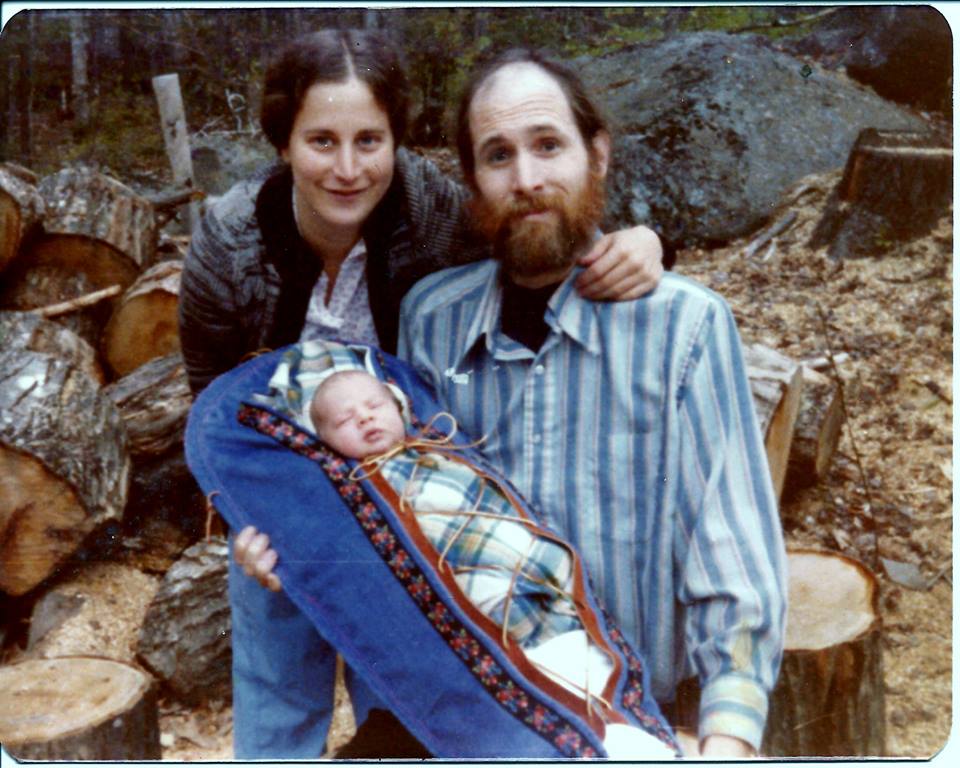
Merlyn in the cradleboard Emmy Rainwalker made for him, with his parents, May, 1980
[NOTE: Laws in New Hampshire at the time dictated that unmarried women could only give our children our own surnames, and I had no wish to give Merlyn my birth name. So, we chose a new surname for our new family. Christopher and I were deliberately and consciously unmarried, calling ourselves “Partnered,” for several reasons: lesbians and gays could not marry at that time; women became men’s property in New Hampshire when married in 1980; and, we both were marriage-averse for individual/personal reasons.]
I am so grateful that Merlyn’s birth occurred intentionally (and quite fortunately) at our rented home in Stoddard, NH, attended by three lay midwives: Katie Schwerin, whose family lived as housemates of ours and are still our good friends; Emmy Rainwalker (Ianiello), who was a former housemate and good friend; and, Cindy Dunleavy, the “senior” midwife who had trained Katie and Emmy and became our good friend.

Also in attendance or present soon after Merlyn’s arrival were other housemates and several good friends: Bill Whyte (Katie’s husband; thanks for the great black-and-white photos, Bill!), Mia Mason (six years old and Katie’s daughter), Emily Schwerin-Whyte (Katie and Bill’s daughter, born in the same house four months prior), Tashin and Toqueem Rainwalker Story Talbot (two months and almost five years old, Emmy and Medicine Story’s children), Dana Dunleavy (three years old, Cindy’s son), Nina (a friend of Katie’s whose surname escapes me), Pamela Faith Lerman (our friend and David’s sweetie), David Eisenberg (a current housemate of ours and a friend), and Zea Moore (family friend). Good thing we had a very large bedroom!

Merlyn and I, 1981
We personally knew and/or were related to a total of over twenty children born within one year of Merlyn. He has cousins one year older and one year younger than he is on both sides, and he was born into what felt like an exploding baby boom, a loosely-knit but connected network of families with children around his age. He grew up in collective households with housemates who often included other children and in close connection with several in particular with whom he is still close as adults. We had buying clubs (food co-ops’ predecessors) we belonged to in several towns nearby for collective purchasing of bulk, organic and healthy foods and supplies. We exchanged childcare, kids’ clothes and baby equipment, recipes, chores, tools and handiwork. We celebrated birthdays, weddings, holidays and other occasions at one another’s houses, often ours.

image from handmademusicclubhouse.com
These other families and their children became our extended family which included children who were students at public and Waldorf schools as well as homeschoolers; Merlyn was all three at one point or another.
Many of these adults and children were/are musicians, as Merlyn is. Our diverse community also included storytellers, teachers, woodworkers, roofers, artists, singers, dancers, therapists, the aforementioned midwives, political activists and social change leaders, construction/building tradespeople, office workers, gardeners, writers, herbalists, acupuncturists, massage therapists, composers, actors, directors, nonprofit social service workers, playwrights, spiritual teachers and leaders, computer techies, farmers/maple syrup makers, publishers, business owners, bookkeepers, retail workers, restaurant workers and many more.
Our ethnic and religious origins included Jewish, Sufi, Buddhist, Hindu, agnostic, Native American, atheist, British Isles/Western European, Chinese, African, Eastern European, and many more. We were/are lesbian, gay, bisexual, queer, transgender, questioning, and unknown or unprovided.
Some of the places we lived right before and after Merlyn was born had no electricity or running water (or even walls). We played board and card games, invented and actual sports games. Most of us intentionally had no televisions or war toys. We put the non-TV-watching time to great use.
We READ a lot! We put on plays, played music, talked a lot with each other, rode bikes, ice skated, sledded, swam, cooked and did “kitchen opera,” made costumes, hiked, walked, repaired, recycled and re-used (long before it was required), spent time in Finnish/Dutch-type saunas and Native American sweat lodges, canned and preserved food and herbs, sang and drummed and worked in ever-changing configurations of children and adults together.
Merlyn, you have become an amazing adult: kind, compassionate, intelligent, capable, worthy of and earning respect and admiration from colleagues, employers, bandmates, friends and peers. I am very proud to be your mother!
I hope, on this anniversary of the day of your birth, in your first year since 1999 of living back in the town you spent most of your growing-up years, that you and your sweetie, Lauren, celebrate in multiple ways with friends and your dad. I wish for you to enjoy a great birthday and many more, healthy, happy and prosperous ones to come!
I love you! Thanks, again, for making me a mother!

I, Merlyn and Christopher, 2013


Johns Hopkins researchers are urging black women to avoid weaves, braids and hair extensions because of the risks of permanent hair loss. Researchers say that these hair styles, which can pull on the scalp, can contribute to traction alopecia, a form of gradual hair loss, which about one-third of African-American women suffer from. –Read more on…
via Johns Hopkins researchers urge black women to avoid weaves, braids and hair extensions — theGrio

Interestingly and unexpectedly, Bookworks decided to make me the Featured Author today, 4/27/16, my mom’s 84th birthday! Happy Birthday, Carole Harris!

https://www.bookworks.com/members/sallyember/
Go visit, comment, make purchases, visit other authors’ pages, join! https://www.bookworks.com/
Thanks, Bookworks!
AND…If you’re in St. Louis or southern Illinois on May 7, stop in and visit me and previous guests on CHANGES conversations between authors guests, Deborah Manber Kupfer, George Sirois and many other local authors and hear me do a public reading May 7, 2016, at the St. Louis Indie Book Fair at the downtown St. Louis Public Library on Olive St., 10 – 5 PM Saturday. FREE! I read at 11:18 AM (or thereabouts) for about 10 minutes. http://shoutout.wix.com/so/eLFPj6yY#/main

Thanks so much, Kasper Beaumont, for featuring me and my Spanners Series books, on April 16th’s #Author Interviews for the Fantasy and Science-Fiction Network (FSFnet)!

<a href="
Check out the entire series! Awesome #fantasy and #scifi #authors!

http://fsfnet.com/?s=Author+interviews&submit=Go http://fsfnet.com/2016/04/15/kasper-interviews-author-sally-ember/
Or, go to Kasper’s website for a summary: http://huntersofreloria.weebly.com/kaspers-ramblings/sci-fi-paranormal-with-a-healthy-sprinkling-of-romance-an-interview-with-sally-ember-sallyemberedd-fsfnet
Check out all previous and current FSFnet Author Interviews after reading mine!
http://fsfnet.com/2016/04/15/kasper-interviews-author-sally-ember/
M.P. McVey
Morgan Bell
Nadja Losbohm
Kate Foster
Ichabod Temperance
H.M. Clark
Bryan Rainey
Patricia Reding
Linda Lee
And, check out my Author Page on this great site while you’re visiting other Authors’ pages!
http://fsfnet.com/authors/sally-ember/

Reposted from 10/30/13 and 2/5/15
Writers are often exhorted to write the books we want to read that seem not to exist, yet. I am following that advice with The Spanners Series, especially Volume I, This Changes Everything, which is now PERMAFREE, and also with subsequent volumes (Volume II, This Changes My Family and My Life Forever, released 6/9/14; look for Volumes III and IV in 2015).
I am an avid reader and have probably read hundreds of thousands of books in my 56 years of reading independently and quickly, sometimes devouring ten books a week. If I say books like mine—a series like The Spanners—don’t yet exist, I’m probably correct.

All buy links, reviews, interviews, readings and more: http://www.sallyember.com/Spanners Look right; scroll down.
Why am I writing #science-fiction/#romance, #Buddhist-infused, #multiverse/#multiple timelines #utopian #novels besides the reason already given? And, why should you read them? Because we live in a deteriorating, or degenerating Age, according to #Tibetan Buddhists (and probably many others I’m not bothering to research right now).
When I first hear this claim, I disbelieve it. Aren’t most things “improving” for humanity? Modern medicine, technology, transportation, knowledge of all types: in the 20th and 21st centuries, we are experiencing incontrovertible advances, mind-blowing progress, right? Plus, that POV is just such a downer!
Why would the Buddha’s followers propose and then Buddhist teachers and scholars maintain such a doom-and-gloom perspective on life? It’s not enough that Buddha focused his teachings on suffering and impermanence? Most Buddhists must be depressed: that’s what I thought.
I could understand why Tibetans, having been living under horrible oppression, genocide and cultural destruction under Chinese rule for decades, would be so pessimistic. But, we’re in the good ole’ USA: things are great here, right?
Not so much. I won’t go into the facts we all know now (even more than ever, thanks to Snodwen and Manning) about how screwed up the USA has been and still is, nor how terrible the economy is here and everywhere. I won’t provide the list. We all know too well the horrors of our modern life. Modern tragedies, however, are actually not even relevant to this discussion.
The “degenerating” part of our Age has little to do with actual external conditions. Our deterioration involves humans’ not being able to learn #dharma, not being able to find qualified and worthy Buddhist teachers, not being able to practice meditation well or at all. The Buddha’s teachings and Buddhists practitioners are what are degenerating, in what is called “The Third Age” or “The Latter Day of the Law.”
You can look this up. http://en.wikipedia.org/wiki/Three_Ages_of_Buddhism
My point is, dystopian futures abound. Most sci-fi writers, even those that include romance in their stories, write of increasingly worsening conditions on and around this planet and across the Universe. They pile on the violence, showing increasing discord, more political and social unrest, deaths and destructions even worse than we have now. We already have too much awfulness for me to want to read about even worse futures.
Enough, already: I believe we need some hope, ideas of how else things could go, whether or not I always believe they will take these turns. Since I can’t find this optimism in the daily news or libraries’ and bookstores’ fiction, I decide to create it. I need this in my personal life, for the USA, for the continent, the water, air and land: I am imagining routes for improvement for the planet and the entire universe.
When I #meditate, especially during a #retreat phase in which I was #contemplating lives of beings in the “God Realm,” it occured to me repeatedly that we live in opulence amid squalor, all over the planet. Beauty smack dab in the middle of ugliness, every day. #Yin and #yang. We do have to “take the good with the bad,” but do we have to emphasize the “bad”?
I do not.
In my novels, even when things are “bad,” there is more good than bad. Buddha teaches often that we have to discern between “good” and “bad” even as we know these are illusory. Many teachings expound on how there is NO “good” or “bad,” no “birth” and no “death,” no “coming” and no “going.”
While you puzzle over that, I’m going to continue my utopian illusions in The Spanners Series. In my current and future multiverses, beings, including humans, will have love, better conditions and dharma: they/we have it all!
Furthermore, I’m going to HOPE—even though we are instructed to meditate partly in order to relinquish all hope and all fear—that YOU read my books and enjoy them as much as I enjoy writing them.
Please let me know! Write your comments here on this and other posts, on excerpts from my novel, and whatever else occurs to you. Let’s converse!


Gloria Steinem’s new project, a documentary-style news magazine show called Woman, will premiere on Viceland May 10, the network announced Monday. On the show, Steinem and a team of female journalists report stories on “the problems once marginalized as women’s issues” around the world, including topics such as sexual violence in the Democratic Republic of Congo, unacknowledged cases of missing women…
via Gloria Steinem’s New Documentary Series ‘Woman’ Coming to Viceland in May — Flavorwire


Here is some great advice on how to build a blog audience.❤ If you build a blog, readers won’t automatically materialize. Follow these steps to grow a healthy blog audience. Source: How to Get People to Read Your Blog: 5 Savvy Strategies You Can Apply Today
via How to Get People to Read Your Blog: 5 Savvy Strategies You Can Apply Today — Silver Threading


Building your writing career is no small task. Here is a list of things that will keep you on track while working toward your goal. Source: 39 Things to Remember While Struggling to Build Your Writing Career | Your Writer Platform


“Take a video of yourself talking about why you love Bernie Sanders, send it to us, and then we’ll have an intern spend hours piecing it together in Final Cut.” These were the directions (probably) sent to large group of celebrities that includes Kristen Wiig, Miley Cyrus, Amanda Palmer, Rosario Dawson, Susan Sarandon, Mark Ruffalo, Michael…
via Kristen Wiig, Mark Ruffalo, Miley Cyrus, and More Endorse Bernie in Video — Flavorwire

Originally posted on Diane Tibert: The first online Indie Author Fringe Event of 2016 kicks off at 10:00 am on Friday April 15th. This is London, England time, so in Nova Scotia, that’s 6:00 am (fours in the difference). There’s an amazing line-up and many will recognise some of the names from the self-publishing industry:…
via Register Now: Online Indie Author Fringe Event April 15th — Kate McClelland

[ First posted 9/14/13 and revised and re-posted, March, 2016]
#Unrequited #Love is for Everyone: What’s Your Story?
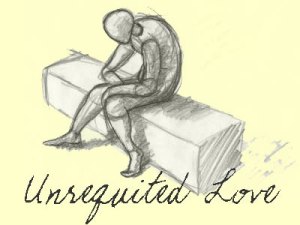
With countless songs, stories, plays, poems about the pain and suffering, the noble martyrdom of the person who is rejected—s/he who lives the unrequited lover’s lonely life—everyone knows that part completely. What about the other person, the object of affection? How do those rebuffing love—the REJECTORS—actually feel?
What is the Point of View (POV) of the REJECTOR?
I decided to spend some time learning that role, getting inside the skin of the one who says: “No, I don’t love you that way,” in order to attempt to fulfill every writer’s goal of understanding all my created characters equally well.
I knew the feelings, thoughts, experiences and dreams of the one who is rejected inside and out (unfortunately). What in my past, real or fictional exposure, brings me to the inner story of the one doing the refusing?
One story, with me as the REJECTOR.
There was a boy in my 7th-grade class of about 350 students who offered to carry my books as he walked me to class He also eagerly awaited me outside our classrooms when his class was the same or hung around nearby to escort me. He was nice and I appreciated the attention. However (nefarious music plays here), I had my heart set on someone else, someone who had no interest in me.
Maybe, I wondered, if the one I was crushing on saw how much attention this boy is giving me, he would realize how interesting I am and turn his eyes more toward me? I ruthlessly and selfishly exploited the boy who was crushing on me without any regard for his well-being or feelings, I am ashamed to admit (almost fifty years later). If I could remember his name, I would try to find him online and apologize. Not only did my encouragement of his attention hurt his feelings by unfairly leading him on, it didn’t work. Not at all.
What I do remember is the situation my ploy created: I was barely giving this nice boy my attention because I was eagerly and pathetically ogling my crush, hoping to win his heart by being appealing to someone else. Horrible. Unsuccessful. Embarrassing to admit, now.
What does this experience teach me about the ways the object of someone’s unwanted affection might feel? It’s possible, unbelievable as it may seem to those of us doing the obsessing, that the target of our love barely gives us a thought. Having his/her own agenda, the only time the rejecting one might even deign to notice the one who longs for our love is in the few moments that person might somehow prove to be useful to our own goals. We who mean “no” sometimes don’t even bother actually to say “no.”
We REJECTORS can be ruthlessly uncaring, unseeing, deliberately unaware and even disdainful of the rejected lover’s feelings.
A great post by Gina Stepp on the subject of the impact of being the rejecting person that can help us all develop empathy for and understand the POV of the REJECTORS is Return to Sender: Unrequited Love is Painful for the Rejector, Too
from March 28, 2012
http://subscribe.vision.org/FamilyMatters/bid/76805/Return-to-Sender-Unrequited-Love-is-Painful-for-the-Rejector-Too
Put your own story in these one or more of these headings.
Use the comments section at http://www.sallyember.com/blog, copying/pasting the heading from your chosen area. Pseudonyms welcomed, especially of the other parties involved in your stories.
Thanks!

Thanks so much, Natacha Guyot, for featuring me and my Spanners Series books, in this month’s #SciFi Women Interviews!

https://wordpress.com/post/natachaguyot.org/4879
Check out her entire series! Awesome #women #scifi #authors!

http://natachaguyot.org/blog-series/scifi-women-interviews/
2016
February 2016: Jennifer A. Miller
January 2016: Robin Rivera and Heather Jackson
2015
December 2015: Laura M. Crawford
November 2015: Patty Hammond
October 2015: Jo Robinson
September 2015: Rose B. Fischer
August 2015: Tricia Barr
July 2015: Natalie McKay
June 2015: Neelu Raut
May 2015: Saf Davidson
April 2015: Yolanda I. Washington
March 2015: Johnamarie Macias

One of my previous CHANGES conversations between authors’ guests, Michael Stephen Daigle, announces a new volume in his series!
“As the third Frank Nagler mystery, The Weight of Living unfolds, new characters emerge. Calista Knox becomes therapist and later companion for Leonard, Nagler’s blind bookstor…
Source: ‘The Weight of Living’: Meet Calista Knox

Sharing books, author voices, and news from the University of Washington Press
Where Adventure, Lifestyle, and Food Come Together
It's a beautiful day in the neighborhood.
Every Second Thursday | 5-8pm
A novelist with a passion for reading and traveling shares his view of the world and his adventures.
Rejuvenate, relax and revitalize with holistic healing.
Information & Analysis on Global Mass Transit Industry
Stories to warm the furry heart and soul
Local Burien News and Stories
Updates from King County's School-Based Partnerships Program
Community News For All of Seattle's Capitol Hill
News that connects you
An interdisciplinary research project on cities and the night.
Manhattan's little, quieter island and beyond
Smile Always
#Evola #Traditionalism #Metaphysics #Initiation #Esotericism #JuliusEvola #SpiritualHierarchy #Transcendence


 Sally Ember, Ed.D.
You must be logged in to post a comment.